On this page
How to identify it
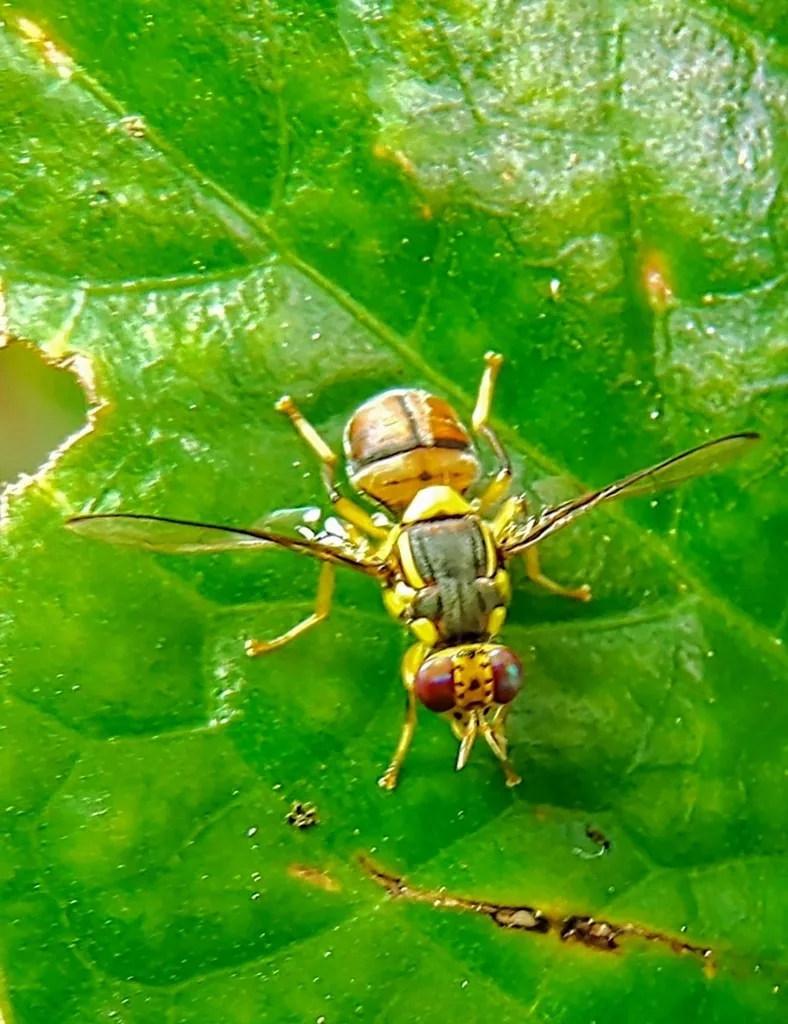
- Its color varies a lot, but the thorax has prominent yellow and dark markings: it ranges from red-brown to black, with yellow patches at the front corners and sides and a yellow scutellum, the rounded shield at the back of the thorax.[7][3]
- The abdominal pattern varies, but the basic pattern is a black T: a narrow black crossband at the front of the third segment and a narrow black stripe down the middle. UF/IFAS notes that two crosswise stripes are usual.[7][3][4]
- The wings are clear apart from a narrow dark band along the front edge.[7]
- Maggots are creamy to yellowish white, with the typical fruit fly shape, cylindrical and narrowed at the front. UF/IFAS gives about 10 mm (about 3/8 inch) for a full-grown larva. It leaves the fruit and forms a tan to dark brown pupal case about 4.9 mm long in the soil. Larvae cannot be identified to species from the larva alone.[2][3][4]
- The adult is noticeably larger than a house fly, with a body about 8 mm (about 1/3 inch) long and mostly clear wings about 7.3 mm long.[3][4]
- The female's egg-laying tube (ovipositor) is very slender and sharply pointed; she uses it to place eggs beneath the skin of fruit. The eggs are white, elongate and elliptical, about 1.17 by 0.21 mm.[3][4]
Look-alikes
| Look-alike | How to tell them apart |
|---|---|
| Mediterranean fruit fly (medfly) | Its larva is quite similar to the medfly's. UF/IFAS separates them by fine details of the front breathing openings, mouth skeleton, tail end and rear breathing openings, and EPPO says fruit fly larvae cannot be identified to species from the larva alone, so suspect maggots need an expert, usually after rearing them to adults.[3][2] |
| House fly | The oriental fruit fly is noticeably larger than a house fly and has bold yellow markings on the thorax, including a yellow scutellum at the back, mostly clear wings with a narrow dark front edge, and a black T-shaped pattern on the abdomen.[3][7][4] |
Where it lives
Native to large parts of tropical Asia, and established over most of sub-Saharan Africa since it appeared in Kenya in 2003 (as B. invadens) and on Pacific islands including the Mariana Islands, Tahiti and Hawaii. It was accidentally introduced to Hawaii in 1944 or 1945, and APHIS says the entire state is under quarantine for it. On the mainland APHIS says it is periodically detected in Florida and regularly detected in California, where detections have increased over the past decade as international air travel has grown. USDA and CDFA announced in August 2024 that all invasive fruit fly populations in California had been eradicated, but new finds in 2025 and 2026 led to new quarantines and treatment programs there.[3][4][2][7][1][6][8][9][10]
Biology and life cycle
Eggs are laid under the skin of the fruit, and three larval stages feed inside. The mature larva leaves the fruit and digs into the soil to pupate. Under summer conditions UF/IFAS gives about 16 days from egg to adult; EPPO gives a life cycle of about 37 days at 25 C (77 F). Cool weather slows every stage, and adults can live up to 11 weeks.[2][3]
It is one of the most wide-ranging fruit flies in what it eats; UF/IFAS counts 478 kinds of fruits and vegetables, with avocado, mango and papaya attacked most often, and more than 125 hosts in Hawaii. CDFA lists fruits, nuts, dates, berries, many vegetables and the fruit of many wild and ornamental plants as hosts or possible hosts. Losses can be heavy on mango, and guava and citrus are also damaged.[3][2][11]
Infested fruit carried by people is the main way it reaches new areas. Flights of up to 2 km are typical, and CDFA cites studies of travel up to 1.5 miles where host plants are present.[2][6]
Under ideal conditions a female can lay more than 3,000 eggs in her lifetime; in the field, 1,200 to 1,500 is usual. Ripe fruit seems to be preferred, but unripe fruit is also attacked.[3]
Adults shelter (roost) on plants, including plants along the borders of crops such as papaya. In a Hawaii test, plants they preferred included tiger's claw, panax, castor bean, Canada cocklebur, Brazilian pepper tree, ti plant, guava and several kinds of citrus.[12]
Four pest flies once treated as separate species, B. dorsalis, B. papayae, B. philippinensis and B. invadens, are now recognized as a single species, B. dorsalis. It was formerly called Dacus dorsalis.[13][3]
Damage and signs
- Egg-laying punctures let in decay organisms, and the larvae reduce the inside of the fruit to a rotten mass, leaving it generally unfit to eat. Early damage is hard to see from outside.[11][2]
- Infestations of 50% to 80% have been recorded in pear, peach, apricot, fig and other fruits in Pakistan, and it is the principal pest of mangoes in the Philippines. After it reached Hawaii about 1945 it soon did more damage than the Mediterranean fruit fly or the melon fly.[3]
- Where it is established it can take over: on Tahiti, after it was discovered in 1996, it displaced two other fruit fly species to become the most abundant fruit fly in coastal areas.[14]
Health risk
UF/IFAS, APHIS, EPPO and CDFA describe it as a pest of fruit and crops and mention no harm to people.[3][4][2][11]
Control
Prevention
APHIS asks people not to bring or mail fresh fruits, vegetables or plants into another state unless agricultural inspectors have cleared them, and to declare all agricultural products when returning from international travel.[4]
Inside a fruit fly quarantine area, APHIS says never to remove fresh produce from your property. Eat or process it there (juiced, frozen, cooked or ground in the garbage disposal), or double-bag it in plastic before throwing it away.[4]
Sanitation
Gathering and destroying all fallen and infested fruit is part of standard management.[2]
Traps and physical control
Males are strongly attracted to methyl eugenol, and traps baited with protein attractants catch both sexes. Many countries run continuous trapping programs with male lures.[2][15]
Biological control
Introduced parasites brought it partly under control in Hawaii. One of them, the wasp Fopius arisanus, was taken from Hawaii to French Polynesia, where it became established and oriental fruit flies emerging from guava fell by about three quarters.[3][14]
Pesticides
Protein bait sprays attract both sexes to an insecticide and can be applied as spot treatments that spare natural enemies. In Hawaii they have traditionally been applied to the crop, and spraying the plants where adults rest along crop borders may also help.[2][12]
When to call a professional
On the mainland, finds are handled by government programs. APHIS works with state partners: a response can include surveys to find the extent of the incursion, fruit inspections, trapping, public outreach and a parallel federal-state quarantine that restricts moving host fruit. CDFA treats with bait stations combining the male lure methyl eugenol with the insecticide spinosad, and removes host fruit where flies are breeding.[4][5][6][10]
Japan declared all its territories free of the oriental fruit fly in 1985, after an 18-year eradication program that combined methyl eugenol baits laced with insecticide and the sterile male technique.[3]
Mainland detections and quarantines
UF/IFAS says four major infestations in California were eradicated between 1960 and 1997. Others found in 2002 and 2004 were eradicated in 2006 and 2007, and flies trapped in Sacramento and Placer counties in July 2010 led to a quarantine and eradication program.[3]
It is not established in Florida, but it and relatives such as B. correcta were trapped there in 10 of the 17 years between 1999 and 2016, leading to eradication programs in Tampa in 2004 and in Miami-Dade County in 2015-2016.[3]
In 2026 CDFA proclaimed new emergency programs after four flies were trapped in Long Beach between June 30 and August 11, two in Menifee in July, and two in Burbank, confirmed on November 5. The Burbank program runs until June 21, 2027, long enough to treat across three life cycles of the fly.[8][9][10]
APHIS says quarantines in California are set with CDFA under the federal-state fruit fly emergency response guidelines, and its pest page links current quarantine maps for each state.[4]
Where the sources disagree
Number of hosts: UF/IFAS counts 478 kinds of fruits and vegetables, APHIS more than 400, EPPO close to 450 in 80 plant families, and Fruit Fly ID Australia over 300.[3][4][2][7]
Time to egg-laying: UF/IFAS says adults need about nine days after emerging to become sexually mature in summer; EPPO says females start laying eggs 18 to 48 days after emerging, depending on temperature.[3][2]
Larva size: UF/IFAS gives about 10 mm for a full-grown larva, APHIS 0.4 inches, and EPPO a range of 5 to 15 mm for fruit fly larvae.[3][4][2]
Common questions
- Is the oriental fruit fly in California?
- It keeps arriving. Four major infestations were eradicated between 1960 and 1997, and later finds led to new quarantines. USDA and CDFA declared California free of invasive fruit flies in August 2024, but flies trapped in Riverside and San Bernardino counties in 2025, and in Long Beach, Menifee and Burbank in 2026, led to new emergency programs.[3][1][6][5][8][9][10]
- What fruits does it attack?
- Hundreds of fruits and vegetables have been recorded as hosts, with avocado, mango and papaya attacked most often. APHIS mentions apricots, cherries, figs and tomatoes, and guava and citrus are also damaged; it can even lay eggs in some fruit while it is still hard and green.[3][4][2][7]
- What should I do if I find fruit fly maggots in an area under quarantine?
- APHIS asks people to report suspected pests right away to their state plant health director or state plant regulatory official, to cooperate with officials who may ask to place and check traps on their property, and not to move fresh produce off the property.[4]
Sources
- USDA National Agricultural Library, National Invasive Species Information Center, “Oriental Fruit Fly (species profile).” www.invasivespeciesinfo.gov/terrestrial/invertebrates/oriental-fruit-fly (accessed 2026-11-14)
- European and Mediterranean Plant Protection Organization (EPPO Global Database), “EPPO Datasheet: Bactrocera dorsalis.” gd.eppo.int/taxon/DACUDO/download/datasheet_pdf (accessed 2026-11-14)
- University of Florida/IFAS Extension (Featured Creatures), “Oriental Fruit Fly, Bactrocera dorsalis (Hendel), EENY-083/IN240 (H. V. Weems Jr., J. B. Heppner, J. L. Nation and G. J. Steck).” ask.ifas.ufl.edu/publication/IN240 (accessed 2026-11-14)
- USDA Animal and Plant Health Inspection Service, “Oriental Fruit Fly (pest page, last modified July 30, 2025).” www.aphis.usda.gov/plant-pests-diseases/oriental-fruit-fly (accessed 2026-11-14)
- USDA Animal and Plant Health Inspection Service (APHIS), “APHIS Establishes an Oriental Fruit Fly (Bactrocera dorsalis) Quarantine in San Bernardino and Riverside Counties, California (DA-2023-17, October 10, 2023).” www.aphis.usda.gov/news/program-update/aphis-establishes-oriental-fruit-fly-bactrocera-dorsalis-quarantine-san (accessed 2026-11-14)
- California Department of Food and Agriculture, “Official Notice: Amendment to the Proclamation of Emergency Program for the Oriental Fruit Fly, Riverside and San Bernardino Counties (September 2025).” www.cdfa.ca.gov/plant/pdep/treatment/2025/20250922_pep_off_jarupa_riversidecounty.pdf (accessed 2026-11-14)
- Fruit Fly ID Australia (Plant Health Australia and partners), “Bactrocera dorsalis (Oriental fruit fly).” www.fruitflyidentification.org.au/species/bactrocera-dorsalis/ (accessed 2026-11-14)
- California Department of Food and Agriculture, “Official Notice: Proclamation of Emergency Program for the Oriental Fruit Fly, Carson, Long Beach and Los Angeles (Los Angeles County), amendment of Aug. 18, 2026.” www.cdfa.ca.gov/plant/pdep/treatment/2026/PEP_OFF_longbeach_LosAngelesCounty_AMD1_20260818.pdf (accessed 2026-11-14)
- California Department of Food and Agriculture, “Official Notice: Proclamation of Emergency Program for the Oriental Fruit Fly, City of Menifee (Riverside County), July 24, 2026.” www.cdfa.ca.gov/plant/pdep/treatment/2026/20260724_pep_off_menifee_riversidecounty.pdf (accessed 2026-11-14)
- California Department of Food and Agriculture, “Official Notice: Proclamation of Emergency Program for the Oriental Fruit Fly, Burbank and Los Angeles (Los Angeles County), Nov. 12, 2026.” www.cdfa.ca.gov/plant/pdep/treatment/2026/PEP_OFF_burbank_LosAngelesCounty_20261112.pdf (accessed 2026-11-14)
- California Department of Food and Agriculture, “Finding of Emergency: Oriental Fruit Fly Eradication Area (El Dorado and Shasta counties, 2018).” www.cdfa.ca.gov/plant/docs/OFF-E2/Finding-of-Emergency-OFF-E2.pdf (accessed 2026-11-14)
- Journal of Insect Science (via NCBI PubMed), “Assessment of attractiveness of plants as roosting sites for the melon fly, Bactrocera cucurbitae, and oriental fruit fly, Bactrocera dorsalis (Journal of Insect Science, 2007; abstract).” pubmed.ncbi.nlm.nih.gov/20334596/ (accessed 2026-11-14)
- ZooKeys (via NCBI PubMed), “Historical perspective on the synonymization of the four major pest species belonging to the Bactrocera dorsalis species complex (ZooKeys, 2015; abstract).” pubmed.ncbi.nlm.nih.gov/26798266/ (accessed 2026-11-14)
- Journal of Economic Entomology (via NCBI PubMed), “Impact of introduction of Bactrocera dorsalis and classical biological control releases of Fopius arisanus on economically important fruit flies in French Polynesia (Journal of Economic Entomology, 2007; abstract).” pubmed.ncbi.nlm.nih.gov/17598524/ (accessed 2026-11-14)
- Environmental Entomology (via NCBI PubMed), “Field longevity of methyl eugenol and cue-lure plugs and associated insecticidal strips: captures of Bactrocera dorsalis and Zeugodacus cucurbitae in Hawaii (Environmental Entomology, 2024; abstract).” pubmed.ncbi.nlm.nih.gov/38956829/ (accessed 2026-11-14)
- iNaturalist, “Bactrocera dorsalis taxon page (order and family).” www.inaturalist.org/taxa/358125 (accessed 2026-11-14)