On this page
How to identify it
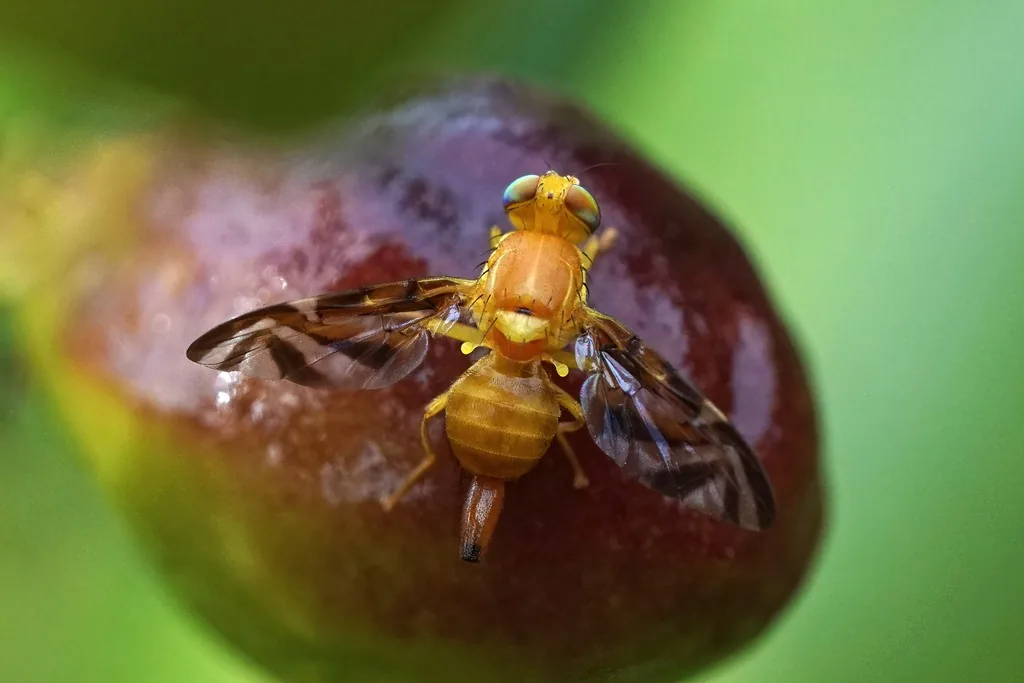
- Adult Anastrepha fruit flies are mostly yellowish brown and slightly larger than a house fly, with yellow and brown banding on the wings and body. USDA APHIS gives a wingspan of 0.24 to 0.35 inches depending on the species. UF/IFAS describes this species as a small yellow-brown fly up to 12 to 14 mm (about 1/2 in) long, with rather long wings banded yellow brown to brown.[3][9]
- The wings carry three orange and brown bands: a C-shaped band along the front edge, a sideways S-shaped band across the middle, and an inverted V-shaped band near the tip. UF/IFAS says that in males the inverted V band is always distinctly joined at its tip to the S band, while in females the connection is weaker or may be nearly gone.[1][3][9]
- The maggots are whitish, legless and up to 12 mm (about half an inch) long, with no visible head. They cannot be reliably told apart from related fruit fly larvae without a specialist.[1]
- Infested fruit shows only tiny egg-laying punctures at first; tunnels and rot develop inside before anything shows on the outside.[1]
- UF/IFAS gives the last larval stage as white and about 8 to 10 mm (roughly 1/3 to 3/8 in) long, and says accurate identification of Anastrepha larvae is difficult.[9]
Look-alikes
| Look-alike | How to tell them apart |
|---|---|
| Mexican fruit fly (Anastrepha ludens) | A near relative. UF/IFAS separates last-stage larvae under magnification: Mexican fruit fly larvae usually have split anal lobes, 12 to 14 ridges near the mouth and about 18 tubules on each front spiracle, while Caribbean fruit fly larvae have entire anal lobes, 8 ridges and 12 to 13 tubules.[9] |
| Other Anastrepha flies (A. obliqua, A. striata, A. fraterculus) | UF/IFAS says A. obliqua and A. striata share much of its range and hosts. In the Caribbean fruit fly the third wing vein ends at or slightly within the S band at the wing tip, a reliable difference from those three, and Florida specimens always show a distinct dark spot where the scutum meets the scutellum, which A. fraterculus and A. obliqua lack.[9] |
Where it lives
Native to the West Indies (EPPO lists the Greater Antilles, Bahamas, Cayman Islands and Virgin Islands) and invasive in Florida, where it was first found on the mainland in Miami-Dade in 1965 and now infests fruit in central and south Florida. UF/IFAS says it now occurs in most of southern peninsular Florida, commonly north to Citrus and Volusia Counties, with isolated records north to Jacksonville.[1][2][9]
Biology and life cycle
Eggs are laid in the fruit. The larvae feed in the flesh through three stages, then leave the fruit and pupate in the soil. Males gather in groups and release a pheromone to attract females, mostly in the early afternoon.[1]
For Anastrepha fruit flies in general, USDA APHIS says eggs hatch in 2 to 9 days at favorable temperatures, the larval stage lasts 2 to 4 weeks, and pupation is typically 1 to 2 inches deep in the soil.[3]
Its preferred hosts are in the myrtle family: Surinam cherry and other Eugenia species, guava, and Syzygium species such as rose apple. Tropical almond, calamondin, loquat, kumquat and sapodilla are also important hosts.[1][2]
It spreads mainly in infested fruit carried by people. Puparia can also move in soil or packaging.[1][3]
UF/IFAS says it infests only mature to overripe fruit. Eggs are laid singly and hatch in about two to three days, larvae feed for 10 to 14 days, pupation takes about as long, and development slows in cool weather.[9]
Nearly 100 hosts have been recorded, including several citrus species. UF/IFAS lists Surinam cherry, peach, common guava, roseapple and tropical almond as preferred hosts.[9]
UF/IFAS notes that the strain found in Florida in the 1930s was never seen infesting citrus or any other fruit on the mainland and was reared in the field only from guava in the Keys, while a strain in Puerto Rico attacks many tropical and subtropical fruits, citrus included.[9]
Damage and signs
- Citrus is not normally a significant host, but in Florida and Puerto Rico it can attack ripe citrus, especially grapefruit and oranges, which gives it quarantine importance for Florida's citrus exports.[1][4]
- Researchers in south Florida call it a major pest of guavas.[6]
- Within its native range its economic damage has been relatively small, though guavas, roseapples and Surinam cherries are usually attacked severely. UF/IFAS says only very ripe citrus has been attacked in Florida, but the fly is viewed with concern as a potential pest of commercial citrus, mangoes and peaches.[9]
Health risk
A fruit pest. None of the sources here describes any risk to people; the concern is infested fruit and export restrictions.[1][2]
Control
Sanitation
Pick up and destroy fallen and infested fruit, and remove alternative host fruit, the cultural practices EPPO lists for this fly.[1]
Biological control
The parasitic wasp Diachasmimorpha longicaudata is the main parasitoid used in biological control programs against it, and it attacks Caribflies in south Florida. UF/IFAS says the wasp lays its eggs in fly larvae and kills the fly in the pupal stage. It has been mass-reared in Gainesville since 1990 in a joint state/federal program, and trapping data indicated a 40 percent reduction in Caribbean fruit fly populations, though it is not an eradication tool.[5][6][9]
In guava field trials in south Florida, the insect-killing nematode Heterorhabditis bacteriophora applied to infested fruit on the ground gave 60% or better suppression of the fly at the best rate.[6]
Pesticides
Bait sprays, an insecticide such as spinosad or malathion mixed with a food attractant like hydrolyzed yeast, are the most common chemical control.[1]
When to call a professional
Florida's Caribbean Fruit Fly Protocol Program, run by the state with USDA APHIS, surveys and removes the preferred hosts guava, Surinam cherry, loquat and rose apple in the off-season, and monitors traps and bait sprays during harvest so grapefruit, oranges, tangerines, peaches and carambola can be certified for shipment. UF/IFAS says certification rests on two things: keeping preferred hosts out of and around designated areas, and routine trap surveys showing no Caribbean fruit flies. Under negative trapping an area must be at least 300 acres and set back from residential or other areas with common guava, Cattley guava, Surinam cherry, roseapple or loquat.[2][9]
Monitoring relies on traps baited with protein or other ammonia-emitting lures, because no special male lures exist for Anastrepha flies.[1]
UF/IFAS says the Florida Department of Agriculture and Consumer Services uses limited bait sprays in groves and nearby areas, and that releasing large numbers of sterile, lab-reared flies (the sterile insect technique) also holds promise; millions of flies are produced each week at a mass-rearing facility in Gainesville.[9]
Where it lives
EPPO lists it from the Greater Antilles, Bahamas, Cayman Islands and Virgin Islands, and as invasive in Florida. It has been trapped in California but is not established there.[1]
The Florida Department of Agriculture says it was first found on the Florida mainland in the Miami-Dade area in 1965 and now attacks fruit across central and south Florida; the EPPO datasheet's reference list includes observations of it at Key West in 1932-33.[2][1]
Every GBIF US record since 1990 comes from Florida.[7]
UF/IFAS lists it from Cuba, Jamaica, Hispaniola, Puerto Rico and Florida and says it was first described from specimens collected in Cuba. It has also been called the Greater Antillean fruit fly, the guava fruit fly and the Caribfly.[9]
UF/IFAS says an earlier strain was first identified in Florida from adults collected at Key West in 1931 and apparently died out after 1936. Today's population is a new introduction: on 23 April 1965 a Miami Springs homeowner near Miami International Airport found larvae in Surinam cherries, and more than 14,000 adults were trapped in Dade County within the first three months.[9]
Where sources disagree
Native range: EPPO and a USDA-led genetic study place it in the Greater Antilles and nearby islands plus southern Florida, while a 2023 risk analysis describes it as causing losses in Central America too.[1][4][5]
How far it flies: EPPO says Anastrepha adults can disperse long distances, while USDA APHIS says this species' general short-range dispersal is under 0.2 miles.[1][3]
Wasp releases: EPPO calls biological control with braconid wasps in Florida and Puerto Rico of limited success, while a 2023 study recommends classical biological control with Diachasmimorpha longicaudata where the climate suits both species.[1][5]
Larva size: EPPO gives maggots up to 12 mm long; UF/IFAS gives 8 to 10 mm for the last larval stage.[1][9]
Larval period: USDA APHIS gives 2 to 4 weeks for Anastrepha fruit flies in general; UF/IFAS gives 10 to 14 days of larval feeding for this species.[3][9]
First Florida record: the Florida Department of Agriculture dates the mainland find to Miami-Dade in 1965; UF/IFAS says an earlier strain was identified from Key West adults in 1931 and died out after 1936.[2][9]
Parasitoid wasps: EPPO calls braconid releases in Florida and Puerto Rico of limited success; UF/IFAS reports trapping data showing a 40 percent drop in Caribbean fruit fly populations after Diachasmimorpha longicaudata releases.[1][9]
Common questions
- What are the maggots in my guavas?
- In central and south Florida, possibly Caribbean fruit fly larvae: guava is one of its preferred hosts. The whitish maggots feed inside the fruit and drop to the soil to pupate.[1][2][6]
- Does it ruin citrus?
- Citrus is not a usual host, but ripe grapefruit and oranges can be attacked in Florida, which is why export fruit goes through a state protocol program.[1][2]
- Can it live outside Florida?
- It has been trapped in California but is not established there. Climate modeling found cold stress to be the main factor limiting where it can live.[1][5]
- Why are my Surinam cherries full of maggots?
- In central and south Florida, Caribbean fruit fly is a likely cause. UF/IFAS lists Surinam cherry among its preferred hosts and says it infests only mature to overripe fruit; the 1965 Florida outbreak was found when a homeowner noticed larvae in Surinam cherries.[9]
Sources
- European and Mediterranean Plant Protection Organization (EPPO Global Database), “Anastrepha suspensa (ANSTSU) datasheet.” gd.eppo.int/taxon/ANSTSU/datasheet (accessed 2026-11-11)
- Florida Department of Agriculture and Consumer Services, “Caribbean Fruit Fly Protocol Program.” www.fdacs.gov/Agriculture-Industry/Pests-and-Diseases/Plant-Pests-and-Diseases/Exotic-Fruit-Flies/Caribbean-Fruit-Fly-Protocol-Program (accessed 2026-11-11)
- USDA Animal and Plant Health Inspection Service, “New Pest Response Guidelines: Anastrepha spp. (last update May 2023).” www.aphis.usda.gov/sites/default/files/anastrepha-new-pest-response-guidelines.pdf (accessed 2026-11-11)
- Bulletin of Entomological Research, via PubMed, “Analysis of host preference and geographical distribution of Anastrepha suspensa using phylogenetic analyses of mitochondrial COI DNA sequence data (Boykin et al. 2006).” pubmed.ncbi.nlm.nih.gov/17092357/ (accessed 2026-11-11)
- Heliyon, via PubMed, “Risk analysis for Anastrepha suspensa and potential areas for its biological control with Diachasmimorpha longicaudata in the Americas (da Silva Santana et al. 2023).” pubmed.ncbi.nlm.nih.gov/37609418/ (accessed 2026-11-11)
- Journal of Nematology, via PubMed, “Responses of Anastrepha suspensa, Diachasmimorpha longicaudata, and sensitivity of guava production to Heterorhabditis bacteriophora in fruit fly IPM (Heve et al. 2018).” pubmed.ncbi.nlm.nih.gov/30451413/ (accessed 2026-11-11)
- Global Biodiversity Information Facility (GBIF), “Anastrepha suspensa: US occurrence records since 1990 by state (GBIF occurrence search API).” api.gbif.org/v1/occurrence/search?taxonKey=1625078&country=US&hasGeospatialIssue=false&occurrenceStatus=PRESENT&year=1990%2C2026&facet=stateProvince&facetLimit=400&limit=0 (accessed 2026-11-11)
- iNaturalist, “Anastrepha suspensa taxon page (order and family).” www.inaturalist.org/taxa/649500 (accessed 2026-11-11)
- University of Florida IFAS Extension, EDIS (Featured Creatures), “Caribbean Fruit Fly, Anastrepha suspensa (Loew), EENY-196/IN353 (Featured Creatures).” ask.ifas.ufl.edu/publication/IN353 (accessed 2026-11-14)