On this page
How to identify it
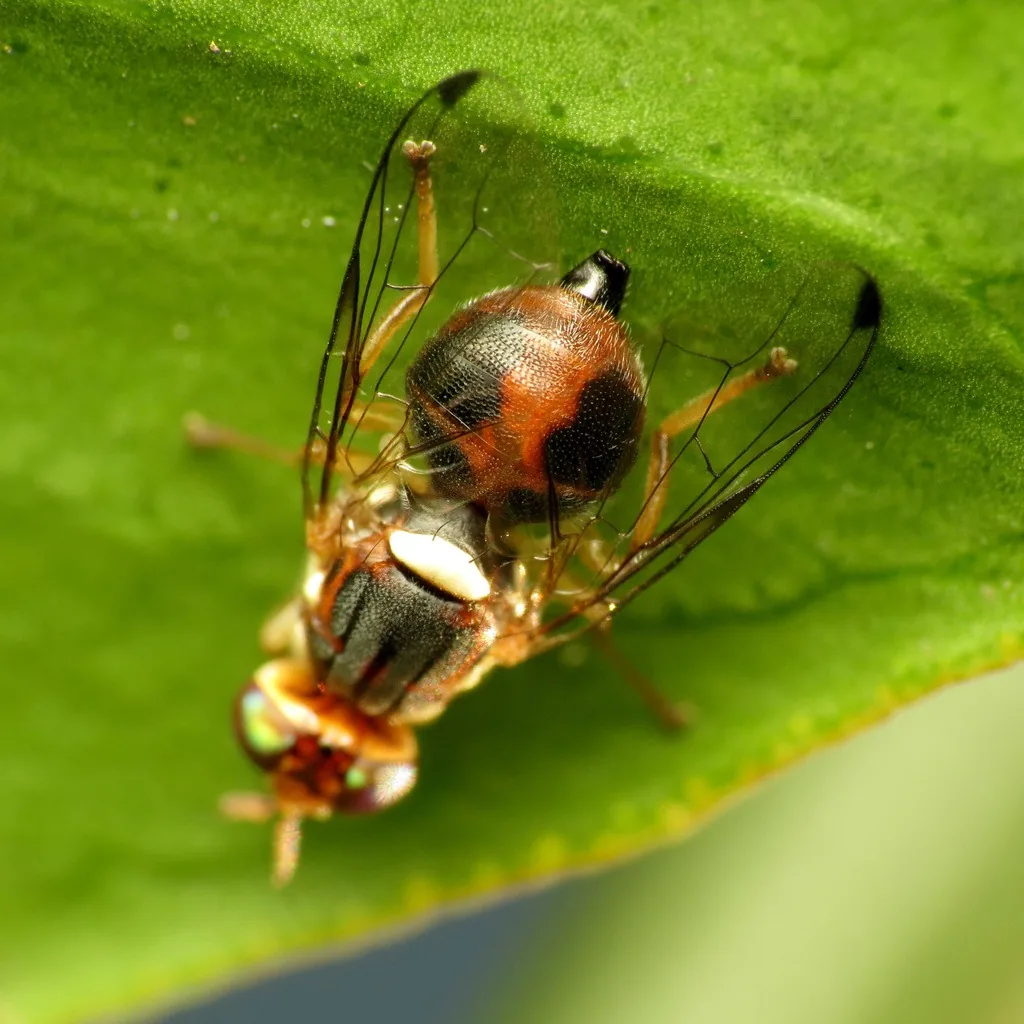
- Adults are about 1/4 inch long in the UC home pest note (0.2 inch, 4 to 5 mm, in UC's grower guidelines), brown with darker marks and white or yellow patches on the thorax.[1][2]
- Wings are clear, held horizontally away from the body, with a small dark spot at each tip and no bands.[1][2]
- Females have a dark, pointed egg-laying tube (ovipositor) at the tip of the abdomen; the male's abdomen is blunt.[1][2]
- Maggots are yellowish white and legless with pointed heads, inside the fruit. Newly hatched ones sit just under the skin and are hard to see.[1][2]
- UF/IFAS gives the adult as about 5 mm long with a 10 mm wingspan, mostly dark brown to black with yellow-brown markings and short, silvery hairs.[9]
- Eggs are laid inside the fruit, so you only see them by cutting it open. UF/IFAS describes them as creamy white, elongated and slightly curved, about 0.74 mm long. Maggots are 5 to 6 mm long and 1.5 mm wide, tapered at each end.[9]
Look-alikes
| Look-alike | How to tell them apart |
|---|---|
| Walnut husk fly, apple maggot and Mediterranean fruit fly | These related fruit flies have bands across the wings; the olive fruit fly has only dark wing-tip spots.[1] |
Where it lives
First found in California in Los Angeles in 1998, it reached all of the state's olive-growing areas within about five years. Worldwide it spreads only within olive-growing areas and is the major pest of commercial olives. UF/IFAS says it is found almost anywhere cultivated olives grow or wild olives occur, with reports from Africa, the Canary Islands, the Middle East, China, California, Mexico and Central America. As of 2015 it had not been reported as established in Georgia or Florida.[1][5][3][9]
Biology and life cycle
On the mild coast, adults are active year round and eggs and maggots can be found all year in leftover fruit. Inland, adults emerge March to May and attack olives left from the previous season.[1][2]
Females start laying in the new crop by late June or July, usually one egg per fruit, just under the skin, often leaving a dimple or brown spot. In the lab a female may lay 10 to 40 eggs a day and 200 to 500 in her lifetime.[1]
Eggs hatch in 2 to 3 days and larvae develop in about 20 days in summer and fall. A generation can take as little as 30 to 35 days at 68 to 86 F, and UC's grower guidelines estimate three, possibly four, generations a year in parts of California.[1][2]
Summer larvae pupate in the fruit; fall larvae drop and pupate in the soil to spend the winter. There is no true dormancy, so all stages can turn up in winter.[1][2]
Heat holds it back. UC notes hot, dry weather of 95 to 105 F kills many eggs and young maggots, and in lab tests mimicking Central Valley summers no eggs hatched at a 37.8 C (100 F) daily high.[1][4]
UF/IFAS says adults don't feed on olives but on nutrient-rich material such as honeydew and bird droppings. Pupae in the soil, more common in winter, can last up to six months; pupae inside fruit last about 8 to 10 days.[9]
Larvae develop only in the fruit of wild and cultivated olives (Olea species), including the wild Olea verrucosa and Olea chrysophylla as well as Olea europaea. Females have shown a preference for larger table olive varieties.[9]
Damage and signs
- Maggots destroy the pulp and let in bacteria and fungi that rot the fruit and lower oil quality. Egg-laying stings also mark the fruit. UF/IFAS adds that the egg-laying cuts make fruit more open to bacterial and fungal disease, and that infested olives lose their market value for both table use and oil.[1][2][9]
- Infested fruit drops early, and rotting fruit on the ground makes a mess in landscapes.[1]
- Where it is established and uncontrolled, it has destroyed up to 100% of some table olive varieties and up to 80% of oil value.[1][2]
Health risk
It feeds only on olive fruit; none of the sources describes any risk to people.[1][2]
Control
Prevention
For trees grown only for looks, plant a fruitless olive variety, or keep fruit from forming with a growth-regulator spray or high-pressure water during bloom; follow the label.[1][2]
Harvest early and press infested fruit quickly to limit off flavors.[1]
Sanitation
Pick up fallen fruit, harvest promptly, and knock remaining fruit off trees after harvest; destroy it by mulching, mowing or burying it at least 4 inches deep.[1][2]
Traps and physical control
Bottle traps baited with torula yeast catch adults and can cut damage, but results vary; UC says not to rely on trapping alone.[1][2]
Biological control
UF/IFAS says several braconid wasps from the fly's native range attack it, among them Psyttalia lounsburyi, Psyttalia concolor and Utetes africanus, with results varying by region. Common predators such as lady beetles and lacewings don't help, because the eggs and maggots are sealed inside the olives.[9]
Pesticides
A spinosad bait spray, started when traps catch flies or 2 to 3 weeks before pit hardening and repeated weekly, kills adults that feed on it. A kaolin clay barrier film that coats the fruit can prevent egg laying. Follow the label.[1][2]
Where it comes from
UC's grower guidelines call it a native of eastern Africa and the most damaging olive pest of southern Europe, North Africa and the Middle East. It spreads only where olives are grown, and genetic work points to the eastern Mediterranean as the source of the California population.[2][5]
Spinosad and resistance
Spinosad was the only insecticide used against the olive fruit fly in California after its 2004 registration, and a 2010 study found five California populations 9 to 13 times more tolerant of it. The authors judged that level not yet a serious problem in the field, but it is a reason to combine bait sprays with sanitation.[6][1]
Where sources disagree
First record: the UC home pest note says a single female was trapped in west Los Angeles in October 1998; UC's grower guidelines say infested fruit was first found on Los Angeles County landscape trees in November 1998.[1][2]
Composting: UC says it is not known whether composting kills the maggots. A study of chipped yard-waste piles found no olive fruit fly larvae survived past 14 days.[1][7]
Generations: UC's grower guidelines estimate three, possibly four, generations a year in parts of California; UF/IFAS says warm areas with abundant olives such as California may see up to five or six.[2][9]
Damage threshold: UF/IFAS cites a damage threshold of 0% for commercial orchards in California, meaning growers tolerate essentially no infested fruit.[9]
Sterile fly releases
UF/IFAS describes releasing large numbers of sterilized male flies so that wild females lay eggs that can't develop, a species-specific method that has worked against the Mediterranean fruit fly. Drawbacks include setting up rearing, choosing a reliable sterilization method and timing releases, and females laying sterile eggs still damage fruit with their egg-laying cuts.[9]
Common questions
- Why are my olives rotting and dropping?
- Olive fruit fly maggots feeding inside let rot organisms in and cause early drop. Cut a fruit open and look for yellowish-white maggots or their tunnels.[1][2]
- How do I tell it from other fruit flies?
- Look for clear wings with dark wing-tip spots and no bands, a brown body with white or yellow thorax patches, and a size of about 1/4 inch.[1][2]
- Is the olive fruit fly in Florida?
- UF/IFAS said that as of 2015 it had not been reported as established in Georgia or Florida. Its main U.S. stronghold is California.[9][1]
Sources
- University of California Statewide IPM Program, “Pest Notes: Olive Fruit Fly (Publication 74112).” ipm.ucanr.edu/PMG/PESTNOTES/pn74112.html (accessed 2026-11-11)
- University of California Statewide IPM Program, “Olive Fruit Fly (Olive: Agriculture Pest Management Guidelines).” ipm.ucanr.edu/agriculture/olive/olive-fruit-fly/ (accessed 2026-11-11)
- Annual Review of Entomology, via PubMed, “Olive fruit fly: managing an ancient pest in modern times (Daane and Johnson 2010).” pubmed.ncbi.nlm.nih.gov/19961328/ (accessed 2026-11-11)
- Environmental Entomology, via PubMed, “High summer temperatures affect the survival and reproduction of olive fruit fly (Wang et al. 2009).” pubmed.ncbi.nlm.nih.gov/19825305/ (accessed 2026-11-11)
- Heredity, via PubMed, “Analysis of olive fly invasion in California based on microsatellite markers (Zygouridis et al. 2009).” pubmed.ncbi.nlm.nih.gov/19107137/ (accessed 2026-11-11)
- Pest Management Science, via PubMed, “Spinosad resistance development in wild olive fruit fly populations in California (Kakani et al. 2010).” pubmed.ncbi.nlm.nih.gov/20146256/ (accessed 2026-11-11)
- Bioresource Technology, via PubMed, “Probabilities for survival of glassy-winged sharpshooter and olive fruit fly pests in urban yard waste piles (Crohn et al. 2008).” pubmed.ncbi.nlm.nih.gov/17419052/ (accessed 2026-11-11)
- iNaturalist, “Bactrocera oleae taxon page (order and family).” www.inaturalist.org/taxa/326609 (accessed 2026-11-11)
- University of Florida IFAS Extension, EDIS (Featured Creatures), “Olive Fruit Fly, Bactrocera oleae (Rossi), EENY645/IN270 (Featured Creatures).” ask.ifas.ufl.edu/publication/IN270 (accessed 2026-11-14)