On this page
How to identify it
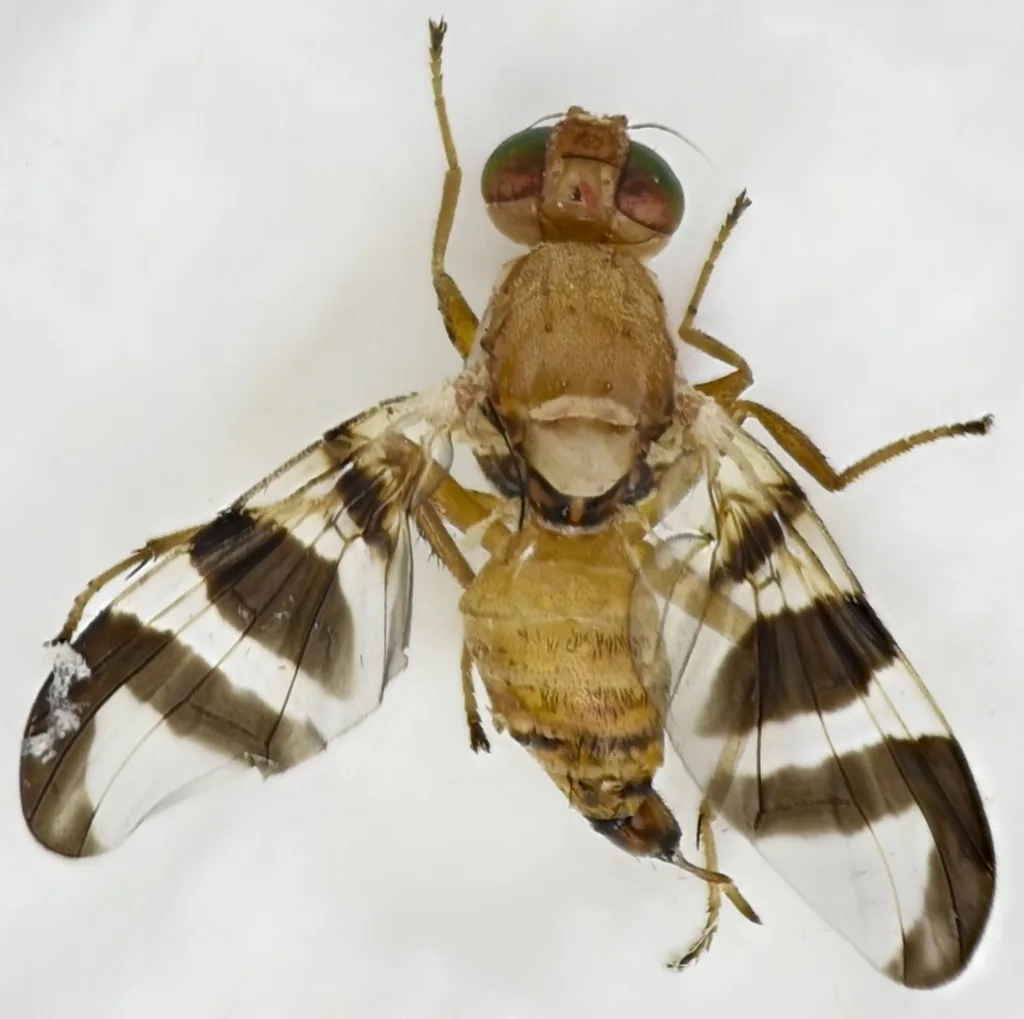
- UC IPM calls adults about the size of a house fly; Utah State says a little smaller, about 1/4 inch. They're tawny brown with a yellow spot behind the wings and iridescent green eyes.[1][4]
- Each wing has dark bands, with the band at the tip forming an upside-down V or triangle.[1][3][4]
- Dark, soft blotches on ripening husks are the main clue; hard, dry blotches are walnut blight instead.[1]
- Females are a bit larger than males and have a pointed abdomen.[3]
Look-alikes
| Look-alike | How to tell them apart |
|---|---|
| Apple maggot | Apple maggot is a smaller banded-wing fly (about 1/5 inch) with a white spot on the thorax; its wing pattern differs, and it attacks apples and hawthorn, not walnuts.[2][4] |
| Western cherry fruit fly | Another Rhagoletis fly with banded wings; Utah State says to compare the wing banding to tell them apart.[4] |
Where it lives
It occurs in all California walnut areas and in Utah, where it's the most common walnut insect, and also hits late apricots and peaches near infested walnuts. Utah State says it's native east of the Rockies and first turned up in California in 1926; genetic work puts its home in the Midwest and Mexico and has it reaching California from the Midwest in the early 1900s.[3][4][5][6]
Biology and life cycle
Pupae overwinter in soil. UC IPM gives emergence from early June to early September (mid-May on the coast), peaking in July to mid-August; Utah State sees adults from late June to early October.[3][1][4]
Females start laying 10 days to four weeks after emerging, in groups of about 15 under the husk surface, and can lay several hundred eggs over a three- to four-week life; maggots hatch in five to seven days.[1][4]
After three to five weeks in the husk, maggots drop and pupate a few inches deep; some wait two or more years to emerge.[1]
A California model found flight timing shifts with latitude, how early the walnut variety leafs out and how old the orchard is.[7]
Damage and signs
- Shells are stained, and the stain can't be bleached out; husks stick to them. Infestations from June to mid-August can leave shriveled, moldy kernels.[1][3]
- Varieties differ. Payne, Serr, Hartley, Franquette and Tulare are very susceptible, Chandler and Howard less so, and black walnut is a favorite host. Once husks split, nuts are no longer at risk.[3][4]
Health risk
It feeds in walnut husks; neither UC IPM nor Utah State mentions any risk to people.[1][4]
Control
Sanitation
Pick up and destroy damaged nuts in July, August and after harvest. A tarp, landscape fabric or mulch under the tree stops maggots from reaching the soil.[1][4]
Traps and physical control
Soak damaged nuts in a damp burlap bag for a few days to loosen stuck husks.[1]
Biological control
Natural enemies do little. Chickens or other fowl foraging under the trees probably have the biggest effect, according to Utah State.[4]
Pesticides
UC IPM says spinosad with a bait, starting in July, is the only home-use option in California and may be only partly effective; Utah State lists more home-use choices. Follow your own state's extension and the label.[1][4]
Common questions
- Are walnuts with black husks safe to eat?
- Usually; the husk fly generally doesn't affect the nutmeat, though early infestations can shrivel kernels.[1][4]
- When do walnut husk flies appear?
- Mostly from July, peaking mid-July to mid-August in California; Utah State sees them from late June into early October.[1][4]
Sources
- University of California Statewide IPM Program, “Pest Notes: Walnut Husk Fly (Publication 7430).” ipm.ucanr.edu/PMG/PESTNOTES/pn7430.html (accessed 2026-11-13)
- University of California Statewide IPM Program, “Apple Maggot (Pests in Gardens and Landscapes).” ipm.ucanr.edu/PMG/GARDEN/FRUIT/PESTS/applemaggot.html (accessed 2026-11-13)
- UC Statewide IPM Program (UC IPM), “Walnut Husk Fly (Walnut Pest Management Guidelines).” ipm.ucanr.edu/agriculture/walnut/walnut-husk-fly/ (accessed 2026-11-13)
- Utah State University Extension and Utah Plant Pest Diagnostic Laboratory, “Walnut Husk Fly (Fact Sheet ENT-173-14).” extension.usu.edu/planthealth/uppdl/files/factsheet/walnut-husk-fly.pdf (accessed 2026-11-13)
- Genetica, 2010 (via PubMed), “Post-colonization temporal genetic variation of an introduced fly, Rhagoletis completa (abstract).” pubmed.ncbi.nlm.nih.gov/20824307/ (accessed 2026-11-13)
- Journal of Insect Science, 2019 (via PubMed), “The Effect of Winter Length on Duration of Dormancy and Survival of Rhagoletis completa (Diptera: Tephritidae) and Associated Parasitoids From Northeastern Mexico (abstract).” pubmed.ncbi.nlm.nih.gov/31095311/ (accessed 2026-11-13)
- Environmental Entomology, 2019 (via PubMed), “Sources of Variation in the Adult Flight of Walnut Husk Fly (Diptera: Tephritidae): A Phenology Model for California Walnut Orchards (abstract).” pubmed.ncbi.nlm.nih.gov/30520946/ (accessed 2026-11-13)
- Global Biodiversity Information Facility (GBIF), “Rhagoletis completa Cresson, 1929 (GBIF Backbone Taxonomy).” api.gbif.org/v1/species/1622658 (accessed 2026-11-13)