On this page
How to identify it
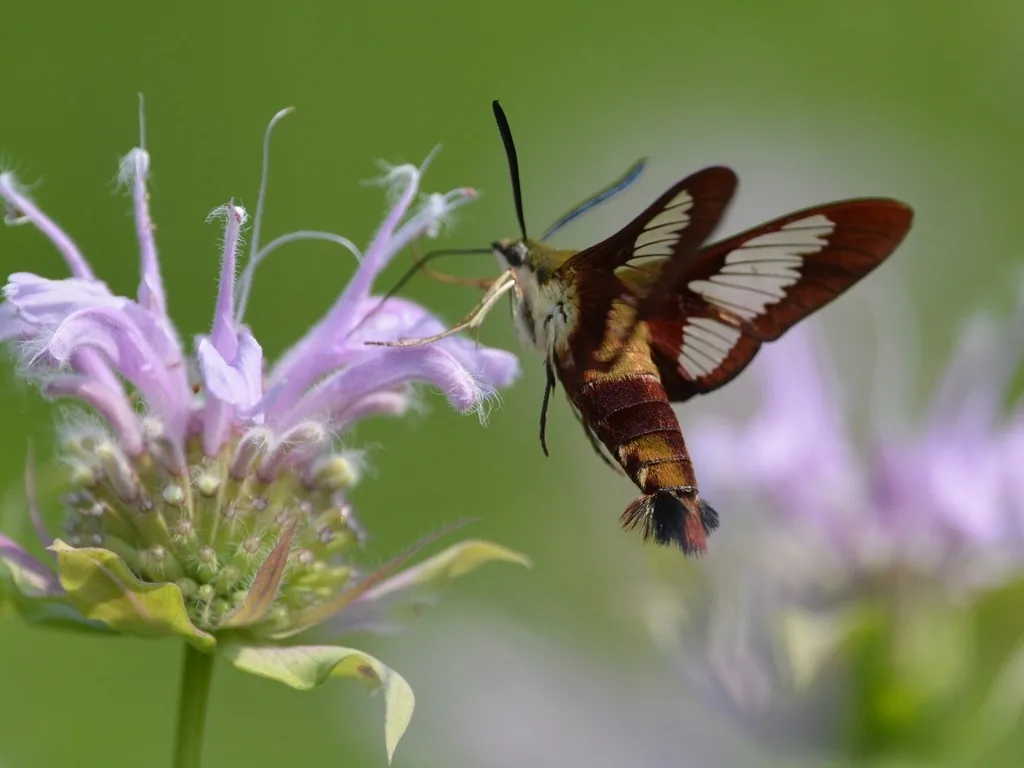
- Clearwings have large clear patches in the middle of the wings, where there are no scales, a furry thorax and a cone-shaped abdomen that sticks out past the hind wings in flight.[5][6][7]
- The hummingbird clearwing (Hemaris thysbe) has an olive to golden-olive back, a dark burgundy to blackish abdomen, pale whitish legs and a fairly wide reddish-brown wing border with a ragged inner edge. Wingspan is 1-3/4 to 2-1/4 inches by Missouri's measure, 1-1/2 to 2-1/4 by UW-Madison's.[5][1][7][8]
- The snowberry clearwing or bumblebee moth (Hemaris diffinis) is golden yellow with black and yellow bands on the abdomen, black legs and underside, a black stripe through the eye along the side of the thorax, and a narrower black wing border. It is a bit smaller, with a wingspan of 1-1/4 to 1-3/4 inches.[6][1][2]
- The caterpillars are hornworms with a tail horn. Snowberry clearwing caterpillars are usually pale green with black spots along the sides, a yellow collar and a black horn with a yellow base; hummingbird clearwing caterpillars are green and granular-looking with a light line down each side of the back and reddish breathing pores.[1][6][5]
- Other sphinx moths get called hummingbird moths too. In Colorado the whitelined sphinx is by far the one most often seen feeding this way, mostly in late afternoon and at dusk.[2]
Look-alikes
| Look-alike | How to tell them apart |
|---|---|
| Whitelined sphinx | Larger than the clearwings, with wings fully covered in scales and strong white bands, and more active at dusk than in daylight. Colorado State calls it the most commonly seen hummingbird moth there.[7][2] |
| Bumble bees | Bumble bees, carpenter bees and Hemaris moths often visit the same flowers. Watch the flight: clearwings hover like a hummingbird and usually don't land and walk on flowers the way bees do. The moths can't sting.[1][6] |
| Tomato hornworm moth | The tomato hornworm is the caterpillar of another sphinx moth that is also called a hummingbird moth. Like most sphinx moths it flies late in the day or after dusk, not in full daylight.[3][2] |
| Slender (graceful) clearwing | Hemaris gracilis looks much like the hummingbird clearwing but is slightly smaller, has reddish legs and always shows brown or rust bands on the side of the thorax. It is uncommon and local, more common to the north and on the East Coast.[6][7] |
Where it lives
The hummingbird clearwing ranges from Alaska and British Columbia south to Oregon and east across the Great Plains and Great Lakes to Maine, Florida and Texas; UW-Madison calls it fairly common throughout the eastern half of the U.S. and Canada. The snowberry clearwing occurs east of the Continental Divide across most of the U.S. Both are found statewide in Missouri. A 2018 study found that what had been called the snowberry clearwing in the Northeast includes a second, more northern look-alike species, Hemaris aethra, from Manitoba to Nova Scotia and nearby U.S. states. GBIF's public U.S. records since 1990 for the genus Hemaris (about 43,000) come from 48 states on the map, most from Ohio, Virginia and Pennsylvania.[8][7][9][5][6][11][12]
Biology and life cycle
Generations vary by place and source: NC State reports at least two a year in North Carolina; Missouri gives the hummingbird clearwing two or three broods there, flying from early April into September; BAMONA gives two broods in the South and one in the North; and UW-Madison says one or two depending on location and temperature.[1][5][8][7]
Females lay eggs singly on the undersides of host-plant leaves. Grown caterpillars spin thin cocoons and pupate in leaf litter or at the soil surface, and the hummingbird clearwing spends the winter there as a pupa.[7][5][1][8]
Caterpillars of the hummingbird clearwing feed on viburnums, honeysuckle, snowberry and coralberry, hawthorns, cherries and plums. Snowberry clearwing caterpillars eat snowberry and coralberry, honeysuckles, dogbane and dwarf bush honeysuckle.[5][8][9][6][1]
Colorado State lists honeysuckle, viburnum, hawthorn, snowberry, cherry and plum as hosts of the snowberry clearwing.[2]
Adults nectar at many flowers, favoring long-tubed ones: honeysuckles, bee balm, phlox, clovers, thistles, vetch, lilac, butterfly weed, coneflower and verbena among them. The tongue coils up when not in use.[5][8][7][1]
Hawk moths have very long tongues, in some species longer than the body, and can be good pollinators.[3][10]
Missouri explains the look-alikes this way: the bee-like pattern protects a moth that has no stinger, while the hummingbird resemblance is probably a shared solution to hovering at deep flowers rather than true mimicry.[5]
Damage and signs
- The caterpillars are rarely noticed and almost never sent in for identification; NC State recommends no control.[1]
Health risk
None. Although they look like stinging insects, Hemaris moths are completely harmless; they have no stinger.[1][5]
Control
Prevention
No control is recommended, because the caterpillars are rarely noticed. Missouri notes that many people enjoy watching the moths hover around hanging baskets and other garden flowers on summer evenings.[1][5]
Common questions
- Is that a hummingbird or a moth?
- If it hovers at flowers in daylight, is about the size of a large bumble bee and has clear wing patches, it's likely a Hemaris clearwing moth. Missouri notes people often notice them at dusk and dawn, while sitting near their flowers.[1][5]
- Do hummingbird moths sting?
- No. They resemble bumble bees, which may protect them from predators, but they have no stinger and are harmless.[1][5]
- Should I get rid of hummingbird moths?
- No. Adults help pollinate flowers, and the caterpillars are rarely noticed, so no control is recommended.[1][6][3]
Sources
- NC State Extension, “Bumblebee Moth and Hummingbird Moth (PDIC Factsheet).” content.ces.ncsu.edu/bumblebee-moth-and-hummingbird-moth (accessed 2026-11-11)
- Colorado State University Extension, “Hornworms and “Hummingbird” Moths (Fact Sheet 5.517).” extension.colostate.edu/resource/hornworms-and-hummingbird-moths/ (accessed 2026-11-11)
- University of Arkansas Division of Agriculture Cooperative Extension Service, “Hummingbird Moth.” www.uaex.uada.edu/yard-garden/in-the-garden/reference-desk/insects/hummingbird-moth.aspx (accessed 2026-11-11)
- iNaturalist, “Hemaris thysbe taxon page (order and family).” www.inaturalist.org/taxa/82379 (accessed 2026-11-11)
- Missouri Department of Conservation, “Hummingbird Clearwing (Hemaris thysbe).” mdc.mo.gov/discover-nature/field-guide/hummingbird-clearwing (accessed 2026-11-11)
- Missouri Department of Conservation, “Snowberry Clearwing (Hemaris diffinis).” mdc.mo.gov/discover-nature/field-guide/snowberry-clearwing (accessed 2026-11-11)
- University of Wisconsin-Madison Division of Extension (Wisconsin Horticulture), “Hummingbird Moth, Hemaris thysbe.” hort.extension.wisc.edu/articles/hummingbird-moths/ (accessed 2026-11-11)
- Butterflies and Moths of North America, “Hummingbird Clearwing, Hemaris thysbe.” www.butterfliesandmoths.org/species/Hemaris-thysbe (accessed 2026-11-11)
- Butterflies and Moths of North America, “Snowberry Clearwing, Hemaris diffinis.” www.butterfliesandmoths.org/species/Hemaris-diffinis (accessed 2026-11-11)
- USDA Forest Service, “Moth Pollination.” www.fs.usda.gov/wildflowers/pollinators/animals/moths.shtml (accessed 2026-11-11)
- Zootaxa, via PubMed, “Cryptic species among bumblebee mimics: an unrecognized Hemaris hawkmoth in eastern North America (Schmidt 2018).” pubmed.ncbi.nlm.nih.gov/29690328/ (accessed 2026-11-11). Cited from the PubMed abstract.
- Global Biodiversity Information Facility (GBIF), “Hemaris: occurrence records in the U.S., 1990-2026 (GBIF occurrence search).” api.gbif.org/v1/occurrence/search?taxonKey=1861796&country=US&hasGeospatialIssue=false&occurrenceStatus=PRESENT&year=1990%2C2026&facet=stateProvince&facetLimit=400&limit=0 (accessed 2026-11-11). State counts are records reported (iNaturalist research-grade, museum specimens, surveys), not abundance.