On this page
How to identify it
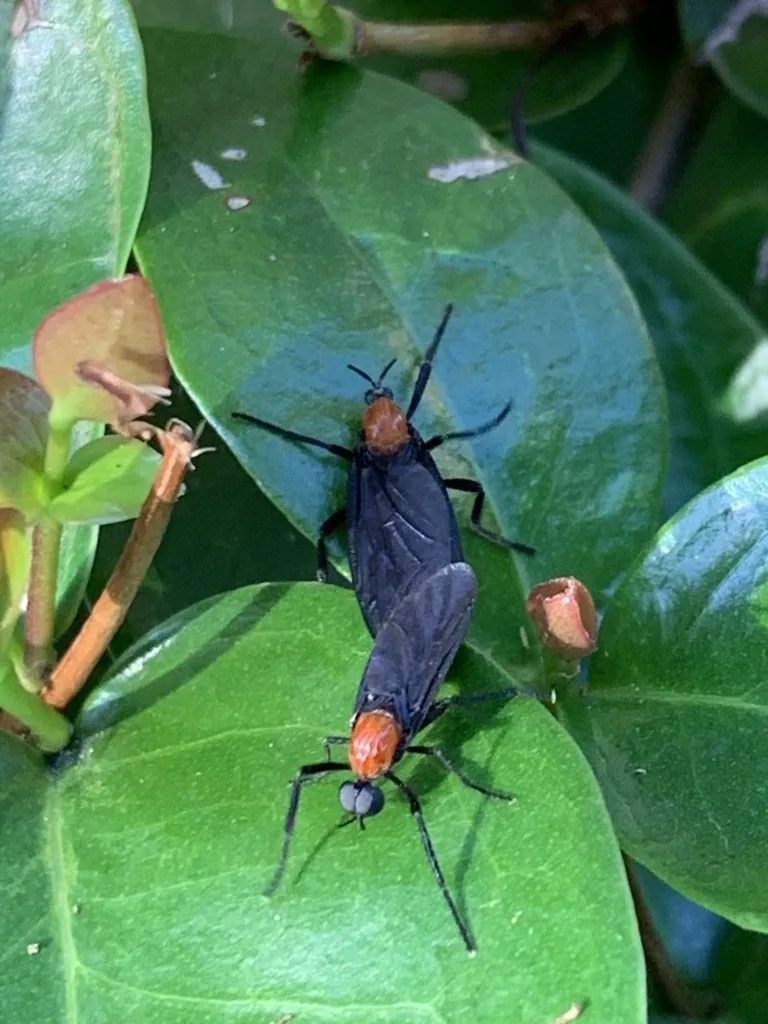
- Small black-and-orange flies; lovebugs are true flies, not bugs, in the March fly family Bibionidae. UF/IFAS describes them as dull, somewhat velvety black flies with red on top of the thorax, the section just behind the head. Males are about 1/4 inch long and females 1/3 inch, and males have big round eyes.[1][3][2][4][5]
- Their best-known habit is flying and resting as joined male-female pairs, together less than an inch long.[2][3]
- Before pairing, several males (six or more) may swarm around a single female in flight.[2]
- The scientific name is Plecia nearctica. Other common names include March flies, double-headed bugs, honeymoon flies and united bugs.[5]
Look-alikes
| Look-alike | How to tell them apart |
|---|---|
| Dilophus sayi (a related March fly) | Smaller and completely black, with no red on the thorax, much less abundant, and it doesn't gather on highways. Females are larger than males and have smoky brown wings.[4][5] |
| Plecia americana | The only other Plecia in the U.S.: a woodland species with an almost completely red thorax that isn't a highway problem. It has been collected only in April, May and June, so fall flights are always the lovebug.[4] |
Where it lives
A southern insect: Clemson describes flights along highways of the southern United States, Mississippi State finds them statewide with the highest numbers in southern counties, and in Texas they are found in the wetter eastern part of the state rather than around San Antonio. UF/IFAS lists it as established in Costa Rica, Guatemala, Honduras, Mexico and the southeastern U.S. (Alabama, Florida, Georgia, Louisiana, Mississippi, South Carolina and Texas), and reported as far north as Wilmington, North Carolina, in 2006.[2][1][3][4]
Biology and life cycle
There are two flights a year, each lasting about four weeks: one in late spring (around May) and one in late summer to fall (around September). In Florida, UF/IFAS puts the flights in April-May and August-September, and says adults have been collected in every month except November, with a minor December peak in south Florida.[2][1][3][4]
Adults are active by day, from about 10 a.m. until dusk. UF/IFAS says flight starts once the air reaches about 68°F, and mating swarms peak at 10-11 am and again at 6-8 pm.[2][5]
Pairs can stay joined for hours. During mating the male passes nutrients to the female, which she uses for her eggs. UF/IFAS says sperm transfer takes an average of 12.5 hours, but a pair can stay coupled for several days while feeding and dispersing, and both sexes may mate again.[2][5]
Adults live only a few days; Clemson puts a female's average life span at 2 to 3 days. Each female lays 150 to 600 eggs under decaying plant material and dies soon after. UF/IFAS gives an average of 350 eggs per female and an adult life in the wild of about 3-4 days; the pupal stage lasts 7-9 days.[2][5]
The larvae feed on decaying vegetation in lawn thatch, pastures and roadsides, including rotting grass clippings along highways and under cow manure, and help return those nutrients to the soil.[2][1][3]
Numbers rise and fall from year to year. In Texas, wet winters and summers bring bigger emergences and drought brings smaller ones.[1][3]
They gather on roads because they are drawn to vehicle exhaust, but only after sunlight has broken it down. In lab tests with irradiated exhaust components, formaldehyde and heptaldehyde were the most attractive. They are also drawn to white, yellow and other light-colored surfaces and to fresh paint. UF/IFAS adds that heat and engine vibration also draw them to highways, and that mated females may confuse exhaust aldehydes with the smell of the decaying matter where they lay eggs.[1][6][4][5]
Larvae grow faster in warm weather, so the summer generation is shorter: UF/IFAS gives roughly 240 days as larvae for the generation that emerges in April-May and 120 days for the one that emerges in August-September.[5]
Adults feed on nectar and pollen. Pairs are weak fliers that stay within a few hundred yards of where they emerged when there is little wind, but stronger winds can carry them as high as 1500 ft and pile them against objects downwind.[5]
Damage and signs
- Splattered lovebugs coat windshields and hoods, reduce visibility when smeared by wipers, and can clog radiators and make engines overheat.[2][1]
- Their body fluids are acidic, and remains left on a car can damage the paint. UF/IFAS says crushed lovebugs start out about neutral (pH 6.5) but turn acidic (pH 4.25) within 24 hours; paint is at risk mainly when remains bake in the sun for a day or two, and better paint coatings have made this less of a problem.[2][1][4][5]
- Adults collect on light-colored and freshly painted surfaces.[1]
Health risk
None: lovebugs don't bite, sting or cause disease and are harmless to people.[2][3]
Control
Prevention
A well-waxed finish, a hood deflector and a screen or cover over the grille protect the paint and keep them out of the radiator; check the radiator often during heavy flights. UF/IFAS also mentions nylon screens that hook onto the front of the vehicle.[2][1][4]
During flights, drive in the early evening or at night when you can, drive slower to cut down on splatter, and put off outdoor painting projects.[2][1]
Keep them out
Screen windows and doors, especially on the windward side, and screen decks and pool areas. A fan blowing outdoors keeps them away from work or seating areas, positive air pressure from an air-conditioning fan helps keep these poor fliers out, and a vacuum handles the few that get in.[5]
Traps and physical control
Wash lovebugs off vehicles within a day or so. Wet the surface and let the remains soak a few minutes before washing with soapy water. UF/IFAS suggests soaking with water for about five minutes, then scrubbing within 15 to 20 minutes.[2][1][4]
Biological control
Birds, small animals and other insects eat lovebugs, and the flights end on their own after a few weeks. UF/IFAS adds that red imported fire ants seem to avoid them and that fungal diseases may hold populations down; in one study only Beauveria bassiana caused significant mortality, 27 to 33 percent.[2][3][1][4][5]
Pesticides
Insecticides aren't worth it. Lovebugs breed over huge areas, new adults keep arriving by the hour during heavy flights, and sprays clear them only briefly while harming other daytime fliers such as honey bees. No government or community programs spray for them. UF/IFAS agrees: household fly sprays kill them, but more return almost immediately, sprays carry risks around people and pets, and they also kill lady beetles, lacewings, honey bees and other helpful insects.[1][2][5]
Where sources disagree
Which flight is bigger: Mississippi State says the fall flight is usually much larger than the spring flight, while Texas A&M AgriLife says the big emergence in Texas comes in spring.[1][3]
Peak in south Florida: UF/IFAS cites a study finding that most south Florida adults appear in April, during the first flight of the year.[4]
Adult life span: Clemson puts a female's average at 2 to 3 days. UF/IFAS cites one study in which males lived two to three days and females a week or longer, and another in which males outlived females in the field.[2][4]
Dilophus sayi season in Florida: one UF/IFAS publication says it peaks from late January through April, while another says adults appear only in April to June.[4][5]
How lovebugs reached Florida
The lovebug was first described in 1940 from Galveston, Texas. UF/IFAS says it is not native to most of the southern U.S. and that since 1940 it has spread from Louisiana and Mississippi across the Gulf states.[4][5]
It was first collected in Florida in 1949 in Escambia County, at the western end of the Panhandle, became established across north Florida in the late 1960s and spread south nearly to the tip of the peninsula and north into South Carolina in the 1970s.[4][5]
Prevailing winds, traffic, sod shipments, roadside habitat and expanding pastures may have sped its spread. UF/IFAS calls the story that University of Florida researchers released or engineered lovebugs a myth: UF and USDA research began only after the fly was well established in Florida.[4][5]
Common questions
- Why do lovebugs gather on highways and my house?
- They are attracted to sunlight-altered exhaust fumes along roads, and to light-colored and freshly painted surfaces.[1][6]
- Are lovebugs dangerous?
- No. They don't bite, sting or carry disease. They are a seasonal nuisance that lasts a few weeks at a time.[2][3]
- Does spraying help?
- Not much. New lovebugs arrive hourly during heavy flights, so sprays give only short relief and also kill honey bees and other daytime fliers.[1][2]
- Did the University of Florida release lovebugs?
- No. UF/IFAS calls that a myth: lovebugs spread on their own around the Gulf Coast into Florida, where they were first collected in 1949, and UF and USDA research began only after they were well established.[4][5]
- Why are lovebugs worse in some places and years?
- UF/IFAS says natural enemies and rainfall make populations rise and fall, and places 20 to 30 miles apart can see very different emergences, so hotspots shift from year to year. They are most abundant near moist, grassy areas.[4][5]
Sources
- Mississippi State University Extension Service, “Lovebug, Bug's Eye View Vol. 4, No. 26 (2018).” extension.msstate.edu/newsletters/bugs-eye-view/2018/lovebug-vol-4-no-26 (accessed 2026-11-14)
- Clemson Cooperative Extension, Home & Garden Information Center, “Lovebugs (HGIC 2432).” hgic.clemson.edu/factsheet/lovebugs/ (accessed 2026-11-14)
- Texas A&M AgriLife Extension Service (AgriLife Today), “Love in the air: lovebug fun facts (2023).” agrilifetoday.tamu.edu/2023/02/09/love-in-the-air/ (accessed 2026-11-14)
- University of Florida/IFAS Extension (Featured Creatures), “Lovebug, Plecia nearctica Hardy, EENY-042/IN204.” ask.ifas.ufl.edu/publication/IN204 (accessed 2026-11-14)
- University of Florida/IFAS Extension (EDIS), “Living with Lovebugs, IN694.” ask.ifas.ufl.edu/publication/IN694 (accessed 2026-11-14)
- Applied Optics, via PubMed, “Mechanism of attraction of the lovebug, Plecia nearctica, to southern highways (Callahan et al. 1985).” pubmed.ncbi.nlm.nih.gov/18217078/ (accessed 2026-11-14)
- iNaturalist, “Plecia nearctica taxon page (order and family).” www.inaturalist.org/taxa/127635 (accessed 2026-11-14)