The short answer
- Tail: a scorpion has a long, segmented tail ending in an enlarged segment that bears a stinger, often curved up over the back. A sun spider has no tail and no stinger; its abdomen is soft and rounded.[4][5][2][1]
- Front end: a scorpion carries a pair of crablike pincers. A sun spider has blunt, leg-like arms called pedipalps instead, and two big jaws (chelicerae) that stick straight forward from the head like pliers.[4][5][1][2]
- Venom: scorpions sting with venom, and the Arizona bark scorpion can be dangerous. Colorado State says sun spiders have no poison glands; the University of Arizona says none are known to have venom.[4][8][2][1]
- Movement: sun spiders are very fast runners, which is where the name wind scorpion comes from, and they hold their pedipalps up in front as they run. A running scorpion holds its pincers out with the tail end curved upward.[1][2][4]
Arachnids on this page
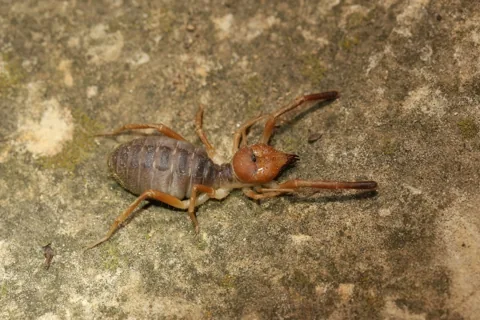 Sun Spiders (Windscorpions, Camel Spiders)
Order Solifugae (e.g., Eremobates species)
Sun spiders, also called windscorpions, camel spiders and solpugids, are not true spiders but fast, mostly nocturnal arachnids with huge jaws. They have no venom glands, and Colorado State says they bite only if held, with no more than a mild pinch. They eat insects and are considered beneficial. One indoors is usually hunting or lost: trap it under a jar and put it outside. To keep them out, seal gaps around doors, windows and utility lines and cut down outdoor lighting that draws their insect prey; Arizona Extension does not recommend pesticides.
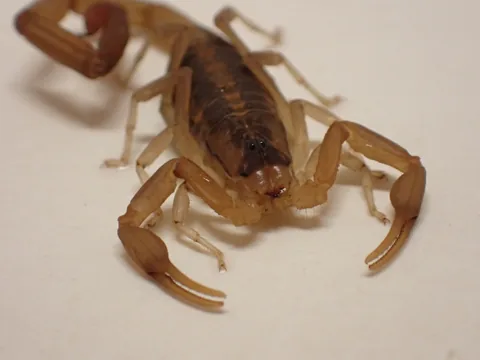 Scorpions
Order Scorpiones (shown: striped bark scorpion, Centruroides vittatus)
Scorpions are arachnids, relatives of spiders, ticks and mites, that hide by day and hunt insects at night. They live across the southern United States, and most U.S. stings are reported from Arizona, Texas and Nevada.
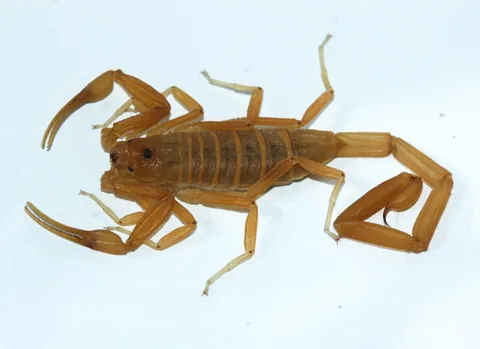 Arizona Bark Scorpion
Centruroides sculpturatus
The Arizona bark scorpion is a slender, climbing scorpion of the desert Southwest that often lives in and around homes. It is the only scorpion in the United States whose sting is considered a hazard to human health.
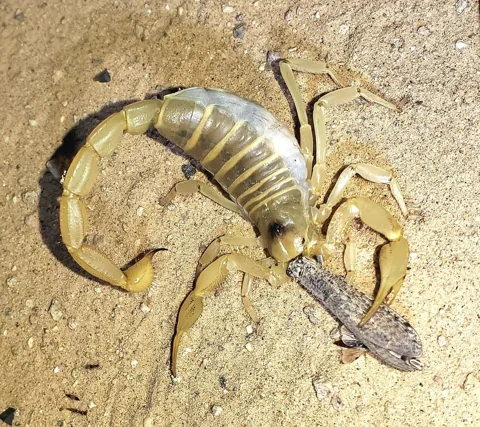 Giant Desert Hairy Scorpion
Hadrurus arizonensis
The giant desert hairy scorpion, also called the Arizona giant hairy scorpion, is the largest scorpion in the United States. Despite its size its venom is mild: in Arizona only the much smaller bark scorpion is regarded as life-threatening. Extension entomologists call it harmless and even beneficial, so the best plan is to seal it out of the house and move any that get in.
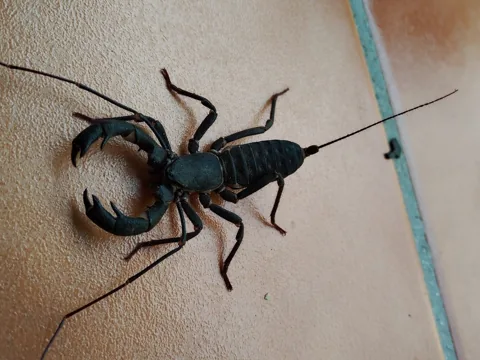 Vinegaroon (Giant Whip Scorpion)
Mastigoproctus giganteus
The vinegaroon (Mastigoproctus giganteus), also called the whip scorpion, is an arachnid that a New Mexico poison center describes as commonly found in the southwestern United States, parts of Mexico and southern Florida. It is best known for the acid spray, mostly the acid in vinegar, that it aims at predators. UF/IFAS calls it the only whip scorpion found in the United States, also known locally as the grampus, and says that despite its looks it has neither a scorpion's venom-filled stinger nor the venomous bite of some spiders.
Side by side
Both are arachnids with eight walking legs, but they belong to different orders: sun spiders to Solifugae, scorpions to Scorpiones. Colorado State calls sun spiders distant relatives of both true scorpions and spiders. More than 120 sun spider species have been described in North America, over 50 of them in the Southwest.[2][1][4]
- Body plan, sun spider: two body regions. The front carries the massive jaws, four pairs of legs and the pedipalps, which look like a fifth pair of legs. The abdomen behind has no appendages and is generally rounded and soft; the University of Arizona counts 10 segments.[2][1]
- Body plan, scorpion: a crablike look, with two large pincer-bearing pedipalps in front, four pairs of legs, and a five-segmented tail that can be arched over the back, with a bulb-like poison gland and stinger at the tip.[4][5]
- Jaws: sun spider chelicerae are two pairs of large fangs that work vertically like pliers and project forward from the mouth; they can twist, cut and crush prey. Scorpions have no such jaws on show; they grab prey with their pincers and may sting it.[1][2][5][4]
- Eyes: sun spiders have two distinct eyes on the head. Scorpions have two eyes in the center of the head and usually two to five more along each side, but they see poorly and depend on touch.[1][4]
- Size, sun spider: 15 to 45 mm in the western U.S. by the University of Arizona's measure. Colorado State says its species reach about 1 1/2 inches with legs extended; Middle East species reach a bit over 4 inches.[1][2]
- Size, scorpion: Texas A&M gives ½ inch to 7¼ inches including the tail, depending on species. The Arizona Poison and Drug Information Center says the bark scorpion reaches only an inch and a half at maturity.[5][8]
- Color: sun spiders are light tan to brown or reddish brown, the abdomen often darker, gray or cream. Texas A&M describes the common striped bark scorpion as yellowish tan with two broad, dark stripes down the back; the Arizona bark scorpion is told from less toxic species by its more slender tail segments and pincers.[1][2][8]
- Hairiness: a sun spider's body is often covered with short hairs.[1]
- Glow test: scorpions glow brightly under a black (ultraviolet) light, which makes them easy to find at night.[4][6][7]
Venom and stings: the difference that matters
Sun spiders: Colorado State says they do not have poison glands and do not attack, and the University of Arizona says none are known to have venom. The Burke Museum adds that, with one possible exception in India, solpugids have no venom and no means of delivering it.[2][1][3]
For any bite or sting, MedlinePlus says to call 911 if the person has trouble breathing or swelling anywhere on the face or in the mouth. For an ordinary bite, MedlinePlus says to wash the site with soap and water and use ice wrapped in a washcloth, 10 minutes on and 10 minutes off, and watch for signs of infection over the next several days.[11]
Scorpions: CDC's NIOSH says a sting may cause mild discomfort or pain and that symptoms usually subside within 48 hours, but stings from a bark scorpion can be life-threatening. The Arizona poison center says only one of the 30 species of scorpions found in Arizona, the bark scorpion, is regarded as life-threatening.[9][8]
Typical sting effects: immediate local pain with minimal swelling, often with numbness and tingling that may travel across the body. Small children are at the highest risk of severe reactions; MedlinePlus says children 6 years and younger are more likely to have harmful effects from venomous scorpions.[8][10]
After a scorpion sting, call Poison Help at 1-800-222-1222; the line reaches your local poison center from anywhere in the United States, 24 hours a day. For severe symptoms call 911. Our scorpion guide covers first aid in more detail.[10][8]
Behavior and where you find them
Both hunt at night. Sun spiders locate prey by touch or vibration, run it down, and eat insects, spiders and other arthropods; they may even kill an occasional scorpion or centipede. Scorpions wait in hiding or search for prey, eating small insects, spiders, centipedes and other scorpions.[2][1][5][4]
By day, sun spiders hide under rocks, boards, logs, cow chips, in rodent burrows and in burrows they dig in soil. Scorpions hide in burrows or debris, under wood, stones or bark, and in crawl spaces; indoors they turn up in cracks, behind baseboards, in closets and attics and inside walls.[2][4]
Climbing: the bark scorpion is the best climber of the scorpions, and Texas A&M says the striped bark scorpion commonly climbs trees and walls.[8][5]
Indoors, sun spiders are usually chasing insects such as crickets or looking for a way back out. Colorado State says they wander in now and then, mainly in mid to late summer, and outdoor lights near the foundation draw the insects they hunt.[1][2]
Desert Southwest homes
Sun spiders are common in dry country: Colorado State lists 15 species in that state, in the drier areas below 7500 feet, and the University of Arizona counts over 50 in the Southwest.[2][1]
Scorpions are found in the Southern and Southwestern United States and mostly in dry, desert areas, says NIOSH. The bark scorpion lives throughout Arizona, in extreme southeastern California and in southwestern New Mexico.[9][4]
Most stings reported to the Arizona poison center happen at night during the warm summer months. The University of Arizona notes homes can see an influx of scorpions during summer monsoons.[8][7]
The third look-alike: vinegaroons (whip scorpions)
Vinegaroons, also called whip scorpions, live in the southwestern United States, parts of Mexico and southern Florida. UF/IFAS says that despite the name this arachnid has neither the venom-filled stinger of a scorpion nor the venomous bite of some spiders.[14][12]
Their defense is a spray from glands at the rear of the body. In the giant vinegaroon the organic part of the secretion is 83% acetic acid, the acid in vinegar, and it works best when sprayed as fine droplets at a predator's eyes, nose or other sensitive surfaces.[13][14]
A New Mexico poison center reviewed 50 vinegaroon exposures reported from 1998 to 2022. Symptoms included pain, skin redness, numbness or tingling, itching and swelling, which resolved in under two days; spray in the eyes caused pain in all 3 cases and lasted longer. Call Poison Help at 1-800-222-1222 with questions.[14][10]
How to confirm what you found
Trap it first. A quart-sized glass jar placed over the animal, with heavy paper slid underneath, lets you look at it safely and carry it outside. The University of Arizona suggests the same jar trick for sun spiders, which are too fast to catch by hand.[4][1]
Look for the tail and stinger, then the front end: pincers mean scorpion, forward-pointing jaws with leg-like arms mean sun spider.[4][1][2]
If someone is stung, NIOSH suggests capturing the scorpion for identification if it is safe to do so.[9]
What to do about each
Sun spiders: no spraying needed. The University of Arizona says pesticides are not recommended for solpugids and calls them beneficial predators outdoors. Move indoor ones out with a jar, and if they keep showing up, look for the indoor insects feeding them.[1][2]
Seal the same gaps for both. Check caulking and weather stripping around windows and doors and seal utility entries; dim or switch off outdoor lights near the foundation. UC IPM recommends yellow outdoor lights where scorpions are common.[1][2][4]
Scorpions: clear trash, logs, boards, stones and bricks from around the foundation, shake out shoes, clothing and towels before use, wear gloves in the yard, and patrol with a black light at night. UC IPM says scorpions are difficult to control with insecticides, so yard cleanup and sealing come first. Our scorpion guide covers the full plan.[4][6][8]
Common questions
- Is a camel spider a scorpion or a spider?
- Neither. Camel spiders, sun spiders and wind scorpions are all names for solpugids, a separate arachnid order, Solifugae, only distantly related to true scorpions and spiders.[2][1]
- Are sun spiders venomous?
- No. Colorado State says they have no poison glands, the University of Arizona says none are known to have venom, and the Burke Museum calls the flesh-eating camel spider stories a myth.[2][1][3]
- Which scorpion should I worry about?
- In the U.S., the Arizona bark scorpion. The Arizona poison center calls it the only life-threatening one of Arizona's 30 species; it is small, slender-tailed and the best climber. Children are at the highest risk.[8][9]
- Does a vinegaroon sting?
- No. It has no stinger and no venomous bite, UF/IFAS says. It can spray an acetic acid mist that stings eyes and skin; a poison center series found effects usually cleared within two days.[12][13][14]
- Will a black light find sun spiders too?
- Our sources describe black-light glow only for scorpions; UC IPM and the University of Arizona recommend a UV flashlight to find scorpions at night.[4][6]
Photo credits
- Sun Spiders (Windscorpions, Camel Spiders): (c) Reid Hardin, some rights reserved (CC BY) — via iNaturalist, CC BY 4.0
- Scorpions: (c) dhasdf, some rights reserved (CC BY) — via iNaturalist, CC BY 4.0
- Arizona Bark Scorpion: (c) Andrew Meeds, some rights reserved (CC BY) — via iNaturalist, CC BY 4.0
- Giant Desert Hairy Scorpion: (c) Bob Miller, some rights reserved (CC BY) — via iNaturalist, CC BY 4.0
- Vinegaroon (Giant Whip Scorpion): (c) Diego López, some rights reserved (CC BY) — via iNaturalist, CC BY 4.0
Sources
- University of Arizona Cooperative Extension, Yavapai County, “Solpugids (Backyard Gardener, Aug. 7, 2013).” extension.arizona.edu/sites/extension.arizona.edu/files/attachment/Solpugids_0.pdf (accessed 2026-11-14)
- Colorado State University Extension, “Windscorpions (Sunspiders) of Colorado.” extension.colostate.edu/resource/windscorpions-sunspiders-of-colorado/ (accessed 2026-11-14)
- Burke Museum, University of Washington, “Myth: Near East "camel spiders," danger!.” burkemuseum.org/blog/myth-near-east-camel-spiders-danger (accessed 2026-11-14)
- University of California Statewide IPM Program, “Scorpions (Pest Notes).” ipm.ucanr.edu/home-and-landscape/scorpions/ (accessed 2026-11-14)
- Texas A&M AgriLife Extension Service, “Scorpions.” extensionentomology.tamu.edu/wp-content/uploads/2025/03/scorpions.pdf (accessed 2026-11-14)
- University of Arizona Cooperative Extension, “Scorpions in Arizona (AZ1768).” extension.arizona.edu/sites/extension.arizona.edu/files/pubs/az1768-2018.pdf (accessed 2026-11-14)
- University of Arizona Cooperative Extension, Yavapai County, “Scorpions (Backyard Gardener).” www.extension.arizona.edu/sites/extension.arizona.edu/files/attachment/Scorpions.pdf (accessed 2026-11-14)
- Arizona Poison and Drug Information Center, “Scorpions.” azpoison.com/venom/scorpions (accessed 2026-11-14)
- Centers for Disease Control and Prevention, NIOSH, “Insects and Scorpions at Work.” www.cdc.gov/niosh/outdoor-workers/about/insects-and-scorpions.html (accessed 2026-11-14)
- MedlinePlus, U.S. National Library of Medicine, “Scorpions (Medical Encyclopedia).” medlineplus.gov/ency/article/002850.htm (accessed 2026-11-14)
- MedlinePlus, U.S. National Library of Medicine, “Insect bites and stings (Medical Encyclopedia).” medlineplus.gov/ency/article/000033.htm (accessed 2026-11-14)
- University of Florida/IFAS Extension (EDIS), “Giant Whip Scorpion, Mastigoproctus giganteus giganteus (EENY493/IN890).” journals.flvc.org/edis/article/view/119240 (accessed 2026-11-14)
- Schmidt JO, Dani FR, Jones GR, Morgan ED (PubMed 12770208), “Chemistry, ontogeny, and role of pygidial gland secretions of the vinegaroon Mastigoproctus giganteus (J Insect Physiol, 2000).” pubmed.ncbi.nlm.nih.gov/12770208/ (accessed 2026-11-14)
- Smolinske SC, Seifert SA, Warrick BW, Tadfor Y (PubMed 36210603), “Vinegaroon exposures reported to a Poison center (Toxicon, 2022).” pubmed.ncbi.nlm.nih.gov/36210603/ (accessed 2026-11-14)