On this page
How to identify it
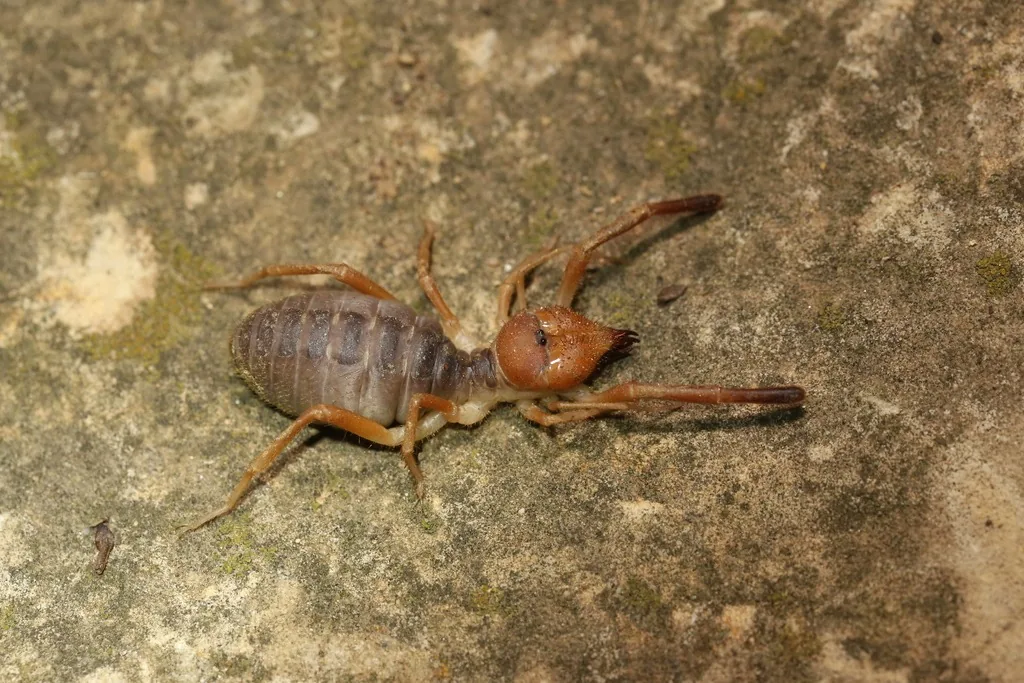
- The head end carries enormous jaws (chelicerae) that project forward and work up and down like pliers; Colorado State says they can twist, cut and crush.[1][4]
- Most are light tan to brown or reddish brown, often with a darker, gray or cream abdomen. Arizona gives 15 to 45 mm (5/8 to 1 3/4 inches) for western species; Colorado State says Colorado ones reach 1 1/2 inches with legs extended and Middle Eastern species a bit over 4 inches.[1][4]
- In front of the eight legs is a pair of long, leg-like pedipalps with sticky tips, carried raised as they run. The pedipalps hold most of the sense organs and help catch prey, climb and dig.[1][4]
- The body is often covered with short hairs and has two parts: a front section with two eyes and the legs, and a soft, 10-segmented abdomen. Leaf-shaped organs called malleoli on the hind legs pick up chemical cues.[1][4]
- A fun fact: in a lab study of two North African camel spiders, the stronger biter, Rhagodes, squeezed with up to 5.63 newtons, and its right jaw was stronger than its left.[5]
Look-alikes
| Look-alike | How to tell them apart |
|---|---|
| Scorpions | Sun spiders look a bit like scorpions without claws or a stinger; instead they have blunt pedipalps and big forward-facing jaws.[1] |
| Spiders | Sun spiders belong to their own order, Solifugae, and are only distant relatives of true spiders; their huge forward jaws and leg-like pedipalps set them apart.[4][1] |
Where it lives
More than 120 species have been described in North America, and the southwestern United States alone has over 50. Colorado has 15 species, in drier areas below 7500 feet. The North American family Eremobatidae began in warm deserts, which is why the Sonoran Desert region is especially rich in species.[1][4][6]
Biology and life cycle
They hunt mainly at night, running down insects, spiders and other arthropods and sometimes even killing a scorpion or centipede.[1][4]
Prey is grabbed with the pedipalps and crushed in the jaws, then turned to liquid with saliva; they suck out the fluids and discard larger pieces.[1][4]
By day they hide under rocks, boards, logs and in rodent burrows. Females dig burrows and lay 50 to 200 eggs in a single mass, usually in late summer, and die soon after; the eggs hatch in 1 to 2 weeks.[4]
The young stay in the burrow for a couple of weeks before leaving to hunt, and a one-year life cycle is assumed for Colorado species.[4]
The windscorpion name comes from how fast they run. Some come to lights at night: a large Arizona species, Eremocosta striata, was attracted to mercury vapor and ultraviolet lights.[1][2]
Damage and signs
Health risk
None are known to have venom; Colorado State says they have no poison glands and do not attack. They bite only if accidentally restrained, and then it is no more than a mild pinch that cannot break the skin.[1][4]
Control
Prevention
Reduce outdoor lighting near the foundation, which draws the insects they hunt, and check firewood and other items stored outdoors or in sheds before bringing them in.[4][1]
Keep them out
Check caulking and weather stripping around windows and doors and seal where utility lines enter; this also blocks scorpions, centipedes, mice and kissing bugs.[1][4]
Sanitation
If they keep showing up inside, look for an indoor insect problem, such as crickets, that is feeding them.[1]
Traps and physical control
A sun spider indoors is usually hunting insects or trying to get back outside; cover it with a jar or glass, slide paper underneath, and release it outdoors.[1]
Pesticides
University of Arizona Extension does not recommend pesticides for managing solpugids, or for scorpions and centipedes.[1]
Common questions
- Are camel spiders venomous?
- No. Camel spider is another name for solpugids, and none are known to have venom; they lack poison glands.[1][4]
- Are sun spiders real spiders?
- No. They are arachnids in their own order, Solifugae, and only distant relatives of true spiders and scorpions.[4][3]
- Why is there a sun spider in my house?
- It is either chasing insect prey such as crickets indoors or looking for a way back outside. Outdoor lights near the foundation draw the insects they hunt, and some come in with firewood.[1][4]
- Can I keep a sun spider as a pet?
- Colorado State calls them interesting but short-lived pets: large adults usually survive only a couple of months at most in captivity.[4]
Sources
- University of Arizona Cooperative Extension, “Solpugids (Backyard Gardener, August 7, 2013, Jeff Schalau, Yavapai County).” extension.arizona.edu/sites/extension.arizona.edu/files/attachment/Solpugids_0.pdf (accessed 2026-11-12)
- Texas A&M AgriLife Extension Service, “Order Solifugae (Windscorpions): Eremocosta striata, male (Extension Entomology image record, January 26, 2019).” elp.tamu.edu/ipm/bugs/windscorpions/05-class-arachnida-solifugae-eremobatidae-eremocosta-striata-windscorpions-male-tarsus-of-fourth-pair-of-legs/ (accessed 2026-11-12)
- iNaturalist, “Eremobates taxon page (order and family).” www.inaturalist.org/taxa/82055 (accessed 2026-11-12)
- Colorado State University Extension, “Windscorpions (Sunspiders) of Colorado.” extension.colostate.edu/resource/windscorpions-sunspiders-of-colorado/ (accessed 2026-11-12)
- Journal of Experimental Biology, via PubMed, “Functional morphology and bite performance of raptorial chelicerae of camel spiders (Solifugae) (van der Meijden et al. 2012).” pubmed.ncbi.nlm.nih.gov/22771748/ (accessed 2026-11-12). Cited from the PubMed abstract.
- Molecular Phylogenetics and Evolution, via PubMed, “Historical biogeography and the evolution of habitat preference in the North American camel spider family, Eremobatidae (Garcia and Cushing 2024).” pubmed.ncbi.nlm.nih.gov/39303972/ (accessed 2026-11-12). Cited from the PubMed abstract.