On this page
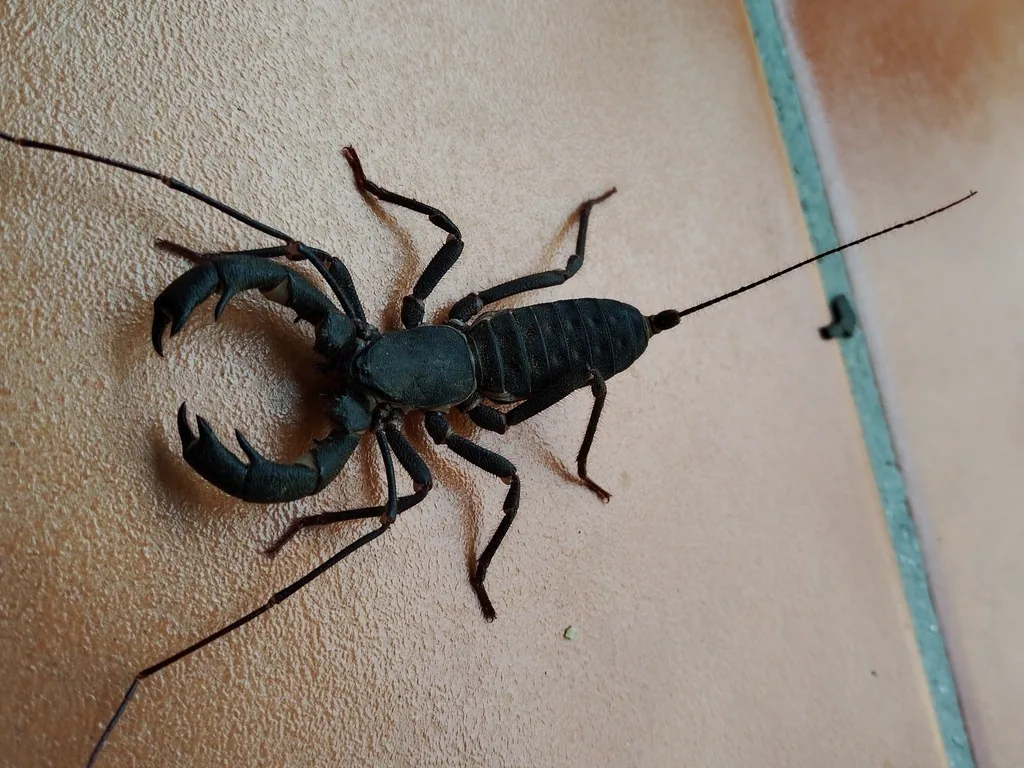
How to identify it
- Vinegaroons don't bite. Special teeth on the inner side of the front appendages are used to crush prey. UF/IFAS says the large pedipalps (pincer-like front appendages) catch and crush prey between special teeth on the inside of their second segment, and that mishandled, they can give a noticeable pinch.[1][3]
- When threatened it sprays a mist from glands at the tip of the body. The secretion is about one-quarter water; of the rest, 83 percent is acetic acid, the acid in vinegar, and 15 percent is octanoic acid. UF/IFAS says the spray comes from a pore at the base of the tail.[2][1][3]
- Vinegaroons belong to the arachnid order Uropygi. With two related orders it forms the closest relatives of spiders, a line that split from spiders more than 400 million years ago.[4]
- UF/IFAS says it grows up to 5 cm long, not counting the long, thin, whip-like tail that gives whip scorpions their name.[3]
- The first pair of legs is long and thin and works almost like antennae, feeling for prey in the dark. With the tail, which is also a sensory organ, these make up for its eight weak eyes, UF/IFAS says.[3]
Look-alikes
| Look-alike | How to tell them apart |
|---|---|
| True scorpions | A scorpion's tail ends in a venom-filled stinger; the vinegaroon's tail is a thin whip with no stinger, and UF/IFAS says it has no venomous stinger or bite.[3] |
Where it lives
The New Mexico poison center study describes vinegaroons as common in the southwestern United States, parts of Mexico and southern Florida. GBIF's U.S. records since 1990 come only from New Mexico, Texas and Arizona, with none from Florida, and most of its records worldwide are from Mexico. UF/IFAS lists Arizona, Florida, New Mexico, Oklahoma, Texas and Mexico for this subspecies, with two other subspecies confined to parts of Mexico; whip scorpions as a group live in the tropics and subtropics worldwide.[1][5][6][3]
Biology and life cycle
Each vinegaroon has its own blend of spray chemicals, the same in both of its glands. The blend varies a lot from one animal to the next but shows no pattern by age across the four free-living stages before adulthood, or between males and females.[2]
The spray is purely a defense. It does not act as a scent signal between vinegaroons and works best as a fine spray against an attacker's eyes, nose and other sensitive surfaces, not as a liquid inside a predator's mouth.[2]
Its genome, the first chromosome-level assembly for this group of arachnids, carries the signature of an ancient whole-genome duplication that dates from before the Silurian period.[4]
Vinegaroons hunt other arthropods at night and spend the day in burrows they dig with their pedipalps, or under logs, boards, rotting wood and rocks. UF/IFAS says this species favors arid places with well-drained soil but also turns up in grassland, scrub, pine forests and barrier islands.[3]
In Florida they spend the driest periods underground and come to the surface in the rainy season, May or June through November, UF/IFAS says.[3]
They eat soft-bodied insects such as termites, cockroaches and crickets; one common prey of adults in Florida is the Florida woods roach.[3]
Mating takes place in fall in a ritual lasting eight to 12 hours. The female carries the eggs inside her for several months, then lays 30 to 40 in a fluid-filled sac held under her abdomen and stays in her burrow for about two more months. The white young ride on her back for about a month and leave after their first molt; the mother dies soon after.[3]
They grow slowly, molting three times in about three years and then once a year, and can live at least seven years. Raccoons, coatis, armadillos, skunks, bears, feral hogs and peccaries are among their predators, UF/IFAS says.[3]
Damage and signs
- None to homes or gardens in the sources used here. UF/IFAS describes vinegaroons as fairly benign nocturnal predators of other arthropods, including termites and cockroaches.[3]
Health risk
A New Mexico poison center logged 50 human exposures to vinegaroons from 1998 to 2022. Callers described bites in 36 cases, though the authors note vinegaroons don't bite; 13 involved spray on the skin, 3 spray in the eyes and 2 swallowing. Symptoms (pain, redness, numbness or tingling, itching and swelling) showed up in 88 percent and cleared in under two days, but all three eye exposures were painful and lasted longer, in one case more than five days.[1]
Control
Prevention
Leave vinegaroons alone rather than picking them up. In the poison center series most problems came from skin contact with the spray, and eye exposures lasted longest. UF/IFAS says mishandled vinegaroons can give a noticeable pinch with their pedipalps.[1][3]
Keep your face back from a disturbed vinegaroon. Its spray works best on an attacker's eyes and breathing passages. UF/IFAS says a threatened vinegaroon retreats to its burrow or rears up and spreads its pedipalps in a bluff display, and can spray accurately a few inches to one foot.[2][3]
Where the sources disagree
Acid strength: UF/IFAS describes the spray as concentrated (85%) acetic acid; the chemical analysis cited above found the secretion about one-quarter water, with acetic acid making up 83 percent of the rest.[3][2]
Common questions
- Is a vinegaroon poisonous?
- No venom is described in the sources used here. Its defense is an acid spray, and in a poison center series of 50 exposures, symptoms such as pain, redness and itching cleared in under two days, except some eye exposures that lasted longer. UF/IFAS says it has neither a scorpion's venom-filled stinger nor the venomous bite of some spiders.[1][2][3]
- Why does it smell like vinegar?
- Its defensive spray is mostly acetic acid, the acid in vinegar: 83 percent of the organic part, with 15 percent octanoic acid.[2][1]
- Is a whip scorpion a real scorpion?
- No. Vinegaroons belong to their own arachnid order, Uropygi, which is grouped with the closest relatives of spiders.[4]
- Does a vinegaroon pinch?
- It can. UF/IFAS says its large pedipalps can give a noticeable pinch if it is mishandled, so leave it alone or move it without bare hands.[3]
Sources
- Toxicon, via PubMed, “Vinegaroon exposures reported to a Poison center (Smolinske, Seifert, Warrick and Tadfor 2022; New Mexico Poison & Drug Information Center).” pubmed.ncbi.nlm.nih.gov/36210603/ (accessed 2026-11-14)
- Journal of Insect Physiology, via PubMed, “Chemistry, ontogeny, and role of pygidial gland secretions of the vinegaroon Mastigoproctus giganteus (Schmidt et al. 2000).” pubmed.ncbi.nlm.nih.gov/12770208/ (accessed 2026-11-14)
- University of Florida/IFAS Extension (Featured Creatures), “Giant Whip Scorpion, Mastigoproctus giganteus giganteus (Lucas, 1835), EENY493/IN890.” ask.ifas.ufl.edu/publication/IN890 (accessed 2026-11-14)
- Journal of Heredity, via PubMed, “A chromosome-level genome of the giant vinegaroon Mastigoproctus giganteus exhibits the signature of pre-Silurian whole genome duplication (Kulkarni, Klementz and Sharma 2025).” pubmed.ncbi.nlm.nih.gov/39679458/ (accessed 2026-11-14)
- Global Biodiversity Information Facility (GBIF), “Mastigoproctus giganteus: U.S. occurrence records since 1990 by state (GBIF occurrence search).” api.gbif.org/v1/occurrence/search?taxonKey=2127943&country=US&hasGeospatialIssue=false&occurrenceStatus=PRESENT&year=1990%2C2026&facet=stateProvince&facetLimit=400&limit=0 (accessed 2026-11-14). Exact count at access: 35 U.S. records since 1990 (New Mexico 21; Texas 10; Arizona 3).
- Global Biodiversity Information Facility (GBIF), “Mastigoproctus giganteus: occurrence records since 1990 by country (GBIF occurrence search).” api.gbif.org/v1/occurrence/search?taxonKey=2127943&hasGeospatialIssue=false&occurrenceStatus=PRESENT&year=1990%2C2026&facet=country&limit=0 (accessed 2026-11-14). Exact counts at access: 239 records since 1990; Mexico 167, United States 35.
- iNaturalist, “Mastigoproctus giganteus taxon page (order and family).” www.inaturalist.org/taxa/126252 (accessed 2026-11-14)