On this page
How to identify it
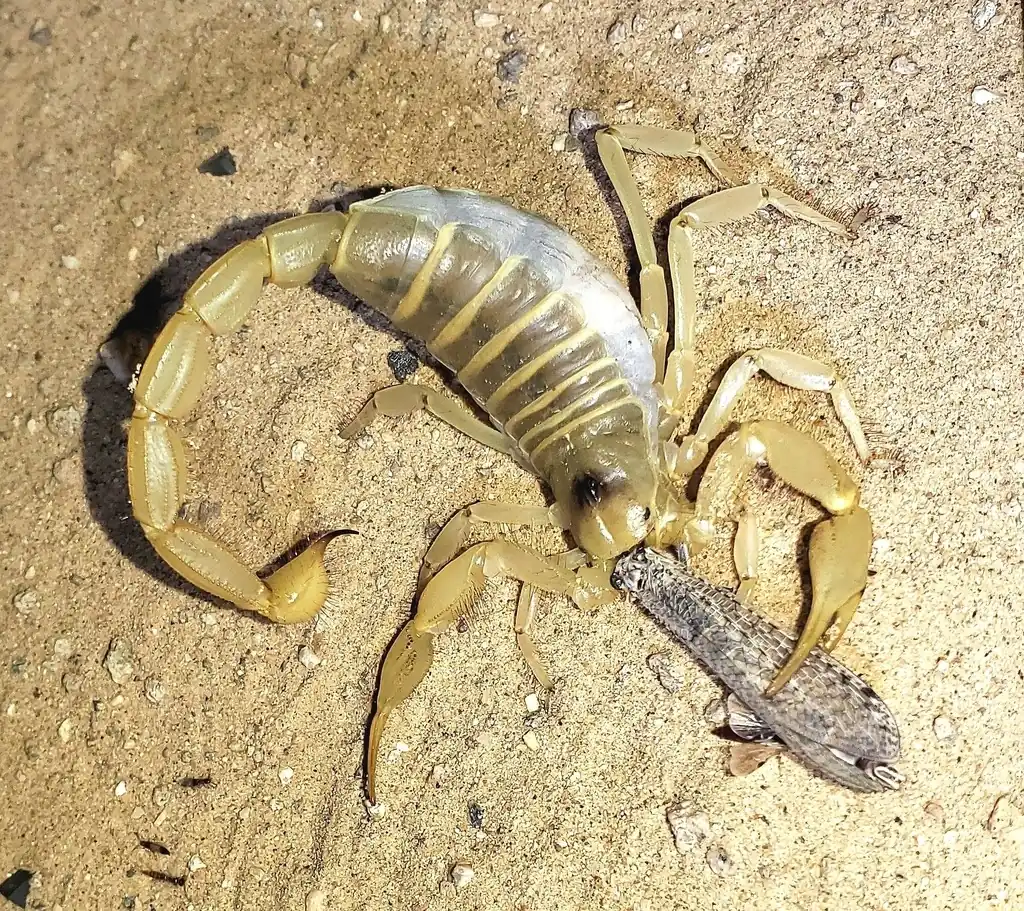
- Adults are heavy-bodied and often longer than 5 inches; UC IPM gives a mature length of 5 to 7 inches.[1][2]
- Seen from above, the body is often darker with pale sides, while the pincers, legs and tail are a pale buff color.[1]
- Its strong pincers, which it uses to grip prey, and thick tail set it apart from the slender bark scorpion.[1][3]
- Like other scorpions, it has four pairs of legs, a pair of pincers, and a long segmented tail ending in a stinger.[2]
Look-alikes
| Look-alike | How to tell them apart |
|---|---|
| Arizona bark scorpion | Much smaller, about 3 inches at most, with a very thin tail; it climbs walls, and its sting is the only U.S. scorpion sting that is a health hazard.[2][1] |
| Stripe-tailed scorpion | A common burrowing scorpion that is full grown at under 3 inches, with stripes on the upper side of the body.[1][2] |
Where it lives
Sonoran and Mojave Desert areas of Arizona, California, Nevada and Utah, plus Sonora and Baja California Norte in Mexico; in California it is reported from Imperial, Inyo, Kern, Los Angeles, Riverside, San Bernardino and San Diego counties.[1][2]
Biology and life cycle
It favors low, sandy areas, which is why it is also called the desert hairy scorpion.[1]
It spends most of its time in shallow burrows or under rocks, logs and other objects lying on the ground.[1][2]
It hunts at night and eats a wide range of prey, including insects, other arachnids and small lizards; it eats Arizona bark scorpions.[1][2]
Water, swimming pools, irrigated areas and outdoor lights draw it in, because those spots attract beetles, cockroaches, crickets and moths.[2]
Scorpions are born live and ride on the mother's back until their first molt, then molt five or six times to adulthood; on average they live 3 to 5 years, and some species 10 to 15.[2][1]
Damage and signs
Health risk
MedlinePlus says most stings from North American scorpions do not need treatment, and the Arizona Poison and Drug Information Center describes immediate local pain with little swelling, often with numbness and tingling. People allergic to venom can have anaphylaxis, which CDC/NIOSH says needs emergency care.[4][3][5]
Control
Prevention
Shake out shoes, clothing and towels before use, wear gloves for yard work, and wear shoes outside in the evening.[2]
Use yellow outdoor bulbs, which attract fewer of the insects scorpions hunt.[2]
Keep them out
Install weatherstripping on loose doors and windows, caulk around eaves and pipes, keep window screens tight, and fix holes and cracks in the house.[2][1][6][3]
Sanitation
Clear trash, logs, boards, stones and bricks away from the foundation, keep grass mowed short, and check firewood before bringing it inside.[2][3]
Traps and physical control
Find scorpions at night with a black (UV) light, since they glow brightly, then trap one under a glass jar or pick it up with 10- to 12-inch forceps; UC IPM adds that glue boards can trap them.[2][1]
Pesticides
Pesticides often fail because scorpions hide in crevices by day and large adults are hard to kill. Texas A&M lists synthetic actives such as permethrin, cyfluthrin, cypermethrin, lambda-cyhalothrin, deltamethrin, bifenthrin and carbaryl, applied around the foundation and entry points; use them only alongside the steps above.[2][6][1]
If you are stung
Clean the site with soap and water and use a cool compress; MedlinePlus advises ice wrapped in a cloth, 10 minutes on and 10 minutes off, keeping the limb still and removing rings.[3][4]
Call Poison Help at 1-800-222-1222 to find out whether you need a hospital. Children 6 and younger are at the highest risk from venomous species.[3][4]
Call 911 for signs of a severe allergic reaction such as trouble breathing.[5][4]
Glow-in-the-dark giants
Like all scorpions, it glows brightly under ultraviolet light, which is how people find them at night.[2][1]
Common questions
- Is the giant hairy scorpion dangerous?
- Its venom is mild; the Arizona Poison and Drug Information Center regards only the bark scorpion as life-threatening among Arizona's scorpions. Allergic people can still react.[1][3][5]
- Should I kill giant hairy scorpions in my yard?
- University of Arizona Extension calls them a beneficial addition to the home landscape, because they eat bark scorpions.[1]
- What should I do after a sting?
- Wash it, apply a cool compress, and call Poison Help at 1-800-222-1222 for advice.[3][4]
Sources
- University of Arizona Cooperative Extension, “Scorpions of the Desert Southwest United States, AZ1768 (May 2018).” extension.arizona.edu/sites/extension.arizona.edu/files/pubs/az1768-2018.pdf (accessed 2026-11-12)
- University of California Statewide IPM Program, “Scorpions (Pest Notes, Home and Landscape).” ipm.ucanr.edu/home-and-landscape/scorpions/ (accessed 2026-11-12)
- Arizona Poison and Drug Information Center, “Scorpions.” azpoison.com/venom/scorpions (accessed 2026-11-12)
- NIH National Library of Medicine, MedlinePlus, “Scorpions (Medical Encyclopedia).” medlineplus.gov/ency/article/002850.htm (accessed 2026-11-12)
- CDC, National Institute for Occupational Safety and Health, “Insects and Scorpions at Work.” www.cdc.gov/niosh/outdoor-workers/about/insects-and-scorpions.html (accessed 2026-11-12)
- Texas A&M AgriLife Extension, “Scorpions (ENTO-PU-032).” extensionentomology.tamu.edu/wp-content/uploads/2025/03/scorpions.pdf (accessed 2026-11-12)
- iNaturalist, “Hadrurus arizonensis taxon page (order and family).” www.inaturalist.org/taxa/119165 (accessed 2026-10-06)