The short answer
- Look at the back: the striped bark scorpion has two broad dark stripes running down the back and a dark triangle on the front of the head above the eyes. The Arizona bark scorpion has no such fixed pattern; it ranges from plain pale yellow to darker, sometimes with stripes or checkered markings.[4][5][1][3]
- Think about where you are: the Arizona bark scorpion lives mainly in Arizona and small neighboring parts of the Southwest. The striped bark scorpion is the most common scorpion in Texas and ranges from there into neighboring states from Nebraska to Tennessee.[1][3][4][5]
- Sting: the Arizona bark scorpion is the only U.S. scorpion of medical concern, and small children are at highest risk of a severe reaction. Stings reported outside Arizona and Nevada mostly cause pain and local skin effects, though striped bark scorpion venom can trigger allergic reactions.[1][6][9][10]
- A blacklight finds both but can't tell them apart, since scorpions of both species glow under UV light.[1][2][5]
Scorpion profiles on this site
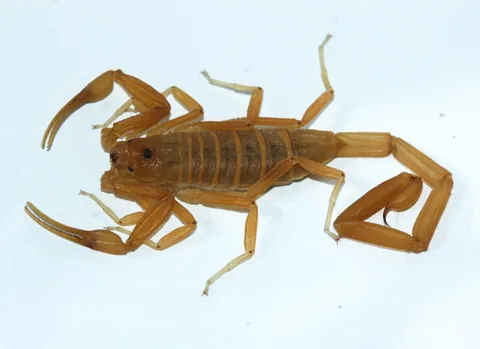 Arizona Bark Scorpion
Centruroides sculpturatus
The Arizona bark scorpion is a slender, climbing scorpion of the desert Southwest that often lives in and around homes. It is the only scorpion in the United States whose sting is considered a hazard to human health.
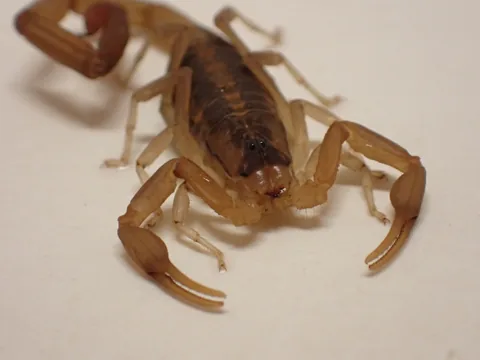 Scorpions
Order Scorpiones (shown: striped bark scorpion, Centruroides vittatus)
Scorpions are arachnids, relatives of spiders, ticks and mites, that hide by day and hunt insects at night. They live across the southern United States, and most U.S. stings are reported from Arizona, Texas and Nevada.
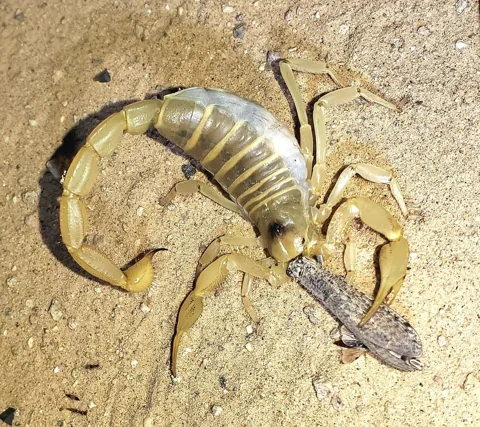 Giant Desert Hairy Scorpion
Hadrurus arizonensis
The giant desert hairy scorpion, also called the Arizona giant hairy scorpion, is the largest scorpion in the United States. Despite its size its venom is mild: in Arizona only the much smaller bark scorpion is regarded as life-threatening. Extension entomologists call it harmless and even beneficial, so the best plan is to seal it out of the house and move any that get in.
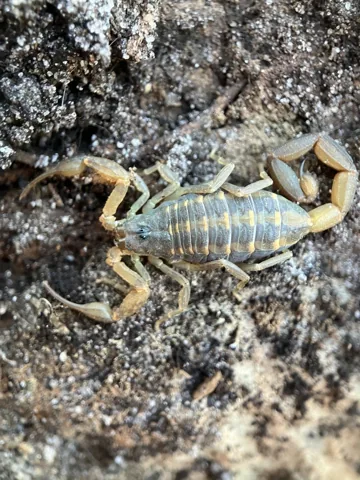 Hentz Striped Scorpion
Centruroides hentzi
The Hentz striped scorpion occurs statewide in Florida and often enters houses there. Researchers who analyzed its venom describe it as a Centruroides species that poses no serious threat to people, though a sting still hurts.
Side by side
Both species belong to the bark scorpion group: slender pedipalps (the pincer arms), a long slender tail, and a habit of climbing rather than digging burrows. The checks below are the ones extension and museum sources give. For scorpions compared with sun spiders and vinegaroons, see the sun spiders vs scorpions guide.[1][6][4][5]
- Pattern: striped bark scorpion adults are yellowish tan with two broad dark stripes the length of the back and a dark triangular mark on the front of the head. Arizona bark scorpion coloring is highly variable, from pale to darker with stripes or checkered patterning; UC IPM describes the body as yellow without stripes or patterns.[4][5][1][3]
- Size: striped bark scorpion adults are about 2½ inches long (Texas A&M), seldom over 3 inches and averaging 2 3/8 inches (Animal Diversity Web). Arizona bark scorpion adults are 2 to 3 inches (University of Arizona) or up to 3 inches (UC IPM); the Arizona poison center describes it as only an inch and a half at maturity.[4][5][1][3][6]
- Pincers and tail: both have slender pincers and a long, slender tail. The Arizona poison center says the bark scorpion's more slender tail segments and pincers set it apart from Arizona's less toxic species; UC IPM puts its tail at only 1/16 inch wide. In the striped bark scorpion the tail is longer in males than females.[6][3][1][4][5]
- Young scorpions: immature striped bark scorpions may be lighter in color, with the base of the pincer arms and the last segment of the tail dark brown or black. Texas A&M adds that striped bark scorpions in the Big Bend area may be only faintly marked or completely pale.[4][5]
- Range: the Arizona bark scorpion is found throughout Arizona, and the University of Arizona says it also colonizes small parts of California, Nevada, New Mexico, Utah, Colorado, Texas and northwestern Mexico; UC IPM lists extreme southeastern California and southwestern New Mexico. The striped bark scorpion occurs throughout Texas and, per Animal Diversity Web, into Arkansas, Colorado, Illinois, Kansas, Louisiana, Mississippi, Missouri, Nebraska, New Mexico, Oklahoma and Tennessee.[1][3][4][5]
- Climbing and hiding: the Arizona bark scorpion is a proficient climber that scales walls, crosses ceilings and does not normally burrow; it hides in crevices, under bark and in wall voids. The striped bark scorpion also does not burrow, commonly climbs trees and walls, and is often found in attics and under rocks, boards and debris.[1][3][2][4][5]
- Under a blacklight: both glow. The University of Arizona says scorpions glow brightly under UV light, and Animal Diversity Web notes the striped bark scorpion's cuticle fluoresces under ultraviolet light.[1][2][5]
- Sting: the Arizona bark scorpion is the one Arizona species regarded as life-threatening. Stings reported outside Arizona and Nevada, including Texas where the striped bark scorpion is the common species, more often caused pain and local redness and swelling than body-wide symptoms.[6][1][9]
Stings: why the species matters
The University of Arizona calls the Arizona bark scorpion the only scorpion species of medical significance in the United States, and CDC's NIOSH notes that while most scorpion sting symptoms subside within 48 hours, a bark scorpion sting can be life-threatening. The Arizona poison center describes immediate pain with little swelling, numbness and tingling that may travel across the body, and skin that is very sensitive to touch, pressure, heat and cold. Small children are at the highest risk and can show jerky body and wild eye movements.[1][7][6]
A review of scorpion stings reported to U.S. poison control centers from 2005 to 2015 found that Arizona had the most sensory, neuromuscular and breathing effects, while local skin effects such as redness and swelling were more common outside Arizona. Children under 10 in Arizona and Nevada had the most body-wide effects and hospital admissions.[9]
Striped bark scorpion venom is not harmless. Researchers at a Texas military medical center described immediate allergic (hypersensitivity) reactions to C. vittatus venom in susceptible people. Anyone with signs of a severe allergic reaction after any sting needs emergency care right away, as NIOSH advises.[10][7]
- MedlinePlus says most stings from North American scorpions don't need treatment, but children 6 and younger are more likely to have harmful effects from venomous scorpions.[8]
The big one: desert hairy scorpions
If the scorpion is much larger and bulky, it is likely neither bark scorpion. The Arizona giant hairy scorpion (Hadrurus arizonensis), also called the desert hairy scorpion, is the largest U.S. scorpion: the University of Arizona says adults often exceed 5 inches, and UC IPM gives 5 to 7 inches at maturity. It is heavy bodied, often with a darker body, pale sides and pale buff appendages.[1][3]
- Hairy scorpions are burrowers that hide under rocks and in shallow burrows, and they are found around homes, garages, pools and irrigated areas, in Southern California and throughout Arizona. The University of Arizona calls them harmless giants that eat Arizona bark scorpions, and the Arizona poison center lists only the bark scorpion as life-threatening among Arizona's scorpions.[1][3][6]
How to confirm what you found
Get a clear photo from above that shows the back and the head, and one from the side that shows the tail. Two broad dark stripes plus a dark head triangle point to the striped bark scorpion; a slender scorpion without that fixed pattern, in Arizona, should be treated as an Arizona bark scorpion. The Arizona poison center notes the bark scorpion is a small scorpion and the best climber of the species there.[4][5][1][6]
Don't pick it up by hand. The University of Arizona suggests using a blacklight to find scorpions at night and kitchen tongs to place them in a well-sealed jar. NIOSH advises capturing a scorpion that stung someone for identification only if it is safe, and MedlinePlus suggests a photo if you can take one without risk.[2][1][7][8]
Why the difference matters
The control steps are much the same for both, but the stakes are not. Where the Arizona bark scorpion lives, a sting in a small child calls for a call to poison control right away, and household habits such as shaking out shoes and clothes are worth keeping up. Outside Arizona and Nevada, reported stings mostly meant pain and local swelling, and with the striped bark scorpion allergic reactions are the main thing to watch for.[1][6][9][10]
Arizona bark scorpions also gather in groups to spend the cold months in protected spaces such as block walls, and can fall from ceilings into beds, sinks and bathtubs they can't climb out of. Both species may move into living areas: Texas A&M notes striped bark scorpions move down from hot attics in hot weather.[1][4]
- A scorpion in a pool or spa may not be dead: the University of Arizona says they can stay alive fully submerged in chlorinated water for surprising lengths of time.[1]
What to do for each
For both species: seal and caulk gaps, replace worn door sweeps, clear boards, woodpiles, rocks and debris from next to the house, prune branches away from the walls, and keep grass short. The University of Arizona says scorpions can't be managed with pesticides alone, so habitat changes come first. UC IPM notes a bark scorpion needs only a 1/16-inch crack to get in. The how to get rid of scorpions guide covers each step.[2][1][3][6]
Arizona bark scorpion areas: check inside with a UV light before bedtime, wear shoes or slippers at night, shake out clothes and shoes, and wear leather gloves when moving objects outdoors.[1][2]
If someone is stung by either species: wash the site with soap and water, apply a cool compress for ten minutes on and ten off, keep the limb in a comfortable position, and call Poison Help at 1-800-222-1222 to decide whether hospital care is needed. Severe symptoms such as trouble breathing, convulsions or roving eye movements need emergency care.[6][1][8]
Common questions
- Is the striped bark scorpion poisonous?
- It is venomous and its sting hurts, but it is not the U.S. scorpion of medical concern; that is the Arizona bark scorpion. Stings reported outside Arizona and Nevada mostly caused pain and local skin effects. Some people do have allergic reactions to striped bark scorpion venom, so watch for them.[1][9][10]
- I found a striped scorpion in Arizona. Is it a harmless one?
- Not necessarily. The University of Arizona says Arizona bark scorpions vary in color, some darker with stripes or checkered patterning, and the stripe-tailed scorpion is also often mistaken for a bark scorpion. In Arizona, treat a slender, thin-tailed scorpion as a bark scorpion.[1][6]
- Do both kinds climb walls?
- Yes. The Arizona bark scorpion scales walls and crosses ceilings, and the striped bark scorpion commonly climbs trees and walls and turns up in attics. Neither normally burrows.[1][3][4]
- Does a blacklight show which one I have?
- No. Both glow under ultraviolet light, which makes a UV flashlight good for finding them at night, but you still need to look at the pattern and size.[1][2][5]
- Is the big hairy scorpion more dangerous because it's bigger?
- No. The giant desert hairy scorpion is the largest U.S. scorpion, but the University of Arizona says its venom is mild, and the Arizona poison center lists only the bark scorpion as life-threatening.[1][6]
Photo credits
- Arizona Bark Scorpion: (c) Andrew Meeds, some rights reserved (CC BY) — via iNaturalist, CC BY 4.0
- Scorpions: (c) dhasdf, some rights reserved (CC BY) — via iNaturalist, CC BY 4.0
- Giant Desert Hairy Scorpion: (c) Bob Miller, some rights reserved (CC BY) — via iNaturalist, CC BY 4.0
- Hentz Striped Scorpion: mikoikoi, public domain (CC0), via iNaturalist
Sources
- University of Arizona Cooperative Extension, “Scorpions of the Desert Southwest United States (AZ1768).” extension.arizona.edu/sites/extension.arizona.edu/files/pubs/az1768-2018.pdf (accessed 2026-11-14)
- University of Arizona Cooperative Extension, Yavapai County, “Backyard Gardener #184: Scorpions.” www.extension.arizona.edu/sites/extension.arizona.edu/files/attachment/Scorpions.pdf (accessed 2026-11-14)
- University of California Statewide IPM Program, “Scorpions (Pest Notes).” ipm.ucanr.edu/home-and-landscape/scorpions/ (accessed 2026-11-14)
- Texas A&M AgriLife Extension, “Scorpions (ENTO-PU-032).” extensionentomology.tamu.edu/wp-content/uploads/2025/03/scorpions.pdf (accessed 2026-11-14)
- University of Michigan Museum of Zoology, Animal Diversity Web, “Centruroides vittatus (Animal Diversity Web species account).” animaldiversity.org/accounts/Centruroides_vittatus/ (accessed 2026-11-14)
- Arizona Poison and Drug Information Center, “Scorpions.” azpoison.com/venom/scorpions (accessed 2026-11-14)
- CDC, National Institute for Occupational Safety and Health, “Insects and Scorpions at Work.” www.cdc.gov/niosh/outdoor-workers/about/insects-and-scorpions.html (accessed 2026-11-14)
- NIH National Library of Medicine, MedlinePlus, “Scorpions (Medical Encyclopedia).” medlineplus.gov/ency/article/002850.htm (accessed 2026-11-14)
- Journal of Medical Toxicology (PubMed 27921219), “Kang AM, Brooks DE. Nationwide scorpion exposures reported to US poison control centers from 2005 to 2015. J Med Toxicol 2017;13(2):158-165.” pubmed.ncbi.nlm.nih.gov/27921219/ (accessed 2026-11-14)
- Annals of Allergy, Asthma & Immunology (PubMed 15562890), “More D, Nugent J, Hagan L, et al. Identification of allergens in the venom of the common striped scorpion. Ann Allergy Asthma Immunol 2004;93(5):493-8.” pubmed.ncbi.nlm.nih.gov/15562890/ (accessed 2026-11-14)