On this page
How to identify it
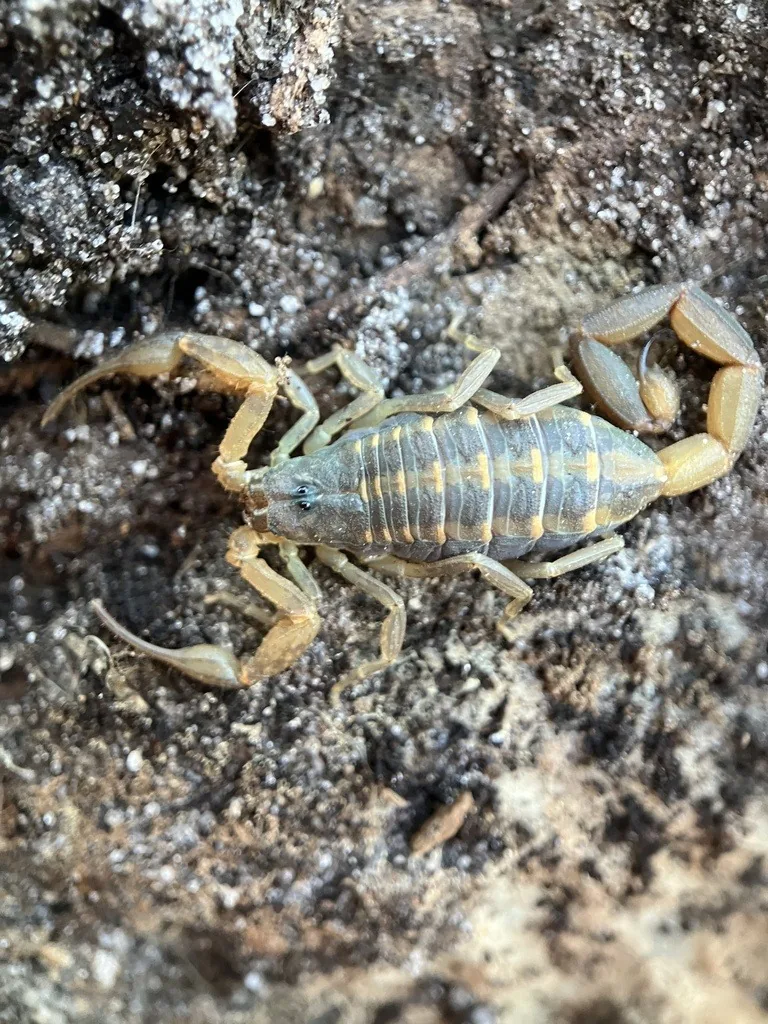
- Its back has dark stripes separated by a narrow yellow stripe, usually about half as wide as the dark stripes.[1]
- The shield over the head is evenly mottled light brown, without the dark triangle over the eyes seen in the striped bark scorpion.[1]
- The pincer fingers and legs are dusky or darkened rather than plain yellow.[1]
- Like other scorpions, it has large pincers and a stinger at the end of a long, narrow tail.[2]
- Scorpions have six to 12 eyes, and like other scorpions this one glows a bright green under ultraviolet (UV) light, which makes a blacklight a handy way to spot them at night.[9]
Look-alikes
| Look-alike | How to tell them apart |
|---|---|
| Striped bark scorpion | Found from the Central Plains to Texas and Mexico rather than Florida; it has a black triangle on the head shield, a center yellow stripe as wide as or wider than the dark stripes, and plain yellow legs and pincers.[1] |
| Arizona bark scorpion | A desert scorpion. The venomous scorpions of real medical concern in the U.S. live mainly in the southwestern deserts, and its genus relative C. sculpturatus has caused human deaths.[3][5] |
| Slender brown scorpion and Keys bark scorpion | The other two Centruroides scorpions that UF/IFAS Extension lists among the three most observed in Florida. Check the back for the Hentz scorpion's dark stripes split by a narrow yellow stripe.[9][1] |
Where it lives
Occurs statewide in Florida and in adjacent southern Alabama (Mobile and Baldwin Counties) and the southern tier of Georgia counties. Finds in North and South Carolina and farther north in Georgia are thought to be accidental introductions by people.[1]
Biology and life cycle
It usually lives under leaf litter, logs, stones and the bark of dead trees, and it often enters houses. UF/IFAS Extension Sarasota County lists it as one of the three scorpions observed most often across Florida, along with the slender brown scorpion and the Keys bark scorpion.[1][9]
Scorpions are active at night. They often lie in wait, grabbing insects and other small animals that wander by. UF/IFAS Extension says scorpions are opportunistic predators that eat a variety of insects, including unwanted pests, and outdoors they hide under stones, logs, boards and debris.[2][4][9]
Its venom is rich in sodium- and potassium-channel toxins, and venom makeup differs between Florida populations, with females driving most of the difference.[5][6]
Damage and signs
Health risk
A sting usually causes pain, tingling or burning at the site with little swelling. Most stings from North American scorpions need no treatment, and the venomous species of concern live mainly in the southwestern deserts, but children 6 and younger are more likely to have harmful effects from venomous types, and anyone with trouble breathing, drooling, muscle twitching or roving eyes needs emergency care.[3][4][5]
Control
Keep them out
Weather-strip doors and thresholds and plug gaps where wires and pipes enter. University of Kentucky calls exclusion the more permanent way to keep out pests that come from outdoors.[2]
Sanitation
After sealing entry points, do a major cleanup to remove as many hiding places as possible for scorpions and their prey. If scorpions keep turning up indoors, UF/IFAS Extension says a moisture source is likely nearby, such as plumbing fixtures, condensers or air conditioning units; fix it where you can and fill cracks and crevices in and around the home that serve as hiding places.[2][9]
Traps and physical control
Sticky boards along walls and under furniture catch scorpions without pesticides. Shake out shoes and clothing before putting them on, and wear gloves when moving objects outdoors.[2][4]
Pesticides
Exclusion can be supplemented with a labeled perimeter insecticide applied around doors, vents and the foundation, following the label.[2]
If you are stung
Wash the sting with soap and water and put a wrapped ice pack on it, 10 minutes on and 10 minutes off. Don't submerge the area in ice water. Keep the stung part still and remove rings and tight jewelry.[3][4]
Call Poison Help at 1-800-222-1222 with any questions; for trouble breathing, seizures or other severe symptoms, call 911. If it's safe, capture the scorpion or take a photo so it can be identified.[3][4]
Symptoms usually fade within 48 hours. Watch young children closely: MedlinePlus says deaths from scorpion stings rarely occur in people older than 6.[4][3]
Common questions
- Are Florida scorpions dangerous?
- Not seriously. Venom researchers describe the Hentz striped scorpion as posing no serious threat to people, and the U.S. scorpions of medical concern live mainly in the southwestern deserts. Of more than 2,200 scorpion species worldwide, only a small fraction are considered harmful to people. A sting still hurts, and a young child who is stung should be watched closely.[5][3][7]
- What should I do if a scorpion stings me?
- Wash the area with soap and water and apply wrapped ice 10 minutes on, 10 off. For questions call Poison Help at 1-800-222-1222; for severe symptoms call 911.[3][4]
- Why are there scorpions in my house?
- It often wanders indoors from outside. Gaps around doors are a major way in, along with gaps where utility wires and pipes enter. UF/IFAS Extension adds that a scorpion indoors usually means moisture nearby, such as around plumbing fixtures, condensers or air conditioning units.[2][1][9]
- Do Florida scorpions glow?
- Yes. UF/IFAS Extension notes that scorpions glow a bright green under UV light, so a blacklight helps you find them outdoors at night, when they are most active.[9]
Sources
- Shelley, R. M. and W. D. Sissom, Journal of Arachnology (American Arachnological Society), “Distributions of the scorpions Centruroides vittatus (Say) and Centruroides hentzi (Banks) in the United States and Mexico (Scorpiones, Buthidae). Journal of Arachnology 23:100-110 (1995).” www.americanarachnology.org/journal-joa/joa-all-volumes/detail/article/download/JoA_v23_p100.pdf/ (accessed 2026-11-12)
- University of Kentucky Entomology, “ENTFACT-633: Scorpions in Kentucky.” entomology.mgcafe.uky.edu/ef633 (accessed 2026-11-12)
- MedlinePlus, U.S. National Library of Medicine, “Scorpions (Medical Encyclopedia).” medlineplus.gov/ency/article/002850.htm (accessed 2026-11-12)
- Centers for Disease Control and Prevention, NIOSH, “Insects and Scorpions at Work.” www.cdc.gov/niosh/outdoor-workers/about/insects-and-scorpions.html (accessed 2026-11-12)
- Toxicon, via PubMed, “Venom-gland transcriptomics and venom proteomics of the Hentz striped scorpion (Centruroides hentzi; Buthidae) reveal high toxin diversity in a harmless member of a lethal family (Ward et al. 2018).” pubmed.ncbi.nlm.nih.gov/29248469/ (accessed 2026-11-12)
- Toxicon, via PubMed, “Female-biased population divergence in the venom of the Hentz striped scorpion (Centruroides hentzi) (Ward et al. 2018).” pubmed.ncbi.nlm.nih.gov/30096334/ (accessed 2026-11-12)
- Toxicon, via PubMed, “A global accounting of medically significant scorpions: epidemiology, major toxins, and comparative resources in harmless counterparts (Ward et al. 2018).” pubmed.ncbi.nlm.nih.gov/30009779/ (accessed 2026-11-12)
- iNaturalist, “Centruroides hentzi taxon page (order and family).” www.inaturalist.org/taxa/199583 (accessed 2026-11-12)
- UF/IFAS Extension Sarasota County, “The Spooky Bug Brigade: Scorpions.” blogs.ifas.ufl.edu/sarasotaco/2024/10/17/the-spooky-bug-brigade-scorpions/ (accessed 2026-11-14)