On this page
How to identify it
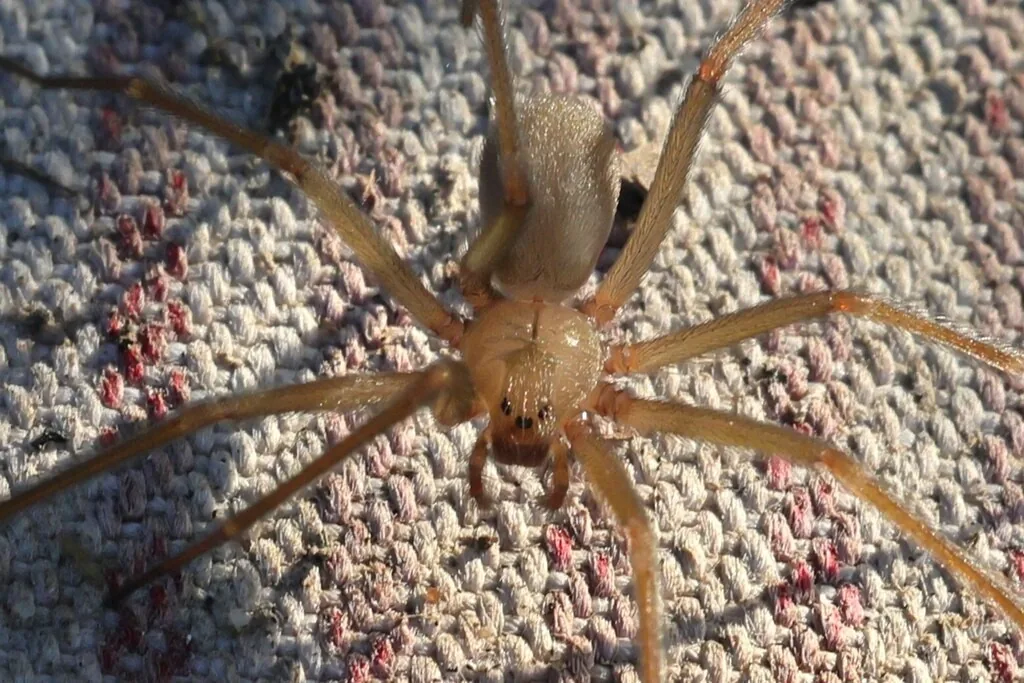
- Recluse spiders have six eyes arranged in three pairs: one pair at the front of the head and one pair on each side farther back, with a space between the pairs. Most other spiders have eight.[1][2]
- The abdomen is covered with fine hairs and is a single color, from light beige to dark brown, with no pattern.[1]
- The legs are one color, without stripes or bands, and lack the stout spines many other spiders have.[1]
- The body is 1/4 to 1/2 inch long by Utah State's measure; UC IPM says a recluse's body is not more than 3/8 inch.[2][1]
- The violin-shaped mark on the head region, so plain on the brown recluse, is very faint to absent on the desert recluse by UC IPM's account.[1]
Look-alikes
| Look-alike | How to tell them apart |
|---|---|
| Brown recluse | Has a well-defined violin mark and lives in the south-central Midwest, from southeastern Nebraska to southwestern Ohio and south through Texas to north Georgia, not in the desert Southwest. Telling recluse species apart takes a high-magnification microscope and a spider expert.[1] |
| Spitting spiders | Share the six-eye pattern but have many black spots or lines and a strongly domed head region.[1] |
| Woodlouse spider | Also six-eyed, but the eyes sit in two groups of three rather than three pairs, and there is no violin mark.[1] |
| Cellar spiders | Some have a dark mark on the head that looks very much like a recluse's violin, but the dark markings on the abdomen show they are not recluses.[1] |
Where it lives
Found mostly in the Sonoran and Mojave deserts, the foothills of the lower San Joaquin Valley and nearby parts of Mexico. In Utah it is found only in Washington County.[1][2][3]
Biology and life cycle
Recluses build small webs that act as trip lines for passing prey, hide in silk retreats by day, and come out at night to hunt or wait near the retreat.[1]
Desert recluses live outdoors in native vegetation and pack rat dens, feeding on small live insects and occasionally larger dead ones.[2]
Around buildings, recluses shelter under trash cans, plywood, tarps and tires and in storage boxes. In California, 12 desert recluses were collected under one doghouse in Yucca Valley, and 6 were taken in a single night from a cottage bedroom at a Mojave Desert research station.[1]
Recluse spiders mature in about a year, live 2 to 4 years on average, and can survive 6 to 12 months without food.[1]
Where conditions suit them, recluse populations are usually dense: if you find one, you usually find many.[1]
Damage and signs
Health risk
Laboratory work found desert recluse and brown recluse venoms share more than 90 percent amino acid identity in their active components and react almost the same way with antibodies, and the skin damage from bites by the two species cannot be told apart clinically.[3]
Control
Prevention
Confirm you actually have desert recluses before attempting control; most spiders people submit as recluses turn out to be something else.[1][4]
Move the bed away from the wall, remove bed skirts and items stored under the bed, shake out clothes and shoes left on the floor, and keep seldom-used clothing, gloves and boots in tightly closed bags or bins.[1][5]
Keep them out
In homes with attached garages, seal cracks around doors and the holes where electrical conduit and plumbing pass through.[1]
Sanitation
Remove outdoor clutter such as woodpiles, boxes, plywood, tires and trash cans, especially next to the house.[1]
Reduce other insects that serve as food, and prune vegetation around buildings to limit habitat.[2]
Traps and physical control
Sticky traps along baseboards, out of reach of children and pets, catch spiders and show how many are present; a single spider can be caught under a jar.[1]
Pesticides
Spraying works poorly unless you see the spider and hit it directly; crushing it is just as easy and far less toxic indoors.[1]
After a suspected bite
NIOSH first aid for any spider bite: stay calm, wash the bite with soap and water, put a cold, damp cloth or wrapped ice on it, raise the area if you can, don't try to remove venom, and get medical care. Identify the spider only if you can do so safely.[5]
MedlinePlus advises emergency treatment right away for a suspected recluse bite, through 911 or Poison Control (1-800-222-1222). Until help arrives, clean the bite, apply wrapped ice 10 minutes on and 10 minutes off, keep the area still and remove rings and tight clothing. Bring the spider in a secure container if you can.[6]
Poison Control notes there is no antidote for recluse venom; care treats the wound, prevents infection and may include surgery for deep wounds. A tetanus booster is usually given if vaccination status is unknown.[7][5]
What a recluse bite does, and what it often is instead
A recluse bite may not be felt. Pain usually builds over the first several hours; in serious cases the tissue dies and forms a black scab that falls off after 2 to 5 weeks, leaving an ulcer that can take months to heal. MedlinePlus says children may react more severely.[6][7]
Most recluse bites are unremarkable, and physicians' reviews say recluse bites are often overdiagnosed and only rarely cause skin necrosis.[8][9]
Many wounds blamed on recluses are infections, including methicillin-resistant Staphylococcus aureus (MRSA). Poison Control lists bacterial, viral and fungal infections, other insect bites and circulation problems as mimics, and a bite is hard to diagnose unless the spider was seen and correctly identified.[10][7]
Is it really a recluse?
In a 2000 to 2005 nationwide identification offer, nearly 600 spiders came in from California, many from people sure they had a brown recluse. Only one was a brown recluse, from a family that had moved from Missouri; the 17 desert recluses submitted all came from the deserts of southeastern California, where the species is known to occur.[1]
Across 1,773 arachnids sent in from 49 states, recluses were almost never submitted from states outside their known range, which is why researchers say a recluse bite diagnosis belongs only in areas with proven recluse populations.[4]
Where sources disagree
Violin mark: UC IPM says it is very faint to absent on the desert recluse, while Utah State describes a darker fiddle-shaped marking on top.[1][2]
Size: Utah State gives a body length of 1/4 to 1/2 inch; UC IPM says recluse bodies are no more than 3/8 inch.[2][1]
Common questions
- Is the desert recluse as dangerous as the brown recluse?
- Its venom is nearly the same as the brown recluse's in laboratory tests, and doctors can't tell the skin damage from the two species' bites apart.[3]
- Why are desert recluse encounters uncommon?
- It lives mostly outdoors in native vegetation and pack rat dens, is seldom found indoors, and most of its range is thinly populated.[2][1]
- Does the desert recluse have a violin marking?
- By UC IPM's account it has only a very faint violin or none, so the six eyes in three pairs are a far better clue; Utah State describes a darker fiddle shape.[1][2]
- How do I get a spider identified?
- Keep it intact: freeze it, soak it in rubbing alcohol for a few days, then pour off the alcohol and rinse it with water before mailing, since it should not be mailed in alcohol.[1]
- What should I do if I think a desert recluse bit me?
- Wash the bite, apply wrapped ice, keep the area still and get medical care right away; call Poison Control at 1-800-222-1222 for advice. Bring the spider in a sealed container if it is safe to catch.[6][5][7]
Sources
- University of California Statewide IPM Program, “Pest Notes: Brown Recluse and Other Recluse Spiders, Publication 7468 (revised November 2018).” ipm.ucanr.edu/legacy_assets/PDF/PESTNOTES/pnbrownrecluse.pdf (accessed 2026-11-11)
- Utah State University Extension, Utah Plant Pest Diagnostic Lab, “Desert Recluse Spider (Loxosceles deserta), IPM nuisance pest note.” extension.usu.edu/planthealth/ipm/notes_nuisance/desert-recluse-spider (accessed 2026-11-11)
- Toxicon, via PubMed, “Gomez, Miller, Waggener, Lankford and Warren (2001), Antigenic cross-reactivity of venoms from medically important North American Loxosceles spider species.” pubmed.ncbi.nlm.nih.gov/11137541/ (accessed 2026-11-11)
- Journal of Medical Entomology, via PubMed, “Vetter (2005), Arachnids submitted as suspected brown recluse spiders: Loxosceles spiders are virtually restricted to their known distributions but are perceived to exist throughout the United States.” pubmed.ncbi.nlm.nih.gov/16119538/ (accessed 2026-11-11)
- Centers for Disease Control and Prevention, NIOSH, “Venomous Spiders at Work (Sept. 28, 2026).” www.cdc.gov/niosh/outdoor-workers/about/venomous-spiders.html (accessed 2026-11-11)
- MedlinePlus, U.S. National Library of Medicine, “Brown recluse spider (Medical Encyclopedia).” medlineplus.gov/ency/article/002859.htm (accessed 2026-11-11)
- Poison Control, National Capital Poison Center, “Brown recluse spider bites: Know the signs, reduce the risks.” www.poison.org/articles/brown-recluse-spider-bites (accessed 2026-11-11)
- Annual Review of Entomology, via PubMed, “Vetter and Isbister (2008), Medical aspects of spider bites.” pubmed.ncbi.nlm.nih.gov/17877450/ (accessed 2026-11-11)
- American Family Physician, via PubMed, “Herness, Snyder and Newman (2022), Arthropod bites and stings.” pubmed.ncbi.nlm.nih.gov/35977137/ (accessed 2026-11-11)
- Critical Care Nursing Clinics of North America, via PubMed, “Vetter (2013), Spider envenomation in North America.” pubmed.ncbi.nlm.nih.gov/23692939/ (accessed 2026-11-11)
- iNaturalist, “Loxosceles deserta taxon page (order and family).” www.inaturalist.org/taxa/50182 (accessed 2026-10-06)