On this page
How to identify it
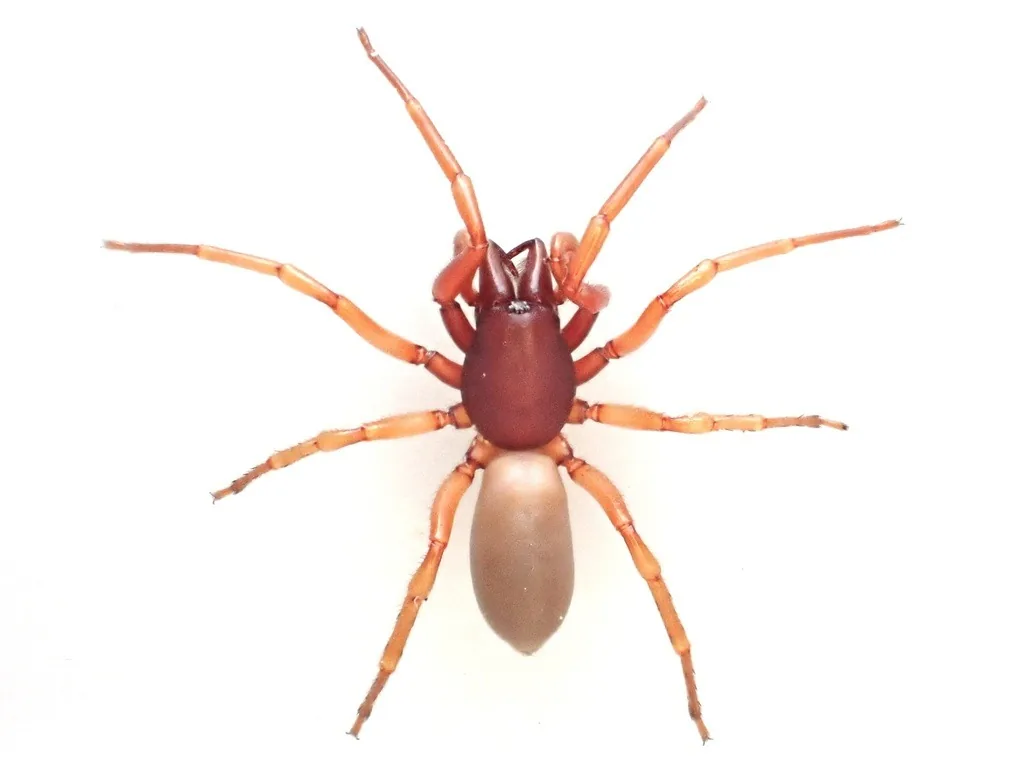
- The front body section and legs are reddish orange to brownish red, and the abdomen is dirty white, cream, pale gray or tan. The body is smooth.[1][2][3][4]
- Large, thick jaws and fangs point forward from the head, built to pierce the hard shell of an isopod.[1][2][3]
- It has six eyes; Penn State describes them as an oval, UC IPM as two groups of three. There is no violin mark.[1][2][5]
- Females are 11 to 15 mm long and males 9 to 10 mm, by Penn State's measure.[1][4]
Look-alikes
| Look-alike | How to tell them apart |
|---|---|
| Brown recluse | Also six-eyed, but its eyes sit in three pairs and it has a violin mark on the head. The woodlouse spider is commonly mistaken for it in the United States.[5][6] |
Where it lives
Native to the Mediterranean region and introduced to South Africa, Australia, Chile, Asia and North America, where it is found from New England to Georgia and west to California.[1][3]
Biology and life cycle
It feeds mainly on sowbugs and pill bugs, which the British call woodlice, and also takes other arthropods.[1][2][3]
It lives under rocks, bark, mulch, plants, woodpiles and trash cans, and in moist leaf litter and rotting wood where isopods are plentiful.[2][3]
Adults probably overwinter. Mating is reported in April; the female hangs up to 70 eggs in her silken retreat on a few threads, and the spiderlings stay with her for a while before leaving.[1]
It is an active wanderer and occasionally turns up inside, although the isopods it hunts seldom live indoors because houses are too dry for them.[3]
Damage and signs
Health risk
Verified bites are close to harmless: the main symptom is minor pain, typically lasting less than an hour and probably caused mostly by the fangs puncturing the skin. Researchers documented the mild effects because the spider bites readily and is often mistaken for a brown recluse, which can lead to unneeded treatment.[6]
Control
Prevention
Utah State also recommends switching exterior lighting to sodium vapor bulbs.[2]
Keep them out
Seal exterior cracks and crevices and install tight-fitting door sweeps on exterior doors.[2]
Sanitation
Reduce hiding places and moisture near the foundation, such as mulch, debris and woodpiles, and control sowbugs and pill bugs to remove its food.[2][3]
Traps and physical control
Vacuum spiders that get indoors, or catch one under a glass jar and release it outside; use a container or gloves rather than bare hands.[2][4]
Pest monitors can catch spiders wandering in, especially from August to October.[2]
Mistaken for a recluse
The woodlouse spider bites readily, bares its large fangs when threatened and is commonly mistaken for the brown recluse in the United States. The two are easy to separate: its six eyes are grouped differently and it has no violin mark.[6][5]
Bite researchers reviewed eight verified bites reported to them and eight more in the literature; the effects were mild in all of them.[6]
Where sources disagree
Size: Penn State gives 11 to 15 mm for females, Colorado State 9 to 15 mm, and the Connecticut Agricultural Experiment Station 1/2 to 3/4 inch.[1][4][3]
Eyes: Penn State describes the six eyes as arranged in an oval, while UC IPM describes two groups of three.[1][5]
Common questions
- Is the woodlouse spider dangerous?
- No. Despite its big fangs, verified bites caused only minor pain that usually faded within an hour.[6]
- Why do I find woodlouse spiders in my basement?
- They follow their prey, sowbugs and pill bugs, which live in damp areas. Cutting moisture, mulch and isopods near the house reduces them.[2][1][3]
- How is it different from a brown recluse?
- A woodlouse spider is reddish orange with a pale abdomen and forward-pointing fangs and has no violin mark; its six eyes are grouped differently from a recluse's three pairs.[5][6][1]
Sources
- Penn State Extension, “Woodlouse Hunter Spider (updated September 8, 2025).” extension.psu.edu/woodlouse-hunter-spider (accessed 2026-11-11)
- Utah State University Extension, “Woodlouse Spider (IPM nuisance pest notes).” extension.usu.edu/planthealth/ipm/notes_nuisance/woodlouse-spider (accessed 2026-11-11)
- The Connecticut Agricultural Experiment Station, “Spiders in the House (Ridge and Dugas).” portal.ct.gov/-/media/caes/documents/publications/fact_sheets/entomology/spiders_in_the_house.pdf (accessed 2026-11-11)
- Colorado State University, Department of Agricultural Biology, “Spiders in the home.” agsci.colostate.edu/agbio/ipm-pests/spiders-in-the-home (accessed 2026-11-11)
- University of California Statewide IPM Program, “Pest Notes: Brown Recluse and Other Recluse Spiders, Publication 7468 (revised November 2018).” ipm.ucanr.edu/legacy_assets/PDF/PESTNOTES/pnbrownrecluse.pdf (accessed 2026-11-11)
- Toxicon, via PubMed, “Vetter and Isbister (2006), Verified bites by the woodlouse spider, Dysdera crocata.” pubmed.ncbi.nlm.nih.gov/16574180/ (accessed 2026-11-11)
- iNaturalist, “Dysdera crocata taxon page (order and family).” www.inaturalist.org/taxa/1454862 (accessed 2026-10-06)