The short answer
- Front legs: a mantis has big, spiny grasping front legs held up in front of its head in a "praying" pose. A walking stick has six spindly legs for walking and clinging; the Indian walking stick stretches its front pair straight forward.[4][2][1][6][10][9]
- Head: a mantis has a triangular head with large bulging eyes that can turn about 180 degrees. A walking stick has two long, thin antennae; the northern walkingstick's antennae are two-thirds of its body length.[1][2][3][7][6]
- Food: mantises eat any insect they can catch. Walking sticks eat leaves, mostly of trees such as oaks.[1][4][7][6]
- Eggs: a mantis glues its eggs into a frothy mass that hardens into a tan egg case on a twig. A walking stick drops single hard, seed-like eggs to the ground.[1][2][6][9]
Mantis and walkingstick profiles on this site
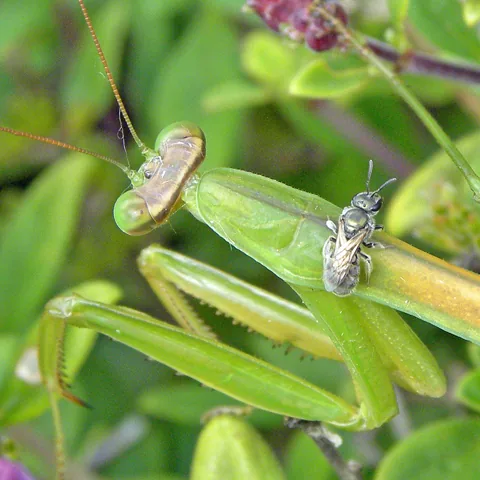 Praying Mantids
Mantidae (e.g., Tenodera sinensis, Mantis religiosa, Stagmomantis carolina)
Mantids are generalist predators. They catch pests, but they also eat bees, butterflies and other beneficial insects, and UC IPM says they're of no benefit for biological pest control.
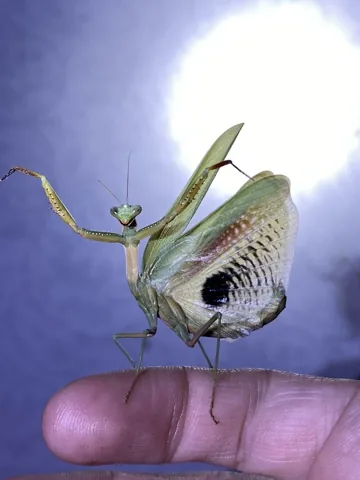 Mediterranean mantis
Iris oratoria
The Mediterranean mantis (Iris oratoria) is one of the introduced mantids of California, along with the Chinese, European and South African mantids. UC IPM says it is sold by mail order and in some garden stores, but that mantids are of no benefit for biological pest control. Field studies at Davis, California, have watched it alongside the native bordered mantis.
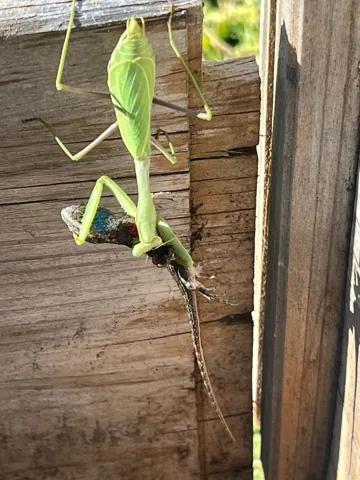 Arizona mantis
Stagmomantis limbata
The Arizona mantis, Stagmomantis limbata, also called the bordered mantid, is a praying mantis native to western North America and Central America, and one of the native mantids of California. Adult females are flightless and sedentary, while the longer-winged males fly in search of mates.
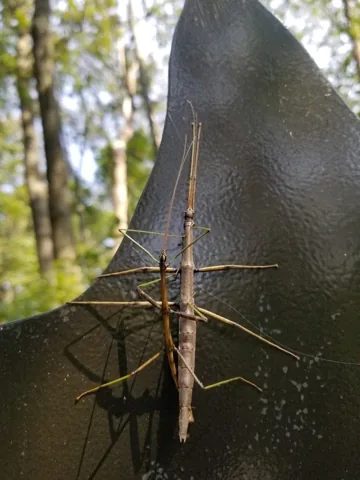 Walkingsticks
Diapheromera femorata (northern walkingstick) and relatives
Walkingsticks look like living twigs and usually go unnoticed. They are harmless to people and cannot sting. The northern walkingstick feeds on oak and other hardwood leaves, rarely enough to matter, so no control is usually needed.
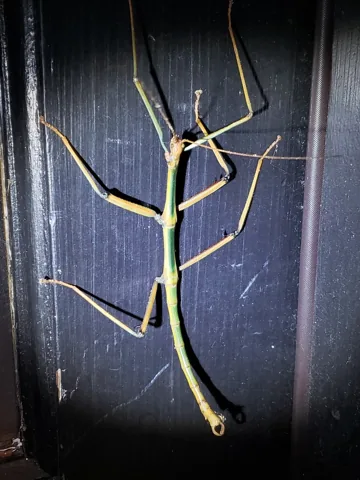 Giant walkingstick
Megaphasma denticrus
The giant walkingstick, Megaphasma denticrus, is the longest insect in North America, with females reaching about 6 to 7 inches. It is a slow-moving, wingless leaf-eater that passes for a twig in trees and shrubs, and most people only notice one when it wanders onto a building or sidewalk.
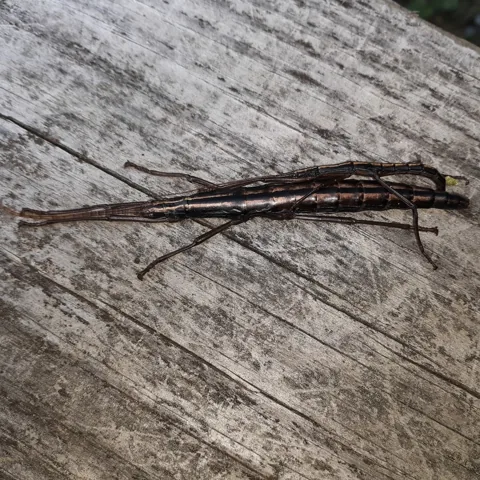 Twostriped walkingstick (devil rider)
Anisomorpha buprestoides
The twostriped walkingstick is a wingless stick insect of the southeastern United States that sprays a smelly defensive chemical from glands behind its head. It aims accurately, and in the eye the spray has caused painful injuries, from conjunctivitis to corneal ulcers.
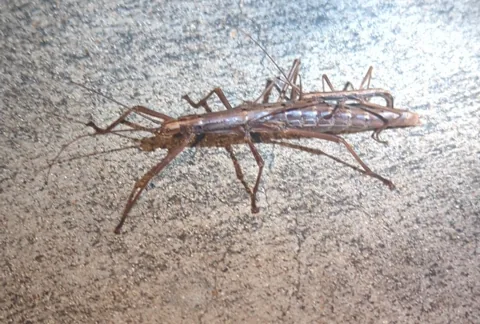 Northern Two-Striped Walkingstick
Anisomorpha ferruginea
The northern two-striped walkingstick, or musk mare, is a chunky, wingless brown stick insect of the southern and central United States. It can squirt a defensive spray from glands behind its head, and doctors have reported eye injuries from the spray of it and its southern relative.
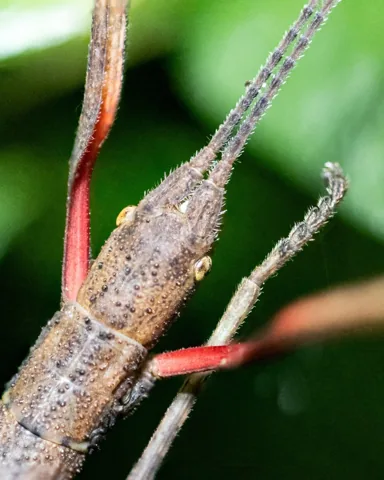 Indian Walking Stick
Carausius morosus
The Indian walking stick is a long, brownish, wingless insect that looks just like a twig. It escaped from captivity or was released as eggs, and it now lives wild along the California coast, eating leaves of ivy, privet, roses and many other garden plants. UC IPM calls it mostly a nuisance, though in some years and places it can seriously defoliate valued plants. UC IPM's suggested control is hand removal: pick them off, freeze them, then throw them away; it says pesticides generally are not recommended, since they might kill beneficial insects.
Side by side
Both insects rely on camouflage and stay still for long periods, which is why they get confused. Mantids sit motionless waiting for prey, and walkingsticks look like twigs and even sway like branches in a breeze. The checks below are the ones extension and state agency sources give.[1][4][7]
- Front legs: mantis forelegs are raptorial, built for grasping like a raptor's claws: large, powerful and lined with spines that hold prey. At rest they are folded and held up under or in front of the head. Walkingsticks have six spindly legs; the Indian walking stick can hold its legs tight alongside its body and stretches its forelegs forward.[4][2][1][6][10]
- Head and neck: mantids have a triangular head with bulging compound eyes at the top corners and a "neck" that lets the head rotate about 180 degrees. Walkingsticks instead have two long, thin antennae, two-thirds of the body length in the northern walkingstick.[4][1][2][3][6][7]
- Size: mantid adults generally run 2 to 5 inches (UC IPM). The northern walkingstick is 2 2/3 to 4 inches (Iowa State) or 3 to 3 3/4 inches (Missouri), and the giant walkingstick reaches about 7 inches, the longest insect in North America.[1][3][6][7][8][9]
- Body shape: mantids are large, elongated insects. A walkingstick looks like a long, slender, cylindrical stick on six spindly legs.[1][4][6]
- Wings: mantid nymphs lack wings and adults have them; Kentucky notes the Carolina mantid is about 2 inches when full grown, "when it has wings", and Missouri says Chinese mantids fly well. Walkingsticks in the upper U.S. are wingless as adults, and the Indian walking stick is wingless too.[3][2][4][6][10]
- Color: mantids are usually brown, green or yellowish, and one species can come in all three color forms. Northern walkingstick males are brown and females greenish brown.[1][4][7]
- Movement: mantids wait for prey, then strike in a lightning-fast move. Walkingsticks are docile and slow moving, and their feet cling tightly to skin and clothing when picked up.[4][9]
- Season: both spend winter as eggs and hatch in spring. Mantid adults appear in late summer and are killed by the first hard frost; northern walkingsticks reach full size in late July or August.[1][5][6]
Diet and garden role
Mantids are generalist predators. They feed on any insect they can catch, including bees, butterflies, syrphid flies and other beneficial insects, and the large females have occasionally been recorded eating small reptiles, amphibians and even hummingbirds.[1][4][5]
That makes their garden value mixed. UC IPM says mantids are of no benefit for biological pest control, partly because they are relatively inactive and each one eats relatively few insects; Missouri says their usefulness is questionable and points to the nonnative Chinese mantid's possible role in the decline of some native mantids. If you want to try mantid egg cases, Missouri suggests the native Carolina mantis instead of the Chinese mantid.[1][4]
Walkingsticks are herbivores with chewing mouthparts. The northern walkingstick prefers oaks, basswood and wild cherry and avoids maples and conifers. Occasional population peaks can defoliate trees, but trees usually recover unless it happens several years in a row; Texas A&M Forest Service says no control is needed.[6][7][9]
- The Indian walking stick, a pet-trade species, has become established in some California landscapes, where the young feed on new growth of roses, ivy, privet and other plants. UC IPM asks owners to bag and freeze cage debris before throwing it out, because the eggs look like droppings.[10]
Egg case vs dropped eggs
Mantids lay eggs in the fall in a mass that is frothy and pale at first, then dries into a brown, hard, paper-like case (an ootheca) attached to twigs, stems, posts or eaves. UC IPM gives the case as up to 1 1/2 inches long. Kentucky puts the clutch at 12 to 400 eggs, Kansas State at 200 to 300, and several dozen to hundreds of young can hatch from one case in spring.[1][2][3][5]
Missouri identifies its three common mantids by egg case shape: the Chinese mantis case looks like a round, tan toasted marshmallow about Ping-Pong-ball size, the native Carolina mantis case is flattened and teardrop-shaped, and the European mantis case is egg-shaped and distinctly layered.[4]
Walkingsticks don't build an egg case. Females scatter single eggs that drop from the treetops to the ground, where they spend the winter. Iowa State describes them as hard, flat, round, about an eighth of an inch long and seed-like, with up to 150 eggs per female; Texas A&M Forest Service says some don't hatch until the second spring.[6][9]
Can either one hurt you?
Neither insect stings. The Connecticut Agricultural Experiment Station says mantids are not venomous but can defend themselves with sharp strikes of their claws if threatened; injuries to people are rare and usually come from prolonged teasing. Texas A&M Forest Service says walkingsticks cannot sting and that the males' claspers only look dangerous.[5][9]
The one real hazard is the defensive spray of the twostriped walkingstick (Anisomorpha buprestoides), a southeastern species. It has two glands just behind the head and can aim a spray 15 inches or more, and the spray irritates eyes, nose and mouth. Mississippi State notes that the old tale of a "devil's horse" spitting in your eye gets pinned on mantids, but it is this walkingstick that does it.[11][12][13]
Eye exposures have been reported in medical journals, ranging from conjunctivitis to corneal ulceration; one case of corneal and conjunctival injury healed over 6 days, and another patient improved with water rinsing. Ferrara and colleagues call it one of two U.S. stick insects that use this defense; the twostriped and northern two-striped walkingstick profiles below cover both.[13][14][11]
How to confirm which one you have
Take a photo from the side that shows the front legs and the head. Spiny front legs folded up under a triangular head with big eyes mean a mantis; a stick-thin body with six similar legs and long antennae means a walkingstick.[4][2][6][7]
In fall and winter, look for the evidence instead of the insect: a hard tan foam case stuck to a twig or post is a mantid egg case, while walkingstick eggs are loose seed-like grains on the ground that are easy to overlook.[1][5][6][9]
- In the Southeast, a stick insect pair with a much smaller male riding on the female's back may be twostriped walkingsticks, so look before you pick one up; Mississippi State says it aims its spray accurately and sprays when handled.[11]
What to do about each
Mantis: leave it be. It eats insects rather than plants, and injuries to people are rare. To encourage a mix of insect predators rather than relying on mantids, Missouri recommends avoiding broad-spectrum insecticides.[5][1][4]
Walkingstick: no control is needed; defoliation from occasional outbreaks is rarely serious unless it repeats year after year. If a twostriped walkingstick has to be moved, keep it away from your face, since it targets the eyes.[9][7][11][13]
- Pet walking sticks: don't release them or dump cage debris outdoors. Bag and freeze debris before putting it in the trash, as UC IPM advises for the Indian walking stick.[10]
Common questions
- Is a walking stick a kind of praying mantis?
- No. Walking sticks belong to the order Phasmatodea and eat leaves; mantids are predators that catch insects with grasping front legs.[10][6][1]
- Does a praying mantis bite or sting?
- It has no sting and isn't venomous. It can defend itself with sharp strikes of its claws if threatened, but injuries to people are rare.[5]
- Which one sprays in your eyes?
- The twostriped walkingstick of the Southeast, not the praying mantis. Its spray can injure the eye, so rinse with plenty of water at once and call Poison Control.[11][13][14][16]
- Should I buy mantis egg cases for my garden?
- UC IPM says mantids give no real benefit for biological pest control because they eat beneficial insects as readily as pests. Missouri discourages releasing the nonnative Chinese mantid.[1][4]
- Will walking sticks kill my trees?
- Rarely. Large populations can strip leaves, but trees usually recover unless defoliation happens several years in a row.[9][7][6]
Photo credits
- Praying Mantids: (c) M. Whitson, some rights reserved (CC BY) — via iNaturalist, CC BY 4.0
- Mediterranean mantis: (c) David Rankin, some rights reserved (CC BY) — via iNaturalist, CC BY 4.0
- Arizona mantis: (c) Kate Crowell Walker, some rights reserved (CC BY) — via iNaturalist, CC BY 4.0
- Walkingsticks: (c) Jason E. Farabaugh, some rights reserved (CC BY) — via iNaturalist, CC BY 4.0
- Giant walkingstick: (c) Tyler Bishop, some rights reserved (CC BY) — via iNaturalist, CC BY 4.0
- Twostriped walkingstick (devil rider): (c) Steven Joyner, some rights reserved (CC BY) — via iNaturalist, CC BY 4.0
- Northern Two-Striped Walkingstick: (c) Megan Kossa, some rights reserved (CC BY) — via iNaturalist, CC BY 4.0
- Indian Walking Stick: (c) Diego González Dopico, some rights reserved (CC BY) — via iNaturalist, CC BY 4.0
Sources
- University of California Statewide IPM Program, “Mantids (Natural Enemies Gallery).” ipm.ucanr.edu/natural-enemies/mantids/ (accessed 2026-11-14)
- University of Kentucky Entomology Extension, “Praying Mantids (ENTFACT-418).” entomology.mgcafe.uky.edu/ef418 (accessed 2026-11-14)
- Kansas State University Research and Extension, “Praying Mantids (MF3593).” bookstore.ksre.ksu.edu/pubs/praying-mantids_MF3593.pdf (accessed 2026-11-14)
- Missouri Department of Conservation, “Mantids (Mantises) field guide.” mdc.mo.gov/discover-nature/field-guide/mantids-mantises (accessed 2026-11-14)
- Connecticut Agricultural Experiment Station, “Praying Mantis (Mantidae) fact sheet.” portal.ct.gov/-/media/caes/documents/publications/fact_sheets/entomology/praying_mantis_mantidae.pdf (accessed 2026-11-14)
- Iowa State University Extension and Outreach, “Walking Stick (Yard and Garden encyclopedia).” yardandgarden.extension.iastate.edu/encyclopedia/walking-stick (accessed 2026-11-14)
- Missouri Department of Conservation, “Northern Walkingstick field guide.” mdc.mo.gov/discover-nature/field-guide/northern-walkingstick (accessed 2026-11-14)
- Missouri Department of Conservation, “Giant Walkingstick field guide.” mdc.mo.gov/discover-nature/field-guide/giant-walkingstick (accessed 2026-11-14)
- Texas A&M Forest Service, “Giant Walking Sticks.” tfsweb.tamu.edu/GiantWalkingSticks/ (accessed 2026-11-14)
- University of California Statewide IPM Program, “Indian Walking Stick (Pest Notes 74157).” ipm.ucanr.edu/PMG/PESTNOTES/pn74157.html (accessed 2026-11-14)
- Mississippi State University Extension, “Twostriped Walkingstick (Bug's Eye View, Vol. 6, No. 26).” extension.msstate.edu/newsletters/bugs-eye-view/2020/twostriped-walkingstick-vol-6-no-26 (accessed 2026-11-14)
- Science (PubMed 17751052), “Eisner T. Defensive spray of a phasmid insect. Science 1965;148(3672):966-8.” pubmed.ncbi.nlm.nih.gov/17751052/ (accessed 2026-11-14)
- Wilderness & Environmental Medicine (PubMed 26961847), “Ferrara AN, Luck JB, Chappell MC. Twostriped walkingstick targets human eye with chemical defense spray. Wilderness Environ Med 2016;27(2):259-61.” pubmed.ncbi.nlm.nih.gov/26961847/ (accessed 2026-11-14)
- Ophthalmology (PubMed 11150287), “Paysse EA, Holder S, Coats DK. Ocular injury from the venom of the Southern walkingstick. Ophthalmology 2001;108(1):190-1.” pubmed.ncbi.nlm.nih.gov/11150287/ (accessed 2026-11-14)
- NIH National Library of Medicine, MedlinePlus, “Eye emergencies (Medical Encyclopedia).” medlineplus.gov/ency/article/000054.htm (accessed 2026-11-14)
- Poison Control (National Capital Poison Center), “Help for Poisons Splashed in the Eye.” www.poison.org/articles/help-for-poisons-splashed-in-the-eye (accessed 2026-11-14)