On this page
How to identify it
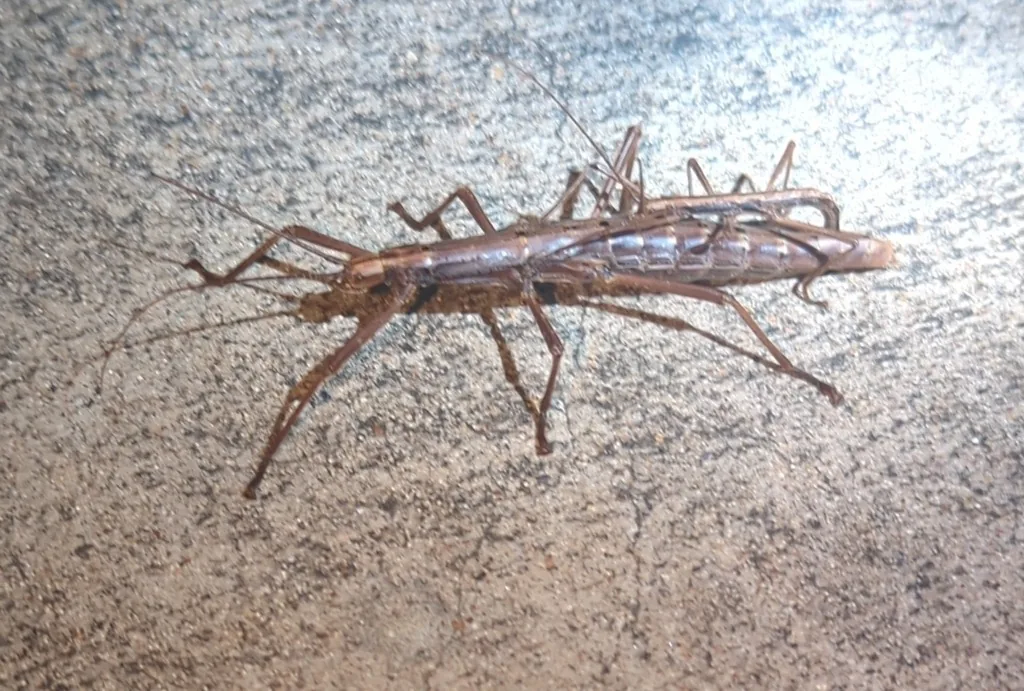
- It is tan, brown or brownish yellow and stouter than most stick insects, with a dark stripe down the middle of the back and fainter stripes along the sides.[2]
- Females are much bigger than males. MDC gives 2 to 2 1/4 inches for females and 1 to 1 1/2 inches for males; NC State puts females at about 4 inches.[2][1]
- It is usually seen in pairs, the small, slender male riding on the stout female's back.[1][2]
- Common names include musk mare, spitting devil, devil's riding horse, prairie alligator and witch's horse.[1]
Look-alikes
| Look-alike | How to tell them apart |
|---|---|
| Southern two-striped walkingstick | The southern two-striped walkingstick (Anisomorpha buprestoides) lives along the Gulf Coast from Texas to Florida and South Carolina. MDC says it is larger and darker with three sharp black stripes and a head longer than wide; NC State says it is less common in North Carolina and its stripes are more distinct. UF/IFAS gives the southern species' females an average of 67.7 mm (2 2/3 in) and males 41.7 mm (1 2/3 in), and says the northern species is smaller and paler and lacks conspicuous striping.[2][1][4] |
| Northern walkingstick | Other stick insects are thinner; two-striped walkingsticks are noticeably chunkier.[2] |
Where it lives
MDC gives a range from Texas and Kansas east to Georgia and Virginia, absent from Florida. In Missouri it may occur statewide but is mostly in the south, north to the Missouri River. NC State says it is not common in North Carolina but can be numerous where it does turn up. UF/IFAS quotes a 1916 account giving its range as from just north of the Ohio River south over the Mississippi Valley to the Gulf States, west to extreme southeastern Nebraska, and east through the Appalachians in Virginia and the high parts of the Carolinas and Georgia. It reports that the same 1916 review traced earlier Florida and Pennsylvania records to a misidentified specimen and mistranscribed label data, and the Florida State Collection of Arthropods has no specimens.[2][1][4]
Biology and life cycle
It feeds and grows in trees and shrubs in summer, well camouflaged, then gathers in open areas in late summer and fall to mate. Mating can last several days.[1][2]
NC State says eggs are laid in a dense mass on bark and other objects; MDC says females apparently lay them in the soil. In the southern species, UF/IFAS and the Forest Service's 1972 manual Eastern Forest Insects both describe females digging small pits in the soil and laying 8 to 10 eggs in each.[1][2][4][5]
When disturbed it aims a spray from a pair of glands in the front of its body, and NC State says it can reach about a foot. In a 1965 study of the southern species, Eisner found contact usually set it off, though birds could trigger it just by approaching; the spray drove off ants, beetles, mice and blue jays but not an opossum. UF/IFAS adds that the spray comes from two sac-like glands in the thorax that open just behind the head, works from the day the nymphs hatch, and contains a compound related to catnip named anisomorphal. Citing Eisner, it says the southern species can aim accurately up to 30 to 40 cm.[2][1][6][4]
Damage and signs
Health risk
The spray targets the eyes. Case reports describe intense pain, then blurred vision and injuries from conjunctivitis to corneal ulcers, mostly from the southern two-striped walkingstick. A 2011 report says the northern species can cause the same harm, and that children and pets may be at higher risk because they get close. If the spray gets in an eye, Poison Control says to rinse it with lots of room-temperature water for 15 to 20 minutes and then contact a poison center.[7][3][8][9]
Control
Prevention
Watch them from a distance and keep children and pets away; handling or poking is what usually sets off the spray.[6][3]
Pesticides
Control is rarely needed. NC State notes adults in late fall are hard to kill because cool weather slows the insects and the insecticide, and suggests treating in the warmest part of the day if you must.[1]
Common questions
- Can a walkingstick hurt my eyes?
- Yes. The spray is aimed at the eyes and is painful. Reported cases range from irritation to corneal ulcers, though in published cases the eyes healed with treatment. Rinse with water right away, and Poison Control says to get an urgent eye exam if pain, redness or vision problems last an hour after rinsing starts.[7][8][3][9]
- Why are two stick bugs stuck together?
- They're mating. Musk mares are usually found as pairs with the little male riding the female, and they can stay together for days.[2][1]
- What if my dog is sprayed?
- Rinse the eye with water and see a veterinarian. A 2011 report described a Chihuahua in Louisiana with a corneal ulcer after getting near a walkingstick; it was treated and recovered in 10 days. The authors found only one earlier dog case.[3]
- Does the northern two-striped walkingstick live in Florida?
- Apparently not. UF/IFAS says Florida's common stick insect is the southern two-striped walkingstick, that a 1916 review traced the old Florida record of the northern species to a misidentified specimen, and that the state's insect collection has no specimens of it.[4]
Sources
- NC State Extension, “Northern Twostriped Walkingstick (PDIC Factsheet).” content.ces.ncsu.edu/northern-two-striped-walkingstick (accessed 2026-11-13)
- Missouri Department of Conservation, “Northern Two-Striped Walkingstick (Musk Mare) (Field Guide).” mdc.mo.gov/discover-nature/field-guide/northern-two-striped-walkingstick-musk-mare (accessed 2026-11-13)
- J Vet Emerg Crit Care 2011;21(4):382-6, via PubMed, “Corneal ulceration in a dog following exposure to the defensive spray of a walkingstick insect (Anisomorpha spp.) (Brutlag, Hovda & Della Ripa, 2011).” pubmed.ncbi.nlm.nih.gov/21827597/ (accessed 2026-11-13)
- University of Florida IFAS Extension (EDIS), “Twostriped Walkingstick, Anisomorpha buprestoides (Stoll), EENY-314/IN590 (M. C. Thomas) (Featured Creatures).” ask.ifas.ufl.edu/publication/IN590 (accessed 2026-11-14)
- USDA Forest Service, “Eastern Forest Insects, Miscellaneous Publication 1175 (W. L. Baker, February 1972; scanned copy).” archive.org/details/easternforestins1175bake (accessed 2026-11-14). Scanned copy of the USDA Forest Service publication on the Internet Archive; text read from the archive.org full-text (djvu.txt) file.
- Science 1965;148(3672):966-8, via PubMed, “Defensive Spray of a Phasmid Insect (Eisner, 1965).” pubmed.ncbi.nlm.nih.gov/17751052/ (accessed 2026-11-13)
- Wilderness Environ Med 2016;27(2):259-61, via PubMed, “Twostriped Walkingstick Targets Human Eye With Chemical Defense Spray (Ferrara, Luck & Chappell, 2016).” pubmed.ncbi.nlm.nih.gov/26961847/ (accessed 2026-11-13)
- Ophthalmology 2001;108(1):190-1, via PubMed, “Ocular injury from the venom of the Southern walkingstick (Paysse, Holder & Coats, 2001).” pubmed.ncbi.nlm.nih.gov/11150287/ (accessed 2026-11-13)
- Poison Control (National Capital Poison Center), “Splashed a poison in your eye?.” www.poison.org/articles/help-for-poisons-splashed-in-the-eye (accessed 2026-11-13)
- Global Biodiversity Information Facility (GBIF), “Anisomorpha ferruginea (Palisot de Beauvois, 1805) (GBIF Backbone Taxonomy).” api.gbif.org/v1/species/1415022 (accessed 2026-11-13)
- iNaturalist, “Anisomorpha ferruginea taxon page (order and family).” www.inaturalist.org/taxa/416291 (accessed 2026-10-06)