On this page
How to identify it
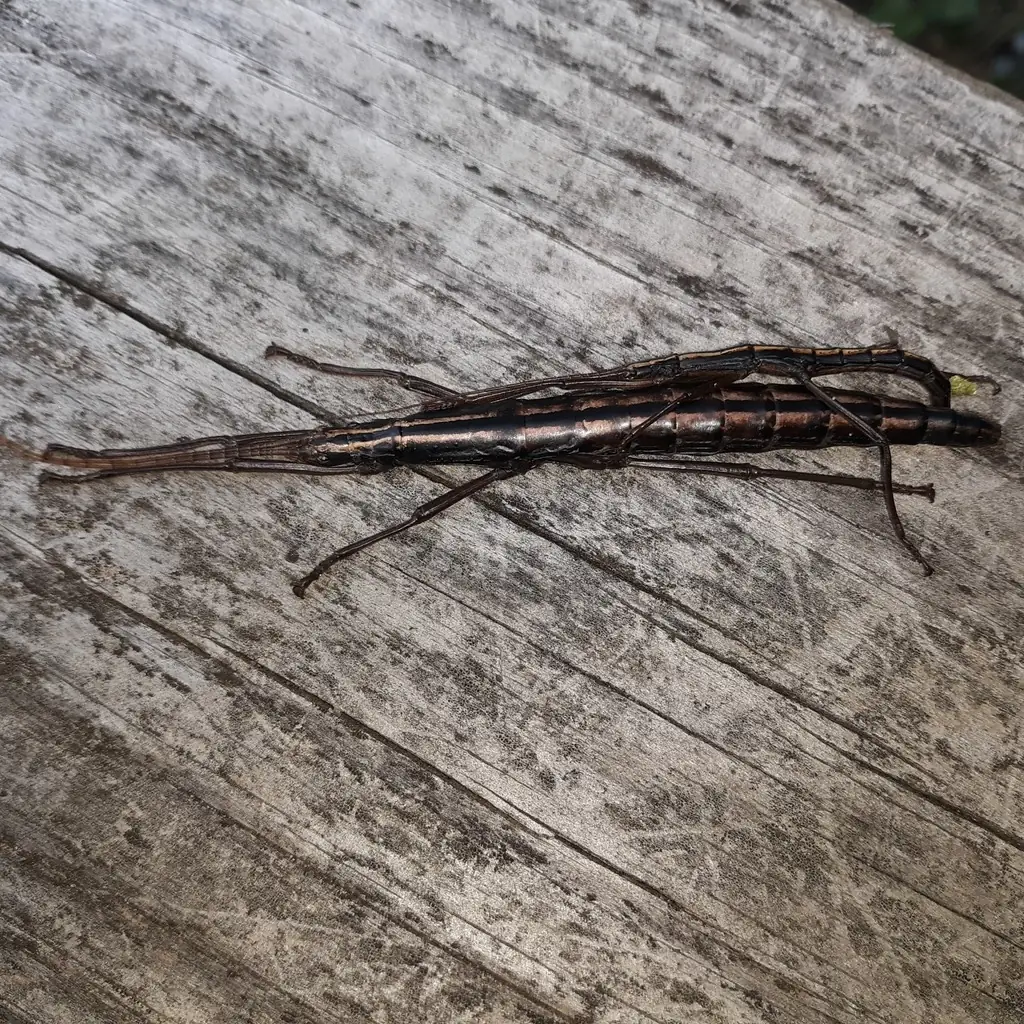
- It is a chunky, wingless stick insect, larger and darker than its northern relative, with three well-defined black stripes running the length of the body. Its head is longer than it is wide. UF/IFAS calls it the most common stick insect in Florida, a large, stout brown stick insect with three conspicuous black stripes running the length of the body.[4][1][5]
- Mature females are only 2 1/2 to 3 inches long and males are much smaller. A female is usually found with a male riding on her back. UF/IFAS gives average lengths of 67.7 mm (2 2/3 inches) for females and 41.7 mm (1 2/3 inches) for the smaller, more slender males.[1][4][5]
- A pair of glands on the back just behind the head produces the spray. Both sexes can spray.[1]
- A distinct black-and-white color form is found only in the Ocala National Forest scrub. Dead specimens fade, so pinned insects are not nearly as distinctively marked as live ones.[5]
Look-alikes
| Look-alike | How to tell them apart |
|---|---|
| Northern two-striped walkingstick | The northern species (Anisomorpha ferruginea) is tan to brownish-yellow with faint side stripes, and its head is about as long as it is wide. It ranges from Texas and Kansas to Georgia and Virginia but is absent from Florida. It can also spray. UF/IFAS says A. ferruginea is smaller and paler and lacks conspicuous striping, and that there are no specimens of it in the Florida State Collection of Arthropods.[4][5] |
| Other walkingsticks | Apart from the two-striped kinds, stick insects are usually longer and cannot spray.[1] |
Where it lives
A Gulf Coast species, it ranges from Texas through Florida to South Carolina. Because it is wingless it turns up in patches: one yard may have many while neighbors never see one. UF/IFAS says it apparently occurs throughout Florida and around the Gulf Coastal Plain west to Texas, with Florida specimens as far south as Boca Chica Key and others from Mississippi, Georgia, South Carolina and Louisiana.[4][1][2][5]
Biology and life cycle
They feed on many kinds of leaves, mostly tree leaves, and are most often seen in late summer and fall after they become adults. In Florida, UF/IFAS says adults are most abundant in fall, when eggs are laid; observations in Louisiana suggest it is active mainly at night.[1][5]
Mating and egg laying happen in late summer and fall, and pairs can stay together for several days. Females of this genus apparently lay their eggs in the soil rather than dropping them from trees like other stick insects. UF/IFAS reports Ocala National Forest females digging small pits in sandy soil, laying eight to 10 eggs in each and covering them with sand; in Louisiana, females laid eggs in crevices of pine bark mulch.[4][5]
The spray is aimed, and either one or both glands can fire. Contact usually triggers it, but birds can set it off just by approaching. In early tests it repelled ants, predatory beetles, mice and blue jays, but not an opossum.[1][6]
Different populations spray different forms of the same irritant compound, and young insects of one population switched to a different form when they matured.[2]
Recorded food plants include crepe myrtle and roses in Louisiana, where males were not seen feeding; oak, mainly, in the Ocala National Forest; and privet for a laboratory colony.[5]
It often gathers in groups under loose bark or in other sheltered places, and can be very abundant: one observer examined several thousand mating pairs of the Ocala form.[5]
Damage and signs
- Leaf feeding is usually minor. On rare occasions local outbreaks have caused significant defoliation of ornamental shrubs such as aucuba and azalea.[1]
Health risk
The spray irritates the eyes, nose and mouth and can reach 15 inches or more. Case reports describe intense eye pain, tearing, conjunctivitis and corneal damage; in one, corneal and conjunctival defects healed over 6 days and vision returned to 20/20 with no scarring. Pets are hit more often than people, and a dog in Louisiana developed a corneal ulcer that took 10 days to resolve.[1][7][3][8]
Control
Prevention
Leave them alone and don't pick them up or poke them; keep your face well away. Children and pets are at higher risk because they are curious and close to the insect's height.[1][8]
More from Mississippi State Extension
Mississippi State Extension's Blake Layton has talked with several people who were sprayed, and all of them called it painful. He notes that mantids get blamed for the eye-spitting of folklore, but the insect that really does it is this walkingstick, which goes by names such as musk mare, prairie alligator and devil's horse.[1]
If you get sprayed in the eye
MedlinePlus first aid for any chemical in the eye: flush right away with a gentle stream of cool tap water for at least 15 minutes, holding the eyelid open, and get emergency care. Seek care for pain, redness or any change in vision.[9]
In a reported case, an older woman sprayed in her home in Florida had red, watering eyes that improved with water irrigation. A more severe case needed daily eye exams until the surface of the eye healed.[3][7]
Where the sources disagree
Defoliation: Mississippi State Extension says rare local outbreaks have caused significant defoliation of ornamental shrubs such as aucuba and azalea, while UF/IFAS knows of no reports of this species causing serious defoliation.[1][5]
Common questions
- What should I do if a walkingstick sprays my eye?
- Flush the eye right away with cool running water for at least 15 minutes and get medical care, especially for pain, redness or blurred vision. Reported cases have ranged from irritation to corneal injury.[9][3][7]
- Are devil riders dangerous?
- Only if you handle or crowd them. Their aimed spray can injure eyes in people and pets. Their leaf feeding usually does little harm.[1][7][8]
- What other names does it go by?
- UF/IFAS lists devil's riding horse, prairie alligator, stick bug, witch's horse, devil's darning needle, scorpion and musk mare.[5]
- Will walkingsticks strip my shrubs?
- Rarely. UF/IFAS knows of no reports of serious defoliation by this species, and Mississippi State Extension says significant defoliation has happened only in rare local outbreaks.[5][1]
Sources
- Mississippi State University Extension, “Twostriped Walkingstick, Vol. 6, No. 26.” extension.msstate.edu/newsletters/bugs-eye-view/2020/twostriped-walkingstick-vol-6-no-26 (accessed 2026-11-11)
- Journal of Chemical Ecology, via PubMed, “Developmental and geographical variation in the chemical defense of the walkingstick insect Anisomorpha buprestoides (Dossey, Walse and Edison 2008).” pubmed.ncbi.nlm.nih.gov/18401661/ (accessed 2026-11-11)
- Wilderness & Environmental Medicine, via PubMed, “Twostriped Walkingstick Targets Human Eye With Chemical Defense Spray (Ferrara and Luck 2016).” pubmed.ncbi.nlm.nih.gov/26961847/ (accessed 2026-11-11)
- Missouri Department of Conservation, “Northern Two-Striped Walkingstick (Musk Mare) (Field Guide).” mdc.mo.gov/discover-nature/field-guide/northern-two-striped-walkingstick-musk-mare (accessed 2026-11-11)
- University of Florida IFAS Extension (EDIS), “Twostriped Walkingstick, Anisomorpha buprestoides (Stoll), EENY-314/IN590 (M. C. Thomas; Featured Creatures).” ask.ifas.ufl.edu/publication/IN590 (accessed 2026-11-14)
- Science, via PubMed, “Defensive Spray of a Phasmid Insect (Eisner 1965).” pubmed.ncbi.nlm.nih.gov/17751052/ (accessed 2026-11-11)
- Ophthalmology, via PubMed, “Ocular injury from the venom of the Southern walkingstick (Paysse et al. 2001).” pubmed.ncbi.nlm.nih.gov/11150287/ (accessed 2026-11-11)
- Journal of Veterinary Emergency and Critical Care, via PubMed, “Corneal ulceration in a dog following exposure to the defensive spray of a walkingstick insect (Anisomorpha spp.) (Brutlag, Hovda and Della Ripa 2011).” pubmed.ncbi.nlm.nih.gov/21827597/ (accessed 2026-11-11)
- MedlinePlus, U.S. National Library of Medicine, “Eye emergencies (Medical Encyclopedia).” medlineplus.gov/ency/article/000054.htm (accessed 2026-11-11)
- iNaturalist, “Anisomorpha buprestoides taxon page (order and family).” www.inaturalist.org/taxa/134119 (accessed 2026-10-06)