On this page
How to identify it
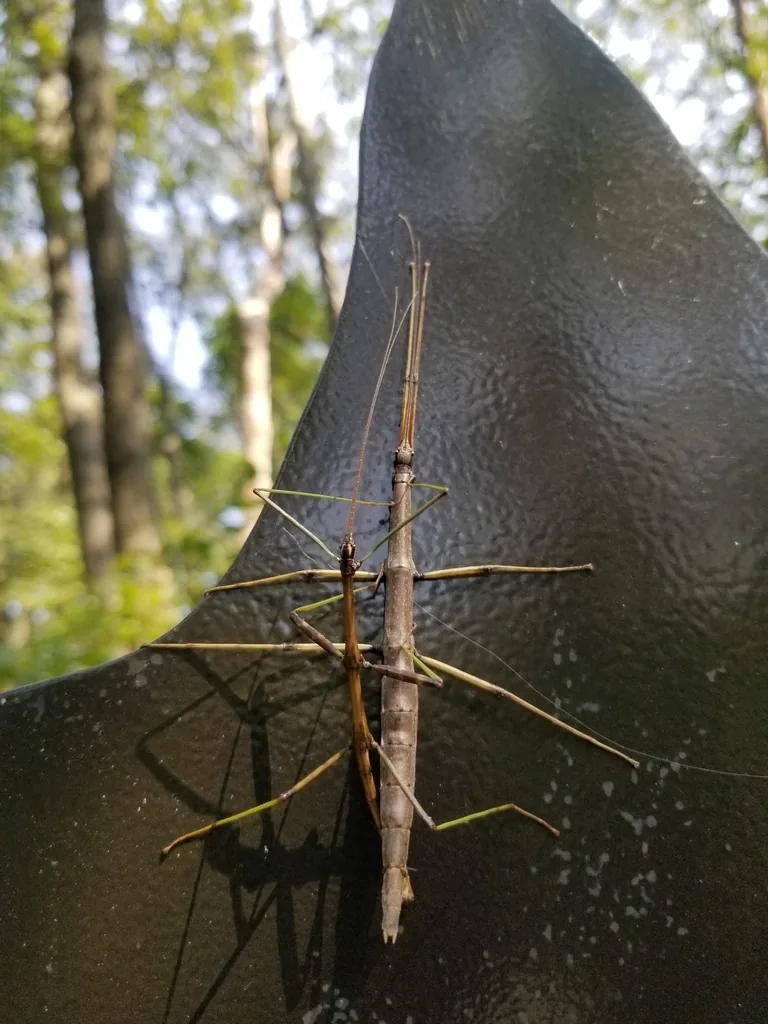
- They're long, slender and twig-like in brown, tan, gray or green, with long legs and antennae.[1]
- Iowa State gives the northern walkingstick an impressive 2 2/3 to 4 inches long; Missouri Department of Conservation gives about 3 inches for males and 3¾ inches for females. The antennae are two-thirds the body length.[4][6]
- Missouri's walkingsticks are wingless, and they sway like branches in a breeze.[1]
- Males are brown, and females are greenish brown and larger. Young walkingsticks (nymphs) are green and look like small adults; Iowa State says they are about a quarter inch long at hatching.[6][4]
- The eggs are hard, flat, round and about an eighth of an inch long, described as seed-like, so even the eggs are camouflaged.[4]
Look-alikes
| Look-alike | How to tell them apart |
|---|---|
| Indian walking stick | A pet-trade species from India now established in coastal California after escapes and discarded eggs.[2] |
Where it lives
About 30 species live in North America, most in the southernmost states. Only four are known from the upper Midwest and one, the northern walkingstick, is common there; it is common in oak-hickory forests and reaches full size in late July or August.[1][4][6]
Biology and life cycle
They overwinter as eggs that females drop one by one into leaf litter in late summer and fall.[1]
Eggs hatch in spring and the young climb into the trees; adults die at freezing.[1]
Iowa State says eggs hatch in May or early June. Nymphs feed near the ground on shrubs and small trees until about mid-summer, then move up into the tree canopy.[4]
Texas A&M Forest Service, writing about the giant walkingstick, says some eggs may not hatch until the second spring and there is one generation a year.[5]
Adults are mostly nocturnal, feeding at night and resting by day.[1]
Damage and signs
- They chew leaves of oaks, hazelnut, locusts, walnut and cherry; feeding is usually not severe.[1]
- Occasional population peaks can defoliate trees, which usually recover unless it repeats or they're stressed.[1]
- Adults prefer oak, basswood and wild cherry leaves and also eat ash, paper birch, hickory, locust, apple and chestnut growing among them; maples and conifers such as pine and spruce are avoided. Occasional defoliations have been reported in northern Wisconsin and Minnesota.[4]
- In Texas, giant walkingstick numbers have occasionally exploded and stripped hardwood trees; Texas A&M Forest Service says that is not particularly damaging unless it happens several years in a row.[5]
Health risk
None. Texas A&M Forest Service says walkingsticks are completely harmless: they do not sting, the claspers at the tip of a male's abdomen only look dangerous, and the old story that they spit blood in your eyes is false. Their feet can cling tightly to skin and clothing when picked up.[5]
Control
Prevention
No control is needed for occasional walkingsticks; trees normally recover even from rare defoliation.[1]
If you keep Indian walking sticks as pets, bag cage debris, freeze it, then trash it so eggs don't escape.[2]
Iowa State says walkingsticks seldom cause enough damage to need any management.[4]
Where sources disagree
Size of the northern walkingstick: Iowa State gives 2 2/3 to 4 inches; Missouri Department of Conservation gives 3 inches for males and 3¾ inches for females.[4][6]
Common questions
- Are walkingsticks harmful?
- Not to people, and their leaf feeding is usually not severe.[1][5]
- Why is a walking stick insect in California?
- Indian walking sticks escaped from captivity or were spread through discarded eggs and now live in coastal California.[2]
- Can a walkingstick sting or spit at you?
- No. Texas A&M Forest Service calls both ideas folklore: walkingsticks are docile, slow-moving leaf eaters and completely harmless.[5]
- What is a fun fact about walkingsticks?
- Iowa State notes the long list of folk nicknames the USDA Forest Service collected for them, including prairie alligator, devil's horse and witch's horse.[4]
Sources
- Missouri Department of Conservation, “Walkingsticks (Stick Insects) field guide.” mdc.mo.gov/node/219675 (accessed 2026-11-12)
- University of California Statewide IPM Program, “Pest Notes: Indian Walking Stick (Publication 74157).” ipm.ucanr.edu/PMG/PESTNOTES/pn74157.html (accessed 2026-11-12)
- iNaturalist, “Diapheromera femorata taxon page (order and family).” www.inaturalist.org/taxa/84286 (accessed 2026-11-12)
- Iowa State University Extension and Outreach (Yard and Garden), “Walking Stick.” yardandgarden.extension.iastate.edu/encyclopedia/walking-stick (accessed 2026-11-12)
- Texas A&M Forest Service, “Giant Walking Sticks.” tfsweb.tamu.edu/GiantWalkingSticks/ (accessed 2026-11-12)
- Missouri Department of Conservation, “Northern Walkingstick.” mdc.mo.gov/discover-nature/field-guide/northern-walkingstick (accessed 2026-11-12)