On this page
How to identify it
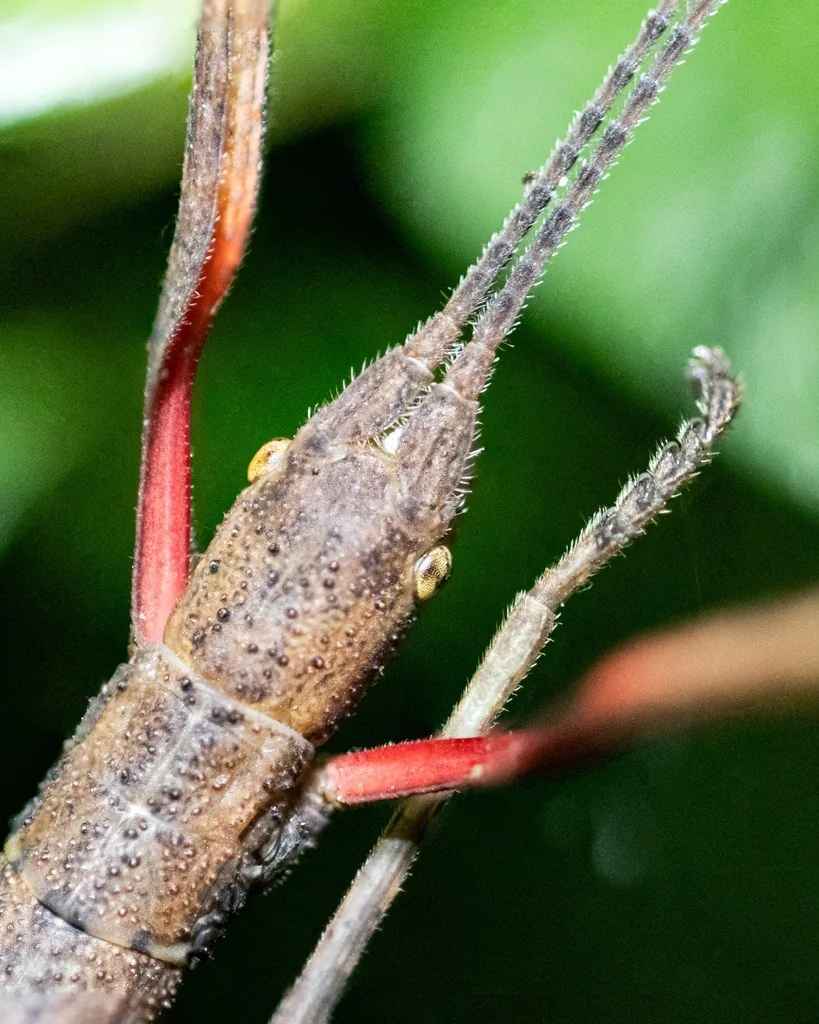
- Adults are wingless, usually brownish, 2 3/4 to 4 inches long, and can tuck their legs along the body to look like a twig.[4]
- When roughly handled, females flash bright red patches at the base of the front legs.[4]
- Eggs look like grayish brown seeds with a small pale cap.[4]
- When disturbed, it pulls its legs in and stays perfectly still, even when picked up, so it really does pass for a stick.[4]
- A fun fact: stick insects can regrow a lost leg. Researchers have studied how the new leg forms inside a special chamber in the old leg stump of this very species.[5]
Look-alikes
| Look-alike | How to tell them apart |
|---|---|
| Native California walking sticks | Native species feed on grasses and scrub in wild areas; Indian walking stick females have red marks at the front leg bases.[4] |
| Twostriped walkingstick | UF/IFAS calls it the most common stick insect in Florida: a large, stout brown stick insect with three conspicuous black stripes. Females average 67.7 mm (2 2/3 in) and the smaller males are often seen riding on them, unlike the unstriped Indian walking stick, whose males are rare.[7][4] |
| Common walkingstick | Diapheromera femorata of the eastern U.S. and southern Canada; the 1972 Forest Service guide gives adults as 62 to 87 mm long, brown, green or mottled, feeding mainly on trees such as black oak, basswood, elm, black locust and wild cherry.[8] |
| Giant walkingstick | Megaphasma denticrus sometimes reaches 150 mm, and the 1972 Forest Service guide says it is apparently never abundant enough to be injurious.[8] |
Where it lives
First found in San Diego County in 1991, it now lives along the California coast as far north as Humboldt County (verified in 2021). CDFA and a 2024 genetic study both put it in at least 10 California counties.[4][1][3]
Biology and life cycle
Females lay eggs without mating, dropping them while they feed or rest; males are rare.[4]
Eggs hatch in 10 to 12 weeks at room temperature; nymphs mature in 4 to 6 weeks, and there are several summer generations.[4]
Females live for several months and lay several hundred eggs in their lifetime. The eggs drop to the ground and look like seeds; in its native home, ants carry them off as if they were seeds but never eat them.[4]
It got loose in California when captive walking sticks escaped and when owners threw away cage debris holding eggs.[3][4]
Damage and signs
- The worst damage comes in spring, when nymphs feed on new growth; they favor small-leaved ivy and privet.[4]
- Leaf edges become tattered, and residents often find them on windows, doors or indoors on warm summer nights.[4]
- UC IPM lists azalea, bramble, camellia, geranium, hawthorn, hibiscus, ivy, jasmine, oak, privet, pyracantha, rose and some vegetables among the plants it eats.[4]
Health risk
It feeds on plants. UC IPM notes that walking sticks out in the open can alarm some people because of their large size; UC IPM and CDFA don't mention any risk to people or pets.[4][1]
Control
Prevention
Never release pet walking sticks; bag cage debris and freeze it for a week before trashing it, since eggs look like droppings.[4]
Traps and physical control
Hand-pick them from plants and freeze before discarding; this reduces numbers over time.[4]
Pesticides
UC IPM says there is no research on how well pesticides work against walking sticks and that pesticide applications generally are not recommended, since they might kill beneficial insects in the landscape.[4]
More from the California Department of Food and Agriculture
The California Department of Food and Agriculture's 2020 pest rating proposal says it has been in California since 1991 and has spread to at least 10 counties (Alameda, Contra Costa, Los Angeles, Orange, San Diego, San Francisco, San Luis Obispo, Santa Barbara, Santa Cruz and Ventura), that it has not been intercepted in California, that USDA considers it reportable, and that it is very popular as a pet and model for research. CDFA proposed a C rating, saying it does not appear to have become a widely significant pest.[1]
Where the sources disagree
Family: CDFA's rating places it in Phasmatidae; GBIF and the 2024 genome paper place it in Lonchodidae.[1][2][3]
Color and size: UC IPM says adults are usually brownish and 2 3/4 to 4 inches long; CDFA says the bodies are green to brown and females reach approximately 90 mm.[4][1]
Range: UC IPM says it is confined to coastal regions and reaches north to Humboldt County (verified finds in 2021); CDFA's 2020 proposal lists counties from San Diego to Contra Costa and says it may be limited to the coast and southern part of the state, while also calling it widespread.[4][1]
Native range: UC IPM says it is native to southern India; CDFA says it is also found over much of Southeast Asia, where it is not clear whether it is native or introduced.[4][1]
Damage: UC IPM says damage reports have become less frequent even as sightings increased; CDFA cites a report that it sometimes occurs in large numbers and defoliates plants in San Diego County.[4][1]
Common questions
- Where did the walking sticks in my yard come from?
- Escaped or released pets, or eggs tossed out with cage debris, established them in California.[4]
- Are Indian walking sticks harmful?
- UC IPM says they are mostly a nuisance, though in some years and some locations they can seriously defoliate valued plants.[4]
- Can I keep the walking sticks I find as pets?
- UC IPM asks pet owners never to release walking sticks and to bag and freeze cage debris for a week before trashing it, because the seed-like eggs hide in it. CDFA notes it is a popular pet and research insect.[4][1]
Sources
- California Department of Food and Agriculture (Pest Ratings), “California Pest Rating for Carausius morosus (Sinéty): Indian walking stick.” blogs.cdfa.ca.gov/Section3162/wp-content/uploads/2020/09/Carausius-morosus.pdf (accessed 2026-11-13)
- Global Biodiversity Information Facility (GBIF), “Carausius morosus Brunner von Wattenwyl, 1907 (GBIF Backbone Taxonomy).” api.gbif.org/v1/species/1411953 (accessed 2026-11-13). GBIF places it in the family Lonchodidae
- Microbiology Resource Announcements (American Society for Microbiology), full text via NSF Public Access Repository, “Complete mitochondrial genome of the introduced Indian walking stick Carausius morosus (Lonchodidae, Insecta) from California (Clarke et al. 2024).” par.nsf.gov/servlets/purl/10544985 (accessed 2026-11-13)
- University of California Statewide IPM Program, “Indian Walking Stick (Pest Notes).” ipm.ucanr.edu/home-and-landscape/indian-walking-stick/ (accessed 2026-11-13)
- Tissue and Cell, via PubMed, “Extracellular matrix of the regeneration chamber and plasma membranes of the epidermis during leg regeneration in an insect Carausius morosus (Browaeys-Poly 1991).” pubmed.ncbi.nlm.nih.gov/18621154/ (accessed 2026-11-13). Cited from the PubMed abstract.
- iNaturalist, “Carausius morosus taxon page (order and family).” www.inaturalist.org/taxa/53592 (accessed 2026-11-12)
- University of Florida IFAS Extension, EDIS (Featured Creatures), “Twostriped Walkingstick, Anisomorpha buprestoides (Stoll), EENY-314/IN590 (Featured Creatures).” ask.ifas.ufl.edu/publication/IN590 (accessed 2026-11-14)
- USDA Forest Service, via Internet Archive scan (USDA National Agricultural Library), “Eastern Forest Insects, USDA Miscellaneous Publication 1175 (W. L. Baker, 1972).” archive.org/details/easternforestins1175bake (accessed 2026-11-14). Read from the Internet Archive full-text (djvu.txt) of the National Agricultural Library scan.