The short answer
- Antennae: a katydid's antennae are very long and thin, as long as the body or longer. A grasshopper's are short and thickened, usually less than half the length of the body.[3][1][5][2]
- Egg-laying tube: a female katydid has a flattened, sword- or sickle-shaped ovipositor at the tip of the abdomen. Female grasshoppers have no long blade; they lay their eggs in pods in the soil.[3][4][8][2][7]
- Ears: katydids (and crickets) hear through organs on the tibia of the front legs, the segment below the knee. Grasshoppers have theirs on the sides of the first abdominal segment.[8][3][11]
- Time of day: grasshoppers are active by day. Most katydids rest during the day and feed and sing at night.[1][3]
Profiles on this site
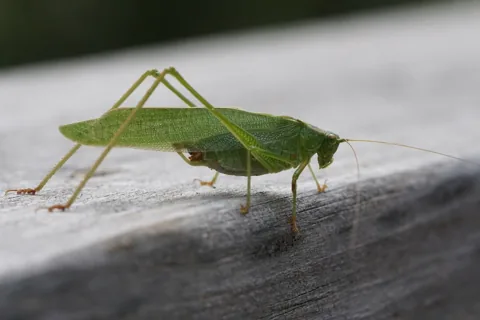 Katydids
Tettigoniidae (shown: Scudderia furcata)
Most katydids nibble a little foliage and move on, but the forktailed bush katydid also chews young fruit, leaving corky scars later.
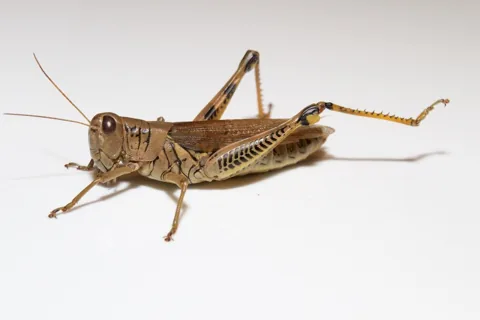 Grasshoppers
Acrididae (e.g., differential grasshopper, Melanoplus differentialis)
Grasshoppers are sporadic garden pests that build up in weedy, uncultivated land and move into yards as nearby vegetation dries out. The differential grasshopper is one of the common, large species that often shows up in gardens first.
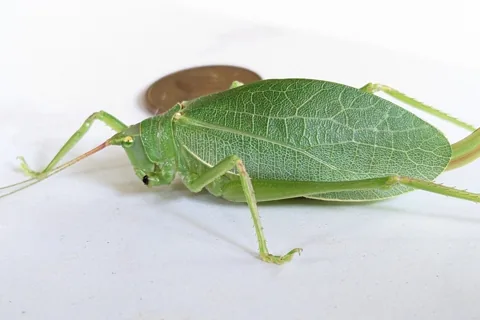 Common True Katydid
Pterophylla camellifolia
The common true katydid is a large leaf-green insect that lives high in trees and fills summer nights with its rasping 'Katy did, Katy didn't' call. It eats tree leaves but rarely causes noticeable damage, it is rarely seen, and no control is needed.
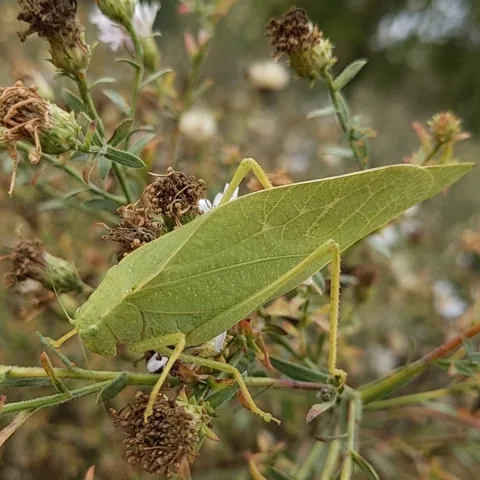 Greater Angle-Winged Katydid
Microcentrum rhombifolium
The greater angle-winged katydid is a large green false katydid whose broad wings make it look like a leaf. Like most katydids it is heard far more often than seen, and it rarely does noticeable harm to plants.
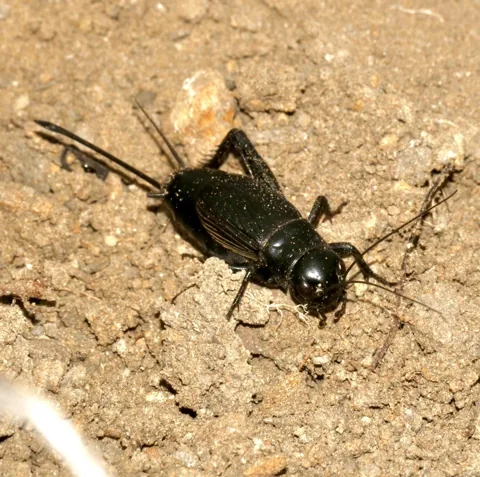 Field Crickets
Gryllus species (e.g., G. pennsylvanicus)
Field crickets are several species in the genus Gryllus that live outdoors in fields, pastures, roadsides and yards. They come into homes most often in late summer and fall, when cooler nights and outdoor lights draw them toward buildings.
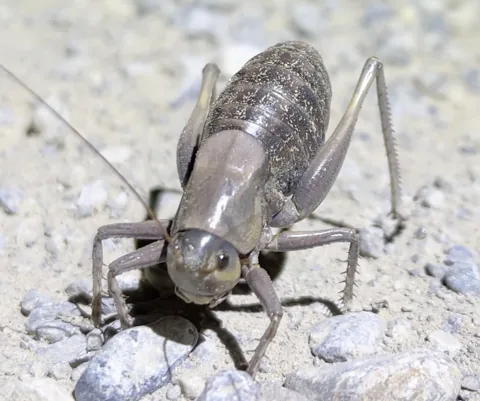 Mormon cricket
Anabrus simplex
The Mormon cricket is not a true cricket but a large, flightless shield-backed katydid of western rangelands. In outbreak years it forms huge bands that walk and hop across the land, eating forage, crops and garden vegetables in their path.
Side by side: katydids and grasshoppers
Each line gives the katydid first, then the grasshopper.[1][2]
- Family: katydids are Tettigoniidae, the long-horned grasshoppers and katydids. Grasshoppers in yards and gardens are mostly Acrididae, the short-horned grasshoppers and locusts.[8][5]
- Antennae: katydid antennae are thread-thin and as long as the body or longer, often much longer. Grasshopper antennae are relatively short and thickened, usually less than half the body length with fewer than 30 segments.[3][1][5][2]
- Color and shape: many katydids are green and shaped like a leaf, with veined wings that look like leaves; a few species can be pink, yellow, orange or tan. Grasshoppers have a robust body and come in many colors, from yellowish olive-green to gray and brown, often with patterned hind legs.[1][4][3][5][2]
- Wings at rest: katydids hold the wings vertically over the body, like the roof of a house.[3]
- Size: UC IPM gives adult angularwinged katydids as about 1-4/5 inches long and broadwinged katydids about 2-1/4 inches, and Missouri says female true katydids reach about 2½ inches. Many garden grasshoppers fall in the same range, so size alone does not separate them.[1][4]
- Feet: katydids have four segments on every foot (tarsus); crickets have three.[3]
- Ovipositor: the female katydid has a flattened blade at the tip of the abdomen, short and curved like a sickle in some species, long and saber-like in others. In some Missouri species it is longer than the rest of her body. The grasshopper has no such blade.[3][4][8]
- Ears: in katydids and crickets the hearing organs are on the tibia of the front legs; in grasshoppers they are on the sides of the first abdominal segment.[8][3][11]
- Song: male katydids make their calls with special structures on the front wings, rasping the wings together. Grasshopper males rasp a file on the inside of the hind leg against a vein on the forewing, or make clacking or buzzing noises in flight.[3][4][5]
- Time of day: katydids rest during the day and feed at night, and most species are nocturnal, though some are active by day and some species sing day and night. Grasshoppers are active in the daytime.[1][3][4]
- Eggs: many katydids lay flat eggs in rows on twigs, insert them into the edges of leaves or lay them in plant stems or the ground. Grasshoppers lay elongated pods of 20 to more than 100 eggs in the upper 2 inches of soil.[1][3][2][7]
- Garden damage: katydids chew one or a few leaves before moving on, and that leaf feeding is not important to plant health. Grasshoppers remove large sections of leaves and flowers and can devour whole plants.[1][3][2]
Listening for them
The sound you hear after dark in late summer is far more likely to be a katydid or a cricket than a grasshopper. In Wisconsin, UW-Madison says katydids generally start late at night and keep calling into the early morning hours in late summer, and the songs slow as the weather cools and usually end by October.[3]
The true katydid is a tree-canopy species that people rarely see but hear rasping loudly on late summer nights. UW-Madison notes that katydids are more often heard than seen, and Missouri lists several species that sing day and night.[4][3]
Grasshopper sounds are a daytime noise: rasping a hind leg against the forewing, or clacking and buzzing in flight. A study of how hearing evolved across the order found that katydids and crickets have ears on the front legs while grasshoppers have them on the abdomen, a split that follows the two main branches of the order.[5][11][8]
Crickets: the third look-alike
Crickets share the katydid's long antennae, as long as the body or longer, and also have their ears on the front legs. Field crickets in the genus Gryllus are usually shiny black rather than green.[9][8][6]
- Ovipositor: a female cricket's is cylindrical or needle-shaped, not a flattened blade like a katydid's. Field cricket females use it to lay eggs in the soil.[8][6]
- Feet: crickets have three segments on each foot; katydids have four.[3]
- Song: male crickets chirp by rubbing rough parts of the wings together, raising the wings at an angle to form a resonating chamber. Crickets are usually active at night.[6][9]
- Tail filaments: field crickets have a pair of thread-like cerci sticking out from the end of the abdomen.[6]
How to confirm which one you have
Look at the antennae first. Antennae that reach past the end of the body mean a katydid or a cricket; short, thick antennae mean a grasshopper. A green, leaf-shaped insect with long antennae is a katydid; a dark, flattened one with long antennae is more likely a cricket.[3][1][5][2][6]
Katydids are easy to overlook on plants because many are green and leaf-shaped. UC IPM says adults sometimes come to lights at night and are easiest to catch in the early morning, while they are still cool and sluggish.[1]
For a female, check the tip of the abdomen: a flat sword or sickle means katydid, a thin needle means cricket, and no blade means grasshopper. Then look on the front leg just below the knee for the katydid's or cricket's ear.[3][8][4]
Check the damage. Katydid feeding on fruit is a single small bite here and there; UC IPM says the wounds heal over and grow into brown, gray or tan, slightly sunken corky patches as the fruit enlarges. Cutworms and earwigs can leave similar shallow round scars. Grasshoppers leave ragged, missing leaves and flowers.[1][2]
Why the difference matters
Most katydids are not worth treating. UC IPM recommends no control for katydids on home fruit bushes and trees, partly because they are usually gone by the time fruit is big enough to show the injury, and the inside of the fruit is little or not at all affected. UW-Madison says katydids rarely cause significant damage to crops or ornamentals.[1][3]
There are exceptions. The forktailed bush katydid can be a pest because it chews young fruit as well as leaves, including citrus and stone fruit, and since it takes one small bite before moving on, a few insects can mark a lot of fruit. In blueberry and pear both adults and nymphs feed on fruit.[1]
Grasshoppers are the real garden threat in outbreak years. UC IPM says populations can build up in foothills and rangeland after a wet spring and then move into gardens, sometimes defoliating everything in sight, and Colorado State says problems tend to start in early summer and can last until a hard frost.[2][7]
One western katydid behaves like a grasshopper: USDA APHIS says the Mormon cricket is a flightless shield-backed katydid, the only katydid species known to hatch outbreak populations in the United States, moving in huge bands that can damage rangeland and crops.[10]
What to do for each
Katydids: usually nothing. Even when a forktailed bush katydid scars fruit, UC IPM generally recommends no control on home fruit trees and bushes.[1]
- Grasshoppers, physical protection: UC IPM says cones, screened boxes and floating row covers give some protection when numbers are low, but hungry grasshoppers chew through cloth or plastic covers, so metal window screening works better.[2]
- Grasshoppers, timing: UC IPM says small nymphs are easier to control than larger ones and adults are very difficult, and that insecticides are best kept for serious situations, ideally as baits around the garden edge before grasshoppers invade. Colorado State says surveys can locate the egg beds where early-season activity starts, and treatments should target the young grasshoppers there.[7][2]
- Grasshoppers, birds: UC IPM says chickens and guinea hens are excellent predators but can also damage some garden plants.[2]
- Crickets indoors: Minnesota recommends cutting weeds and tall grass near the foundation and turning off unneeded lights at night or switching to yellow bulbs.[9]
Common questions
- Is a katydid a kind of grasshopper?
- No. The old name long-horned grasshopper sticks, but UW-Madison says katydids are more closely related to crickets than to grasshoppers. NC State places them in their own family, Tettigoniidae, separate from the short-horned grasshoppers, Acrididae.[3][8]
- Do katydids bite?
- They have chewing mouthparts like grasshoppers, but the sources here describe them only as plant feeders, and in the tropics some prey on other insects. None of them describe katydids as a biting pest of people.[3][1]
- Why do I hear katydids but never see them?
- Many species are green, leaf-shaped and active at night, and the true katydid rarely leaves the tree canopy. Missouri says a chorus is impressive but a single katydid may escape notice.[1][4]
- Is the big green insect in my garden a grasshopper or a katydid?
- Check the antennae. If they are as long as the body or longer and the insect is leaf-shaped, it is a katydid. If they are short and thick, it is a grasshopper.[3][5][2]
- Is a Mormon cricket a cricket?
- No. USDA APHIS calls the Mormon cricket a flightless shield-backed katydid.[10]
Photo credits
- Katydids: (c) Matt Pelikan, some rights reserved (CC BY) — via iNaturalist, CC BY 4.0
- Grasshoppers: (c) Brian Gratwicke, some rights reserved (CC BY) — via iNaturalist, CC BY 4.0
- Common True Katydid: Kirill Levchenko, public domain (CC0), via iNaturalist
- Greater Angle-Winged Katydid: Vasily Reinkymov, public domain (CC0), via iNaturalist
- Field Crickets: (c) Dustin Snider, some rights reserved (CC BY) — via iNaturalist, CC BY 4.0
- Mormon cricket: (c) Nicole Michel, some rights reserved (CC BY) — via iNaturalist, CC BY 4.0
Sources
- University of California Statewide IPM Program, “Katydids.” ipm.ucanr.edu/PMG/GARDEN/FRUIT/PESTS/katydids.html (accessed 2026-11-14)
- University of California Statewide IPM Program, “Pest Notes: Grasshoppers, Publication 74103.” ipm.ucanr.edu/home-and-landscape/grasshoppers/ (accessed 2026-11-14)
- University of Wisconsin-Madison Extension, “Katydids.” hort.extension.wisc.edu/articles/katydids/ (accessed 2026-11-14)
- Missouri Department of Conservation, “Katydids.” mdc.mo.gov/discover-nature/field-guide/katydids (accessed 2026-11-14)
- Missouri Department of Conservation, “Short-Horned Grasshoppers.” mdc.mo.gov/discover-nature/field-guide/short-horned-grasshoppers (accessed 2026-11-14)
- Missouri Department of Conservation, “Field Crickets.” mdc.mo.gov/discover-nature/field-guide/field-crickets (accessed 2026-11-14)
- Colorado State University Extension, “Grasshopper Control in Gardens and Small Acreages.” extension.colostate.edu/resource/grasshopper-control-in-gardens-and-small-acreages/ (accessed 2026-11-14)
- NC State University Department of Entomology, “Order Orthoptera (ENT 425 General Entomology).” genent.cals.ncsu.edu/order-orthoptera/ (accessed 2026-11-14)
- University of Minnesota Extension, “Crickets.” extension.umn.edu/garden-and-home/home-maintenance/household-insects/crickets (accessed 2026-11-14)
- USDA APHIS, “Grasshoppers and Mormon Crickets: Western FAQs.” www.aphis.usda.gov/plant-pests-diseases/ghmc/grasshoppers-mormon-crickets-western-faqs (accessed 2026-11-14)
- Nature Communications (PMC7532154), “Song H et al. 2020. Phylogenomic analysis sheds light on the evolutionary pathways towards acoustic communication in Orthoptera. Nature Communications 11:4939.” pmc.ncbi.nlm.nih.gov/articles/PMC7532154/ (accessed 2026-11-14)