The short answer
- Look at it from the side: a camel cricket has a humped back, with the head bent down between the front legs. A house cricket has no hump, and its wings lie flat over its back.[8][5][4][6]
- Wings: adult house crickets have long, pointed wings. Camel crickets have no wings at any age.[6][1][7][3]
- Color pattern: a house cricket is light yellowish-brown with three dark bands across the head. Camel crickets are tan to dark brown, often with dark bands on some body segments.[6][4][8][9]
- Sound and place: chirping means a winged cricket, such as a house or field cricket; camel crickets can't chirp. Camel crickets gather in damp basements, crawl spaces and garages, while house crickets favor warm spots and come to lights.[7][3][5][4][6]
Profiles on this site
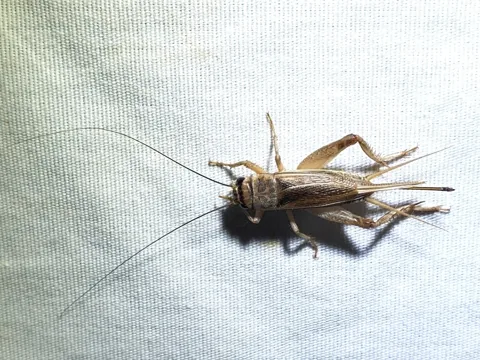 House Cricket
Acheta domesticus
The house cricket is a light brown cricket that is common outdoors, strongly attracted to light and often found inside houses, especially in late summer and fall.
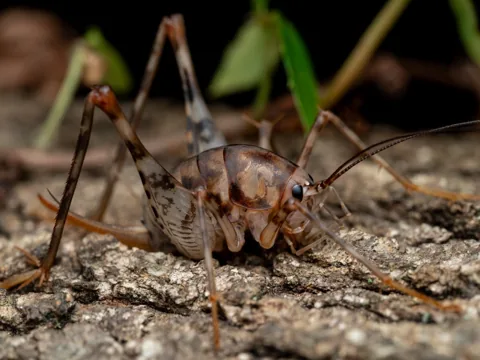 Camel Cricket
Rhaphidophoridae (shown: Tachycines asynamorus)
Camel crickets, also called cave crickets, are humpbacked, wingless crickets that live in cool, damp, dark places and often turn up in basements, crawl spaces and garages. They are a nuisance, not a danger.
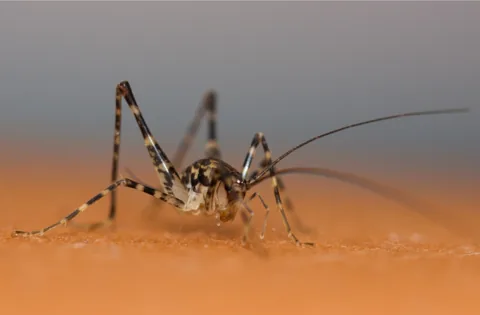 Japanese camel cricket
Diestrammena japanica
The Japanese camel cricket (Diestrammena japanica) is a wingless, humpbacked Asian cricket of damp basements, garages and crawl spaces in the northeastern United States. The sources treat camel crickets as a household nuisance. To get rid of them, dry out damp areas, seal entry points, vacuum up the crickets and set sticky traps.
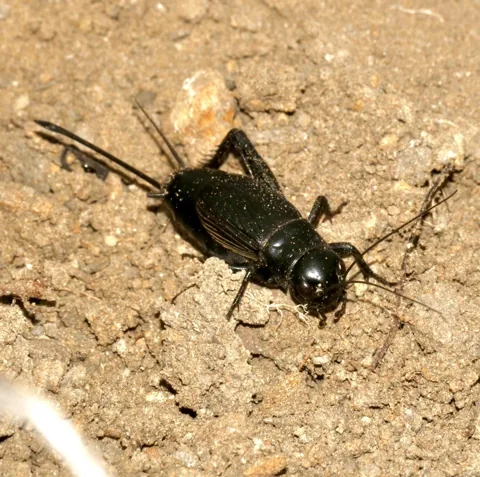 Field Crickets
Gryllus species (e.g., G. pennsylvanicus)
Field crickets are several species in the genus Gryllus that live outdoors in fields, pastures, roadsides and yards. They come into homes most often in late summer and fall, when cooler nights and outdoor lights draw them toward buildings.
Side by side
Each line gives the house cricket first, then the camel cricket.[1][3]
- What they are: the house cricket (Acheta domesticus) is a true cricket in the family Gryllidae, the same group as field crickets. Camel and cave crickets belong to a different family, Rhaphidophoridae.[1][2][10]
- Size: UF/IFAS gives the house cricket 16 to 21 mm (5/8 to 7/8 inch), Minnesota about 3/4 inch, Missouri Extension 0.75 to 1 inch and the Missouri Department of Conservation 1/2 to 3/4 inch. For camel crickets Minnesota gives about 3/4 inch, the Missouri Department of Conservation up to about 1 inch, and Missouri Extension, Clemson and Cornell Cooperative Extension Nassau County 1/2 to 1 1/2 inches.[1][6][8][2][3][5][9]
- Color: house crickets are light yellowish-brown or tan with three dark crossbands on the head. Camel crickets are light tan to dark brown, sometimes reddish brown, and can look black in the dark places they live; Missouri Extension says they often have dark bands on some body segments, and the Nassau County sheet says some look banded.[1][2][4][3][5][8][9]
- Body shape: the house cricket has a large head, like a field cricket, and no hump. The camel cricket is humpbacked when seen from the side, with the head bent down between the front legs, which gives it its name.[2][8][5][3]
- Wings: adult house crickets have wings that cover the abdomen and are held flat over the back, with long hind wings that are sometimes shed later. Camel crickets have no wings and can't fly.[1][4][6][3][7]
- Legs and antennae: both have big jumping hind legs. Camel crickets have very long legs and antennae much longer than the body, which make them look spider-like and earned them the name spider crickets.[2][5][7][3]
- Females: both carry an egg-laying tube at the tip of the abdomen. The house cricket's is needle-like; on a camel cricket it can be more than half the body length.[2][9]
- Young: in both, nymphs look like small adults. House cricket nymphs have no wings yet, and camel cricket females don't show a developed egg-laying tube until they mature.[4][1][5][9]
- Sound: male house crickets chirp by rubbing a scraper on one wing against a file on the other; UF/IFAS describes the calling song as a series of short chirps. Camel crickets are wingless and can't chirp.[1][2][3][7][8]
- Light: house crickets are strongly attracted to light. Camel crickets aren't.[6][8]
- Where indoors: house crickets look for warmth; in winter Clemson finds them near fireplaces, kitchens, water heaters and furnaces. Camel crickets look for cool, damp, dark places such as basements, crawl spaces, garages and laundry rooms.[4][6][5][7][9]
- Activity: both are mostly active at night. Camel crickets are almost entirely nocturnal and can jump a surprisingly long distance.[4][3][5]
- Season: cooler temperatures drive house crickets indoors. Camel crickets come in to spend the winter, or when it's too dry or hot outside.[8][9][5]
- Breeding indoors: Missouri Extension says all stages of the house cricket can live in buildings year-round, and Clemson says they can lay many eggs inside. For camel crickets the sources differ: the Missouri Department of Conservation says they're unlikely to breed indoors unless darkness and moisture are just right, while Clemson says they may breed year-round in greenhouses and other warm places and the Nassau County sheet says they can breed through the year indoors.[8][4][3][5][9]
- Damage: house crickets can chew cotton, linen, wool, silk and fur, especially items soiled by food or sweat. Sources differ on camel crickets: Minnesota says they rarely feed on fabric and sometimes eat paper, and the Missouri Department of Conservation calls them completely harmless, while Clemson says they can damage fine fabrics and houseplants and NC State says garments and linens stored in boxes can be damaged if a problem goes on.[8][4][6][3][5][7]
- Where they came from: UF/IFAS says the house cricket is probably native to southwestern Asia, spread by people, and is also sold in bait and pet stores. North American homes host native camel crickets and Asian species; a continent-wide citizen-science survey found the Asian Diestrammena asynamora in eastern houses far more often than native camel crickets.[1][2][10]
How to confirm which one you have
Catch one and look at it from the side. NC State recommends sticky boards, the kind used for cockroaches and mice, in corners and behind appliances, and Clemson suggests traps around entry points. Missouri Extension notes the camel cricket's humpbacked look shows when it's viewed from the side.[7][6][4][8]
Then check three things: wings on the back (house cricket) or none (camel cricket); three dark bands across a yellowish-brown head (house cricket); and legs and antennae so long the insect looks spider-like (camel cricket).[6][4][8][7]
If the cricket is winged but black or dark brown rather than yellowish-brown, it's probably a field cricket. Field crickets are usually black, and they're controlled the same way as house crickets.[6][8][7]
Listen at night. NC State says chirping indoors most likely means field crickets; camel crickets never make it.[7][3]
Note where you found it. Indoors, camel crickets often turn up in damp basements, crawl spaces and garages, and Missouri's conservation department says a lot of them in a basement can point to a moisture problem.[5][3][7]
Telling native camel crickets from the Asian greenhouse camel cricket or the Japanese camel cricket takes a closer look; the camel cricket and Japanese camel cricket profiles linked below cover those.[10]
Why it matters
The fixes are different. Light draws house crickets, so cutting outdoor lighting or switching to yellow bulbs helps against them, but camel crickets aren't attracted to light, so it does nothing for them.[6][4]
Moisture is what draws camel crickets. Minnesota says a fan or dehumidifier is especially effective against them, and Clemson calls cutting down moist habitat essential for long-term control.[6][5]
House crickets are the bigger fabric risk, and they're the one that can live and breed inside, in warm parts of a building, year-round.[8][4][6]
What to do about each
Both: vacuum up the ones you see, set sticky traps, and seal cracks and gaps in the foundation and around doors and ground-level windows. Cornell Cooperative Extension Nassau County suggests throwing out the vacuum bag afterward.[4][6][7][9]
House crickets: turn off lights you don't need at night, or use yellow or sodium vapor bulbs that attract fewer insects. Cut weeds and tall grass near the foundation, and look for them in warm spots such as around the water heater and furnace, where Clemson says they gather in winter.[6][4]
Camel crickets: dry out basements and crawl spaces with a fan or dehumidifier, and fix leaks. NC State says to keep ground cover and mulch at least 12 inches from the foundation, and Clemson says to keep moisture-holding plantings away from the house.[6][7][5][9]
Either one: insecticides come last. Minnesota says pesticides generally aren't effective or necessary indoors, and Clemson says to use them indoors only for a large infestation. The cricket control guide covers baits and labeled perimeter treatments.[6][4]
Common questions
- Do camel crickets chirp?
- No. Camel crickets have no wings, so they can't chirp. A chirp indoors is a winged cricket, usually a field or house cricket.[3][7][8]
- Are camel crickets the same as spider crickets?
- Yes. Spider cricket is another common name for camel and cave crickets, from their long legs and antennae. They're crickets, not spiders.[3][7]
- Can house crickets live in my house all winter?
- Yes. Missouri Extension says all stages of the house cricket can live in buildings year-round, and Clemson says they settle near fireplaces, kitchens, water heaters and furnaces in winter.[8][4]
- Which one eats clothes?
- House crickets are the main fabric feeders, chewing cotton, linen, wool, silk and fur, especially soiled items. Camel crickets rarely do, though Clemson and NC State say they can damage fabrics and stored linens in some cases.[8][4][6][5][7]
- Why are camel crickets in my basement?
- They seek cool, damp, dark places. A lot of them can point to a moisture problem, so drying the area out is the main fix.[6][3][5]
Photo credits
- House Cricket: (c) Bob Miller, some rights reserved (CC BY) — via iNaturalist, CC BY 4.0
- Camel Cricket: (c) Zachary Dankowicz, some rights reserved (CC BY) — via iNaturalist, CC BY 4.0
- Japanese camel cricket: (c) Christopher Eliot, some rights reserved (CC BY) — via iNaturalist, CC BY 4.0
- Field Crickets: (c) Dustin Snider, some rights reserved (CC BY) — via iNaturalist, CC BY 4.0
Sources
- UF/IFAS Extension, “EENY-063/IN220: House Cricket, Acheta domesticus.” ask.ifas.ufl.edu/publication/IN220 (accessed 2026-11-14)
- Missouri Department of Conservation, “House Cricket.” mdc.mo.gov/discover-nature/field-guide/house-cricket (accessed 2026-11-14)
- Missouri Department of Conservation, “Camel Crickets (Cave Crickets).” mdc.mo.gov/discover-nature/field-guide/camel-crickets-cave-crickets (accessed 2026-11-14)
- Clemson Cooperative Extension Home & Garden Information Center, “House and Field Crickets (HGIC 2425).” hgic.clemson.edu/factsheet/house-and-field-crickets/ (accessed 2026-11-14)
- Clemson Cooperative Extension Home & Garden Information Center, “Camel Crickets (HGIC 2405).” hgic.clemson.edu/factsheet/camel-crickets/ (accessed 2026-11-14)
- University of Minnesota Extension, “Crickets.” extension.umn.edu/garden-and-home/home-maintenance/household-insects/crickets (accessed 2026-11-14)
- NC State Extension, “Camel Crickets.” content.ces.ncsu.edu/camel-crickets (accessed 2026-11-14)
- University of Missouri Extension, “House-Invading Crickets (G7366).” extension.missouri.edu/publications/g7366 (accessed 2026-11-14)
- Cornell Cooperative Extension Nassau County, “Cave (Camel) Crickets (Home Grounds Fact Sheet).” ccenassau.org/resources/cave-camel-crickets (accessed 2026-11-14)
- PeerJ, via PubMed, “Too big to be noticed: cryptic invasion of Asian camel crickets in North American houses (Epps et al. 2014).” pubmed.ncbi.nlm.nih.gov/25210654/ (accessed 2026-11-14)