The short answer
- Count the legs. A house centipede has up to 15 pairs of long, banded legs that stick out all around it. A silverfish is an insect, and UC IPM notes insects have three pairs of legs, all on a flat, compact body.[1][2][3][7]
- Look at the color and shape. House centipedes are dirty yellow to grayish-brown with three dark stripes down the back. Silverfish are silver or pearly gray, covered in tiny scales, and taper from head to tail, which gives them a fishlike look.[1][2][7][9]
- Check the ends. A silverfish has two long antennae in front and three long, thin tail bristles at the back. A house centipede has very long antennae and, on adult females, a last pair of legs nearly twice the length of its body, so both ends look like legs.[7][9][1][2]
Profiles on this page
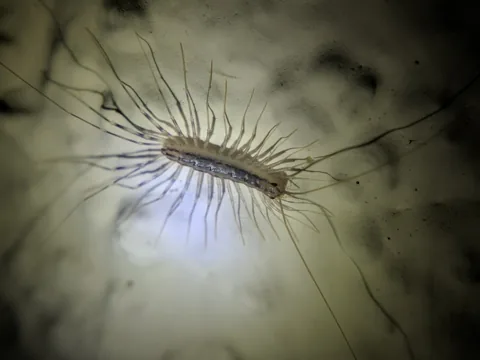 House Centipede
Scutigera coleoptrata
House centipedes are fast, long-legged predators that live in damp parts of buildings and feed on silverfish, cockroaches, carpet beetle larvae and other small arthropods; they are largely harmless.
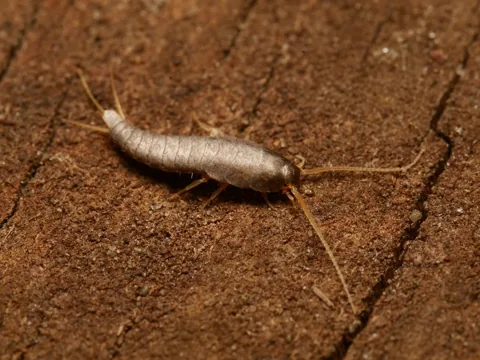 Silverfish
Lepisma saccharinum
Silverfish are nocturnal, wingless insects that hide by day and graze at night on paper, book bindings, starch in clothing and dry foods, preferring damp, warm places such as laundry rooms.
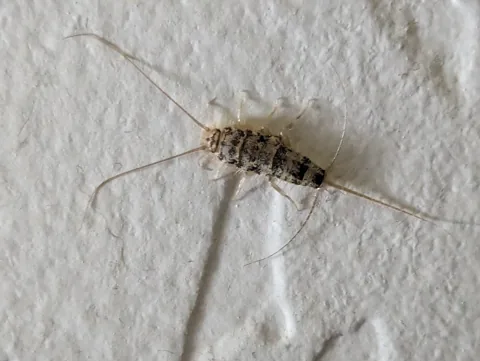 Firebrat
Thermobia domestica
Firebrats are close relatives of silverfish that thrive in very warm spots such as around ovens, furnaces, fireplaces and hot water pipes, grazing on paper, starch and dry foods. They're mostly a nuisance pest.
Side by side
What they are: the house centipede is a centipede, not an insect, with one pair of legs per body segment. Silverfish are wingless, soft-bodied insects in the order Thysanura.[3][4][7][6]
- Size: Penn State gives the house centipede's body as one to one and one-half inches long, but its legs and antennae make it look three to four inches long overall. UC IPM puts the common silverfish at about 1/2 inch, up to 3/4 inch; Ohio State gives ⅓ to ¾ inch and Penn State up to 12 mm.[1][2][7][9][6]
- Legs: adult house centipedes have 15 pairs of legs, banded light and dark, and Kentucky calls them spindly. Silverfish have the three pairs of legs every insect has.[1][2][3]
- Body and color: the house centipede's body is dirty yellow (Kentucky says grayish-brown to yellowish-brown) with three dark stripes running lengthwise. Silverfish are shiny silver or pearl gray from tiny scales, broad near the head and tapering toward the rear. Firebrats, their close relative, are mottled gray or brown.[1][2][7][9]
- Front and back: house centipedes have long, thin antennae and long ultimate legs at the rear. Silverfish have two slender antennae nearly as long as the body, and three long, antenna-like appendages at the tip of the abdomen.[2][1][9][7]
- Movement: house centipedes can run very quickly across floors and up walls. Silverfish are fast-moving too, but they stay low and flat, and Ohio State says they sometimes end up stuck in a bathtub, sink or washbasin they can't climb out of.[2][1][9]
- Where indoors: both like damp places. House centipedes hide in dark, damp spots by day, often basements and bathrooms, though Kentucky says they can turn up in any room. Silverfish live in damp, cool places such as basements, bathrooms, kitchens and laundry rooms, preferring 75 to 95 percent relative humidity.[1][2][4][9]
- Life indoors: Ohio State says the house centipede can live its whole life indoors, and Penn State says it doesn't survive Pennsylvania winters outdoors but reproduces readily in heated buildings. Silverfish also live and breed indoors, and Clemson says they are usually brought in with food, books, paper, starched clothing and furniture.[4][1][8]
- Lifespan: Penn State says female house centipedes can live several years and produce up to 150 young. Penn State says silverfish live at least two to three years; Clemson and Ohio State say adults may live two to eight years.[1][6][8][9]
- Food: house centipedes hunt silverfish, firebrats, carpet beetle larvae, cockroaches, spiders and other small arthropods. Silverfish eat starchy and dry materials such as glue, wallpaper paste, book bindings, paper, cereals, flour and starch in clothing, and Penn State notes they also take protein foods and dead insects.[1][2][7][9][6]
- Damage: house centipedes are predators of other arthropods, and Penn State says they are of little concern to homeowners. Silverfish can leave irregular chewed patches or holes in paper, books, wallpaper and starchy fabrics.[1][8][6][7]
- Bites: Kentucky says house centipedes pose a minimal bite hazard because their fang-like front legs are so small they have trouble piercing human skin. Silverfish have very weak jaws; UC IPM says they scrape the surface of paper rather than bite it, and Ohio State says they are generally considered harmless.[2][4][7]
How to confirm which one you have
If it ran off before you saw it well, set out cockroach sticky traps around the house. UC IPM recommends them for detecting silverfish, and Penn State and Ohio State recommend them in homes with house centipedes.[7][1][4][9]
- UC IPM also describes a jar trap for silverfish: a small glass jar wrapped on the outside with masking tape. They climb the tape, fall in and can't climb the slick glass.[7]
- For a photo, get the whole animal in the frame from above. Long legs reaching out past the body on every side mean house centipede. A compact, silvery body with three tail bristles means silverfish or firebrat.[1][2][7][9]
- Look under damaged books, papers or stored clothes. UC IPM says silvery, dustlike scales stuck around or beneath damaged items are a good sign silverfish or firebrats did it. House centipedes feed on other arthropods, not on household materials.[7][1]
- If a silverfish-shaped insect is mottled brown and lives near a furnace, oven or boiler, it is more likely a firebrat, which prefers places above 90°F (see our silverfish vs firebrats guide).[9][7]
Why the difference matters
Silverfish are a pest in their own right because of what they chew. House centipedes are a sign of something else: Penn State says frequent sightings mean some prey arthropod is plentiful, which may be a bigger problem than the centipedes. Seeing both is not unusual, since silverfish are on the centipede's menu.[1][6][8]
- For silverfish, the target is the damp, the food and the hiding spots. Clemson and Penn State both advise lowering humidity with dehumidifiers, sealing cracks and clearing out old papers, books and fabrics.[8][6][9]
- For house centipedes, the target is moisture and their prey. Penn State recommends sticky monitors to find out which arthropods they are feeding on, then dehumidifiers and sealing cracks.[1][4]
- Indoor sprays are rarely the answer for either. Kentucky says pesticides inside the home are rarely needed for centipedes, and Ohio State says insecticides are generally not needed for silverfish.[2][9]
What to do about each
Both: dry the house out. Ohio State recommends ventilating basements and crawl spaces and using a dehumidifier for centipedes, and dehumidifiers and fans for silverfish. Penn State recommends dehumidifiers for both.[4][9][1][6]
- Both: seal gaps. Kentucky recommends caulk, door sweeps and weather stripping to keep centipedes out, and Penn State recommends caulk, spackle or expandable foam to close openings silverfish use. Penn State also suggests screening basement floor drains and sump covers against house centipedes.[2][6][1]
- House centipedes: sweep them up, vacuum them or catch them on glue traps, and reduce mulch, woodpiles and leaf litter near the foundation. Ohio State suggests a strip about three feet wide cleared of litter around the house.[4][2][3]
- Silverfish: vacuum carpets, floors and upholstered furniture, keep dry foods in containers with tight lids, clean out closets, cabinets and storage containers now and then, and keep basements, laundry rooms and bathrooms clean and dry. Sticky traps help with small numbers.[6][7][9][8]
- If you do treat: Penn State says boric acid and diatomaceous earth dusts placed in cracks and crevices are options for house centipedes. For silverfish in wall voids, Clemson says control may take 10 to 14 days because the insects have to come out and contact the product. Follow the label.[1][8]
If a house centipede bites
MedlinePlus says some centipede bites can be very painful but are not fatal and usually need nothing beyond managing the symptoms. Wash the area with plenty of soap and water, not alcohol.[5]
- Put ice wrapped in a clean cloth on the bite for 10 minutes, then off for 10 minutes. MedlinePlus says an emergency room visit may not be needed unless the person has an allergic reaction, but to contact poison control to be sure: 1-800-222-1222 anywhere in the United States, or call 911 in an emergency.[5]
Common questions
- Do house centipedes eat silverfish?
- Yes. Penn State and Kentucky both list silverfish among the house centipede's prey, along with cockroaches, carpet beetle larvae and spiders.[1][2]
- Are silverfish a kind of centipede?
- No. Silverfish are wingless insects with three pairs of legs. Centipedes are not insects; they have one pair of legs on each of many body segments.[7][3][4]
- Is either one dangerous?
- Neither is considered a threat. Penn State calls house centipedes harmless, and Kentucky says their fangs have trouble piercing human skin. Ohio State says silverfish are generally considered harmless, though they damage paper, dry food and clothing.[1][2][9]
- Should I leave house centipedes alone to eat the silverfish?
- They do eat silverfish, but a lot of house centipedes means a lot of prey. Penn State says to find and deal with whatever they are feeding on and to cut the humidity that draws both.[1]
Photo credits
- House Centipede: Danijel Ostović, public domain (CC0), via iNaturalist
- Silverfish: (c) Alexis Tinker-Tsavalas, some rights reserved (CC BY) — via iNaturalist, CC BY 4.0
- Firebrat: (c) Rachel Stringham, some rights reserved (CC BY) — via iNaturalist, CC BY 4.0
Sources
- Penn State Extension, “House Centipedes.” extension.psu.edu/house-centipedes (accessed 2026-11-14)
- University of Kentucky Entomology, “Centipedes and Millipedes (EF645).” entomology.ca.uky.edu/ef645 (accessed 2026-11-14)
- University of California Statewide IPM Program, “Pest Notes: Millipedes and Centipedes.” ipm.ucanr.edu/PMG/PESTNOTES/pn7472.html (accessed 2026-11-14)
- Ohio State University Extension, “Centipedes (ENT-50).” ohioline.osu.edu/factsheet/ENT-50 (accessed 2026-11-14)
- MedlinePlus, U.S. National Library of Medicine, “Centipede bite.” medlineplus.gov/ency/article/002842.htm (accessed 2026-11-14)
- Penn State Extension, “Bristletails: Silverfish and Firebrats.” extension.psu.edu/bristletails-silverfish-and-firebrats (accessed 2026-11-14)
- University of California Statewide IPM Program, “Silverfish and Firebrats.” ipm.ucanr.edu/home-and-landscape/silverfish-and-firebrats/ (accessed 2026-11-14)
- Clemson Cooperative Extension Home & Garden Information Center, “Silverfish & Firebrats.” hgic.clemson.edu/factsheet/silverfish-firebrats/ (accessed 2026-11-14)
- Ohio State University Extension, “Silverfish and Firebrats (ENT-64).” ohioline.osu.edu/factsheet/ENT-64 (accessed 2026-11-14)