The short answer
- Color: the common silverfish is shiny silver or pearl gray. The firebrat is mottled gray or brown, from tufts of brown scales or dark spots and stripes on dull gray scales.[1][6][2][7][5]
- Where you find it: silverfish turn up in damp rooms such as basements, bathrooms, laundry rooms and kitchens. Firebrats live in hot spots, above about 90°F, near furnaces, ovens, fireplaces, boilers and hot water pipes, and in attics in summer.[3][5][7][1][2]
- Antennae: Penn State and Maine describe the silverfish's antennae as about as long as its body and the firebrat's as longer than its body.[2][7]
- Damage and control are nearly the same for both. The main difference is where you look and which part of the house you dry out or seal.[1][4][5]
Insects on this page
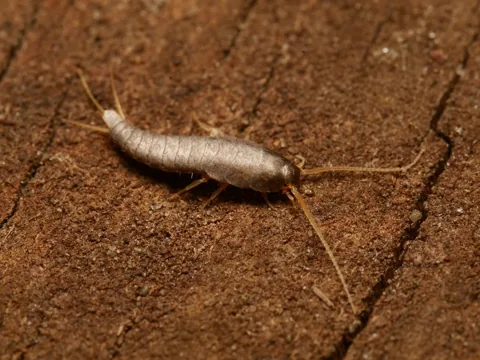 Silverfish
Lepisma saccharinum
Silverfish are nocturnal, wingless insects that hide by day and graze at night on paper, book bindings, starch in clothing and dry foods, preferring damp, warm places such as laundry rooms.
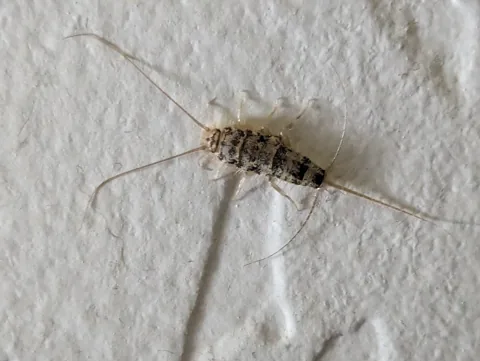 Firebrat
Thermobia domestica
Firebrats are close relatives of silverfish that thrive in very warm spots such as around ovens, furnaces, fireplaces and hot water pipes, grazing on paper, starch and dry foods. They're mostly a nuisance pest.
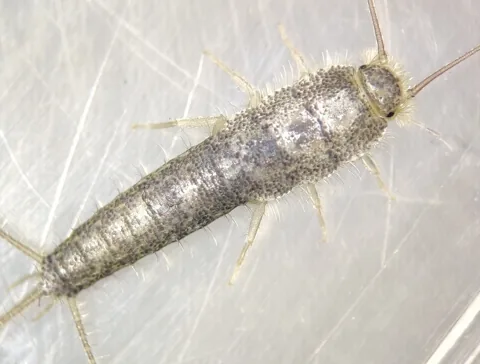 Long-tailed silverfish
Ctenolepisma longicaudatum
The long-tailed silverfish, Ctenolepisma longicaudatum, also called the gray silverfish or paperfish, is a large indoor silverfish that tolerates drier rooms than the common silverfish. It eats paper, book bindings, photos and cotton, and in recent years it has spread quickly in Europe, turning up in homes, museums and archives.
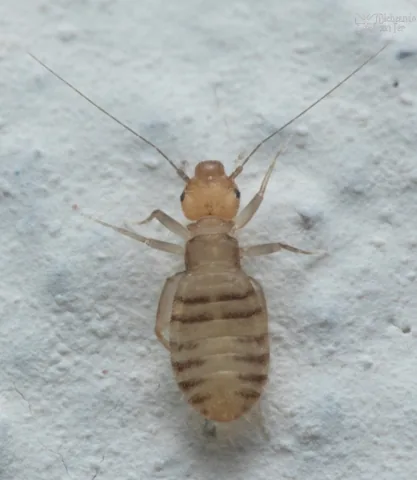 Booklice
Liposcelis species and other psocids (family Liposcelididae)
Booklice, also called psocids, are tiny insects that feed on mold and fungi. Finding them indoors usually means high humidity or a moisture problem, and drying things out is the most effective control.
Side by side
Both insects belong to the order Zygentoma, still called Thysanura in many fact sheets. Penn State notes that they are also called bristletails, fishmoths, tasseltails or fringetails because of the three tail-like appendages at the tip of the abdomen.[6][5][2][3]
- Shape: both have flat, wingless, elongated bodies that are broad near the head and taper toward the rear, which gives them a fishlike look. Both have two long, slender antennae in front and three long, thin tails behind.[3][4][1][6]
- Size: the two are about the same size. UC IPM puts each at about 1/2 inch, with silverfish growing to 3/4 inch. Penn State gives silverfish up to 12 mm, Florida gives adults of both as 1/3 to 1/2 inch (8 to 13 mm), and Ohio State and Clemson give ranges of 1/3 to 3/4 and 1/2 to 3/4 inch.[1][2][6][3][4]
- Silverfish color: shiny, silver or pearl gray. Penn State and Maine describe silvery-metallic scales covering the body, and the Connecticut station says the scales give a slightly metallic, silvery look.[1][6][2][7][5]
- Firebrat color: shiny, mottled gray or brown. Penn State and Maine describe tufts of brown scales that make the mottled pattern. Ohio State calls firebrats generally a duller gray than silverfish, and the Connecticut station says their dull gray scales are usually marked with darker spots or stripes.[1][6][2][7][3][5]
- Antennae: as long as the body on the silverfish, longer than the body on the firebrat, according to Penn State and Maine.[2][7]
- Young: both hatch looking like small adults. UC IPM says newly hatched nymphs are about 1/16 inch long, plump, white and scaleless, and nymphs under about 1/8 inch lack scales, so a tiny white one can't be sorted by color.[1][4][6][3]
- Temperature: silverfish prefer cooler places than firebrats. UC IPM gives silverfish areas such as laundry rooms at 71° to 90°F. Firebrats prefer places above 90°F, and UC IPM gives their optimum as 98° to 102°F.[1][2][5][3]
- Humidity: silverfish need a lot of moisture. Ohio State gives a preference of 75 to 95 percent relative humidity, and UC IPM says that at higher temperatures silverfish need humidity above 75%. Penn State says firebrats are more resistant to dry air. Sources split on how damp firebrat spots are: UC IPM says firebrats thrive in very warm, dry places with relative humidity as low as 30%, while Ohio State and Connecticut describe their spots as hot or warm and humid.[1][3][2][5]
- Where in the house, silverfish: basements, bathrooms, kitchens and laundry rooms, shower stalls and other damp spots. Ohio State, Penn State and the Connecticut station all describe them as liking cool, damp places, while UC IPM calls their spots damp and warm.[3][7][5][2][1]
- Where in the house, firebrats: around ovens, furnaces, boiler rooms, fireplaces, heating units and ducts, hot water or steam pipes and the insulation around them, and attics in summer. Penn State adds roofing shingles, and Ohio State notes they can infest houses with shake roofs.[3][1][6][2][5][7]
- Habits: both are fast-moving and active at night and hide in cracks and crevices by day. People usually see them when they open a cabinet or move a book or box they were hiding under.[3][5][4][1]
- Life span: UC IPM says firebrats live about 2 years and silverfish about 3. Clemson says adult silverfish may live two to eight years.[1][4]
- Eggs: firebrats lay about 50 eggs at a time in batches, while a female silverfish lays about 100 eggs in a lifetime. UC IPM says firebrat eggs hatch in about 14 days and silverfish eggs in about 19 to 32 days.[3][4][6][1][2]
Gray silverfish and jumping bristletails
Gray silverfish (Ctenolepisma longicaudatum): a silverfish that has spread through European homes, museums and archives. Peer-reviewed surveys from Czechia, the UK and northern Europe describe it as tolerant of low indoor humidity and temperatures, with a much lower moisture demand than the common silverfish, and able to survive long periods without food.[8][9]
- Gray silverfish damage: the same surveys list it as a pest of paper and stored materials, feeding on paper, book bindings, books, wallpaper, papier-mâché, photos and other starchy or cellulose materials.[8][9]
- Jumping bristletails (order Archaeognatha, also called Microcoryphia): outdoor relatives with the same three tails and scaly body. The body is arched in the front half, and the large compound eyes meet on top of the head. They live in leaf litter, under bark and wood and in rocky places, and they eat algae, lichens and fungi.[11][10]
- The easy test for a jumping bristletail is that it jumps. The University of Wisconsin-Milwaukee field station says they leap six inches and more, which silverfish can't do, and the British Columbia E-Fauna says that unlike the domesticated silverfish and firebrats, the bristletails there live outdoors. The field station calls them blameless and not house pests.[10][11]
Damage: the same for both
Food: both insects come out at night for food and water and prefer dry foods such as cereals, flour, pasta and pet food, along with paper with glue or paste, sizing in paper including wallpaper, book bindings and starch in clothing. Their gut enzymes can digest cellulose.[1][6][4]
- Fabrics: Ohio State lists cotton, linen and rayon fabrics and starch in clothing, and Clemson lists linen and rayon. Penn State says silverfish and firebrats don't feed on wool or other animal products, which helps separate their damage from clothes moth or carpet beetle damage.[3][4][2]
- Protein: although most people think of book bindings and starch, Penn State says they actually prefer dried beef, beef extract, dead insects and other high-protein items. Ohio State and Clemson also list dried meats, and Ohio State adds leather and dead insects.[2][3][4]
- What paper damage looks like: their jaws are weak, so they scrape the surface rather than bite through it. Feeding usually starts in one spot and spreads as unconnected, irregular holes. Over time the Connecticut station describes a thinning of the material, with heavily damaged paper or fabric turning tissue-like with ragged holes.[1][5]
- Firebrat damage on paper, per UC IPM: large dark spots from feeding, gray areas and missing letters from grazing, dark brown spots from fungi, and lighter brown spots from scales and droppings.[1]
- Health: Ohio State says they are generally considered harmless, a nuisance and a pest of paper, dried foods and clothing rather than a danger.[3][2]
How to confirm which one you have
Note the spot. A silvery insect in a damp basement, bathroom or laundry room points to silverfish. A mottled one near the furnace, water heater, oven, fireplace or hot pipes, or in a hot summer attic, points to firebrats.[3][5][1][2]
- Look for scales. UC IPM says the scales are delicate, dustlike, slightly shiny in light and stick to most surfaces, and finding them around or under damaged items is a good sign these insects did the damage.[1]
- Trap one. UC IPM suggests cockroach sticky traps to detect and monitor them, or small glass jars wrapped on the outside with masking tape: the insects climb the tape, fall in and can't climb the slick sides. Place traps in corners and along edges, and Ohio State says sticky traps also give some control of small populations.[1][3]
- Check sinks and tubs. Silverfish and firebrats found in a bathtub, sink or washbasin fell in and can't climb out.[3][1]
- Check the color on a larger one. Newly hatched nymphs of both are white and have no scales, so a tiny white one can't be sorted until it grows.[1][4]
- If the insect is tiny, soft and pale with no tails, it may be a booklouse instead. Florida describes booklice as small, soft-bodied insects usually under 1/16 inch long.[6]
Why the difference matters
You dry out or fix different parts of the house. Silverfish point to damp rooms, plumbing leaks and wet basements and bathrooms. Firebrats point to the hot spots around heating equipment, hot pipes and attics.[1][3][5][2]
- Some dusts work differently on each. UC IPM says several inorganic dusts containing boric acid are ineffective against firebrats, while some inorganic dusts with synergized pyrethrin, including certain boric acid or silica gel products, are very effective against both if applied directly on the pests.[1]
- Gray silverfish need much less moisture than the common silverfish, so they can survive in dry, centrally heated buildings, including archives, libraries and museums.[8][9]
What to do: moisture control first
Remove the water first. UC IPM says it is almost impossible to control large populations unless dripping water and moist surfaces are gone. Fix plumbing leaks and keep basements, laundry rooms, bathrooms and shower stalls clean and dry.[1][5]
- Lower the humidity. Ohio State and Clemson recommend dehumidifiers and fans, and UC IPM says fan ventilation can bring humidity down to a level silverfish can't tolerate. Penn State suggests dehumidifiers in damp basements, plastic sheeting over the ground in dirt crawl spaces, and ridge vents so humid attic air escapes.[3][4][1][2]
- For firebrats, look at the hot spaces: the areas around furnaces, water heaters, ovens, fireplaces and hot water pipes, and attics. Penn State notes they reach hiding spots through cracks behind baseboards, window and door trim and holes where pipes pass through walls and floors, so seal those.[3][2][5]
- Cut the food and clutter. Clear out old stacks of papers, magazines, books and fabrics and unused cardboard boxes, keep food in containers with tight lids, and store valuable papers and fabrics in dry, airtight containers.[4][5][1]
- Vacuum to remove the insects and their food, then treat cracks and crevices only if needed. Expect it to be slow: Clemson says control may take 10 to 14 days because insects in wall voids have to come out and contact the product.[6][5][4][3]
- Skip foggers. UC IPM says foggers aren't recommended for silverfish and firebrats. Sources differ on baits: UC IPM says baits aren't very successful because the insects tend not to feed on them, while Florida lists fine granular boric acid baits as an option.[1][6]
Common questions
- Are silverfish and firebrats the same thing?
- No. They are two different species in the same group. The common silverfish is Lepisma saccharina and the firebrat is Thermobia domestica. They look very similar, but the firebrat is mottled and lives in hotter places.[2][3][1]
- Do silverfish or firebrats bite?
- No. Their jaws are weak and they scrape at paper rather than biting through it. Ohio State considers them generally harmless.[1][3]
- Why do I see them in the bathtub?
- They fell in while looking for food or water and can't climb the slippery sides. They did not come up the drain.[3][1]
- Will a dehumidifier get rid of firebrats?
- Less reliably than silverfish. Penn State says firebrats are more resistant to dry conditions, and UC IPM says they can thrive at relative humidity as low as 30%. For firebrats, also focus on the hot areas they live in and seal the cracks they use.[2][1]
- Do silverfish eat clothes?
- They can damage cotton, linen and rayon and eat starch in clothing, but Penn State says they don't feed on wool or other animal products. Holes in wool point to clothes moths or carpet beetles.[3][4][2]
Photo credits
- Silverfish: (c) Alexis Tinker-Tsavalas, some rights reserved (CC BY) — via iNaturalist, CC BY 4.0
- Firebrat: (c) Rachel Stringham, some rights reserved (CC BY) — via iNaturalist, CC BY 4.0
- Long-tailed silverfish: (c) Thomas Gyselinck, some rights reserved (CC BY) — via iNaturalist, CC BY 4.0
- Booklice: (c) Luis Fernando Valdez Ojeda, some rights reserved (CC BY) — via iNaturalist, CC BY 4.0
Sources
- University of California Statewide IPM Program, “Pest Notes: Silverfish and Firebrats.” ipm.ucanr.edu/home-and-landscape/silverfish-and-firebrats/ (accessed 2026-11-14)
- Penn State Extension, “Bristletails (Silverfish and Firebrats).” extension.psu.edu/bristletails-silverfish-and-firebrats (accessed 2026-11-14)
- Ohio State University Extension (Ohioline), “Silverfish and Firebrats (ENT-64).” ohioline.osu.edu/factsheet/ENT-64 (accessed 2026-11-14)
- Clemson Cooperative Extension Home & Garden Information Center, “Silverfish & Firebrats.” hgic.clemson.edu/factsheet/silverfish-firebrats/ (accessed 2026-11-14)
- The Connecticut Agricultural Experiment Station, “Silverfish and Firebrats (fact sheet, K. Dugas).” portal.ct.gov/-/media/caes/documents/publications/fact_sheets/entomology/silverfish_firebrats_zygentoma.pdf (accessed 2026-11-14)
- University of Florida IFAS Extension, “ENY-225/IG094: Booklice and Silverfish.” ask.ifas.ufl.edu/publication/IG094 (accessed 2026-11-14)
- Maine Board of Pesticides Control, Maine DACF, “Silverfish and Firebrats (Got Pests?).” www11.maine.gov/dacf/php/gotpests/bugs/silverfish-firebrats.htm (accessed 2026-11-14)
- MDPI (peer-reviewed), “Kulma et al. 2021. Ctenolepisma longicaudatum Escherich (1905) Became a Common Pest in Europe: Case Studies from Czechia and the United Kingdom. Insects 12(9):810.” doi.org/10.3390/insects12090810 (accessed 2026-11-14)
- Pensoft (peer-reviewed), “Sammet et al. 2021. Ctenolepisma longicaudatum in northern Europe (Biodiversity Data Journal 9:e61848).” doi.org/10.3897/BDJ.9.e61848 (accessed 2026-11-14)
- University of Wisconsin-Milwaukee Field Station, “Jumping Bristletails (Family Machilidae).” uwm.edu/field-station/jumping-bristletail/ (accessed 2026-11-14)
- E-Fauna BC, University of British Columbia Department of Geography, “Jumping Bristletails of BC (Archeognatha).” linnet.geog.ubc.ca/biodiversity/efauna/JumpingBristletailsofBCARCHEOGNATHA.html (accessed 2026-11-14)