On this page
How to identify it
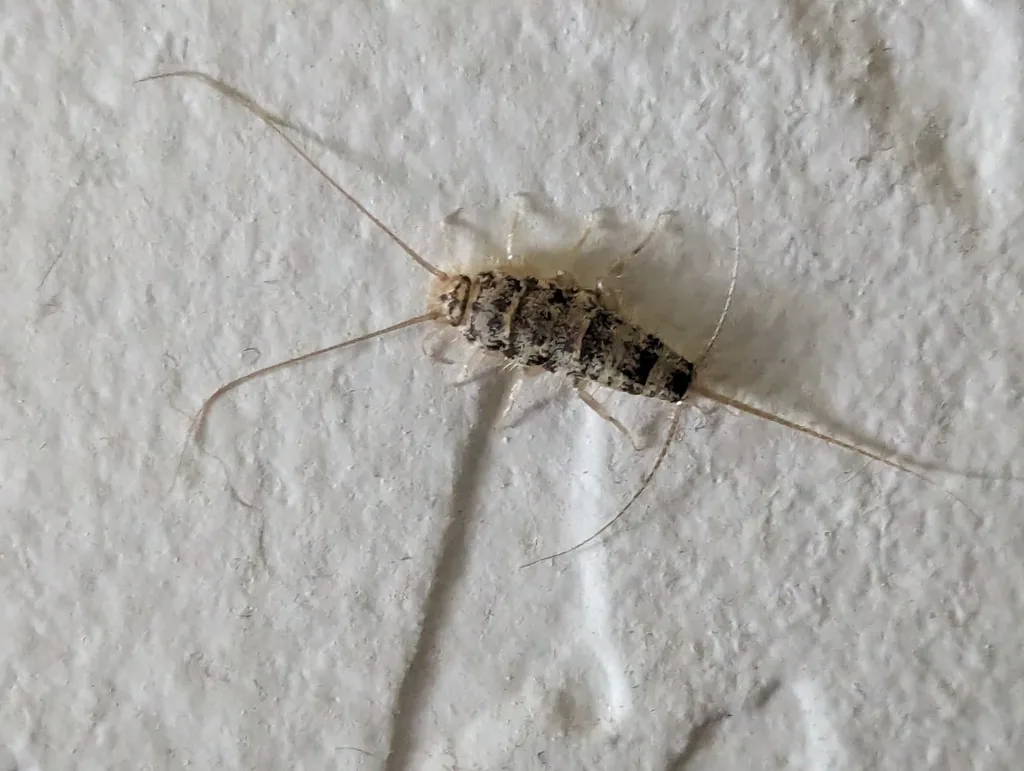
- Shiny, mottled gray or brown, slender and wingless with two long antennae and three long tail filaments. UC IPM gives a length of about 1/2 inch; Clemson gives 1/2 to 3/4 inch for both firebrats and silverfish.[1][3]
- Delicate dustlike scales near damaged items point to firebrats or silverfish. The smallest young lack scales and are whitish.[1][3]
- Penn State says firebrats have tufts of brown scales that give them a mottled look, and antennae longer than the body.[2]
Look-alikes
| Look-alike | How to tell them apart |
|---|---|
| Silverfish | Same shape but shiny silver or pearl gray, with antennae about as long as the body, and prefers cooler, damper places such as basements and laundry rooms.[1][2] |
Where it lives
Thrive above 90°F (best around 98 to 102°F) at humidity as low as 30%: near ovens, furnaces, fireplaces, hot pipes and summer attics; they move between floors along pipes.[1]
Biology and life cycle
Eggs are laid in batches averaging about 50 and hatch in about two weeks in warm conditions. Penn State says a female can produce more than 100 offspring.[1][3][2]
They molt throughout life and live about 2 years. Above 75°F they can reach adulthood in as little as 40 days; below 50°F development can take 300 days.[1]
Sources disagree on humidity: UC IPM says firebrats do well at relative humidity as low as 30%, while Penn State says both firebrats and silverfish prefer high humidity, with firebrats more resistant to dry air.[1][2]
They hide by day and come out at night, and they can live for months without food. They are often carried in with lumber, wallboard, books, paper and furniture.[1][3]
Damage and signs
Health risk
Firebrats damage paper, fabrics and dry food; Penn State calls them mostly a nuisance pest.[1][2]
Control
Prevention
Dehumidifiers and fans can help make the house less suitable, though Clemson notes that sanitation alone isn't entirely effective at reducing numbers.[3][2]
Sanitation
Clean regularly, vacuum, store dry foods in airtight containers, clear out old stacks of paper, and caulk cracks under baseboards and around pipes.[1][3][2]
Traps and physical control
Monitor with sticky traps or tape-wrapped jars placed along edges and corners.[1]
Pesticides
Light infestations don't need insecticides. UC IPM says baits work poorly and several boric acid dusts are ineffective against firebrats; dusts with silica gel and pyrethrin or diatomaceous earth, put directly into hiding places, stay effective while dry. If they aren't under control in two to three weeks, look for untreated hiding places.[1]
Telling firebrats from silverfish
Firebrats have mottled brown scales and antennae longer than the body; silverfish have silvery scales and antennae about as long as the body. Firebrats prefer heat above 90°F near furnaces, hot pipes, attics and roofing, while silverfish favor cooler spots such as basements.[2][1]
Clemson says a large population usually means the infestation has been there a long time.[3]
Common questions
Sources
- University of California Statewide IPM Program, “Pest Notes: Silverfish and Firebrats, Publication 7475 (December 2009).” ipm.ucanr.edu/legacy_assets/PDF/PESTNOTES/pnsilverfish.pdf (accessed 2026-11-13)
- Penn State Extension, “Bristletails, Silverfish, and Firebrats.” extension.psu.edu/bristletails-silverfish-and-firebrats (accessed 2026-11-13)
- Clemson Cooperative Extension, Home & Garden Information Center, “Silverfish & Firebrats (HGIC 2443).” hgic.clemson.edu/factsheet/silverfish-firebrats/ (accessed 2026-11-13)
- Global Biodiversity Information Facility (GBIF), “Thermobia domestica (Packard, 1837) (GBIF Backbone Taxonomy).” api.gbif.org/v1/species/1421105 (accessed 2026-11-13)
- iNaturalist, “Thermobia domestica taxon page (order and family).” www.inaturalist.org/taxa/261301 (accessed 2026-10-06)