The short answer
- Count the legs on one body segment. A centipede has one pair per segment. A millipede has two pairs on most segments; Penn State notes the first three segments carry one pair each, and UC IPM says some millipedes have two or four pairs.[2][1][3][9]
- Look at the shape. Centipedes are flattened, with long antennae and fang-like front legs. Most millipedes are rounded like a piece of wire, with short, elbowed antennae.[1][2][3]
- Watch how it moves. Centipedes run fast and never coil up. Millipedes walk slowly, their legs moving in a wave, and most curl up when touched.[2][1][6]
- Centipedes can bite with venom-injecting front legs; millipedes do not bite or sting but some ooze a fluid that can stain and burn skin. Neither damages the house, and both point to damp conditions.[1][2][8][5]
Profiles on this site
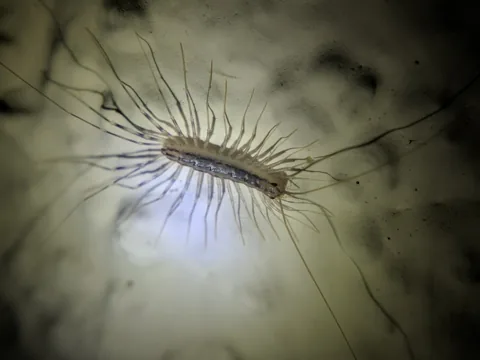 House Centipede
Scutigera coleoptrata
House centipedes are fast, long-legged predators that live in damp parts of buildings and feed on silverfish, cockroaches, carpet beetle larvae and other small arthropods; they are largely harmless.
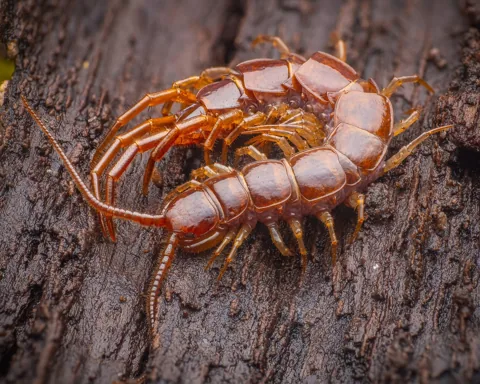 Outdoor centipedes (stone, soil and bark centipedes)
Class Chilopoda: stone centipedes (Lithobiomorpha), soil centipedes (Geophilomorpha) and large centipedes (Scolopendromorpha) (shown: brown centipede, Lithobius forficatus)
Besides the house centipede, homes get visits from outdoor species: the stone, soil and bark centipedes that hunt under rocks, mulch and logs. They wander in through cracks and gaps, especially in wet weather, but most die soon after because they dry out easily, so fixing moisture and entry points works better than spraying indoors.
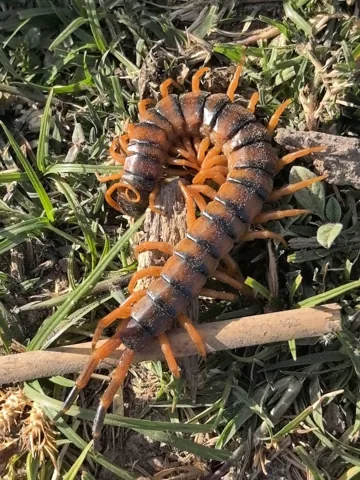 Giant desert centipede (giant redheaded centipede)
Scolopendra heros
The giant desert centipede, also called the giant redheaded centipede, is the largest centipede in North America: a fast, brightly colored predator that hides under rocks and wood by day. It is beneficial outdoors, but its bite is painful, so keep it out of the house by sealing gaps and remove any that wander in with tongs and a jar rather than bare hands.
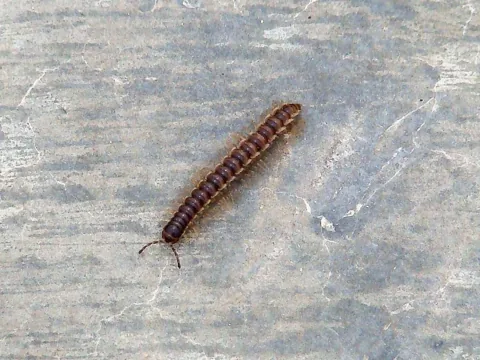 Greenhouse Millipede
Oxidus gracilis
Millipedes live in cool, damp places under leaves, mulch and stones; occasionally they migrate into buildings in large numbers but do no damage and soon die indoors. Clemson says the garden millipede (Oxidus gracilis) is the species that most often invades homes in large numbers.
Side by side
Extension fact sheets agree on the main marks. Where they give different numbers, both are listed with their source.[1][2]
- Legs per segment: centipedes one pair. Millipedes two pairs per segment except the first three, which have one pair each (Penn State); UC IPM puts it at two (more common) or four pairs.[2][1][3]
- Total legs: Kentucky says most of its centipedes have 15 to 30 pairs, and Ohio State says 15 to over 30 pairs. For millipedes, Kentucky gives 30 to 300 legs for most species, while UC IPM says even the largest have somewhat fewer than a hundred. Clemson notes one Australian species with 1,306 legs.[1][5][2][6]
- Body: centipedes are flattened with a distinct head. Millipedes are cylindrical to slightly flattened; Penn State compares them to wire. Kentucky has flat millipedes too, so check the legs as well as the shape.[1][2][3]
- Antennae: centipedes have long antennae; millipedes have shorter, elbowed antennae.[1]
- Front and rear legs: the centipede's first pair of legs is modified into pincer- or fang-like forcipules that inject venom, and its last legs extend backward. Millipedes have neither.[1][2][9]
- Size: Kentucky says most of its centipedes are half an inch to an inch long, while UC IPM says adults are usually more than 1 inch. Penn State says most millipedes people meet are about an inch long; UC IPM gives 1/2 to 6 1/2 inches for adults, and Clemson 1/2 to 3/4 inch for the garden millipede that invades homes.[1][2][3][6]
- Speed: centipedes are built for running and move quickly. Millipedes are slow, and UC IPM says their legs move in an undulating, wavelike way.[1][5][2][6]
- Diet: centipedes are predators of insects, spiders, earthworms and other small invertebrates. Millipedes feed on rotting leaves, rotting wood and other decaying plant matter.[1][5][2]
- Defense: centipedes can bite when handled. Millipedes do not bite; they curl up or release a defensive fluid that can smell, stain and irritate skin.[1][2][6][8]
- Indoors: the house centipede is the only centipede that can live its whole life inside buildings. Millipedes that wander in usually die quickly from the dry conditions and lack of food.[1][5][2]
The house centipede, the one most people find
The centipede people see indoors is usually the house centipede, Scutigera coleoptrata. Penn State describes a body one to one and one-half inches long with 15 pairs of long legs, which makes it look three to four inches long; Ohio State gives a body length of about an inch to two inches. Kentucky describes three dark bands down the body and banded legs.[4][5][1]
It hides in dark, damp places by day and comes out at night. Penn State says it feeds on silverfish, firebrats, carpet beetle larvae, cockroaches, spiders and other small arthropods, and that seeing many of them can mean some prey insect is plentiful.[4][5]
- Kentucky says house centipedes pose a minimal bite hazard because their forcipules are so small that it is hard for them to pierce human skin.[1]
Predator vs decomposer
Centipedes are generalist predators, and Ohio State and UC IPM consider them beneficial. Ohio State says house centipedes indoors feed mainly on spiders and cockroaches.[5][2][1]
Millipedes help break down dead plant matter, UC IPM says. When they are numerous they can damage sprouting seeds, seedlings, and strawberries or other ripening fruit touching the ground; Clemson says garden millipedes occasionally feed on young plants.[2][6][1]
A venomous bite vs defensive fluids
Centipede: MedlinePlus says a bite causes pain, swelling and redness at the site, with lymph node swelling or numbness in rare cases. Bites can be very painful but are not fatal, and symptoms usually last less than 48 hours, though swelling and tenderness can last as long as 3 weeks. Larger centipedes are the ones to avoid handling.[7][2]
A 2025 medical review says centipedes inject venom through the forcipules and that envenomation causes intense pain and moderate local inflammation. Ohio State says bites from large species are very infrequent.[9][5]
Millipede: MedlinePlus and UC IPM say millipedes do not bite. Some species release a defensive fluid; MedlinePlus lists brown skin staining and intense burning or itching on the skin, and eye inflammation (conjunctivitis or keratitis) if it gets in the eyes.[8][2]
The same 2025 review says the fluids contain benzoquinones, phenols, hydrogen cyanide and other compounds and can cause redness, swelling, burning and blisters. The stain can turn yellow, brown or black, may persist for months and fades on its own. Kentucky says the cyanide some millipedes release is not in high enough amounts to harm people.[9][8][1]
- Clemson says to wash hands thoroughly after touching a millipede.[6]
Why they come indoors: moisture
Both are very sensitive to drying out, Kentucky says. Ohio State explains that centipedes lack the waxy coating that helps most arthropods hold in water, so they need moist places: soil, leaf litter, under rocks and in dead wood.[1][5]
Ohio State says most home-invading centipedes show up after the spring warm-up and in fall when cooler weather sends them looking for shelter, entering through expansion cracks, floor drains and gaps around plumbing. Stone and soil centipedes die fairly quickly in dry buildings.[5][4]
Millipedes move in groups. Penn State links these migrations to cooler weather or heavy rains, Clemson to heavy spring rains, and UC IPM to a dwindling food supply or living places that become too wet or too dry. Kentucky says it is unclear exactly what causes them.[3][6][2][1]
How to confirm which one you have
- Take a close photo from the side and count the legs on one middle segment: one pair for a centipede, two for a millipede.[2][1][3]
- A dead one helps: Penn State says most millipedes curl into a spiral when they die, and Kentucky says those that get indoors are often found dead in piles.[3][1]
- Ohio State says sticky traps can show whether centipedes are active indoors.[5]
- Rule out other look-alikes. Wireworms are click beetle larvae with only 3 pairs of legs that stay in the soil. Garden symphylans are white, less than 1/4 inch long, with 12 pairs of legs as adults.[2][3]
Why the difference matters
A house centipede problem is often a sign of something else: Penn State and Ohio State say many centipedes indoors suggest their prey insects are plentiful, so cutting the food supply cuts the centipedes.[4][5]
What to do for each
- Centipedes: lower indoor humidity with a dehumidifier and ventilation of basements and crawl spaces, seal cracks in slabs and block walls, and screen floor drains and sump pump covers, per Penn State and Ohio State.[4][5]
- Centipedes: control the insects they eat, and pick up stray ones with a broom and dustpan or a vacuum.[5][2]
- Millipedes: clear excess mulch, leaf litter, thick grass, rocks and boards from around the foundation, mow closely, and water the lawn in the morning so it dries before night.[6][2][3]
- Millipedes: make sure doors and windows fit tightly, caulk cracks, and sweep or vacuum the ones that get in. Clemson says insecticides give only temporary control unless these steps are taken. The centipede and millipede control guide linked below covers treatments.[6][2][1]
- Centipede bite: MedlinePlus says to wash the area with soap and water (not alcohol) and apply wrapped ice 10 minutes on, 10 minutes off. Get emergency help for signs of an allergic reaction.[7]
- Millipede fluid: MedlinePlus says to wash skin with soap and water, not alcohol, and to rinse eyes with water for at least 20 minutes and get medical attention right away. The 2025 review instead says washing with alcohol right after contact could help; when in doubt, ask poison control.[8][9]
- Poison control can be reached anywhere in the United States at 1-800-222-1222, MedlinePlus says, and you can call even if it is not an emergency.[7][8]
Common questions
- Are house centipedes dangerous?
- Rarely. Kentucky says their forcipules are so small they have trouble piercing skin, and Penn State calls them harmless. They do eat other household pests.[1][4]
- Do millipedes bite?
- No. MedlinePlus and UC IPM say millipedes do not bite or sting. Some release a fluid that can stain or irritate skin, so wash your hands after handling one.[8][2][6]
- Why do I find dead millipedes in the house?
- Millipedes need moisture and usually die quickly in the dry air indoors. Sweep them up and seal the gaps they came through.[2][1]
- Which has more legs?
- Usually the millipede, since it has two pairs on most segments. Most centipedes have 15 to 30 or more pairs.[1][5][2]
Photo credits
- House Centipede: Danijel Ostović, public domain (CC0), via iNaturalist
- Outdoor centipedes (stone, soil and bark centipedes): (c) Alexis Tinker-Tsavalas, some rights reserved (CC BY) — via iNaturalist, CC BY 4.0
- Giant desert centipede (giant redheaded centipede): Sinaloa Silvestre, public domain (CC0), via iNaturalist
- Greenhouse Millipede: (c) capacoscar, some rights reserved (CC BY) — via iNaturalist, CC BY 4.0
Sources
- University of Kentucky Entomology, “ENTFACT-645: Centipedes & Millipedes in & Around the Home.” entomology.ca.uky.edu/ef645 (accessed 2026-11-14)
- University of California Statewide IPM Program, “Pest Notes: Centipedes and Millipedes.” ipm.ucanr.edu/PMG/PESTNOTES/pn7472.html (accessed 2026-11-14)
- Penn State Extension, “Millipedes.” extension.psu.edu/millipedes (accessed 2026-11-14)
- Penn State Extension, “House Centipedes.” extension.psu.edu/house-centipedes (accessed 2026-11-14)
- Ohio State University Extension (Ohioline), “Centipedes (ENT-50).” ohioline.osu.edu/factsheet/ENT-50 (accessed 2026-11-14)
- Clemson Cooperative Extension Home & Garden Information Center, “Millipedes (HGIC).” hgic.clemson.edu/factsheet/millipedes/ (accessed 2026-11-14)
- MedlinePlus (U.S. National Library of Medicine), “Centipede (Medical Encyclopedia).” medlineplus.gov/ency/article/002842.htm (accessed 2026-11-14)
- MedlinePlus (U.S. National Library of Medicine), “Millipede toxin (Medical Encyclopedia).” medlineplus.gov/ency/article/002846.htm (accessed 2026-11-14)
- Revista da Sociedade Brasileira de Medicina Tropical, via PubMed Central, “Myriapods (Diplopoda and Chilopoda): medical aspects of envenomations (Haddad Junior et al. 2025; full text PMC12169687).” pubmed.ncbi.nlm.nih.gov/40531675/ (accessed 2026-11-14)