The short answer
- An insect has 3 body parts (head, thorax and abdomen) and 6 legs. Most insects have 2 antennae, and most insects have wings.[1]
- A spider has 2 body parts and 8 legs. Spiders have no wings and no antennae.[4][2]
- Ticks, mites and daddy longlegs also have 8 legs. They are arachnids, like spiders, not insects.[3][2][15]
- Lots of legs means something else. Centipedes and millipedes have many pairs of legs, and pill bugs have 7 pairs. Pill bugs are crustaceans, kin to shrimp and lobsters.[9][12][17]
Meet these critters
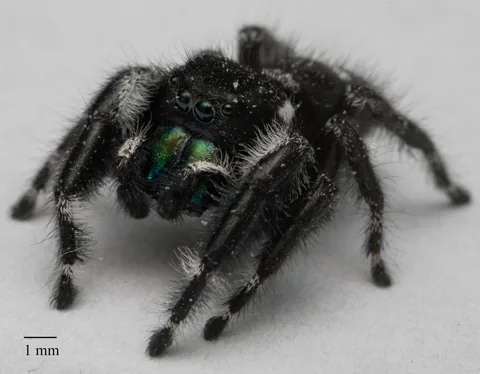 Bold Jumping Spider
Phidippus audax
Jumping spiders are compact, day-active hunters that build no web; they stalk prey by sight and pounce from a short distance. They live on plants, bark and walls and only occasionally wander indoors.
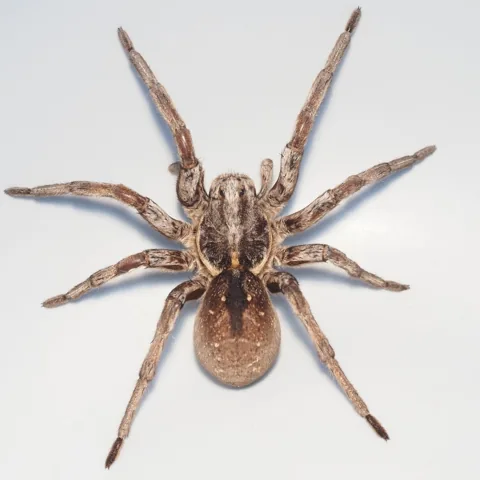 Carolina Wolf Spider
Hogna carolinensis
Wolf spiders are large hunting spiders that don't use webs; they wander into homes by accident, especially males searching for mates, and they don't persist indoors.
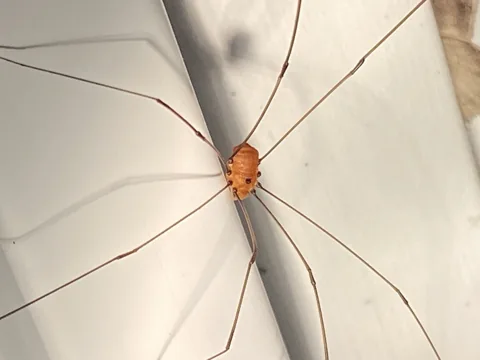 Harvestmen (Daddy Longlegs)
Opiliones (e.g., eastern harvestman, Leiobunum vittatum)
Harvestmen, widely called daddy longlegs, are arachnids related to spiders but are not true spiders. They make no silk, have no venom glands, and are beneficial predators and scavengers in yards and gardens.
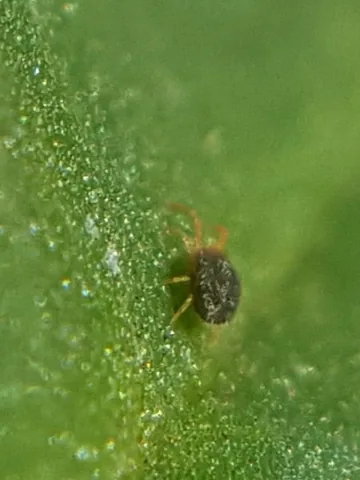 Clover Mite
Bryobia praetiosa
Clover mites are tiny plant feeders that invade homes in early spring and sometimes fall; they don't bite people or pets, don't breed indoors and soon die inside.
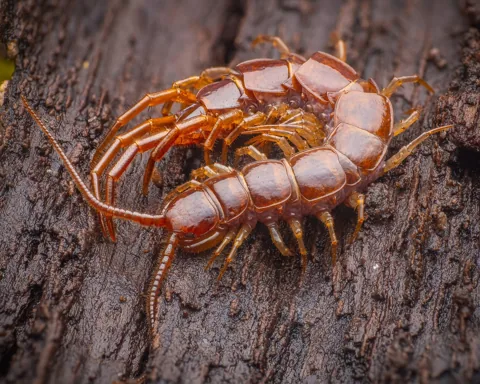 Outdoor centipedes (stone, soil and bark centipedes)
Class Chilopoda: stone centipedes (Lithobiomorpha), soil centipedes (Geophilomorpha) and large centipedes (Scolopendromorpha) (shown: brown centipede, Lithobius forficatus)
Besides the house centipede, homes get visits from outdoor species: the stone, soil and bark centipedes that hunt under rocks, mulch and logs. They wander in through cracks and gaps, especially in wet weather, but most die soon after because they dry out easily, so fixing moisture and entry points works better than spraying indoors.
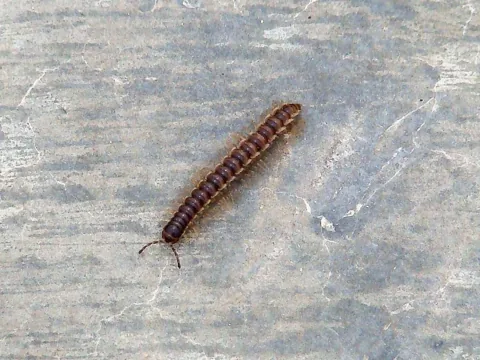 Greenhouse Millipede
Oxidus gracilis
Millipedes live in cool, damp places under leaves, mulch and stones; occasionally they migrate into buildings in large numbers but do no damage and soon die indoors. Clemson says the garden millipede (Oxidus gracilis) is the species that most often invades homes in large numbers.
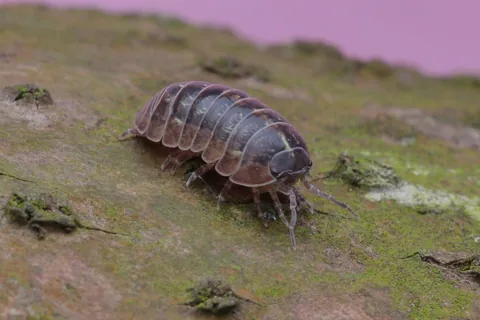 Common Pillbug
Armadillidium vulgare
Sowbugs and pillbugs are land-living crustaceans, more closely related to shrimp and crayfish than to insects, that feed mostly on decaying plant matter. They are harmless indoors, and finding many inside usually points to dampness, a large population outdoors or a gap at a door or window.
The 4-clue bug check
These clues come from how scientists describe each group. Look closely (a magnifying glass helps) and check these four clues in order.[1][4]
- Clue 1, body parts: insects have 3 (head, thorax, abdomen). Spiders have 2: a front part called the cephalothorax and a back part called the abdomen.[1][4]
- Clue 2, legs: insects usually have 6 legs. Spiders and their arachnid relatives have 8.[1][2]
- Clue 3, antennae: most insects have one pair of antennae on the head. Spiders have none.[1][4]
- Clue 4, wings: insects usually have two pairs of wings. Spiders never have wings.[1][4]
Meet an insect's body
An insect's body has three sections: the head, the thorax in the middle, and the abdomen at the back. The legs and wings are all attached to the thorax.[1]
Most insects have one pair of antennae. A few kinds have none at all.[1]
Beetles are insects with a trick. Their front pair of wings are hard covers that protect the back wings when the beetle is not flying.[1]
Other animals often get confused with insects. Clemson University's experts point out that insects have three pairs of walking legs, while sowbugs and pillbugs have seven pairs.[17]
There are a lot of insects. The Missouri Department of Conservation says there may be as many as 10 million kinds alive today, probably more than 90 percent of all animal species.[12][13]
Meet a spider's body
A spider's body has two main sections. The front part is the head and thorax joined together (the cephalothorax). The eyes, legs and mouthparts are attached there. The back part is the abdomen.[2][4]
Spiders have eight walking legs, and each leg has seven segments.[2]
Careful when you count. Spiders also have two pedipalps near the mouth that look like short legs. They help the spider handle food and build webs, but they are not walking legs.[2]
Most spiders have eight eyes, set in patterns.[2]
Spiders make silk. It comes out of spinnerets at the tip of the abdomen, and only spiders have them among their arachnid relatives. Spiders use silk for webs, egg sacs and draglines.[2]
More than 46,000 kinds of spiders are known in the world, and more than 630 have been found in Illinois alone. Spiders are important hunters of insects.[2][4]
Spider cousins: daddy longlegs, ticks and mites
Spiders belong to a bigger group called arachnids. Scorpions, daddy longlegs (also called harvestmen), mites and ticks are arachnids too, and they all have eight legs.[2][3][15]
Daddy longlegs look like spiders, but they are not true spiders. They have a small oval body and very long legs. They can't spin silk and have no venom glands, and Clemson University says they cannot bite you.[15]
Ticks are arachnids, not insects. Grown-up hard ticks have 8 legs and tough skin that is hard to crush. An adult tick is about the size of a sesame seed.[8][3]
Mites are arachnids too. All mites have two main body parts and eight legs. Clover mites are reddish-brown and slightly smaller than the head of a pin.[20][11]
Tricky cases: babies that break the rules
Baby ticks don't follow the 8-leg rule. A just-hatched tick, called a seed tick or larva, has only 6 legs and is about as big as a poppy seed. Older ticks have 8 legs.[8]
Baby clover mites also hatch with only six legs. They have eight legs after they molt.[18]
Baby insects can look strange too. Ladybug larvae are long, soft and bristly, a bit like tiny lizards, but they still have six legs, just like the adult beetles they grow into.[14][1]
So if you find something tiny with six legs, it might still be a baby arachnid. That's a good time to ask a grown-up or a bug expert to take a look.[8][18]
Not insects, not spiders: centipedes and millipedes
Centipedes and millipedes are arthropods, related to insects and spiders, but they belong to their own groups. Their long bodies are made of many segments.[9][12]
Centipedes have flat bodies, long antennae and one pair of legs on most body segments. They run fast. Even though their name means 100 legs, most kinds have far fewer than that. The house centipede has up to 15 pairs.[9][16][12]
Millipedes have rounder bodies and two pairs of legs on most body segments. They move slowly and often curl into a coil when they are bothered.[16][12][13][9]
Centipedes hunt small insects and other little animals. Millipedes mostly eat rotting leaves and plant matter.[12][9][16]
Pill bugs and sowbugs: land crustaceans
Pill bugs and sowbugs are not insects at all. They are crustaceans, so their closest relatives are lobsters and shrimp. They have seven pairs of walking legs.[17][10]
You can tell the two apart. A pill bug can roll up into a tight ball, which is why people call it a roly-poly. A sowbug can't roll up, and it has two little tail-like parts at its back end.[10][17]
They need damp places to live. Rolling up helps a pill bug hold in water, and sowbugs and pillbugs die quickly if they can't find moisture. Look for them under leaves, mulch and stones.[10][19]
They are harmless. Pill bugs and sowbugs don't bite or sting.[10][19]
Safe bug-watching rules
Look first, touch later, and only with a grown-up's OK. Some of these animals can bite, sting or squirt stinky fluids.[5][6][16][9]
- Spiders: most can't hurt people, because their jaws are too small to bite through skin. Some may bite if they get trapped in clothes or bedding. Black widows and brown recluses are venomous spiders found in the United States, so don't pick spiders up.[4][5]
- Shake out shoes, clothes and towels before you use them. CDC gives this tip to keep from getting bitten by spiders.[5]
- If a spider bites you, tell a grown-up right away. CDC's first steps are to wash the bite with soap and water and put a cold, wet cloth or ice on it. CDC also says to get medical care after a spider bite.[5]
- Ticks live in grassy, brushy and wooded places. CDC says to walk in the middle of trails, check your whole body for ticks when you come inside, even from your own backyard, and take a shower soon after. Any tick you find should be removed, so get a grown-up to help.[7]
- Centipedes have venom. Missouri's conservation department says to handle any animal with venom carefully, and to get medical help right away if someone who was bitten has trouble breathing.[12][9]
- Millipedes don't bite, but many can give off a fluid that irritates skin. Clemson University says to wash your hands well after touching one.[16][9]
- Bees, wasps, hornets and fire ants can sting or bite. A person who is allergic can have a severe reaction that needs emergency care right away.[6]
Printable ID sheet
Print this page and take it outside. Each card gives three clues and whether it's OK to touch. When in doubt, look but don't touch.[1][4][5]
- LADYBUG (insect). Clues: 6 legs; round, shiny, domed body; often red, orange or yellow with spots. Touch? Gently, with a grown-up's OK. It may give off a smelly liquid.[1][14]
- BEE OR WASP (insect). Clues: 6 legs; 3 body parts; wings. Touch? No. They can sting.[1][6]
- SPIDER (arachnid). Clues: 8 legs; 2 body parts; no antennae or wings. Touch? No. Look only, because a few kinds are venomous.[4][2][5]
- DADDY LONGLEGS (arachnid, not a true spider). Clues: 8 very long legs; small oval body; no silk webs. Touch? It can't bite, but ask a grown-up first.[15]
- TICK (arachnid). Clues: 8 legs (babies have 6); adults about the size of a sesame seed; tough skin. Touch? No. Tell a grown-up, who can remove it.[8][7]
- CLOVER MITE (arachnid). Clues: 8 legs; red or reddish-brown; smaller than a pinhead. Touch? Don't squish it. It doesn't bite, but it leaves a red stain.[20][11]
- CENTIPEDE. Clues: flat body; 1 pair of legs on most segments; runs fast. Touch? No. It has venom.[9][12][16]
- MILLIPEDE. Clues: round body; 2 pairs of legs on most segments; slow, curls into a coil. Touch? Better not. If you do, wash your hands.[16][13][9]
- PILL BUG (crustacean). Clues: 7 pairs of legs; no tail parts showing; rolls into a ball. Touch? Yes, gently. It doesn't bite or sting.[17][10][19]
Common questions
- Is a daddy longlegs a spider?
- Not a true one. Daddy longlegs (harvestmen) are arachnids like spiders, with eight legs, but they don't make silk and don't have venom glands. Clemson University says they cannot bite you.[15][2]
- Is a tick an insect?
- No. Ticks are arachnids, in the same big group as spiders, mites and scorpions. Adult ticks have 8 legs. Only the tiny babies have 6.[3][8]
- Is a pill bug an insect?
- No. Pill bugs (roly-polies) are crustaceans, so they're related to shrimp and lobsters. They have seven pairs of legs instead of an insect's three pairs.[17][10]
- Why isn't a centipede an insect?
- It has far too many legs. Insects have 6 legs on a 3-part body. A centipede has a long body with many segments and one pair of legs on most of them.[1][9][16]
- Do all insects have wings and antennae?
- Most do, but not all. The Illinois Department of Natural Resources says insects usually have two pairs of wings and most have one pair of antennae, and a few kinds have no antennae at all.[1]
- Are spiders bad?
- Mostly no. UC IPM says most spiders can't harm people and are helpful because they eat pest insects. Still, a few kinds are venomous, so look and don't touch.[4][5]
Photo credits
- Bold Jumping Spider: Jesse Rorabaugh, public domain (CC0), via iNaturalist
- Carolina Wolf Spider: (c) Russell Pfau, some rights reserved (CC BY) — via iNaturalist, CC BY 4.0
- Harvestmen (Daddy Longlegs): (c) Mark Eanes, some rights reserved (CC BY) — via iNaturalist, CC BY 4.0
- Clover Mite: (c) Alexis Tinker-Tsavalas, some rights reserved (CC BY) — via iNaturalist, CC BY 4.0
- Outdoor centipedes (stone, soil and bark centipedes): (c) Alexis Tinker-Tsavalas, some rights reserved (CC BY) — via iNaturalist, CC BY 4.0
- Greenhouse Millipede: (c) capacoscar, some rights reserved (CC BY) — via iNaturalist, CC BY 4.0
- Common Pillbug: (c) Carlos Alexandre Mattos Raposo, some rights reserved (CC BY) — via iNaturalist, CC BY 4.0
Sources
- Illinois Department of Natural Resources, “Wild About Illinois Beetles!.” dnr.illinois.gov/education/wildaboutpages/wildaboutinvertebrates/wildaboutbeetles.html (accessed 2026-11-15)
- Illinois Department of Natural Resources, “Wild About Illinois Spiders!.” dnr.illinois.gov/education/wildaboutpages/wildaboutinvertebrates/wildaboutspiders.html (accessed 2026-11-15)
- Illinois Department of Natural Resources, “Wild About Illinois Ticks!.” dnr.illinois.gov/education/wildaboutpages/wildaboutinvertebrates/wildaboutticks.html (accessed 2026-11-15)
- University of California Statewide IPM Program, “Spiders (Home and Landscape).” ipm.ucanr.edu/home-and-landscape/spiders/ (accessed 2026-11-15)
- U.S. Centers for Disease Control and Prevention (NIOSH), “Venomous Spiders at Work.” www.cdc.gov/niosh/outdoor-workers/about/venomous-spiders.html (accessed 2026-11-15)
- U.S. Centers for Disease Control and Prevention (NIOSH), “Insects and Scorpions at Work.” www.cdc.gov/niosh/outdoor-workers/about/insects-and-scorpions.html (accessed 2026-11-15)
- U.S. Centers for Disease Control and Prevention, “Preventing Tick Bites.” www.cdc.gov/ticks/prevention/index.html (accessed 2026-11-15)
- University of Kentucky Entomology, “Ticks and Disease in Kentucky (ENTFACT-618).” entomology.mgcafe.uky.edu/ef618 (accessed 2026-11-15)
- University of Kentucky Entomology, “Centipedes & Millipedes in & Around the Home (ENTFACT-645).” entomology.ca.uky.edu/ef645 (accessed 2026-11-15)
- University of Kentucky Entomology, “Sowbugs & Pillbugs (ENTFACT-439).” entomology.mgcafe.uky.edu/ef439 (accessed 2026-11-15)
- University of Kentucky Entomology, “Clover Mites (ENTFACT-627).” entomology.mgcafe.uky.edu/ef627 (accessed 2026-11-15)
- Missouri Department of Conservation, “Centipedes (Field Guide).” mdc.mo.gov/discover-nature/field-guide/centipedes (accessed 2026-11-15)
- Missouri Department of Conservation, “Millipedes (Field Guide).” mdc.mo.gov/discover-nature/field-guide/millipedes (accessed 2026-11-15)
- Missouri Department of Conservation, “Lady Beetles (Ladybird Beetles; Ladybugs) (Field Guide).” mdc.mo.gov/discover-nature/field-guide/lady-beetles-ladybird-beetles-ladybugs (accessed 2026-11-15)
- Clemson Cooperative Extension Home & Garden Information Center, “Daddy Longlegs.” hgic.clemson.edu/factsheet/daddy-longlegs/ (accessed 2026-11-15)
- Clemson Cooperative Extension Home & Garden Information Center, “Millipedes.” hgic.clemson.edu/factsheet/millipedes/ (accessed 2026-11-15)
- Clemson Cooperative Extension Home & Garden Information Center, “Sowbugs & Pillbugs.” hgic.clemson.edu/factsheet/sowbugs-pillbugs/ (accessed 2026-11-15)
- Clemson Cooperative Extension Home & Garden Information Center, “Clover Mites.” hgic.clemson.edu/factsheet/clover-mites/ (accessed 2026-11-15)
- Iowa State University Extension and Outreach, “Sowbugs and Pillbugs.” hortnews.extension.iastate.edu/sowbugs-and-pillbugs (accessed 2026-11-15)
- University of Minnesota Extension, “Clover mites.” extension.umn.edu/insect-relatives/clover-mites (accessed 2026-11-15)