The short answer
- An insect's body has three parts. The head holds the brain, the mouthparts and the main sense organs: antennae, compound eyes and simple eyes.[8][1]
- The thorax is the middle part. It carries the 3 pairs of legs and, in many grown-up insects, 1 or 2 pairs of wings.[2][8][10]
- The abdomen is the back part. It holds much of the stomach and the parts for making eggs, and it has tiny breathing holes called spiracles along its sides.[10][3]
- The hard outside skeleton can't stretch, so an insect has to molt (shed it) to grow bigger.[8][6]
Meet the insects on this page
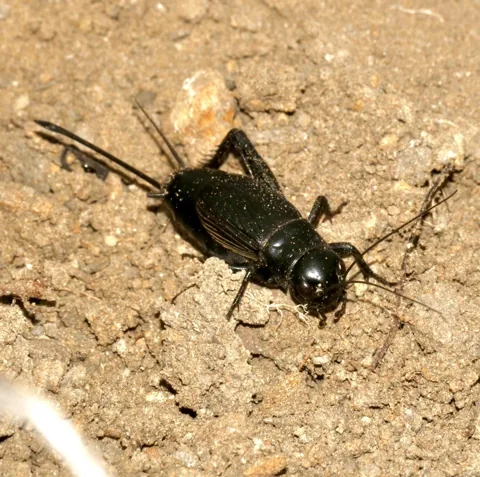 Field Crickets
Gryllus species (e.g., G. pennsylvanicus)
Field crickets are several species in the genus Gryllus that live outdoors in fields, pastures, roadsides and yards. They come into homes most often in late summer and fall, when cooler nights and outdoor lights draw them toward buildings.
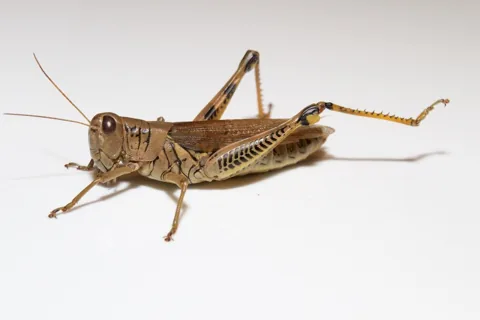 Grasshoppers
Acrididae (e.g., differential grasshopper, Melanoplus differentialis)
Grasshoppers are sporadic garden pests that build up in weedy, uncultivated land and move into yards as nearby vegetation dries out. The differential grasshopper is one of the common, large species that often shows up in gardens first.
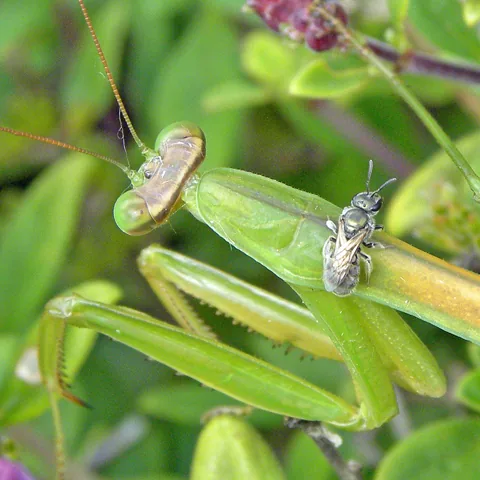 Praying Mantids
Mantidae (e.g., Tenodera sinensis, Mantis religiosa, Stagmomantis carolina)
Mantids are generalist predators. They catch pests, but they also eat bees, butterflies and other beneficial insects, and UC IPM says they're of no benefit for biological pest control.
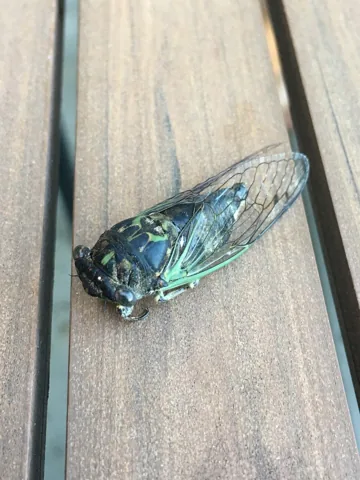 Annual Cicadas (dog-day cicadas)
Neotibicen species (e.g., N. canicularis)
Annual cicadas, also called dog-day cicadas, are the large cicadas heard droning from trees every summer. Their life cycles overlap, so some adults come out every year. They can't bite or sting, and Clemson and Minnesota extension both say they pose no danger to people or pets.
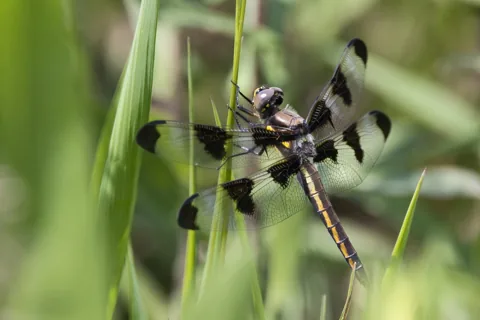 Dragonflies
Anisoptera (shown: Libellula pulchella)
Dragonflies are harmless to people and catch mosquitoes and other small insects on the wing. Their aquatic young eat mosquito larvae too, but sources disagree on how much they can do about a mosquito problem.
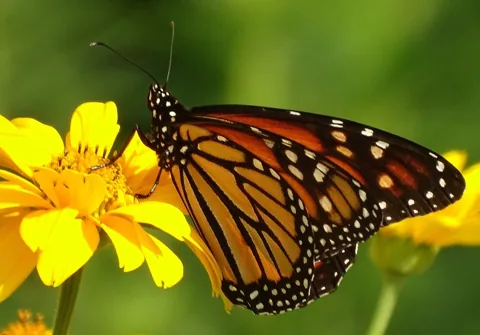 Monarch Butterfly
Danaus plexippus
The monarch is a large orange-and-black butterfly whose caterpillars feed only on milkweeds. North America has two migratory populations: eastern monarchs overwinter in mountain forests of central Mexico and western ones in groves on the California coast.
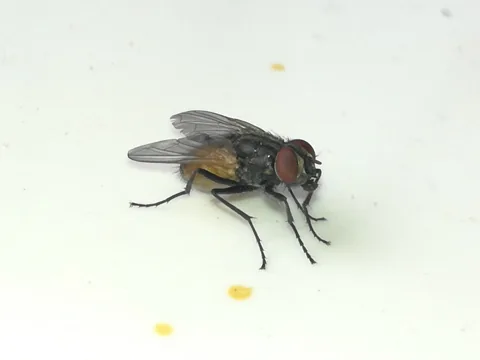 House Fly
Musca domestica
The house fly is a worldwide companion of people and domestic animals; it breeds in garbage, manure and other moist organic matter and is most numerous in hot summer months.
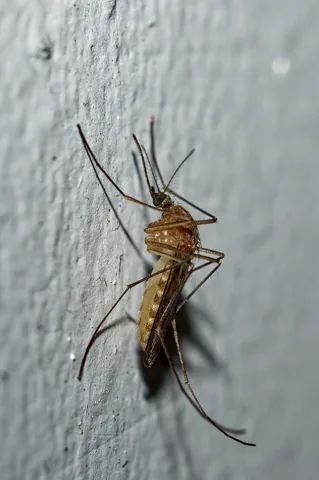 Mosquito
Culicidae (shown: Culex pipiens complex)
Mosquitoes are small, delicate flies whose females feed on blood and can pass on viruses such as West Nile; the control that works best goes after the larvae in standing water.
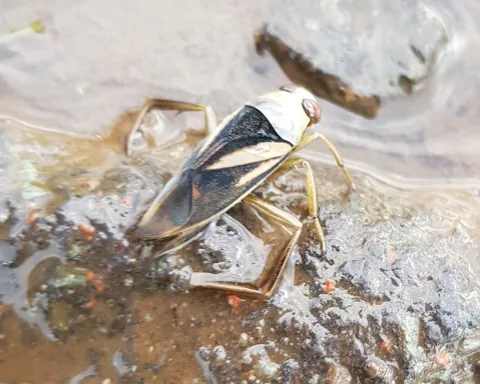 Backswimmers
Notonectidae (about 32 North American species)
Backswimmers are predatory water bugs that swim upside down. They fly at night, often land in swimming pools, and, unlike the look-alike water boatmen, can give a painful bite if handled.
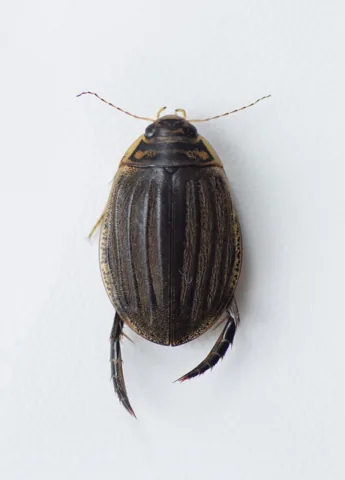 Predaceous diving beetles
Dytiscidae (predaceous diving beetles, e.g., Cybister, Dytiscus, Thermonectus)
Predaceous diving beetles are freshwater beetles of the family Dytiscidae. Adults and their larvae, called water tigers, are fierce hunters in ponds, wetlands and slow streams. Because the adults are strong fliers and electric lights can lure them away from home, they sometimes land in swimming pools and birdbaths.
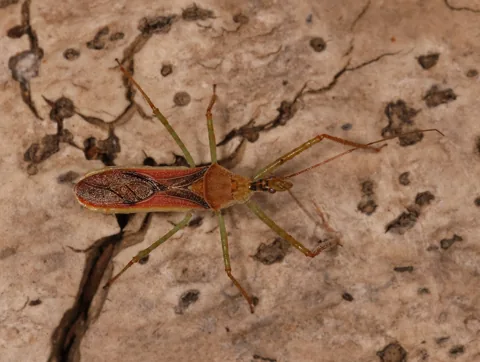 Assassin Bugs
Zelus and Sinea species (shown: Zelus renardii)
Assassin bugs are stalking and ambushing predators with a needlelike beak. They kill caterpillars, other bugs and bees alike, and they can deliver a painful bite if handled.
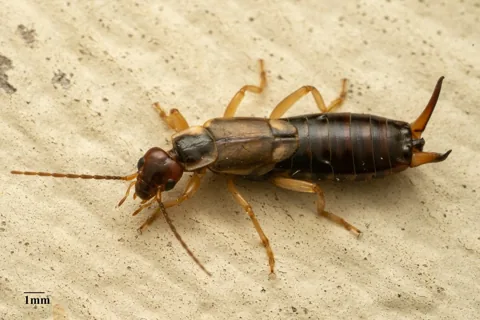 European Earwig
Forficula auricularia
The European earwig, introduced from Europe in the early 1900s, is a familiar garden insect that feeds at night and hides in dark, moist places by day; it damages seedlings and soft fruit but also eats aphids. Clemson says it is the most common earwig pest around homes, and Minnesota says it was first noticed there in the early 1990s.
Three body parts
Not sure if your bug is even an insect? Start with our page on telling insects from spiders. This page zooms in on the insect itself.[8]
Scientists call the three parts of an insect the head, the thorax and the abdomen. The legs and wings are all attached to the thorax, the middle part.[8][10]
The thorax is really three segments joined together into a strong box. The box holds the muscles that move the legs and wings, and each of the three segments has one pair of legs.[2][4]
Where the thorax meets the abdomen, most insects are wide. Some insects are pinched in very thin there. That shape is called a wasp waist.[3]
Antennae: smelling, feeling and more
Most insects have one pair of antennae on the head. A few kinds have none.[8][9]
People call antennae feelers, but they do much more than feel. They are usually covered with sensors that smell odors floating in the air. Many insects also use them to sense how damp the air is.[5]
Some insects use their antennae for special jobs. Mosquitoes hear sounds with theirs, and many flies use theirs to measure how fast they are flying through the air.[5]
A mosquito's long, feathery antennae can detect carbon dioxide in a person's breath and air moving nearby.[10][5]
Scarab beetles have fancy antennae that they use to smell and find food.[19]
- Antennae come in many shapes. Scientists have names for them, like thread-like, beaded, sawtoothed, comb-like, feathery and clubbed.[5]
- Predaceous diving beetles have thread-like antennae.[16]
- Short-horned grasshoppers are named for their short antennae, which are usually less than half as long as the body. Katydids are the long-horned ones.[11]
- Sphinx moths have antennae that slowly get wider toward the tip.[21]
Eyes: big compound eyes and tiny simple eyes
Insects can have two kinds of eyes. Most have a pair of big compound eyes, and many also have one or more small simple eyes, called ocelli.[1][8]
Look closely at a cicada. Besides its 2 large compound eyes, it has 3 ocelli, which look like tiny eyespots.[18]
Mosquitoes have two large compound eyes that help them spot movement.[10]
Dragonflies have giant compound eyes. They touch each other and cover almost the whole head.[13]
A praying mantis has bulging compound eyes on the top corners of its triangle-shaped head, and it can swivel its head around.[17]
Mouthparts: chewers, sippers, sponges and piercers
An insect's mouthparts are on its head, and their shape tells you what the insect eats.[1][18][19]
- Chewing: beetles have mouthparts made for chewing. Most scarab beetles have chewing mouthparts and eat all kinds of food, from rotting fruit and mushrooms to plant roots and flowers. Field crickets that get into homes sometimes chew on clothing.[8][19][12]
- Sucking with a coiled tube: butterflies and moths have mouthparts made for sucking, usually a coiled tube. Sphinx moths sip flower nectar with a very long tube, and some of these moths have tongues longer than their bodies.[9][21][25]
- Sponging: house flies have sponging mouthparts. They visit moist things like garbage and manure and blot up a liquid meal. House flies don't bite.[22][23]
- Piercing and sucking: a female mosquito's long mouthpart, the proboscis, pierces skin and sucks out blood. Male mosquitoes can't pierce skin, so they drink nectar and fruit juice instead.[10]
- True bugs have straw-like mouthparts made for piercing and sucking. Cicadas suck plant juices, and assassin bugs suck the juices of other insects.[20][18]
Legs built for special jobs
Most insects have three pairs of legs. Each leg has five main parts joined by hinge joints. The end of the leg often has a pair of claws, and some insects also have sticky pads there.[4][10]
Legs can be shaped for special jobs. Scientists sort them into types such as jumping, grabbing, digging, swimming and running legs.[4]
- Jumping: crickets have big back legs made for jumping.[12][4]
- Grabbing: a praying mantis's front legs are big and spiny, perfect for grabbing and holding prey, a lot like a hawk's claws. When the mantis rests, it holds them folded together.[17][4]
- Digging: young cicadas, called nymphs, live underground. Their front legs are made for burrowing through soil and for clinging to trees.[18][4]
- Swimming: backswimmers row through the water with long, oar-like back legs that have fine hairs. Predaceous diving beetles have flat back legs fringed with hairs, and they kick both back legs at the same time to swim.[15][16][4]
- Catching in the air: a dragonfly holds its legs in a basket shape while it flies, which is perfect for snatching mosquitoes and other small flying insects.[13]
- Standing on water: the ends of a mosquito's legs help it stand and walk on water.[10]
- Extra legs on babies: caterpillars have short, fleshy legs on their abdomen, called prolegs, often with tiny hooks that help them grip. Grown-up insects never have these.[4]
Wings
Insects usually have two pairs of wings, and the wings are attached to the thorax.[8][2]
Flies have only one pair of wings, while bees and wasps have two pairs. Mosquitoes have two wings, plus two tiny wing-like parts called halteres that help them steer.[24][10]
A beetle's front wings are hard covers. They protect the back wings, which the beetle uses to fly.[8]
Butterfly and moth wings are covered with tiny overlapping scales, like shingles on a roof. The scales can rub off and look like dust on your fingers.[14][9]
Dragonflies have two pairs of thin, veiny wings that they usually hold straight out to the sides.[13]
Baby insects don't fly. A dragonfly nymph lives in water and has only small wing buds. It gets working wings when it grows up.[13]
The exoskeleton and molting
An insect's skeleton is on the outside, a hard covering made mostly of a material called chitin. Scientists call it an exoskeleton.[8][9][6]
The exoskeleton is like a suit of armor. It protects the insect, keeps its body from drying out, and gives its muscles a place to attach.[6]
Armor can't stretch. To grow, an insect has to molt, which means it sheds the old hard covering. The new covering is soft at first and then hardens.[8][6]
During a molt, air sacs inside the insect fill up and swell. That helps it break out of the old skin and stretch the new one.[7]
Cicadas are famous for this. A nymph crawls out of the ground, climbs a tree, and makes its final molt into a winged adult.[18]
Breathing through spiracles
Insects don't breathe through their mouths. Air goes in through small openings along the sides of the thorax and abdomen, called spiracles. Most insects have about one pair per body segment.[7][3]
Tiny muscles open and close little flaps inside each spiracle, like doors.[7]
From the spiracles, the air travels through a branching network of tubes that reach every part of the body.[7]
Some caterpillars use their spiracles in a surprising way. When the walnut sphinx caterpillar is bothered, it pushes air out of the breathing holes along its side and makes a whistling hiss.[21]
Water insects have tricks too. Predaceous diving beetle larvae come to the surface and pull in air through spiracles at the back end, like snorkels.[16]
Air spreads slowly through these tubes. That is one of the main reasons real insects can't grow as big as the giant bugs in scary movies.[7]
Cool parts at the tail end
The abdomen is the back part of an insect. Besides spiracles, its tip can carry some surprising tools.[3]
- Stingers: a stinger is a changed egg-laying part. Only female bees and wasps have one.[26][3]
- Egg-laying tubes: a female field cricket has a long, needle-like egg-laying tube at her back end. It looks scary, but it's harmless.[12]
- Pincers: an earwig's pincers grow at the end of the abdomen. Earwigs use them mostly for defense.[3]
- Tail feelers: some insects have a pair of feelers at the back end, called cerci, that sense touch.[3]
Printable label-the-bug sheet
Print this page and take it outside with a grown-up. For each bug, try to find the three body parts listed. Then check whether it's OK to touch. When in doubt, just look.[8][15][20]
- GRASSHOPPER OR CRICKET. Find: big jumping back legs; short antennae (short-horned grasshoppers); a needle-like egg-laying tube on female crickets. Touch? Gently, with a grown-up's OK. A cricket's egg-laying tube is harmless.[12][11]
- PRAYING MANTIS. Find: triangle-shaped head that swivels; bulging compound eyes; spiny grabbing front legs. Touch? Just watch it.[17]
- CICADA. Find: 2 big compound eyes plus 3 tiny ocelli; straw-like mouthparts under the head; 4 thin wings. Touch? It may jab you with its mouth if it sits on you a long time. That hurts but is harmless.[18]
- DRAGONFLY. Find: giant eyes covering most of the head; 2 pairs of wings held out flat; long thin abdomen. Touch? Watch it hunt instead.[13]
- BUTTERFLY OR MOTH. Find: scaly wings; coiled sipping tube; antennae. Touch? Better not. The wing scales rub off.[14][9][21]
- HOUSE FLY. Find: 1 pair of wings; sponging mouthparts; black stripes on the thorax. Touch? No. House flies can carry germs.[24][23][22]
- MOSQUITO. Find: feathery antennae; long proboscis; 2 wings and 6 legs. Touch? No. Females bite to drink blood.[10]
- BACKSWIMMER. Find: boat-shaped back; long oar-like back legs; swims upside down. Touch? No. It can give a painful bite.[15]
- PREDACEOUS DIVING BEETLE. Find: streamlined oval body; thread-like antennae; hairy, flat swimming legs. Touch? No. Its bite is painful.[16]
- ASSASSIN BUG. Find: straw-like mouthparts; wings folded flat on the back, often in an X shape; usually black or brown. Touch? No. It can give a painful bite.[20]
Common questions
- What are the 3 body parts of an insect?
- The head, the thorax and the abdomen. The legs and wings are attached to the thorax, the middle part.[8][10]
- How do insects breathe?
- Through small openings on the sides of the body called spiracles. Air flows through them into a network of tubes that carry it all through the body.[7][3]
- Why do insects molt?
- Their hard outer skeleton can't stretch, so it has to be shed for the insect to grow bigger.[8][6]
- What do insects use antennae for?
- Mostly for smelling, and also for touch. Many insects sense damp air with them, mosquitoes hear with them, and many flies use them to sense air speed.[5][10]
- Do all insects have wings?
- No. Many grown-up insects have one or two pairs, but babies like dragonfly nymphs and cicada nymphs have no working wings.[2][13][18]
- What are simple eyes?
- Small eyes called ocelli. Many insects have one or more of them on the head as well as their two big compound eyes. A cicada has 3.[1][18]
Photo credits
- Field Crickets: (c) Dustin Snider, some rights reserved (CC BY) — via iNaturalist, CC BY 4.0
- Grasshoppers: (c) Brian Gratwicke, some rights reserved (CC BY) — via iNaturalist, CC BY 4.0
- Praying Mantids: (c) M. Whitson, some rights reserved (CC BY) — via iNaturalist, CC BY 4.0
- Annual Cicadas (dog-day cicadas): suzannehale, public domain (CC0), via iNaturalist
- Dragonflies: (c) Lauren McLaurin, some rights reserved (CC BY) — via iNaturalist, CC BY 4.0
- Monarch Butterfly: (c) Shirley Zundell, some rights reserved (CC BY) — via iNaturalist, CC BY 4.0
- House Fly: ivan_humljani, public domain (CC0), via iNaturalist
- Mosquito: (c) Donald Davesne, some rights reserved (CC BY) — via iNaturalist, CC BY 4.0
- Backswimmers: Neil Clark, public domain (CC0), via iNaturalist
- Predaceous diving beetles: (c) Евгений Рыбальченко, some rights reserved (CC BY) — via iNaturalist, CC BY 4.0
- Assassin Bugs: (c) Joey Bom, some rights reserved (CC BY) — via iNaturalist, CC BY 4.0
- European Earwig: Jesse Rorabaugh, public domain (CC0), via iNaturalist
Sources
- North Carolina State University Department of Entomology, “The Head (ENT 425 General Entomology).” genent.cals.ncsu.edu/bug-bytes/head/ (accessed 2026-11-15)
- North Carolina State University Department of Entomology, “Thorax (ENT 425 General Entomology).” genent.cals.ncsu.edu/bug-bytes/thorax/ (accessed 2026-11-15)
- North Carolina State University Department of Entomology, “Abdomen (ENT 425 General Entomology).” genent.cals.ncsu.edu/bug-bytes/abdomen/ (accessed 2026-11-15)
- North Carolina State University Department of Entomology, “Legs (ENT 425 General Entomology).” genent.cals.ncsu.edu/bug-bytes/thorax/legs/ (accessed 2026-11-15)
- North Carolina State University Department of Entomology, “Antennae (ENT 425 General Entomology).” genent.cals.ncsu.edu/bug-bytes/head/antennae/ (accessed 2026-11-15)
- North Carolina State University Department of Entomology, “The Exoskeleton (ENT 425 General Entomology).” genent.cals.ncsu.edu/bug-bytes/exoskeleton/ (accessed 2026-11-15)
- North Carolina State University Department of Entomology, “Respiratory System (ENT 425 General Entomology).” genent.cals.ncsu.edu/bug-bytes/respiratory-system/ (accessed 2026-11-15)
- Illinois Department of Natural Resources, “Wild About Illinois Beetles!.” dnr.illinois.gov/education/wildaboutpages/wildaboutinvertebrates/wildaboutbeetles.html (accessed 2026-11-15)
- Illinois Department of Natural Resources, “Wild About Illinois Butterflies!.” dnr.illinois.gov/education/wildaboutpages/wildaboutinvertebrates/wildaboutbutterflies.html (accessed 2026-11-15)
- U.S. Centers for Disease Control and Prevention, “About Mosquitoes.” www.cdc.gov/mosquitoes/about/index.html (accessed 2026-11-15)
- Missouri Department of Conservation, “Short-Horned Grasshoppers (Field Guide).” mdc.mo.gov/discover-nature/field-guide/short-horned-grasshoppers (accessed 2026-11-15)
- Missouri Department of Conservation, “Field Crickets (Field Guide).” mdc.mo.gov/discover-nature/field-guide/field-crickets (accessed 2026-11-15)
- Missouri Department of Conservation, “Dragonflies (Field Guide).” mdc.mo.gov/discover-nature/field-guide/dragonflies (accessed 2026-11-15)
- Missouri Department of Conservation, “Monarch (Field Guide).” mdc.mo.gov/discover-nature/field-guide/monarch (accessed 2026-11-15)
- Missouri Department of Conservation, “Backswimmers (Field Guide).” mdc.mo.gov/discover-nature/field-guide/backswimmers (accessed 2026-11-15)
- Missouri Department of Conservation, “Predaceous Diving Beetles (Water Tigers) (Field Guide).” mdc.mo.gov/discover-nature/field-guide/predaceous-diving-beetles-water-tigers (accessed 2026-11-15)
- Missouri Department of Conservation, “Mantids (Mantises) (Field Guide).” mdc.mo.gov/discover-nature/field-guide/mantids-mantises (accessed 2026-11-15)
- Missouri Department of Conservation, “Annual Cicadas (Field Guide).” mdc.mo.gov/discover-nature/field-guide/annual-cicadas (accessed 2026-11-15)
- Missouri Department of Conservation, “Scarab Beetles (Scarabaeids) (Field Guide).” mdc.mo.gov/discover-nature/field-guide/scarab-beetles-scarabaeids (accessed 2026-11-15)
- Missouri Department of Conservation, “Assassin Bugs (Field Guide).” mdc.mo.gov/discover-nature/field-guide/assassin-bugs (accessed 2026-11-15)
- Missouri Department of Conservation, “Sphinx Moths (Hawk Moths) (Field Guide).” mdc.mo.gov/discover-nature/field-guide/sphinx-moths-hawk-moths (accessed 2026-11-15)
- University of Kentucky Entomology, “Fly Control Around Horse Barns and Stables (ENTFACT-514).” entomology.ca.uky.edu/ef514 (accessed 2026-11-15)
- Penn State Extension, “Filth Fly Control on Horse Farms.” extension.psu.edu/filth-fly-control-on-horse-farms (accessed 2026-11-15)
- USDA Forest Service, “Fly Pollination.” www.fs.usda.gov/wildflowers/pollinators/animals/flies.shtml (accessed 2026-11-15)
- USDA Forest Service, “Moth Pollination.” www.fs.usda.gov/wildflowers/pollinators/animals/moths.shtml (accessed 2026-11-15)
- Ohio State University Extension, “HYG-2074: Carpenter Bees.” ohioline.osu.edu/factsheet/hyg-2074 (accessed 2026-11-15)