The short answer
- Where you find them: clover mites crawl on walls and windowsills, mostly on the sunny side of the house. Spider mites live in colonies on the undersides of plant leaves.[4][2][6][8]
- The front legs: a clover mite's front legs are about twice as long as its other legs and are held out in front like antennae. Colorado State says that sets them apart from the common spider mites on garden plants.[5][6][3]
- The season: clover mites are cool-season mites, a nuisance in spring and fall. Spider mites boom in hot, dry summer weather.[3][1][9][8]
- The signs: crushed clover mites leave a red stain on walls and fabric. Spider mites leave stippled, bronzed leaves and fine webbing.[1][5][8][9]
Profiles on this site
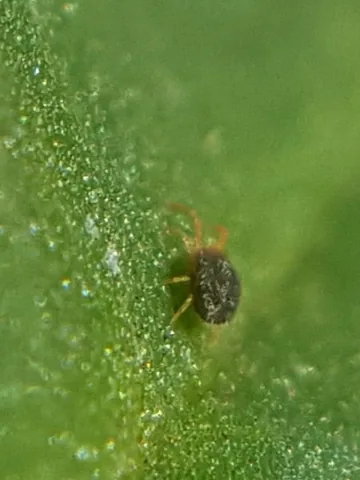 Clover Mite
Bryobia praetiosa
Clover mites are tiny plant feeders that invade homes in early spring and sometimes fall; they don't bite people or pets, don't breed indoors and soon die inside.
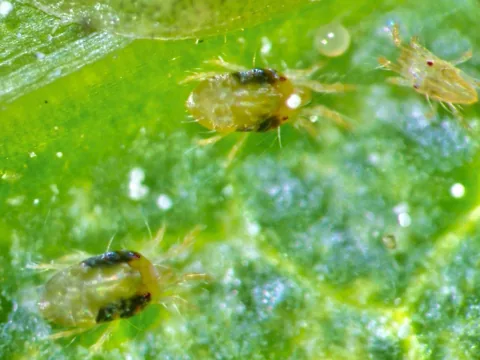 Spider Mites
Tetranychus urticae
Spider mites are tiny arachnids, relatives of spiders and ticks, that live in colonies on leaf undersides and suck out plant cells. The twospotted spider mite is the most important species in yards and gardens and on house plants, and Minnesota says it can infest over 200 species of plants.
No photo yet
Banks grass mite
Oligonychus pratensis
The Banks grass mite is a spider mite that feeds on grasses. It can be destructive in turfgrass, and on farms it attacks corn and sorghum in summer and moves into winter wheat in the fall. Drought-stressed grass suffers the most, and in healthy turf chemical control is usually not warranted.
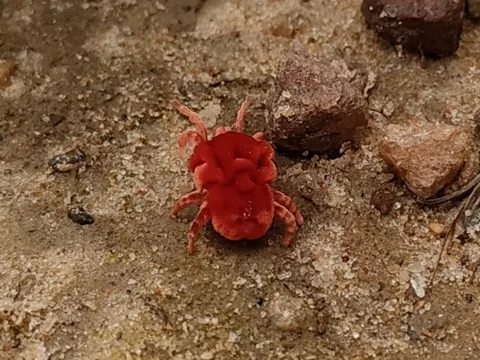 Velvet Mites
Trombidiidae (velvet mites)
Velvet mites are tiny, bright red, velvety mites seen scurrying over patios, brick walls and soil in spring. The adults prey on small insects and insect eggs, and they are harmless to people.
Side by side
Each line gives the clover mite first, then the spider mites found on garden and house plants (the twospotted spider mite is the most familiar). Colorado State lists the clover mite among the spider mites that feed on turfgrass, so the two are relatives, not strangers.[3][9][8]
Size, clover mite: about 1/30 inch, smaller than a pinhead, per Clemson and Ohio State; Penn State gives 0.75 mm. The PNW Insect Management Handbook calls it one of the larger mites and gives about 1/16 inch.[5][6][2][7]
Size, spider mites: about 1/50 inch for the twospotted spider mite per Minnesota, and less than 1/50 inch (0.4 mm) for the summer female per NC State. UC IPM says adults are less than 1/20 inch.[9][11][8]
Color, clover mite: reddish-brown to dark olive-green with pale orange legs (Ohio State), reddish or greenish (Penn State), rust-brown to dull green in the PNW handbook, which also calls it bright red.[6][2][7]
Color, spider mites: twospotted spider mites are yellow-orange or greenish yellow with two dark spots, one on each side of the body. Colorado State says spider mite colors range from red and brown to yellow and green depending on species and season, and NC State says the twospotted mite overwinters as a spotless orange female.[9][11][10]
Legs: both have eight legs as adults and six as newly hatched larvae. The clover mite's first pair is greatly elongated; spider mites have no such long front pair.[9][8][5][2][3]
Where found, clover mite: breeds outdoors on turfgrass, clover and other plants, especially heavy, well-fertilized lawns, and wanders onto walls, windows, drapes and furniture.[3][1][4][6]
Where found, spider mites: fruit trees, vegetables, berries, vines, ornamentals and houseplants, in colonies mostly on the underside of leaves.[8]
Season, clover mite: early spring and fall; Penn State says spring is when they bother homeowners most, and they go inactive through the summer heat.[1][2][5][4]
Webbing on plants vs red stains on walls
Spider mites spin webbing over the leaves they feed on, which is where the name comes from; heavy infestations can cover leaves, twigs and fruit. Minnesota says webbing indicates a spider mite infestation.[9][8]
Colorado State warns that spider webs and cottonwood fluff are often mistaken for spider mite webbing, so look for the mites themselves too.[10]
What each one damages
Spider mites: feeding leaves tiny white or yellow dots, so leaves look stippled or speckled; as it gets worse, leaves bronze, yellow and can drop.[9][8][10]
Spider mites: UC IPM says a generation can be completed in less than a week when temperature and food are favorable, which is why damage can build fast in summer.[8]
Clover mites: in large numbers they can give parts of a lawn a bronze or silvery look, Clemson says. Indoors they are a nuisance by their presence.[5][3]
Clover mites: Ohio State and Minnesota say they don't bite people or animals. Ohio State adds they don't transmit disease or feed on furnishings or pantry food.[6][4]
- Clover mite life cycle: Ohio State says they develop from unfertilized eggs, with no males needed, and each female lays about 70 eggs in cracks of foundations and mortar.[6]
How to confirm which one you have
Start with where they are. Specks crawling on a sunny windowsill, wall or curtain in spring or fall point to clover mites; specks on a plant with stippled leaves point to spider mites.[4][6][8]
Use a magnifying lens; Clemson suggests 10X. On a clover mite, look for the long front legs held forward like antennae. On a twospotted spider mite, look for the two dark spots.[12][5][9]
For plants, hold a sheet of white paper or cardboard under the leaves, shake them, and look for mites moving on the paper.[9]
- Check the undersides of leaves when you see stippling or webbing, since that is where spider mite colonies live.[8]
Why the difference matters
Clover mites start in the lawn and come inside, so the fix is at the foundation: keep grass and weeds back and remove the mites you see.[6][4][1]
Spider mites live on the plant, so the fix is on the plant: water, natural enemies, and soaps or oils on the leaves. Minnesota warns that long-lasting insecticides such as bifenthrin and permethrin kill natural enemies and could make spider mite problems worse.[9][8]
- Colorado State says spring clover mite problems will end on their own by the end of May if left alone.[3]
What to do for each
Clover mites indoors: vacuum them up or wipe them with a damp cloth, and don't crush them, since the stain can be permanent. Clemson says to put the vacuum bag in the outside trash.[4][5][6]
Clover mites outdoors: keep an 18 to 24 inch strip free of grass and weeds along the foundation, especially on the sunny sides, and avoid overfertilizing the lawn.[4][6][1]
Clover mites, sprays: extension guides list foundation and turf treatments with a labeled product; Kentucky notes there's no way to predict when the mites will move, so timing is a guess. Our clover mite guide covers when sprays help.[4][5][1]
Spider mites outdoors: hose plants with a strong water spray to knock mites off, keep plants watered, and let predatory mites and other natural enemies work.[9][8]
Spider mites, sprays: insecticidal soaps and horticultural oils are the most common choices and only kill mites they touch, so cover the leaf undersides. Water plants before spraying, and UC IPM says not to spray water-stressed plants or in very hot weather.[9][8]
Common questions
- Are clover mites a type of spider mite?
- Yes. Colorado State calls the clover mite a common type of spider mite, one of several that feed on turfgrass. It differs from garden spider mites in its long front legs, its cool-season habits and its habit of wandering indoors.[3]
- Do clover mites or spider mites bite?
- Clover mites don't bite people or animals, according to Minnesota and Ohio State. Spider mites use piercing-sucking mouthparts to feed on plant sap, Minnesota says.[4][6][9]
- Will clover mites hurt my houseplants?
- Clover mites feed on grasses, clover and other outdoor plants and get indoors by accident. Ohio State says they don't feed on furnishings or stored food. Mites with webbing on a houseplant are far more likely spider mites.[1][6][8]
- Why are there red mites on my windowsill?
- Most likely clover mites. They gather on the sunny side of the house in spring and fall and come in around windows and doors.[4][3][6]
Photo credits
- Clover Mite: (c) Alexis Tinker-Tsavalas, some rights reserved (CC BY) — via iNaturalist, CC BY 4.0
- Spider Mites: (c) Mike Bowie, some rights reserved (CC BY) — via iNaturalist, CC BY 4.0
- Velvet Mites: (c) Firos AK, some rights reserved (CC BY) — via iNaturalist, CC BY 4.0
Sources
- University of Kentucky Entomology, “Clover Mites (ENTFACT-627).” entomology.mgcafe.uky.edu/ef627 (accessed 2026-11-10)
- Penn State Extension, “Clover Mites.” extension.psu.edu/clover-mites (accessed 2026-11-10)
- Colorado State University Extension, “Clover Mites and Other Mites of Turfgrass, Fact Sheet 5.505.” extension.colostate.edu/topic-areas/insects/clover-and-other-mites-of-turfgrass-5-505/ (accessed 2026-11-10)
- University of Minnesota Extension, “Clover mites.” extension.umn.edu/insect-relatives/clover-mites (accessed 2026-11-10)
- Clemson Cooperative Extension Home & Garden Information Center, “Clover Mites.” hgic.clemson.edu/factsheet/clover-mites/ (accessed 2026-11-10)
- Ohio State University Extension and Ohio Department of Agriculture, “Clover Mites (HYG-2095, 2010).” ohioline.osu.edu/factsheet/HYG-2095 (accessed 2026-11-10)
- Pacific Northwest Pest Management Handbooks, “Nuisance and household pests: Clover mite.” pnwhandbooks.org/insect/structural-health/nuisance-household/nuisance-household-clover-mite (accessed 2026-11-10)
- University of California Statewide IPM Program, “Pest Notes: Spider Mites (UC ANR Publication 7405).” ipm.ucanr.edu/home-and-landscape/spider-mites/ (accessed 2026-11-10)
- University of Minnesota Extension, “Twospotted spider mites in home gardens.” extension.umn.edu/yard-and-garden-insects/spider-mites (accessed 2026-11-10)
- Colorado State University Extension, “Spider Mites (Fact Sheet 5.507).” extension.colostate.edu/topic-areas/insects/spider-mites-5-507/ (accessed 2026-11-10)
- NC State Extension, “Twospotted Spider Mite.” content.ces.ncsu.edu/twospotted-spider-mite (accessed 2026-11-14)
- Clemson Cooperative Extension Home & Garden Information Center, “Common Houseplant Insects & Related Pests.” hgic.clemson.edu/factsheet/common-houseplant-insects-related-pests/ (accessed 2026-11-10)