The short answer
- Legs and shape: spider mites are arachnids with eight legs and an oval body. Thrips are slender insects, and adults have long, narrow wings fringed with hairs.[1][2][5][9]
- Silk: spider mites spin fine webbing on leaves when numbers are high. Thrips make no webbing, and UC IPM says webbing is an easy way to tell spider mites from thrips and aphids.[1][2][3]
- Leaf marks: spider mites leave tiny pale dots (stippling) that can turn the leaf bronze. Thrips leave larger, more silvery scars speckled with black, varnish-like specks of excrement.[1][2][8][5][10]
- Flowers: thrips feed inside buds and blooms, so petals come out streaked, scarred or distorted, or buds fail to open. Some thrips also spread plant viruses such as tomato spotted wilt.[5][10][9][6]
Profiles on this site
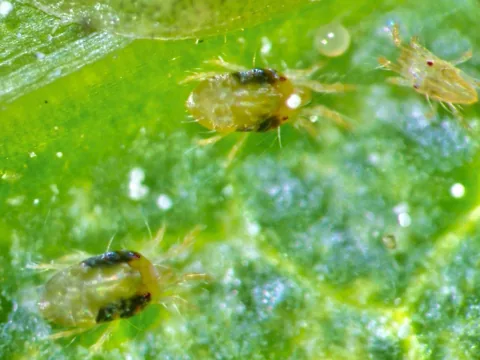 Spider Mites
Tetranychus urticae
Spider mites are tiny arachnids, relatives of spiders and ticks, that live in colonies on leaf undersides and suck out plant cells. The twospotted spider mite is the most important species in yards and gardens and on house plants, and Minnesota says it can infest over 200 species of plants.
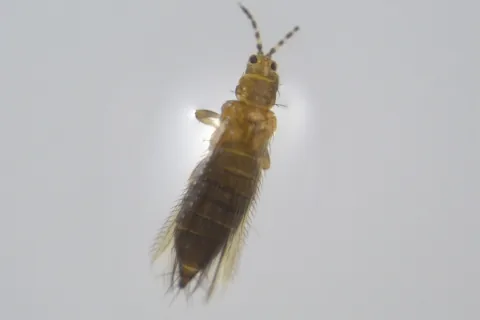 Thrips
Frankliniella occidentalis
Thrips are tiny, slender insects with fringed wings that scar and distort leaves, flowers and fruit. Woody plants usually tolerate them, but flowers, vegetables and young plants can be hurt badly, and thrips are hard to control.
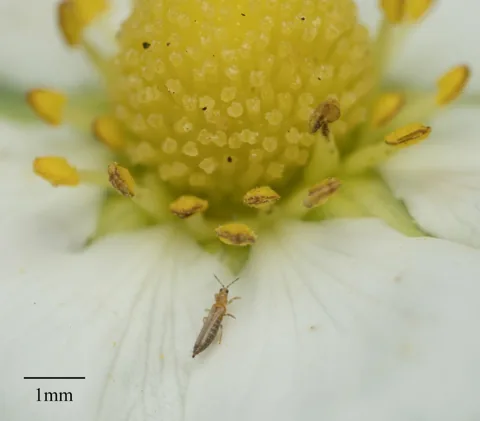 Western Flower Thrips
Frankliniella occidentalis
Western flower thrips are slender yellow to dark brown insects, about 1/16 inch long or smaller, that feed in flowers and buds and on fruit and leaves. Their feeding leaves silvery or pale scars and distorted growth, and they spread tospoviruses such as tomato spotted wilt and impatiens necrotic spot.
No photo yet
Onion Thrips
Thrips tabaci
Onion thrips are tiny, pale insects that hide in the necks of onion plants and rasp the youngest leaves, leaving white to silvery streaks and, when numbers are high, smaller bulbs. None of these sources reports harm to people or pets. To manage them, keep onions away from alfalfa and grain, use straw mulch and overhead watering, protect natural enemies, and spray only when counts pass a threshold.
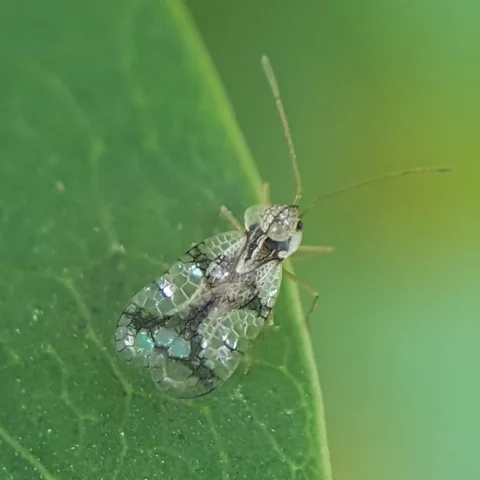 Lace Bugs
Stephanitis pyrioides
Lace bugs are small sap-feeding bugs with lacy wings that live under the leaves of trees and shrubs. Their feeding bleaches and stipples leaves; UC IPM says the damage is generally not a serious threat to plant health, though UMass says heavily infested azaleas in full sun can be killed.
 Leafhoppers
Empoasca fabae
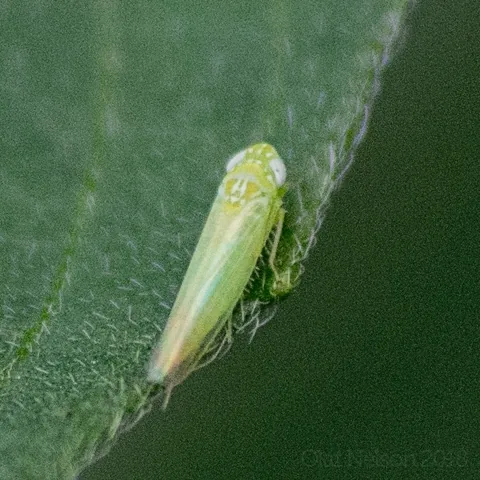
Leafhoppers are small, wedge-shaped sap feeders found on flowers, vegetables, fruit and woody ornamentals. Most just speckle leaves and need no control, but a few, like the potato leafhopper, injure crops or spread plant diseases.
 Predatory Mites
Phytoseiulus persimilis
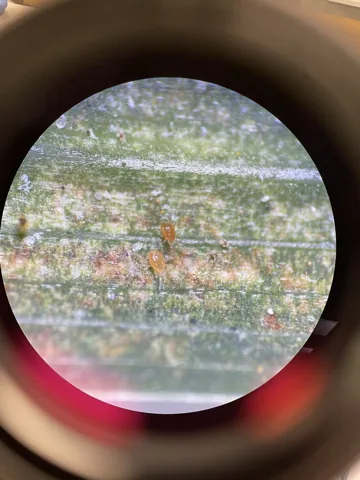
Phytoseiulus persimilis is a small, fast predatory mite that UC IPM says feeds, reproduces and develops only on spider mites that spin heavy webbing, such as the twospotted spider mite. Greenhouse growers use it widely against twospotted spider mites, and it is sold for crops such as strawberries and caneberries.
Side by side
What they are: spider mites (family Tetranychidae) are arachnids, relatives of spiders and ticks. Thrips (order Thysanoptera) are insects.[3][2][5]
Size: both are barely visible. UC IPM puts adult spider mites at less than 1/20 inch; Minnesota and NC State say the twospotted spider mite is about 1/50 inch. Thrips are less than 1/20 inch (UC IPM, Mississippi State) or less than 1/16 inch (Colorado State, Clemson); NC State says most are about 1 mm.[1][2][4][5][6][8][9][7]
Body and legs: spider mites have eight legs, an oval body and two eyespots near the head. NC State notes newly hatched mite larvae have six legs; later stages have eight. Thrips are elongate and slender, and adults have two pairs of long, narrow wings with long fringes. Young thrips have no wings.[1][2][4][5][7]
Color: twospotted spider mites are yellow-orange or greenish yellow with a dark spot on each side; Colorado State says spider mites range from red and brown to yellow and green by species and season. Thrips run from translucent white or yellowish to dark brown or black.[2][4][3][5][10]
How they move: to the naked eye spider mites look like tiny moving dots on the leaf underside. Most pest thrips feed hidden in buds, shoot tips and flowers, so UC IPM says you often see the damage before the thrips.[1][5]
Silk: spider mites produce webbing, especially in high numbers; Colorado State notes spider webs and cottonwood fluff are often mistaken for it. Thrips make none.[1][2][3][9]
Excrement: thrips feeding comes with black, varnish-like flecks of frass. UC IPM says mite damage can usually be told apart by the absence of dark excrement, and sometimes by mite cast skins and fine webbing.[5][10][11]
When they peak: spider mite damage is worst in hot, dusty conditions and on water-stressed plants, and mites commonly build up from June through September. Colorado State adds that houseplants in very hot, dry spots are prone to spider mites.[1][2][8]
Reading the damage
Spider mites: feeding leaves tiny white or yellow spots, a stippled or mottled look. As it gets worse, leaves look bronzed or bleached, may turn yellow, and drop.[1][2][3]
Thrips on leaves: stippling, discolored flecking or silvering of the leaf surface, often speckled with dark fecal spots. Colorado State says thrips damage can resemble spider mite damage, but the wounds are larger and more silvery.[5][10][8]
Thrips on flowers and fruit: streaked, scarred or distorted petals, buds that die without opening, and scabby silvery to brown marks on fruit. Rose petals can show dark streaks from feeding inside the bud.[5][10][9][7]
Thrips and viruses: western flower thrips spreads tomato spotted wilt virus and impatiens necrotic spot virus, which can badly damage or kill some vegetables and herbaceous ornamentals. NC State notes many thrips species are the only insect vectors of tospoviruses, the virus group that includes tomato spotted wilt.[5][6][7][8]
- UC IPM says suspected virus infections can be confirmed only by sending samples from the sick plants to a plant pathogen testing lab.[5]
Other bugs that stipple leaves
UC IPM lists lace bugs, plant bugs and other true bugs, spider mites and thrips as the usual causes of bleached, speckled leaves, and says the way to tell them apart is to look at the pests on the underside of the leaf.[13]
Lace bugs: adults and nymphs feed in groups on leaf undersides, causing pale stippling and bleaching that shows on the upper surface by mid to late summer. They leave dark, varnish-like specks of excrement like thrips do; adults are 1/8 to 1/3 inch (Minnesota), with semitransparent cells on the wings and thorax that give a lacelike look (UC IPM).[11][12]
Leafhoppers: wedge-shaped insects, commonly under 1/4 inch, that walk sideways or jump when disturbed. Their feeding also causes pale stippling, and they leave whitish cast skins on leaf undersides.[13]
How to confirm which one you have
Paper tap test: hold a white sheet of paper or cardboard under the leaves or flowers and shake them, then look at what fell onto the paper. Minnesota and UC IPM give this test for spider mites, and UC IPM uses the same method to dislodge thrips.[1][2][5]
Use a 10x hand lens on the leaf underside. Count legs and look for silk and round, translucent mite eggs; for thrips, look for narrow bodies and black specks.[1][9][5]
For thrips in buds, UC IPM suggests clipping suspect buds or shoot tips into a jar of rubbing alcohol and shaking it to free the thrips. NC State suggests peeling back the outer petals of a rose and looking at the base for tiny brown to orange insects.[5][7]
Hang blue or bright yellow sticky cards to detect flying adult thrips.[5]
- Species-level thrips ID needs an expert under a microscope; color is not reliable. A plant pathogen testing lab can check samples for thrips-spread viruses.[5]
Why the ID changes the treatment
Most insecticides do little to spider mites. Colorado State says few insecticides work on spider mites and many make the problem worse; chemical control means products made for mites (miticides, also called acaricides).[3][1]
Broad-spectrum sprays flare mites: UC IPM says some organophosphates and pyrethroids kill mite predators and can cause spikes in spider mite numbers. Colorado State singles out carbaryl (Sevin), and Minnesota says bifenthrin and permethrin may worsen infestations in the long run.[1][3][2]
The same trap applies when spraying for thrips: UC IPM says organophosphates, carbamates and pyrethroids are highly toxic to natural enemies, can cause spider mite outbreaks, and do not work well on most thrips. It also says imidacloprid commonly fails on thrips and that acephate can make spider mites abundant.[5]
Sprays will not stop viruses: insecticides do not kill thrips fast enough to keep them from passing a virus to the plant. Row covers, reflective mulch and resistant varieties work better for virus-prone crops.[5][6]
Natural enemies differ. Predatory mites, spider mite destroyer lady beetles (Stethorus), minute pirate bugs and predatory thrips eat spider mites. Predatory thrips, green lacewings, minute pirate bugs, predatory mites and certain parasitic wasps attack plant-feeding thrips.[3][2][1][5]
What to do about each
Spider mites: water plants enough to avoid drought stress, and hose or mist leaf undersides to knock mites down and break up webbing. If a spray is needed, UC IPM suggests insecticidal oil or soap; do not spray stressed plants or in very hot weather.[1][10]
Thrips: healthy woody plants usually tolerate thrips. On houseplants a brisk water spray can remove many thrips; insecticidal soap, oils and pyrethrins give short-term control, and UC IPM says spinosad may work better (keep it off flowering plants, since it is toxic to bees for about a day).[5][9]
Badly infested houseplants that are easy to replace are often best thrown out, Kentucky and Colorado State advise.[10][8]
Common questions
- Do thrips make webs?
- No. Fine silk webbing on leaves points to spider mites, not thrips or aphids.[1][2]
- Are the black dots on silvery leaves thrips?
- Often, yes. Thrips leave silvered patches speckled with dark, varnish-like fecal spots. Lace bugs also leave dark excrement, so check the leaf underside for the insects.[5][10][11]
- Will a regular bug spray kill spider mites?
- Usually not. Few insecticides work on spider mites, and broad-spectrum sprays such as some pyrethroids and carbaryl can kill their predators and cause mite outbreaks.[3][1]
- Can spider mites and thrips be on the same plant?
- Yes. UC IPM notes that aphids and thrips can infest the same leaf undersides as spider mites, and some thrips even eat spider mites. Check under a hand lens for both.[1][5]
- Do thrips spread plant diseases?
- Some do. Western flower thrips spreads tomato spotted wilt virus and impatiens necrotic spot virus.[5][6][8]
Photo credits
- Spider Mites: (c) Mike Bowie, some rights reserved (CC BY) — via iNaturalist, CC BY 4.0
- Thrips: (c) Julia Palmer, some rights reserved (CC BY) — via iNaturalist, CC BY 4.0
- Western Flower Thrips: Jesse Rorabaugh, public domain (CC0), via iNaturalist
- Lace Bugs: (c) giantcicada, some rights reserved (CC BY) — via iNaturalist, CC BY 4.0
- Leafhoppers: (c) moxostoma, some rights reserved (CC BY) — via iNaturalist, CC BY 4.0
- Predatory Mites: (c) rosaceae_roberts, some rights reserved (CC BY) — via iNaturalist, CC BY 4.0
Sources
- University of California Statewide IPM Program, “Pest Notes: Spider Mites.” ipm.ucanr.edu/home-and-landscape/spider-mites/ (accessed 2026-11-14)
- University of Minnesota Extension, “Twospotted spider mites in home gardens.” extension.umn.edu/yard-and-garden-insects/spider-mites (accessed 2026-11-14)
- Colorado State University Extension, “Spider Mites (5.507).” extension.colostate.edu/topic-areas/insects/spider-mites-5-507/ (accessed 2026-11-14)
- NC State Extension, “Twospotted Spider Mite.” content.ces.ncsu.edu/twospotted-spider-mite (accessed 2026-11-14)
- University of California Statewide IPM Program, “Pest Notes: Thrips.” ipm.ucanr.edu/home-and-landscape/thrips/ (accessed 2026-11-14)
- Mississippi State University Extension, “Thrips (Bug's Eye View, Vol. 4, No. 8).” extension.msstate.edu/newsletters/bugs-eye-view/2018/thrips-vol-4-no-8 (accessed 2026-11-14)
- NC State Extension, Department of Entomology and Plant Pathology, “Thrips: Biology and Rose Pests.” entomology.ces.ncsu.edu/thrips-2/ (accessed 2026-11-14)
- Colorado State University Extension, “Managing Houseplant Pests.” extension.colostate.edu/resource/managing-houseplant-pests/ (accessed 2026-11-14)
- Clemson Cooperative Extension Home and Garden Information Center, “Common Houseplant Insects and Related Pests.” hgic.clemson.edu/factsheet/common-houseplant-insects-related-pests/ (accessed 2026-11-14)
- University of Kentucky Entomology, “Houseplant Insect Control (EF406).” entomology.mgcafe.uky.edu/ef406 (accessed 2026-11-14)
- University of California Statewide IPM Program, “Pest Notes: Lace Bugs.” ipm.ucanr.edu/home-and-landscape/lace-bugs/ (accessed 2026-11-14)
- University of Minnesota Extension, “Lace bugs.” extension.umn.edu/yard-and-garden-insects/lace-bugs (accessed 2026-11-14)
- University of California Statewide IPM Program, “Pest Notes: Leafhoppers.” ipm.ucanr.edu/home-and-landscape/leafhoppers/ (accessed 2026-11-14)
- University of California Statewide IPM Program, “Phytoseiulus Predatory Mites (Natural Enemies Gallery).” ipm.ucanr.edu/natural-enemies/phytoseiulus-predatory-mites/ (accessed 2026-11-14)