The short answer
- Aphids are pear-shaped, soft-bodied and bare, with two little tailpipes (cornicles) sticking out the rear end. They walk, and some adults have wings.[7][9][11]
- Mealybugs are soft, oval, segmented insects covered in white, cottony or mealy wax. Most species keep their legs for life and can crawl around.[2][10]
- Scale insects look like small bumps or shells stuck on bark, stems or leaves, with no obvious head or legs. Only the newly hatched crawlers move.[3][8]
- To split the two kinds of scale, try lifting the cover. An armored scale's cover usually comes off and leaves the insect behind on the plant, and armored scales make no honeydew. A soft scale's cover does not lift off, and soft scales drip honeydew.[3][16][8]
Profiles on this site
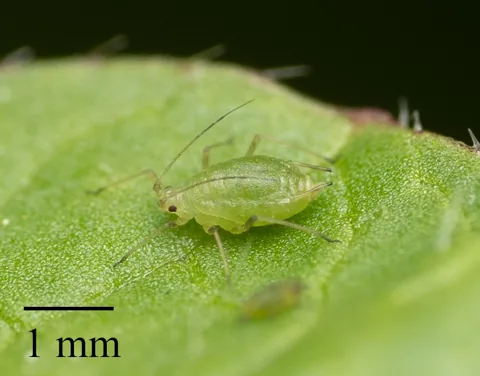 Aphids
Myzus persicae
Aphids are small, soft-bodied insects that pierce tender stems and leaves and suck out plant sap. Almost every plant hosts at least one aphid species, but established plants usually tolerate them, treating aphids for the plant's health is usually unnecessary, and natural enemies often bring numbers down.
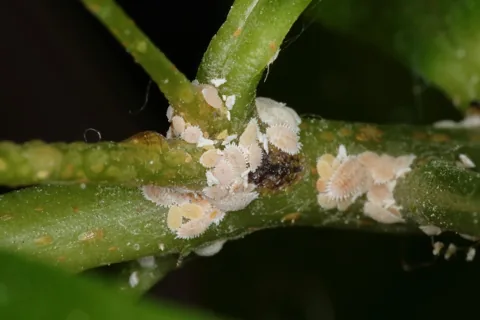 Mealybugs
Planococcus citri
Mealybugs are soft, oval insects covered in white wax that suck sap from houseplants and outdoor plants. They thrive indoors and where winters are mild, and their wax and hiding habits make them hard to reach with sprays.
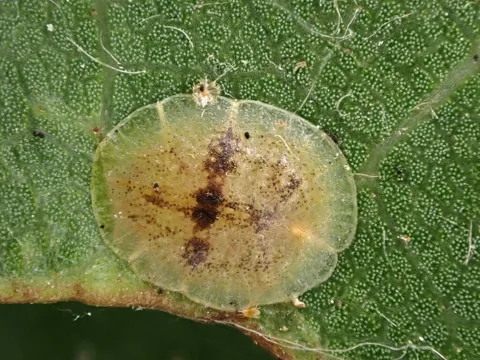 Scale Insects
Superfamily Coccoidea (representative: brown soft scale, Coccus hesperidum)
Scales are small sap-sucking insects that settle on the bark, leaves or fruit of trees, shrubs and houseplants and rarely look like insects at all. Most plants tolerate low to moderate numbers, but heavy infestations cause yellowing, leaf drop and dieback, and the soft scales drip sticky honeydew.
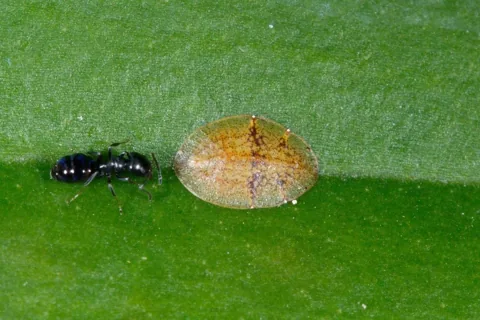 Brown Soft Scale
Coccus hesperidum
Brown soft scale is a small, oval, yellowish-brown scale insect that settles on stems and leaf veins of houseplants such as ficus, schefflera, English ivy and citrus, coating leaves with sticky honeydew.
 Oystershell Scale
Lepidosaphes ulmi
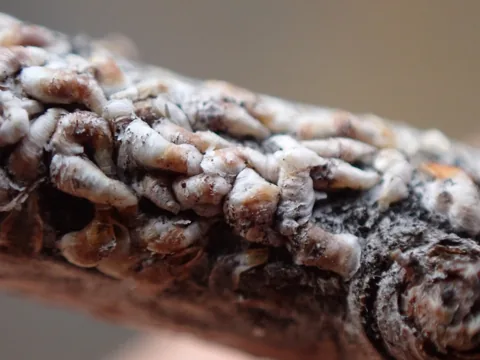
Oystershell scale is one of the most common armored scales on shade trees and shrubs. The tiny shells blend into the bark until branches are crusted with them, and severe infestations can kill shrubs and trees.
 San Jose Scale
Comstockaspis perniciosa
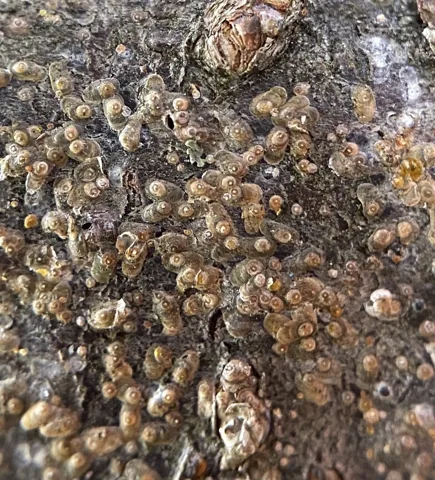
San Jose scale is a tiny armored scale insect that feeds on the bark, leaves and fruit of fruit trees. UK Extension and UC IPM both warn that unchecked infestations can kill limbs or whole trees.
 Cottony Cushion Scale
Icerya purchasi
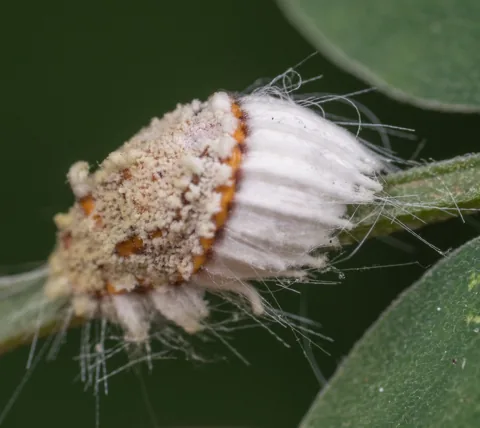
Cottony cushion scale is usually kept in check by the vedalia beetle and a parasitic fly; outbreaks mostly follow insecticide use, dust or ants that disrupt them.
 Mealybug Destroyer
Cryptolaemus montrouzieri
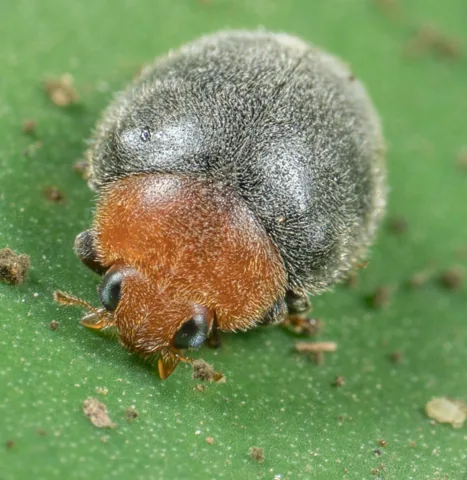
The mealybug destroyer is a small lady beetle introduced from Australia. Its white, waxy larvae look so much like mealybugs that they're easily mistaken for the pest.
Side by side
Family: aphids are their own group (Aphididae, often called plant lice). Mealybugs are Pseudococcidae, soft scales are Coccidae and armored scales are Diaspididae; the Connecticut Agricultural Experiment Station counts all three as scale insects.[9][16]
Body: aphid, pear-shaped and soft-bodied, 1/16- to 1/8-inch-long, with a pair of cornicles at the back. Mealybug, oval and segmented, soft and wingless as an adult female, with females about 1/16 inch long. Scale, no obvious head or legs, so it does not look much like an insect at all.[7][9][11][2][10][3]
Covering: aphids have no covering, though a few species, such as the cabbage aphid, carry a grayish-white waxy coating. Mealybugs are covered with white, waxy, cottony material. Soft scales have a smooth, cottony or waxy surface, and a hard wax layer on the outer skin that cannot easily be removed. Armored scales live under a separate hard cover that usually lifts off.[7][10][2][3][16]
Size of scales: Minnesota Extension puts soft scales at about 1/8 to 1/4 inch and armored scales at about 1/16 to 1/8 inch. The Connecticut Agricultural Experiment Station gives 5-10 mm for soft scales and 2-3 mm for armored scales.[8][16]
Shape of scales: soft scales are usually larger, rounder and more humped (convex) than armored scales; armored scales are tiny and flat, oval or somewhat elongate, and often match the bark color.[3][8][16]
Movement: aphids walk, and winged forms appear when colonies get crowded or the plant declines. Mealybugs keep their legs and can move around. Scales settle as crawlers, lose their legs and stay put as adults; except for the males of some species, adult scales are fixed in place.[11][7][10][3][17]
Where on the plant: aphids feed on stems, leaves and other tender plant parts, and many species prefer the undersides of leaves. Mealybugs hide in protected spots such as the plant crown, branch crotches, stems near the soil, stem tips, leaf junctures and new growth. Scales sit on bark, twigs, leaves or fruit, mostly on trees, shrubs and other perennials.[7][2][10][3]
Honeydew and sooty mold: aphids, mealybugs and soft scales all excrete sticky honeydew, and sooty mold grows on it. Armored scales feed on individual plant cells rather than phloem sap and do not produce honeydew.[1][2][3][8][5]
Ants: ants tend aphids, soft scales and mealybugs for their honeydew and protect them from natural enemies. Armored scales give ants nothing, so ants on the plant point away from armored scale.[4][14][3]
The crawler stage
Scale insects have three stages: egg, crawler and adult. Crawlers move out from under the parent scale to settle on new spots on the plant. Once they settle and start to feed they become immobile.[8][16]
Crawlers are tiny and often yellow to orangish, and they can be mistaken for mites. They can be blown by wind to other plants or carried on the feet of birds.[3][17][8]
The Connecticut Agricultural Experiment Station says crawler emergence usually lasts 2-4 weeks. Cornell Cooperative Extension notes that oystershell scale crawlers do not move far from the parent and mostly colonize current-season and 1-year-old wood.[16][17]
Newly hatched mealybugs also lack wax and move around before they settle and make a waxy covering. Citrus mealybugs of all sizes can be seen crawling over the plant.[2][15]
- To see when crawlers are out, Minnesota Extension suggests wrapping double-sided tape around branches where scales are present and checking the tape for crawlers.[8]
How to confirm what you have
Use a hand lens on the rear end. If you can see two cornicles, it is an aphid. All aphids have them, but on some species they are small.[7][9]
Gently lift a bump with a fingernail or pin. If a cover comes off and the insect body stays on the plant, it is an armored scale. If the cover will not separate from the body, it is more likely a soft scale.[3][16]
Look for white wax. Mealybugs may be confused with cottony cushion scale, woolly aphids, soft scales and whiteflies, which also make wax and honeydew. Azalea bark scale is also often mistaken for a mealybug.[2][17]
Check for a ladybug larva in disguise. Larvae of the mealybug destroyer, a lady beetle that eats mealybugs, grow up to 1/2 inch long and closely resemble a mealybug. Leave them on the plant.[6][12]
Find sticky leaves but no insects nearby? Look above. Honeydew drips onto leaves, cars and furniture under an infested plant, and on trees the insects may be higher up.[17][8]
- If you are still unsure, take a sample to your county extension office. Minnesota Extension notes that identifying the scale species matters for choosing the most effective way to manage it.[8]
Why the ID changes what works
Natural enemies: aphids have many predators and parasites, including lady beetles, lacewings, flower fly (syrphid) larvae and parasitic wasps that turn aphids into mummies. Mealybugs have the mealybug destroyer and parasitic wasps. Scales are usually kept down by lady beetles and tiny parasitic wasps. Broad-spectrum insecticides can be toxic to these allies.[1][11][2][12][8]
Ants: because ants protect honeydew producers from natural enemies, outbreaks of aphids and scales often follow ant tending. Keeping ants off the plant helps with aphids, mealybugs and soft scales, but not armored scales.[4][1][3]
Soaps and oils need contact: insecticidal soaps and horticultural oils only kill insects they actually touch, and leave no residue that keeps working. Aphids, mealybugs and scale crawlers are among the soft-bodied pests most easily killed by soap.[18][8]
Timing for scales: the best time to treat most scales is when crawlers are first active, after eggs hatch but before they make their shells. Scales with a long egg hatch may need repeat sprays, since soaps and oils only reach the crawlers they contact. Horticultural oil can also go on as a dormant spray in late winter or early spring.[8][3]
Wax makes mealybugs harder to hit: soaps, horticultural oil or neem oil sprayed directly on mealybugs give some suppression, mostly on younger nymphs that have less wax.[2]
Armored scales shrug off some systemics: the armored scale's hard cover helps protect it from insecticides and natural enemies, and UC IPM says the systemic imidacloprid controls soft scales but not armored scales or cottony cushion scale.[16][3]
- Oil can also slow aphid-spread viruses: Colorado State notes that horticultural oils may interfere with how aphids feed and can inhibit some aphid-spread (nonpersistent) plant viruses.[13]
What to do for each
Aphids: most established plants tolerate aphids and outgrow the damage. Knock them off sturdy plants with a strong stream of water, keep ants off, and if a spray is needed choose insecticidal soap or oil. See how to get rid of aphids.[1]
Mealybugs: inspect new plants before bringing them home, since mealybug and scale infestations on houseplants almost always start from a recently bought or gifted plant. Swab small numbers with rubbing alcohol on a cotton swab, and consider discarding a badly infested houseplant. See how to get rid of mealybugs.[2][12][14]
Soft scales: control ants, protect natural enemies, and time soap or oil sprays to the crawlers. On houseplants, washing broadleaved plants with soapy water and a soft brush or cloth can hold scale at bay for several months.[4][8][14]
Armored scales: if the infestation is small, prune out the affected plant parts, and aim oil or soap at crawlers or use a dormant oil spray. Do not count on imidacloprid. See how to get rid of scale insects.[17][8][3]
Sooty mold on any of them: sooty mold does not infect the plant; it grows on honeydew. Control the insect making the honeydew, and wash the mold off with a strong stream of water or mild soap and water.[5][3]
Common questions
- Are mealybugs a type of scale insect?
- They are close relatives. The Connecticut Agricultural Experiment Station lists mealybugs (Pseudococcidae) with armored and soft scales as scale insects. Unlike most scales, mealybugs keep their legs and can move around.[16][10]
- Is the white fuzz on my plant mealybugs or woolly aphids?
- Both make wax. Look for cornicles, the two tailpipes at the rear of every aphid, and for the oval, segmented body of a mealybug. UC IPM lists woolly aphids, cottony cushion scale, soft scales and whiteflies among the insects confused with mealybugs.[2][7]
- Why are ants all over my plant?
- They are probably collecting honeydew from aphids, soft scales or mealybugs, and protecting those insects from natural enemies while they do it.[4][14]
- Does insecticidal soap kill scale?
- It works on crawlers it touches, and soap has no residual effect, so timing matters. Adults under a shell or thick wax are much harder to reach.[18][8][16][2]
- My plant is sticky but I see no bugs. What is it?
- Honeydew comes from aphids, soft scales, mealybugs and whiteflies, not from armored scales. Check the undersides of leaves and the stems above the sticky spot.[3][8][5]
Photo credits
- Aphids: Jesse Rorabaugh, public domain (CC0), via iNaturalist
- Mealybugs: (c) Carlos Alexandre Mattos Raposo, some rights reserved (CC BY) — via iNaturalist, CC BY 4.0
- Scale Insects: (c) Grey Smith, some rights reserved (CC BY) — via iNaturalist, CC BY 4.0
- Brown Soft Scale: (c) Lek Khauv, some rights reserved (CC BY) — via iNaturalist, CC BY 4.0
- Oystershell Scale: Randal, public domain (CC0), via iNaturalist
- San Jose Scale: (c) Zihao Wang, some rights reserved (CC BY) — via iNaturalist, CC BY 4.0
- Cottony Cushion Scale: Jesse Rorabaugh, public domain (CC0), via iNaturalist
- Mealybug Destroyer: Jesse Rorabaugh, public domain (CC0), via iNaturalist
Sources
- University of California Statewide IPM Program, “Pest Notes: Aphids.” ipm.ucanr.edu/home-and-landscape/aphids/ (accessed 2026-11-14)
- University of California Statewide IPM Program, “Pest Notes: Mealybugs.” ipm.ucanr.edu/home-and-landscape/mealybugs/ (accessed 2026-11-14)
- University of California Statewide IPM Program, “Pest Notes: Scales.” ipm.ucanr.edu/home-and-landscape/scales/ (accessed 2026-11-14)
- University of California Statewide IPM Program, “Pest Notes: Ants.” ipm.ucanr.edu/home-and-landscape/ants/ (accessed 2026-11-14)
- University of California Statewide IPM Program, “Pest Notes: Sooty Mold.” ipm.ucanr.edu/home-and-landscape/sooty-mold/ (accessed 2026-11-14)
- University of California Statewide IPM Program, “Natural Enemies Gallery: Mealybug Destroyer.” ipm.ucanr.edu/natural-enemies/mealybug-destroyer/ (accessed 2026-11-14)
- University of Minnesota Extension, “Aphids in home yards and gardens.” extension.umn.edu/yard-and-garden-insects/aphids (accessed 2026-11-14)
- University of Minnesota Extension, “Scale insects on Minnesota trees and shrubs.” extension.umn.edu/garden-and-home/yard-and-garden/yard-and-garden-insects/scale-insects (accessed 2026-11-14)
- University of Wisconsin-Madison Extension (Wisconsin Horticulture), “Aphids.” hort.extension.wisc.edu/articles/aphids/ (accessed 2026-11-14)
- University of Wisconsin-Madison Extension (Wisconsin Horticulture), “Mealybugs.” hort.extension.wisc.edu/articles/mealybugs-2/ (accessed 2026-11-14)
- Colorado State University Extension, “Aphids on Shade Trees and Ornamentals (5.511).” extension.colostate.edu/topic-areas/insects/aphids-on-shade-trees-and-ornamentals-5-511/ (accessed 2026-11-14)
- Colorado State University Extension, “Managing Houseplant Pests.” extension.colostate.edu/resource/managing-houseplant-pests/ (accessed 2026-11-14)
- Colorado State University Extension, “Insect Control: Horticultural Oils.” extension.colostate.edu/resource/insect-control-horticultural-oils/ (accessed 2026-11-14)
- University of Kentucky Entomology, “Houseplant Insect Control (ENTFACT-406).” entomology.mgcafe.uky.edu/ef406 (accessed 2026-11-14)
- NC State Extension, “Citrus Mealybug.” content.ces.ncsu.edu/citrus-mealybug (accessed 2026-11-14)
- Connecticut Agricultural Experiment Station, “Scale Insect Pests of Connecticut Trees and Ornamentals.” portal.ct.gov/-/media/caes/documents/publications/fact_sheets/entomology/scaleinsectpestsofconnecticuttreesandornamentalspdf.pdf (accessed 2026-11-14)
- Cornell Cooperative Extension, Nassau County, “Scale Insects (Home Grounds Fact Sheet).” ccenassau.org/resources/scale-insects (accessed 2026-11-14)
- Clemson Cooperative Extension Home & Garden Information Center, “Insecticidal Soaps for Garden Pest Control.” hgic.clemson.edu/factsheet/insecticidal-soaps-for-garden-pest-control/ (accessed 2026-11-14)