The short answer
- Touch the leaf: leafhoppers walk rapidly sideways, jump or fly when disturbed. Most aphids don't move rapidly; they stay put in clusters.[1][3][6]
- Look at the rear end: aphids have a pair of tubelike tailpipes called cornicles sticking backward from the end of the body. No other insect has them.[6][7][9]
- Body shape: leafhoppers are long for their width and wedge-shaped, with rows of small spines along the hind legs. Aphids are soft, plump and pear-shaped, with long legs and antennae.[1][2][6][7]
- Damage: leafhoppers leave pale specks (stippling), and potato leafhopper causes yellow-brown leaf tips called hopperburn. Aphids more often curl and distort new leaves and drip heavy honeydew.[1][3][6][8]
Profiles on this site
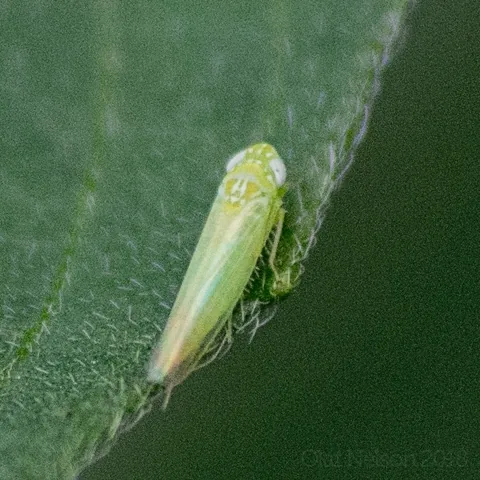 Leafhoppers
Empoasca fabae
Leafhoppers are small, wedge-shaped sap feeders found on flowers, vegetables, fruit and woody ornamentals. Most just speckle leaves and need no control, but a few, like the potato leafhopper, injure crops or spread plant diseases.
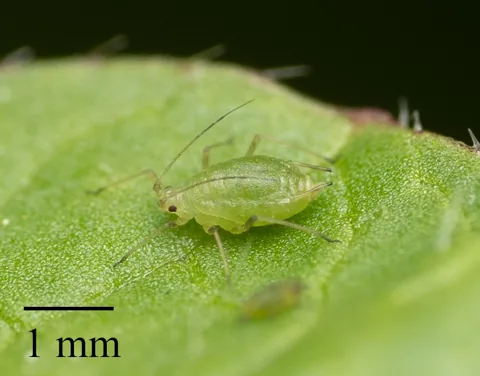 Aphids
Myzus persicae
Aphids are small, soft-bodied insects that pierce tender stems and leaves and suck out plant sap. Almost every plant hosts at least one aphid species, but established plants usually tolerate them, treating aphids for the plant's health is usually unnecessary, and natural enemies often bring numbers down.
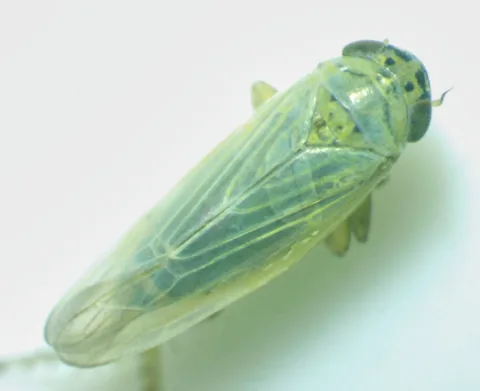 Aster Leafhopper
Macrosteles quadrilineatus
The aster leafhopper, also called the sixspotted leafhopper, is a small leafhopper whose own feeding does little harm but which is the main carrier of aster yellows, a plant disease caused by a phytoplasma (Candidatus Phytoplasma asteris).
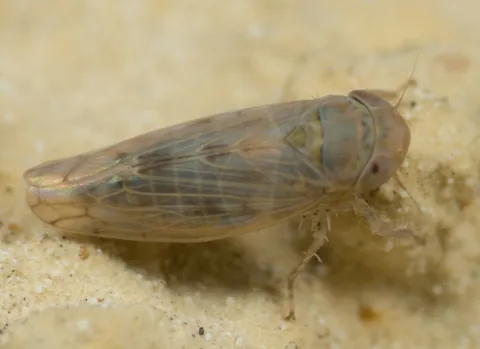 Beet leafhopper
Neoaliturus tenellus (formerly Circulifer tenellus)
The beet leafhopper is a small, pale, wedge-shaped leafhopper whose feeding spreads curly top virus, which leaves tomatoes, peppers, beets and beans curled, yellowed and stunted. It is the only insect known to carry the virus, and an infected leafhopper can pass it on within minutes of feeding. In gardens, the fixes are weed control, row covers or netted cages over young plants, and pulling infected plants; sprays work poorly.
 Green Peach Aphid
Myzus persicae
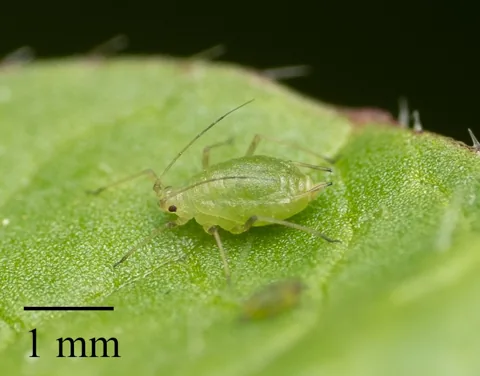
The green peach aphid is a small, pale green to yellowish aphid that overwinters on peach and other Prunus trees and spreads in summer to hundreds of vegetables, flowers and weeds. It carries many plant viruses and builds up so fast that it is a major greenhouse pest. UF/IFAS says many consider it the most important carrier of plant viruses in the world.
Side by side
Both suck plant juices through long, piercing mouthparts. The quickest checks are how the insect reacts when you disturb it and whether it has cornicles. For aphids versus mealybugs and scale, see the aphids vs mealybugs vs scale guide.[1][3][6]
- Movement: leafhopper adults and nymphs walk rapidly sideways or readily jump when disturbed; Wisconsin describes potato leafhopper as highly mobile, jumping, flying or running sideways. UC IPM says that unlike leafhoppers, most aphids don't move rapidly when disturbed.[1][3][6]
- Cornicles: most aphid species have a pair of tubelike cornicles projecting backward from the hind end. Minnesota calls these two tail pipes the best way to identify aphids, though some are short and less obvious. Leafhoppers have none.[6][9][7]
- Shape: leafhopper adults are long compared with their width and wedge-shaped. Aphids have soft pear-shaped bodies with long legs and antennae; UMass calls them soft and plump bodied with long spindly legs.[1][3][6][7]
- Hind legs: leafhoppers have one or more long rows of small spines along the hind legs, a feature both UC IPM and the Missouri Department of Conservation use to separate them from similar hoppers.[1][2]
- Size: UC IPM says leafhopper adults are commonly less than 1/4 inch long, and Missouri says most species are less than about ½ inch, with a few reaching 1¼ inches. Minnesota gives aphids as 1/16- to 1/8-inch-long (2-4 mm).[1][2][9]
- Color: leafhoppers are commonly brown, gray, green or yellow, or mottled, and some are vividly patterned. Aphids may be green, yellow, brown, red or black depending on the species and host plant, and a few are covered in white or gray wax.[1][2][6]
- Wings: adult leafhoppers fly as well as jump. Adult aphids are generally wingless, but most species also produce winged forms, especially when populations are high or in spring and fall, which move to new plants.[1][3][6][9][7]
- Where they sit: leafhopper adults, nymphs and their pale cast skins are found on leaf undersides and green shoots. Aphids gather in clusters on new succulent growth, the undersides of young leaves, buds, stems and sometimes roots.[1][9]
- Leftovers: both leave whitish cast skins as the young molt, and both excrete honeydew on which black sooty mold grows. Aphids are the classic heavy honeydew producers, often tended by ants.[1][9][6][7]
Reading the damage
Leafhoppers: leaf stippling, bleached specks, is commonly the most obvious sign. Leaves and shoot tips fed on by many leafhoppers may turn yellow then brown, curl and die. Penn State notes leafhoppers also leave many small spots of excrement on fruit.[1][4]
Hopperburn: potato leafhopper first causes paling of leaf veins and curling of leaves, then a triangular yellowing or browning of the leaf tips, called hopperburn. Plants can become stunted and yellow with upward-curled leaves.[3]
Aphids: light infestations usually do little harm, but large populations can turn leaves yellow and stunt shoots. Some species inject a toxin that curls leaves and distorts growth, and Minnesota lists twisted and curled leaves, yellowed leaves and stunted or dead shoots as signs of severe feeding.[6][9][8]
The plant diseases each one spreads
Leafhoppers: the aster leafhopper and some other leafhoppers spread aster yellows, a phytoplasma disease that can damage carrots, celery, lettuce, potatoes and many flowers. The beet leafhopper spreads curly top virus to beans, beets, melons, potatoes, peppers and tomatoes. Glassy-winged sharpshooter and other sharpshooters carry the bacterium Xylella fastidiosa.[1][5]
Aphids: aphids may carry viruses from plant to plant, including cucumber mosaic virus. UC IPM lists squash, cucumber, pumpkin, melon, bean, potato, lettuce, beet, chard and bok choy as crops that often have aphid-transmitted viruses, which mottle, yellow or curl leaves and stunt growth.[6][9]
How to confirm what you have
Turn a leaf over and gently touch the insects. If they scatter sideways, hop or fly off, think leafhoppers; if they stay in a cluster, look with a hand lens for the two cornicles at the rear. Leafhoppers also show rows of small spines along the hind legs.[1][3][6][9]
Look at the damage pattern too: scattered pale specks with no sticky film point to leafhoppers, curled new growth with sticky honeydew and ants to aphids. Many leafhoppers look alike; Minnesota notes the aster leafhopper is hard to tell from other species, so a county extension office can help with the exact species.[1][6][5]
- Check for natural enemies while you look: crusty golden-brown aphid mummies mean parasitic wasps are already at work, and the aphid numbers are likely to fall within a week or two in warm weather.[6]
Why the difference matters
Aphids hide in leaves they have curled, where contact sprays and natural enemies can't reach them, so they are easiest to manage before leaves distort. Ants protect aphids from natural enemies, so ant control is part of aphid control.[6]
Leafhoppers are quick and mobile, and the worst harm from some species is the disease they carry rather than the feeding. Keeping them off susceptible crops matters more than killing the ones you see.[1][5][3]
What to do for each
Aphids: knock them off with a strong stream of water or by shaking the plant, avoid overfertilizing, keep ants off plants, and protect seedlings with covers or aluminum foil mulches. Lady beetles, lacewings, syrphid fly larvae and parasitic wasps often bring numbers down. If numbers stay high, insecticidal soaps and oils are the next step; avoid broad-spectrum insecticides that kill natural enemies.[6][9]
Leafhoppers: regularly inspect plants for nymphs from late winter if leafhoppers were a problem the year before, and remove weed and other alternate hosts. If nymphs are abundant early in the season, thoroughly spraying green shoots and leaf undersides with horticultural oil, insecticidal soap or neem oil gives some control. Assassin bugs, lacewings, damsel bugs, lady beetles, minute pirate bugs, spiders and egg parasitoid wasps all attack them.[1]
Leafhopper-spread disease: Minnesota says covering a crop with floating row covers for the whole season keeps aster leafhoppers from reaching it, that perennial weeds should be controlled, and that infected plants should be removed and destroyed.[5]
Common questions
- Do leafhoppers make honeydew like aphids?
- Yes. UC IPM says leafhoppers also excrete honeydew on which blackish sooty mold grows, and Penn State notes it can leave black specks on fruit and foliage. Heavy, dripping honeydew with ants on the plant still points first to aphids.[1][4][6]
- Are the tiny green bugs that jump off my beans aphids?
- Probably not. Aphids don't move rapidly when disturbed. A small, bright-green, wedge-shaped insect that jumps, flies or runs sideways is more likely a leafhopper, such as the potato leafhopper.[6][3]
- Do winged aphids hop?
- No. Winged aphids still have the aphid's pear-shaped body and cornicles; they fly to new plants when colonies get crowded or the host declines, while leafhoppers jump as well as fly.[9][7][1]
- Will spraying stop the plant viruses they carry?
- Usually not. Both UC IPM fact sheets say transmission happens faster than an insecticide can kill the insect. Row covers on young or susceptible plants, weed control and removing infected plants do more.[6][1][5]
Photo credits
- Leafhoppers: (c) moxostoma, some rights reserved (CC BY) — via iNaturalist, CC BY 4.0
- Aphids: Jesse Rorabaugh, public domain (CC0), via iNaturalist
- Aster Leafhopper: Ken Kneidel, public domain (CC0), via iNaturalist
- Beet leafhopper: Jesse Rorabaugh, public domain (CC0), via iNaturalist
- Green Peach Aphid: Jesse Rorabaugh, public domain (CC0), via iNaturalist
Sources
- University of California Statewide IPM Program, “Leafhoppers (Pest Notes, Home and Landscape).” ipm.ucanr.edu/home-and-landscape/leafhoppers/ (accessed 2026-11-14)
- Missouri Department of Conservation, “Leafhoppers (Field Guide).” mdc.mo.gov/discover-nature/field-guide/leafhoppers (accessed 2026-11-14)
- University of Wisconsin-Madison Division of Extension, Wisconsin Horticulture, “Potato Leafhopper (XHT1132, revised 2020).” hort.extension.wisc.edu/articles/potato-leafhopper/ (accessed 2026-11-14)
- Penn State Extension, “Tree Fruit Insect Pest - Rose Leafhopper.” extension.psu.edu/tree-fruit-insect-pest-rose-leafhopper (accessed 2026-11-14)
- University of Minnesota Extension, “Aster yellows.” extension.umn.edu/plant-diseases/aster-yellows (accessed 2026-11-14)
- University of California Statewide IPM Program, “Pest Notes: Aphids.” ipm.ucanr.edu/home-and-landscape/aphids/ (accessed 2026-11-14)
- University of Minnesota Extension, “Aphids in home yards and gardens.” extension.umn.edu/yard-and-garden-insects/aphids (accessed 2026-11-14)
- Colorado State University Extension, “Aphids on Shade Trees and Ornamentals (5.511).” extension.colostate.edu/topic-areas/insects/aphids-on-shade-trees-and-ornamentals-5-511/ (accessed 2026-11-14)
- UMass Amherst Center for Agriculture, Food, and the Environment, “Aphids (Landscape fact sheet).” ag.umass.edu/landscape/fact-sheets/aphids (accessed 2026-11-14)