On this page
How to identify it
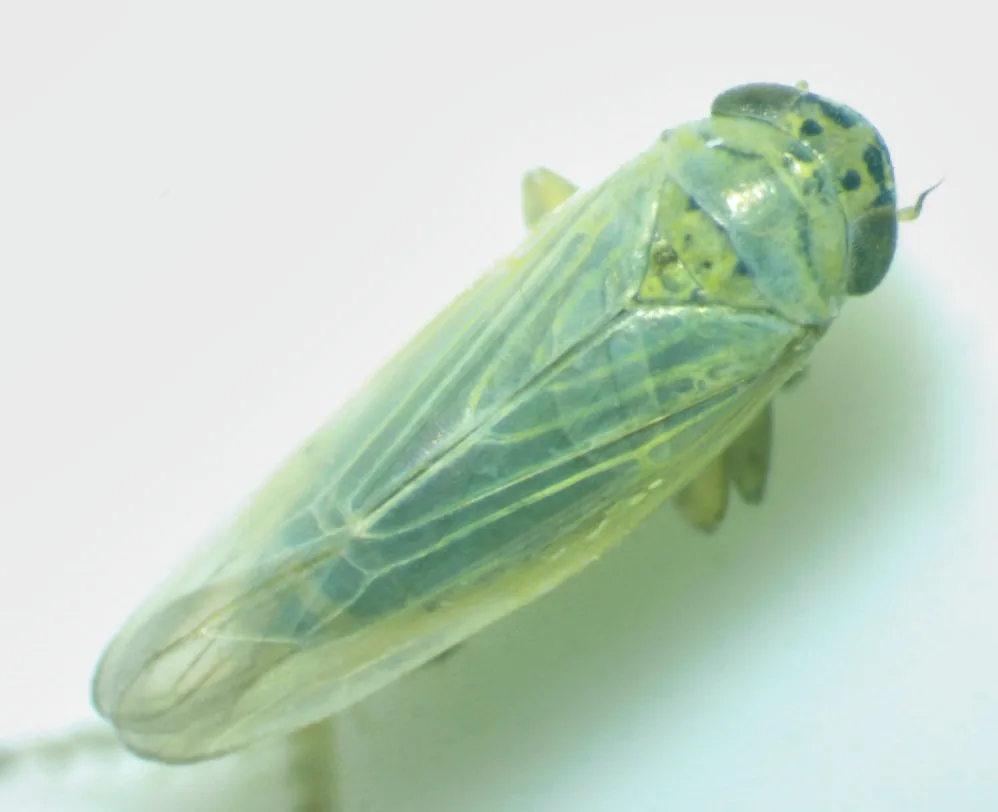
- Adults are about 0.19 inch long, narrow and wedge-shaped, with six dark spots arranged in three rows on top of the head. The PNW Handbook calls them yellow or yellow-green, while Utah State describes gray to green bodies.[1][4]
- Nymphs look like small, wingless adults, often lighter colored, from 0.03 to 0.12 inch long, and scuttle sideways when disturbed.[1][4]
- Adults are weak fliers that tend to glide along on the wind.[1]
- Minnesota Extension warns that it is hard to tell apart from other leafhopper species.[5]
Look-alikes
| Look-alike | How to tell them apart |
|---|---|
| Other leafhoppers | Look for the six spots in three rows on the head. In a Michigan survey of carrot and celery farms, the potato leafhopper was the second most common leafhopper after this species and may also be able to carry aster yellows.[1][3] |
Where it lives
Researchers call it an important pest in Western Canada and the upper Midwest, and the PNW Handbook covers it on Pacific Northwest carrots. Minnesota Extension says most of the population overwinters in southern states and weather systems carry the insects north each season. GBIF holds about 490 U.S. records since 1990, the most from Illinois, and about 2,600 from Canada.[6][1][5][7][8]
Biology and life cycle
It overwinters as eggs in the north and as adults in warmer areas; Minnesota Extension says only a few overwinter there as eggs.[1][5]
Eggs are laid in plant tissue. Each generation takes 27 to 34 days through five nymph stages, with three to four generations a year.[4][1]
In lab tests on barley, adults survived 18 days at 0 °C without reproducing, and insects held at 35 °C reproduced before dying within 18 days.[9]
Cereals and some weeds such as fleabane are suitable egg-laying hosts, and researchers suggest weeds may host leafhoppers that arrive before crops emerge.[2]
Damage and signs
- Feeding gives leaves a yellow, speckled or white-flecked look, usually minor, though heavy feeding can scorch leaves brown at the feeding sites.[1][4]
- Its real harm is aster yellows. Researchers report the disease in over 300 plant species, including cereals and oilseeds. Symptoms include stunted growth, yellow or white (sometimes red to purple) leaves, witches'-broom clusters of thin stems and small, malformed flowers that stay green. In carrots, infection causes root proliferation and thin, hairy, often bitter taproots.[2][5][4][1]
- Infection rates are usually low: Minnesota Extension says only a small number of the migrating leafhoppers carry the pathogen, and Wisconsin carrot-field data put annual infectivity at around 2 percent, varying widely from year to year.[5][10][11]
Health risk
It feeds on plants; none of the sources mentions any risk to people.[1][4][5]
Control
Prevention
Monitor with yellow sticky traps or sweep nets. In Wisconsin carrot fields, leafhopper numbers ran above average from about 11 June to early August and infectivity from mid- to late May to mid-July, the window to focus protection.[1][10][11]
Keep them out
Row covers keep leafhoppers off valuable crops, and aluminum foil or straw mulches can reduce aster yellows.[1][4]
Sanitation
Remove perennial weeds that harbor aster yellows and the leafhoppers, pull and destroy infected plants (they never recover), and don't plant cloves from infected garlic. The phytoplasma doesn't survive in dead plant debris but does survive in the crowns and roots of infected perennials.[1][5][4]
Pesticides
Home-use options listed include insecticidal soap, neem oil, pyrethrins and spinosad, among others.[1]
More from Utah State University Extension
After feeding on an infected plant, a leafhopper needs an incubation period before it can pass aster yellows on: Utah State says up to 18 days, and Minnesota Extension says a minimum of two weeks, after which the insect transmits the pathogen every time it feeds for the rest of its life. Infected plants can't be cured and should be pulled.[4][5]
Temperature doesn't stop the disease: infected leafhoppers held at 0 to 20 °C for 18 days still produced aster yellows in canola, and researchers concluded typical Canadian Prairie growing-season temperatures will not limit spread.[9]
Common questions
- What tiny yellow-green leafhoppers are on my carrots?
- Likely aster leafhoppers, which have six dark spots in three rows on the head, but other leafhoppers also visit carrots, so check closely.[1][3]
- Do aster leafhoppers spread disease?
- Yes. They're the main carrier of aster yellows, a phytoplasma disease, though only a small share of them carry it in a given year.[1][3][5]
Sources
- Pacific Northwest Pest Management Handbooks (OSU, WSU, University of Idaho), “Carrot: Sixspotted leafhopper (Insect Management Handbook).” pnwhandbooks.org/insect/vegetable/vegetable-pests/hosts-pests/carrot-sixspotted-leafhopper (accessed 2026-11-11)
- Journal of Economic Entomology, via PubMed, “Oviposition behavior and development of aster leafhoppers on selected host plants from the Canadian Prairies (Romero et al. 2020).” pubmed.ncbi.nlm.nih.gov/33128450/ (accessed 2026-11-11)
- Insects, via PubMed, “Identifying leafhopper targets for controlling aster yellows in carrots and celery (2020).” pubmed.ncbi.nlm.nih.gov/32630777/ (accessed 2026-11-11)
- Utah State University Extension, “Aster Leafhopper.” extension.usu.edu/planthealth/ipm/notes_ag/veg-aster-leafhopper.php (accessed 2026-11-11)
- University of Minnesota Extension, “Aster yellows.” extension.umn.edu/plant-diseases/aster-yellows (accessed 2026-11-11)
- Environmental Entomology, via PubMed, “Effects of insect longevity and drought conditions on aster leafhopper fecundity (2025).” pubmed.ncbi.nlm.nih.gov/40601483/ (accessed 2026-11-11)
- Global Biodiversity Information Facility (GBIF), “Macrosteles quadrilineatus: U.S. occurrence records since 1990 by state (GBIF occurrence search).” api.gbif.org/v1/occurrence/search?taxonKey=2039662&country=US&hasGeospatialIssue=false&occurrenceStatus=PRESENT&year=1990%2C2026&facet=stateProvince&facetLimit=400&limit=0 (accessed 2026-11-11). Exact count at access: 487 U.S. records since 1990 (Illinois 123, California 67).
- Global Biodiversity Information Facility (GBIF), “Macrosteles quadrilineatus: occurrence records since 1990 by country (GBIF occurrence search).” api.gbif.org/v1/occurrence/search?taxonKey=2039662&hasGeospatialIssue=false&occurrenceStatus=PRESENT&year=1990%2C2026&facet=country&limit=0 (accessed 2026-11-11). Exact counts at access: 3,172 records since 1990; Canada 2,646, United States 487.
- Scientific Reports, via PubMed, “Aster leafhopper survival and reproduction, and aster yellows transmission under static and fluctuating temperatures (Bahar et al. 2018).” pubmed.ncbi.nlm.nih.gov/29321551/ (accessed 2026-11-11)
- Environmental Entomology, via PubMed, “Factors influencing aster leafhopper abundance and aster yellows phytoplasma infectivity in Wisconsin carrot fields (Frost et al. 2013).” pubmed.ncbi.nlm.nih.gov/23726057/ (accessed 2026-11-11)
- Environmental Entomology, via PubMed, “Seasonal patterns of aster leafhopper abundance and aster yellows phytoplasma infectivity in Wisconsin carrot fields (Frost et al. 2013).” pubmed.ncbi.nlm.nih.gov/23726058/ (accessed 2026-11-11)
- iNaturalist, “Macrosteles quadrilineatus taxon page (order and family).” www.inaturalist.org/taxa/224357 (accessed 2026-10-06)