On this page
How to identify it
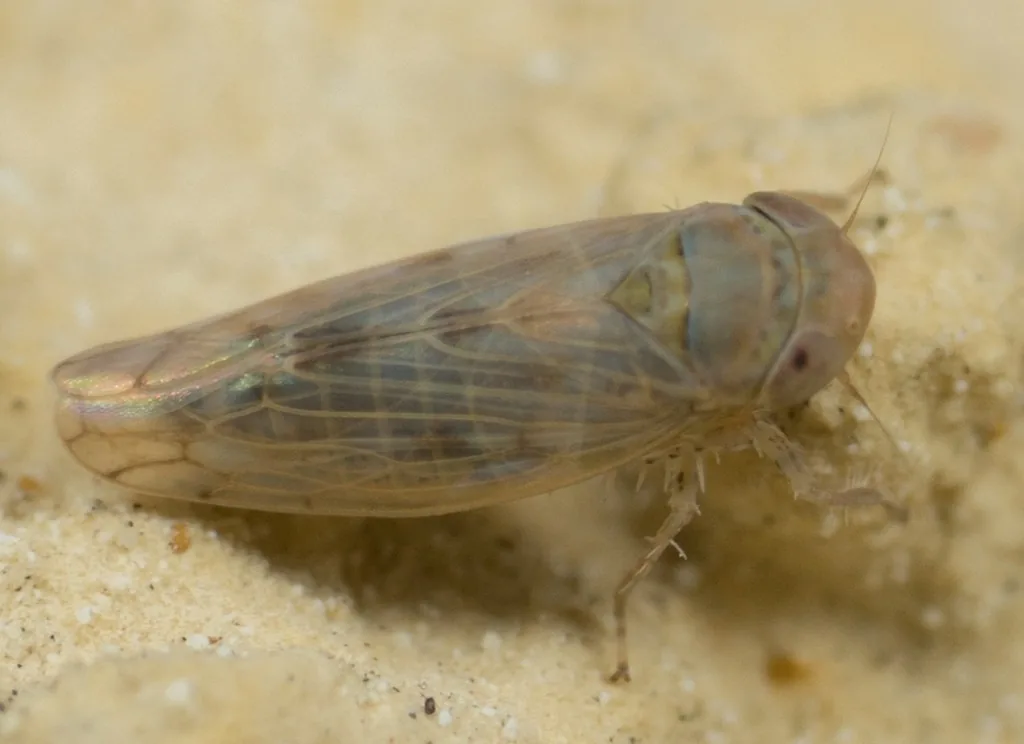
- Adults are about 3 mm (1/8 inch) long, wedge-shaped, and pale green, gray or tan, sometimes with dark markings.[1][4]
- CDFA adds that adults are light green in summer but tan to brown with patterned wings in winter, with distinctive dark bands around the abdomen, long serrated rear legs and a triangular crest at the base of the head.[5]
- Nymphs look like small adults whose wings are not fully developed. The eggs are tiny and white.[1]
- Extension guides still list it under its older scientific name, Circulifer tenellus.[1][2][3]
Look-alikes
| Look-alike | How to tell them apart |
|---|---|
| Aster leafhopper (Macrosteles quadrilineatus) | Also a small, gray to green, wedge-shaped garden leafhopper, but it has six dark spots on top of the head, and it spreads aster yellows rather than curly top.[8][5] |
Where it lives
Curly top, the virus it spreads, is common in the western United States from Mexico to Canada. Utah State says the leafhopper overwinters as mated females on weeds and uncultivated land in the southern U.S. and migrates or is blown north in early summer; in southern Idaho it moves from rangeland and weedy breeding areas into crops any time from early May to the end of August. In California, CDFA says beet leafhoppers overwinter in the foothills of the Coast Range west of the Central Valley. There they breed on filaree, peppergrass, mustards and buckhorn plantain that sprout after the winter rains, then migrate onto the valley floor in spring and return to the foothills in late fall.[3][1][2][5]
Biology and life cycle
When the weeds it overwinters on dry up, adults move into fields and gardens to feed and breed, and wind can carry them long distances. There are several generations a year, and development from egg hatch to adult takes about 2 to 3 months. CDFA says they can pass three generations on the California valley floor, spreading the virus as they move from weeds to crops.[1][2][5]
It picks up curly top virus by feeding on infected weeds in spring. The virus survives in weeds such as Russian thistle (tumbleweed) and mustards like London rocket and flixweed. UC IPM notes that populations are greatest in years when rainfall drives strong growth of their foothill weed hosts.[1][3][4]
An infected leafhopper can pass the virus to a healthy plant in a few minutes of feeding and remains able to spread it for life (Idaho notes more than three months), but it does not pass the virus to its offspring.[1][2][3]
The virus infects more than 300 plant species in 44 families, apparently only broadleaf plants. Common hosts include tomatoes, peppers, beets, Swiss chard, beans, potatoes, spinach, squash, melons, cucumbers, cabbage, alfalfa and many ornamentals. In New Mexico, a 2024 study found the virus in all three types of hemp grown there (CBD, fiber and grain).[3][2][7]
Damage and signs
- Heavy feeding by adults and nymphs can shrivel and burn leaves, a condition called hopper burn, but the most severe damage to tomatoes and peppers comes from the curly top virus it transmits.[1]
- On tomatoes and peppers, infected leaves turn thick, stiff and crisp and roll upward while the leaf stems curve down; the leaves yellow and may show purplish veins. Beet leaves become very twisted and curly.[3]
- Young plants infected early often die soon after. Plants infected later survive but stay yellow and stunted, yield drops, and fruit ripens early; dull, wrinkled, immature tomato fruit is a good sign of curly top. Symptoms can appear within 24 hours in high summer heat, in 12 to 14 days at average temperatures, or in up to 30 days when it is cool.[3]
- New Mexico State finds the disease particularly troublesome in home gardens, possibly because weeds the leafhoppers prefer and infected source plants are close by.[3]
- In sugar beet fields, severe outbreaks can cut yields by 30 percent or more.[2]
- Curly top hurts commercial tomatoes in central and southern California. In 2021 and 2022, unusual outbreaks hit processing tomato fields in northern California. A rare spinach curly top strain caused them, and the affected fields sat close to the foothills during unusually hot, dry, windy springs; in the cool, wet spring of 2023 there were no outbreaks.[6][4]
Health risk
It feeds on plants and matters because of the curly top virus it spreads to crops, and no cited source describes any risk to people or pets.[1][2][3][4]
Control
Prevention
Keep weeds down in and around the garden or field, and clear away plant debris and volunteer plants from earlier crops. Weeds and volunteers can harbor both the leafhoppers and the virus over winter.[1][3][2]
Leafhoppers prefer to feed in sunny spots, so New Mexico State suggests growing tomatoes and peppers in a slightly shaded part of the garden.[3]
Utah State reports that the resistant-labeled tomato varieties 'Rowpac', 'Roza', 'Salad Master' and 'Colombian' performed well in trials in St. George, Utah, and that planting more densely than normal lowers the odds that every plant is infected. New Mexico State says true resistance to curly top is not known, but planting several cultivars may help because some may be somewhat tolerant.[1][3]
Keep them out
Cover young plants. Utah State suggests floating row covers; New Mexico State suggests a netted cage over young plants in full sun, with holes small enough to keep leafhoppers out and the netting kept off the plant. Remove cages once plants mature, since mature plants are less susceptible and need the light to develop fruit.[1][3]
Sanitation
Pull out plants with curly top as soon as you notice them so they stop serving as a source of the virus. No chemical controls the virus itself.[3]
Biological control
Few natural enemies are known. A parasitic fly (family Pipunculidae) attacks beet leafhoppers, but how much it reduces their numbers is unknown.[1]
Pesticides
Insecticides are hard to use well against this pest because of its wide host range, long migrations and fast virus transmission. Sprays may stop some spread within a field and are mostly aimed at weed hosts to keep leafhoppers from moving into the crop, but the results are often costly and less than ideal, so cultural control is the main approach. In sugar beets, tolerant varieties and insecticide seed treatments are the common tools.[1][2]
For commercial tomatoes, UC IPM lists the systemic insecticides imidacloprid (example trade name Admire Pro) and dinotefuran (Venom) where infestations recur every year. Field sprays may prevent some spread within a field, but infected plants will not recover. In sugar beets, Idaho relies on tolerant varieties and neonicotinoid seed treatments.[4][2]
When to call a professional
California has run a Beet Curly Top Virus Control Program since 1943. Each year CDFA crews survey leafhoppers in the foothill breeding areas and treat them by air and ground, in spring before they migrate into valley crops and in fall before they return to the overwintering range.[5][4]
Where the sources disagree
Scientific name: the GBIF Backbone Taxonomy accepts Neoaliturus tenellus and lists Circulifer tenellus as a synonym, while Utah State, Idaho and New Mexico State still use Circulifer tenellus.[9][1][2][3]
Where it overwinters: Utah State says mated females overwinter on weeds and uncultivated land in the southern U.S. and migrate or are blown north; CDFA says California's leafhoppers overwinter in the Coast Range foothills west of the Central Valley; Idaho describes them moving into crops from overwintering and breeding sites.[1][5][2]
When they move into crops: CDFA says the migration to the valley floor tends to happen between March and April, Utah State says early summer, and Idaho says any time from early May to the end of August in southern Idaho.[5][1][2]
How fast it spreads the virus: New Mexico State says a leafhopper can transmit the virus after feeding on an infected plant for as little as one minute, while Idaho says four hours must pass after it picks up the virus before it can transmit it, after which it transmits within a few minutes of feeding and stays infective for more than three months.[3][2]
Resistant varieties: Utah State lists resistant-labeled tomato varieties that did well in Utah trials, while New Mexico State says true resistance to curly top is not known and suggests planting several cultivars.[1][3]
Sprays: UC IPM lists systemic insecticides for commercial tomatoes where infestations recur every year, while Utah State says insecticide results are often costly and less than ideal and relies on cultural control.[4][1]
Host range of the virus: New Mexico State and Idaho say more than 300 species in at least 44 plant families, and CDFA says approximately 300 species.[3][2][5]
Common questions
- Why are my tomato leaves curling up, turning yellow and getting stiff?
- That pattern fits curly top, a virus spread by the beet leafhopper. Infected tomato leaves thicken, roll upward and yellow, often with purplish veins, and the fruit ripens early and looks dull and wrinkled. No chemical cures the virus, so pull infected plants promptly.[3]
- Can I spray for beet leafhoppers to stop curly top?
- Spraying gives poor results. The leafhoppers feed on many hosts, migrate in from weedy areas and can infect a plant within minutes, so Utah State relies mainly on cultural steps such as weed control, row covers and resistant varieties.[1]
- Does covering my plants help?
- Yes. Floating row covers or a netted cage over young plants keep leafhoppers from feeding. Keep the netting off the leaves and remove cages once plants mature.[1][3]
- Where do beet leafhoppers come from each spring?
- In California they breed over winter on weeds in the Coast Range foothills and migrate onto the valley floor in spring. Utah State describes mated females overwintering on weeds in the southern U.S. and moving or being blown north in early summer.[5][1]
Sources
- Utah State University Extension, “Beet Leafhopper (Circulifer tenellus), Utah Vegetable Production and Pest Management Guide.” extension.usu.edu/vegetableguide/tomato-pepper-eggplant/beet-leafhopper (accessed 2026-11-13)
- University of Idaho Extension, “Beet curly top virus (Pest Management: agricultural pests).” www.uidaho.edu/extension/food/ipm/ag-pests/beet-curly-top (accessed 2026-11-13)
- New Mexico State University, College of Agricultural, Consumer and Environmental Sciences, “Curly Top Virus, Guide H-106 (revised by N. Goldberg and P. Lujan).” pubs.nmsu.edu/_h/H106/ (accessed 2026-11-13)
- UC Statewide IPM Program, “Beet Leafhopper, Tomato Pest Management Guidelines.” ipm.ucanr.edu/agriculture/tomato/beet-leafhopper/ (accessed 2026-11-13)
- California Department of Food and Agriculture, “Beet Curly Top Virus Control Program.” www.cdfa.ca.gov/plant/ipc/curlytopvirus/ctv_hp.htm (accessed 2026-11-13)
- Virology, via PubMed, “Unusual outbreaks of curly top disease in processing tomato fields in northern California in 2021 and 2022 (Melgarejo et al. 2024).” pubmed.ncbi.nlm.nih.gov/38211381/ (accessed 2026-11-13). Cited from the PubMed abstract.
- Environmental Entomology, via PubMed, “Interactions of beet leafhopper, vector of beet curly top virus, and hemp in New Mexico (Creamer et al. 2024).” pubmed.ncbi.nlm.nih.gov/37478402/ (accessed 2026-11-13). Cited from the PubMed abstract.
- Utah State University Extension, “Aster Leafhopper.” extension.usu.edu/planthealth/ipm/notes_ag/veg-aster-leafhopper.php (accessed 2026-11-13)
- Global Biodiversity Information Facility (GBIF), “Neoaliturus tenellus (Baker, 1896) (GBIF Backbone Taxonomy).” api.gbif.org/v1/species/8497397 (accessed 2026-11-13)