On this page
How to identify it
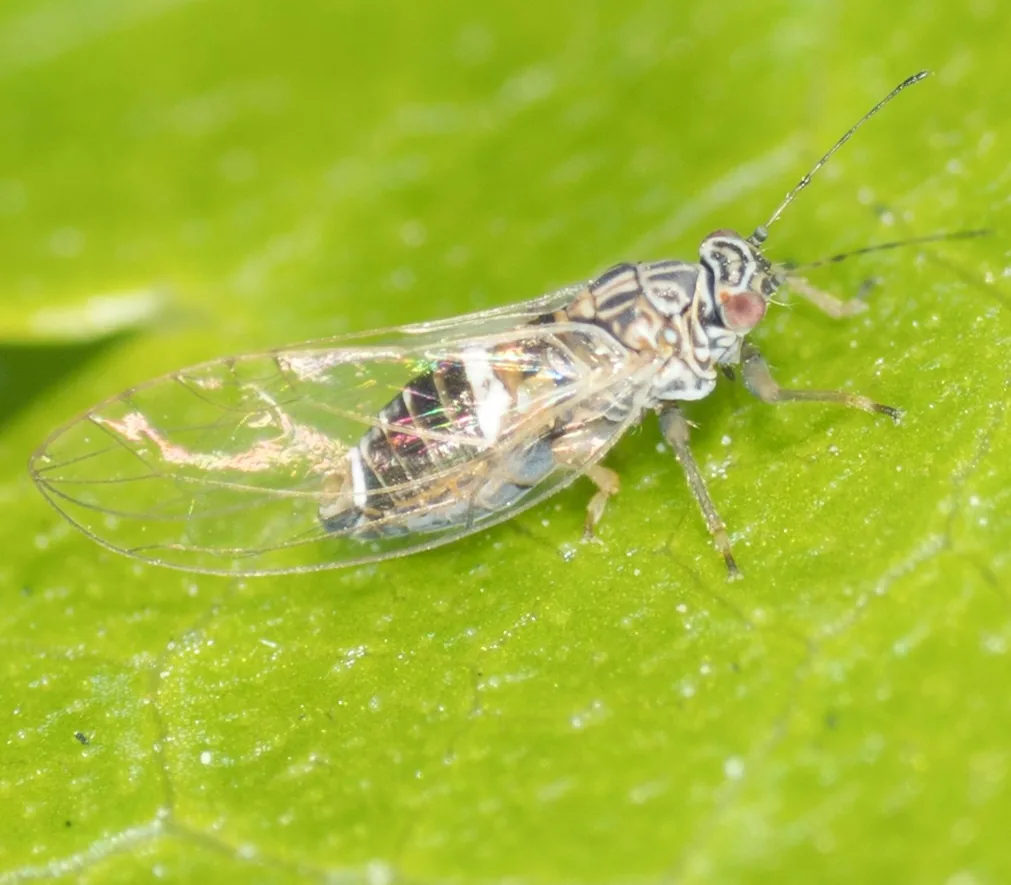
- Adults look like tiny cicadas with clear wings and jump when disturbed. Colorado State describes them as dark gray with prominent white bands on the abdomen and stripes on the thorax; UC IPM mentions white or yellowish markings on the thorax. The sources differ on size (see Where the sources disagree).[1][2]
- Nymphs are flat, oval, scalelike and wingless, yellowish or orange at first and greener as they grow, with red eyes. They sit still on leaf undersides, mostly on the lower, shaded part of the plant. Unlike whitefly nymphs, older psyllid nymphs have wing buds and a fringe of hairs and will move if disturbed.[1][2][3]
- Feeding nymphs leave 'psyllid sugar': wax-covered pellets that look like granulated salt or sugar on the leaves below them. EPPO notes that nymphs and adults produce large amounts of these small whitish droppings, which can stick to leaves and fruit.[1][3]
Look-alikes
| Look-alike | How to tell them apart |
|---|---|
| Potato flea beetles | They also jump and often turn up in the same sweep-net samples on potato.[1] |
Where it lives
It overwinters mainly in southern Texas and northern Mexico and migrates north, usually reaching Colorado in May or early June. It has also spread to New Zealand, Ecuador and Western Australia. GBIF holds 1078 U.S. records since 1990 from 8 state-level areas, most from California (934) and Arizona (51).[1][3][4][6]
Biology and life cycle
Females lay tiny eggs on short stalks, mostly on leaf undersides and along leaf edges. Colorado State says they are orange-yellow and hatch in about a week; UC IPM says they are white at first, turn yellow within hours, and hatch in 4 to 15 days.[1][2]
Nymphs take about two to three weeks to become adults. Colorado State counts four nymphal stages and UC IPM five.[1][2]
Four or more generations can occur in a growing season, and indoors on greenhouse tomatoes it can occur year-round.[1]
It does not survive outdoors where winters bring long periods below freezing. In Colorado, each year's infestations come from migrants that spend the winter mostly in southern Texas and northern Mexico and arrive in May or early June; EPPO says it overwinters as an adult.[1][3]
It feeds on many plants but prefers the nightshade family: tomato, potato, pepper, eggplant, tomatillo and nightshade weeds. UC IPM notes it favors yellow pear tomatoes among tomato varieties.[1][2]
Adults are good fliers and readily jump when disturbed, and the species has spread far beyond its native range in the southwestern US and northern Mexico: EPPO dates the first New Zealand detection to May 2006 and the first Australian record to February 2017, in private gardens and a field near Perth.[3]
Damage and signs
- The harm comes from the saliva, not from the sap the insect removes. Psyllid yellows turns leaves yellow or purple and stunts and curls new growth; UC IPM adds that it can kill transplants. Potato tubers stay small, misshapen and sprout early.[1][2]
- On tomatoes, fruit stays smaller and duller and tastes weaker; UC IPM says larger plants may set no fruit or many very small, unmarketable fruits.[1][2]
- It carries the bacterium 'Candidatus Liberibacter solanacearum', the putative cause of zebra chip disease, which lowers potato yield and quality. Colorado State says zebra chip has been confirmed in Colorado and Wyoming but is not yet as serious there as psyllid yellows.[5][1]
Health risk
A plant pest. Colorado State and UC IPM describe damage to plants; no cited source describes any risk to people or pets.[1][2]
Control
Prevention
Scout every year, because outbreaks are irregular. Look on the undersides of lower leaves for nymphs, which are easier to see on smooth pepper leaves, check for psyllid sugar, and in bigger plantings use a sweep net; Colorado State says adults caught early in the season (June, early July) mean the crop will likely benefit from treatment.[1]
Yellow sticky cards placed near the tops of plants at the edge of the planting show when adults move in; if you catch psyllids, look closely at the edge plants for eggs and nymphs.[2]
Biological control
Damsel bugs and minute pirate bugs eat psyllids, and Colorado State calls them the most important predators, while lady beetles and lacewing larvae matter less. UC IPM is less hopeful: most parasites strike too late to prevent crop loss, so biological control alone is not a promising strategy in the field.[1][2]
In greenhouses, insect-killing fungi such as Isaria fumosorosea and Beauveria bassiana can be used. They need high humidity, and outdoor applications in dry climates are often ineffective.[1]
Pesticides
Colorado State calls spinosad the most commonly available insecticide with good ability to control this psyllid, and UC IPM says the Entrust formulation of spinosad is acceptable on organically certified produce. Horticultural oils (paraffinic, neem or vegetable oils) give some control of nymphs. Both must thoroughly cover leaf undersides and contact the insects, and multiple applications are needed during outbreaks.[1][2]
Avoid carbaryl (Sevin) and other carbamate sprays for other pests when psyllids are present: UC IPM says they actually promote psyllid build-up. Reviews warn that heavy reliance on insecticides risks resistance and harms natural enemies.[2][5][4]
More from the EPPO Global Database
EPPO's datasheet notes that nymphs settle on leaf undersides in sheltered, shaded spots and stay put while they develop, that nymphs and adults leave large amounts of small whitish droppings on leaves and fruit, and that adults are strong fliers that jump when disturbed.[3]
Where the sources disagree
Adult size: Colorado State gives about 2 mm, UC IPM about 3 mm (0.12 inch).[1][2]
Eggs: Colorado State says they are orange-yellow and hatch in about a week; UC IPM says they are white at first, turn yellow within hours and hatch in 4 to 15 days; EPPO gives 3 to 7 days.[1][2][3]
Nymphal stages: Colorado State counts four, UC IPM five.[1][2]
Natural enemies: Colorado State calls damsel bugs and minute pirate bugs the most important predators; UC IPM says most parasites attack too late and biological control does not appear promising in the field.[1][2]
Common questions
- Why are my tomato plants turning yellow-purple and stunted?
- Psyllid yellows, caused by potato/tomato psyllid saliva, is one cause. Look under the lower leaves for flat, scale-like nymphs and sugary white pellets.[1][2]
- What is the white sugary stuff on my tomato leaves?
- It may be psyllid sugar, wax-covered pellets excreted by feeding psyllid nymphs; it collects on leaves below them and looks like granulated sugar or salt.[1][3]
- Is it a whitefly?
- No. Psyllid nymphs look a bit like whitefly nymphs, but older psyllid nymphs have wing buds and a fringe of hairs and can crawl when disturbed; whitefly nymphs cannot move.[2]
- Can I use beneficial insects?
- Damsel bugs and minute pirate bugs help, according to Colorado State, but UC IPM says natural enemies usually act too late to stop crop loss, so keep scouting and be ready to spray spinosad or oil.[1][2]
Sources
- Colorado State University Extension, “Potato or Tomato Psyllids (Fact Sheet 5.540).” extension.colostate.edu/resource/potato-or-tomato-psyllids/ (accessed 2026-11-13)
- UC Statewide IPM Program, University of California, “Tomato Psyllid (Potato Psyllid): Tomato Pest Management Guidelines.” ipm.ucanr.edu/agriculture/tomato/tomato-potato-psyllid/ (accessed 2026-11-13)
- European and Mediterranean Plant Protection Organization (EPPO Global Database), “Bactericera cockerelli (PARZCO) datasheet.” gd.eppo.int/taxon/PARZCO/datasheet (accessed 2026-11-13)
- Insects 2023;14(3):263, via PubMed, “Tomato Potato Psyllid Bactericera cockerelli (Hemiptera: Triozidae) in Australia: Incursion, Potential Impact and Opportunities for Biological Control.” pubmed.ncbi.nlm.nih.gov/36975948/ (accessed 2026-11-13)
- Annu Rev Entomol 2024;69:139-157, via PubMed, “Biology, Ecology, and Management of the Potato Psyllid, Bactericera cockerelli (Hemiptera: Triozidae), and Zebra Chip Disease in Potato.” pubmed.ncbi.nlm.nih.gov/37616600/ (accessed 2026-11-13)
- Global Biodiversity Information Facility (GBIF), “Bactericera cockerelli: U.S. occurrence records since 1990 by state (GBIF occurrence search).” api.gbif.org/v1/occurrence/search?taxonKey=2014706&country=US&hasGeospatialIssue=false&occurrenceStatus=PRESENT&year=1990%2C2026&facet=stateProvince&facetLimit=400&limit=0 (accessed 2026-11-13). Fetched 2026-11-13: 1078 U.S. records since 1990 from 8 states; California 934, Arizona 51, New Mexico 8, Nevada 6. Counts are records reported, not abundance.
- Global Biodiversity Information Facility (GBIF), “Bactericera cockerelli (Šulc, 1909) (GBIF Backbone Taxonomy).” api.gbif.org/v1/species/2014706 (accessed 2026-11-13)