The short answer
- Look at the back legs. Grasshoppers and locusts have hind legs with greatly enlarged thighs (femurs) built for jumping. Cicadas crawl and fly but do not jump.[6][7][4]
- Look at the mouth. Cicadas have a beak like a small, sharp straw and suck plant juices. Grasshoppers have chewing mouthparts that remove large pieces of leaves and flowers.[3][1][6][7]
- Look at the damage. Cicada damage is egg-laying slits in twigs that make branch tips wilt and turn brown (flagging). Grasshopper damage is chewed, missing leaves, and in outbreak years whole plants eaten.[1][5][6]
- Listen. Male cicadas make their loud song with drum-like organs called tymbals on the abdomen. Many grasshoppers rasp a hind leg against a forewing, or make crackling or buzzing sounds in flight.[1][2][7][8]
Profiles on this site
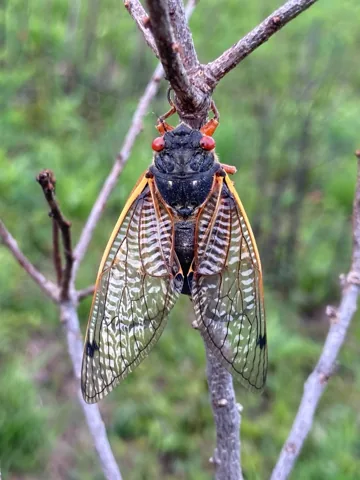 Periodical Cicadas
Magicicada species (e.g., M. septendecim)
Periodical cicadas spend 13 or 17 years underground feeding on root sap, then emerge together in huge numbers in late spring. They don't bite or sting; the real harm is egg-laying damage to small twigs, which matters most on young trees.
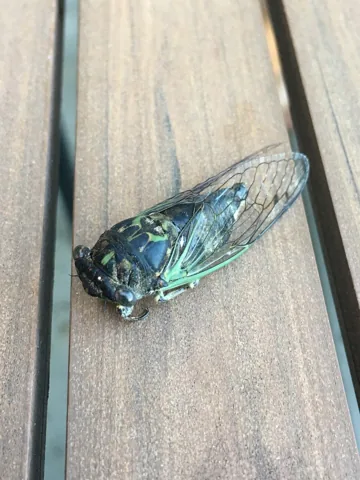 Annual Cicadas (dog-day cicadas)
Neotibicen species (e.g., N. canicularis)
Annual cicadas, also called dog-day cicadas, are the large cicadas heard droning from trees every summer. Their life cycles overlap, so some adults come out every year. They can't bite or sting, and Clemson and Minnesota extension both say they pose no danger to people or pets.
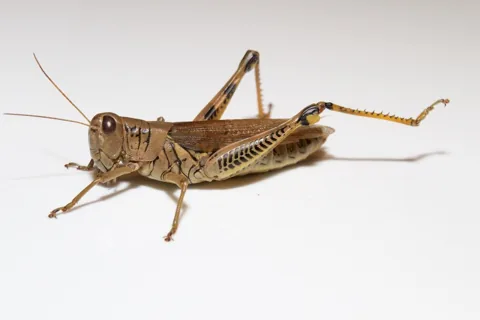 Grasshoppers
Acrididae (e.g., differential grasshopper, Melanoplus differentialis)
Grasshoppers are sporadic garden pests that build up in weedy, uncultivated land and move into yards as nearby vegetation dries out. The differential grasshopper is one of the common, large species that often shows up in gardens first.
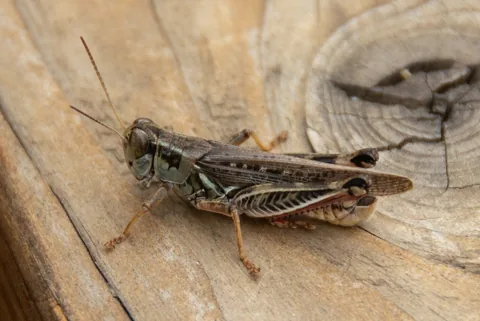 Migratory grasshopper
Melanoplus sanguinipes
The migratory grasshopper is a medium-sized, reddish-brown spur-throated grasshopper that causes more crop damage than any other grasshopper species in the United States, and Alberta calls it one of the most destructive pests in western Canada. Outbreaks that build on weedy rangeland and idle cropland can take off in swarms and land on crops, rangeland or city gardens miles away.
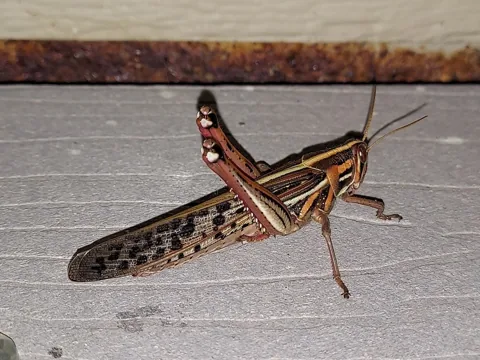 American Grasshopper
Schistocerca americana
The American grasshopper is a large, long-winged grasshopper that flies off into trees when flushed. It can feed destructively on crops and garden plants, especially in Florida, where it is a notable pest of citrus groves. UF/IFAS says it occasionally causes serious damage to crops and ornamental plants, and its sheer numbers can be a nuisance.
Side by side
Each line compares cicadas (periodical and annual) with grasshoppers, the insect group that locusts belong to.[1][11]
- Insect order: cicadas are family Cicadidae in the order Hemiptera, the true bugs, related to leafhoppers, planthoppers and spittlebugs. Grasshoppers are order Orthoptera; Ohio State notes the true locusts are grasshoppers in Orthoptera.[1][4][7]
- Size: periodical cicadas reach about 1 1/2 inches and annual cicadas up to 2 inches. Most short-horned grasshoppers are 1/2 to 1 inch long, but some species reach 3 inches.[3][4][7]
- Body shape and color: periodical cicadas are blackish with red eyes; annual cicadas are black, green or olive-patterned with black or brown eyes. Grasshoppers have a ridged or rounded shield (pronotum) behind the head, and some have brightly colored hindwings that show only in flight.[3][4][7]
- Eyes and antennae: cicadas have wide-set compound eyes and short, bristle-like antennae. Grasshoppers are called short-horned because their antennae are usually less than half the body length.[1][3][7]
- Wings: cicadas have four membranous wings, with a gold, orange or red tinge in periodical cicadas and a black or green tinge in annual cicadas. Grasshoppers have long, narrow, thick front wings that cover membranous hind wings used for flying.[3][4][7]
- Legs: cicadas have enlarged front legs that the nymphs use to dig through soil and climb trees, and adults crawl and fly but do not jump. Grasshoppers have powerful hind legs with greatly enlarged femurs for leaping.[1][3][4][6][10]
- Mouthparts and food: cicada nymphs and adults use piercing-sucking mouthparts to draw juices from plant xylem, nymphs from roots and adults from stems. Grasshoppers have chewing mouthparts and are mostly general feeders that prefer young green plants.[1][6][7]
- Sound: only male cicadas sing; females lack tymbals. Male cicadas vibrate the tymbals with muscles that contract up to 50 times per second, and the abdomen amplifies the sound. Many male grasshoppers rasp a file on the inside of the hind femur against raised veins on the forewing, and some make clacking or buzzing noises in flight.[2][1][7]
- Life cycle: periodical cicadas take 13 or 17 years to develop from egg to adult, living underground on tree roots; annual cicadas spend about 2 to 5 years as nymphs, and some adults come out every year. Most grasshoppers have one generation a year, laying eggs in soil in late summer and fall that hatch the next spring.[2][3][6][8]
- Eggs: female cicadas cut slits in small woody twigs and lay eggs in a double row up to four or five inches long. Grasshopper eggs go into the upper 2 inches of soil in elongated pods holding 20 to more than 100 eggs.[5][1][6]
- Season: periodical cicadas usually emerge around late May or early June once soil 8 inches deep reaches 64 degrees F; annual cicadas show up in summer, usually July through September in Illinois. Grasshopper eggs hatch when the soil warms in spring, and adult females lay eggs in late summer and fall.[2][3][6]
- Bites and stings: cicadas are not venomous, don't sting, and only rarely and accidentally poke someone with their mouthparts. Illinois Extension says cicadas pose no threat to people or pets.[3][2]
Why Americans call cicadas locusts
Ohio State says periodical cicadas are sometimes called locusts in the United States, a mistaken identity that began with early European colonists who saw the sudden appearance of huge numbers of periodical cicadas as a plague of locusts like those described in Exodus 10:1-20.[1]
The name stuck. Illinois Extension notes that cicadas are sometimes mistakenly called locusts, and the Missouri Department of Conservation lists Locusts among the other common names for annual cicadas, alongside jar flies.[2][4]
Ohio State is plain about it: periodical cicadas bear no relation to the plant-chewing true locusts, which are grasshoppers. Cicadas are related to sap-sucking insects like planthoppers, leafhoppers and spittlebugs.[1]
What a locust actually is
A locust is a type of grasshopper able to form huge migratory swarms, as University of Wyoming entomologist Jeffrey Lockwood puts it in the Encyclopedia of the Great Plains.[11]
What makes a grasshopper a locust is a change triggered by crowding. In 1921 Boris Uvarov recognized that two locust species were really one species in two phases, a solitary phase and a gregarious phase. Desert locusts switch from the little-seen solitary form to the swarming gregarious form depending on population density.[15][14]
A 2009 study in Science found that serotonin in the locust nervous system drives the switch from solitary locusts avoiding each other to gregarious locusts that group together and become more active, the first step toward swarm formation and mass migration.[14]
Something similar shows up in a native grasshopper. UF/IFAS says American grasshopper nymphs raised at high density turn yellow, orange and black, while nymphs at low density may be mostly green. The Missouri Department of Conservation says the New World species of Schistocerca, the genus that includes the Old World desert locust, don't swarm.[9][7]
The Rocky Mountain locust
North America did have a true locust. The Rocky Mountain locust (Melanoplus spretus) formed swarms trillions of individuals strong that ravaged farms in the western United States in the 1800s. The last one seen alive was collected in 1902, and the species is extinct.[12][11][7]
Lockwood's account says major outbreaks came in 1855-57 and 1864-67, and the swarms of 1873-78 stripped land of vegetation across the Great Plains. Frozen locusts in Rocky Mountain glaciers show outbreaks going back at least 1,000 years.[11]
Why it vanished is still debated. Lockwood's explanation is that settlers turned the fertile river valleys where the locust survived between outbreaks into farmland, destroying the habitat it needed and leaving North America without a locust species. A DNA study of museum and glacier specimens found the species still had considerable genetic diversity, so a loss of genetic variation was not a factor in its disappearance.[11][13]
In the West today, the outbreaks are grasshoppers and Mormon crickets. USDA APHIS says when their populations reach outbreak levels they cause serious losses on rangeland, and the agency runs survey and suppression programs in Western states.[10]
Damage: twig flagging vs chewed leaves
Cicada damage comes almost entirely from egg-laying. Females insert eggs into the white wood of live stems, mostly stems about 1/2 inch across or smaller. The split stems can't move water, so leaves past the wound wilt and turn brown, a symptom called flagging.[1][5]
Flagging won't kill healthy, mature trees. It is most serious on trees 4 years old or younger, which have more branches in the preferred 1/4 to 1/2 inch size, and damaged branches can break.[2][1]
Cicadas feed on plant juices, but NC State says adult feeding usually isn't enough to notice. Root feeding by nymphs can reduce wood growth and flowering of trees and shrubs.[5][2]
Grasshopper damage is chewing. UC IPM says they take large sections of leaves and flowers and sometimes eat entire plants, favoring lettuce, beans, corn, carrots, onions and some annual flowers. After a wet spring, large populations can build up on rangeland and migrate into gardens, defoliating everything in sight, and adults can fly 15 or more miles a day in swarms during migrations.[6]
How to confirm which one you have
Check the twigs. Rows of slits in small branches, with wilted brown tips beyond them, point to cicadas. Holes chewed in leaves and flowers point to grasshoppers.[5][1][6]
- Look for cast skins and holes: periodical cicada nymphs crawl out at night, leaving 1/2-inch holes in the soil, then cling to trees for the final molt and leave their cast skins behind.[1][3]
- Watch it move: an insect that leaps when you approach, or flashes colored hind wings in flight, is a grasshopper. The Missouri Department of Conservation says cicadas crawl and fly but do not jump.[10][7][4]
- Check the head: a short beak tucked under the head means a cicada. Jaws and short antennae on a long body mean a grasshopper.[3][7]
- Young grasshoppers have wing pads instead of full wings, and the wing pads get bigger with each molt. Young cicadas live underground and are seen only when the last-stage nymphs climb out.[9][1]
What to do for each
Cicadas: Illinois Extension recommends netting small trees and shrubs, secured around the base, and says insecticides are not recommended for periodical cicadas and protect small trees less well than netting. Ohio State specifies nylon netting with mesh no larger than 1/4 square inch. Twigs with eggs can be pruned off. The full plan is in our periodical cicadas guide.[2][1]
Grasshoppers: UC IPM says covers and screened boxes give some protection when numbers aren't high, but hungry grasshoppers will chew through cloth or plastic row covers, so metal window screening works better. In migration years, treatment works best early in the season while grasshoppers are still young nymphs in uncultivated areas. Our grasshopper guide covers the options and the evidence on Nosema bait.[6]
Common questions
- Are cicadas locusts?
- No. Cicadas are true bugs in the order Hemiptera. Locusts are grasshoppers in the order Orthoptera. The name was mistakenly applied by early colonists who took periodical cicada emergences for a plague of locusts.[1][2]
- Do cicadas eat leaves like locusts?
- No. Cicadas suck plant juices through a straw-like beak. The damage people notice is wilted twig tips from females laying eggs in small branches, not chewed leaves.[3][1][5]
- Do cicadas swarm like locusts?
- Periodical cicadas come out of the ground in huge numbers at once, which is what reminded colonists of a locust plague. A locust swarm is something else: crowded grasshoppers switch into a gregarious phase, group together and set off on mass migrations.[2][1][14]
- Are there locusts in the United States?
- Not today. The Rocky Mountain locust swarmed across the West in the 1800s but has been extinct since the early 1900s; the last living specimen was collected in 1902. Native grasshopper outbreaks still happen on Western rangeland.[12][11][10]
- Can cicadas bite or sting?
- Cicadas are not venomous and don't sting; they only rarely and accidentally poke someone with their mouthparts. Illinois Extension says they are no threat to people or pets.[3][2]
Photo credits
- Periodical Cicadas: (c) Jake McCumber, some rights reserved (CC BY) — via iNaturalist, CC BY 4.0
- Annual Cicadas (dog-day cicadas): suzannehale, public domain (CC0), via iNaturalist
- Grasshoppers: (c) Brian Gratwicke, some rights reserved (CC BY) — via iNaturalist, CC BY 4.0
- Migratory grasshopper: (c) Daniel Patterson, some rights reserved (CC BY) — via iNaturalist, CC BY 4.0
- American Grasshopper: (c) florawhite, some rights reserved (CC BY) — via iNaturalist, CC BY 4.0
Sources
- Ohio State University Extension (Ohioline), “Periodical Cicada (ENT-58).” ohioline.osu.edu/factsheet/ent-58 (accessed 2026-11-14)
- University of Illinois Extension, “Cicadas.” extension.illinois.edu/insects/cicadas (accessed 2026-11-14)
- Missouri Department of Conservation, “Periodical Cicadas (field guide).” mdc.mo.gov/discover-nature/field-guide/periodical-cicadas (accessed 2026-11-14)
- Missouri Department of Conservation, “Annual Cicadas (field guide).” mdc.mo.gov/discover-nature/field-guide/annual-cicadas (accessed 2026-11-14)
- NC State Extension, “Periodical Cicadas.” content.ces.ncsu.edu/periodical-cicadas (accessed 2026-11-14)
- UC Statewide IPM Program, “Grasshoppers (Pest Notes).” ipm.ucanr.edu/home-and-landscape/grasshoppers/ (accessed 2026-11-14)
- Missouri Department of Conservation, “Short-Horned Grasshoppers (field guide).” mdc.mo.gov/discover-nature/field-guide/short-horned-grasshoppers (accessed 2026-11-14)
- UF/IFAS Extension, “Common Grasshoppers in Florida (SP98/IN010).” ask.ifas.ufl.edu/publication/IN010 (accessed 2026-11-14)
- UF/IFAS Extension (Featured Creatures), “American Grasshopper, Schistocerca americana (EENY-012/IN130).” ask.ifas.ufl.edu/publication/IN130 (accessed 2026-11-14)
- USDA APHIS, “Grasshoppers and Mormon Crickets: Western FAQs.” www.aphis.usda.gov/plant-pests-diseases/ghmc/grasshoppers-mormon-crickets-western-faqs (accessed 2026-11-14)
- Encyclopedia of the Great Plains, University of Nebraska-Lincoln, “Insect Lore (Jeffrey A. Lockwood, University of Wyoming).” plainshumanities.unl.edu/encyclopedia/doc/egp.fol.026.html (accessed 2026-11-14)
- Mississippi State University Museums (Mississippi Entomological Museum), “Rocky Mountain Locust (specimen of the month).” museums.msstate.edu/specimen-of-the-month/rocky-mountain-locust (accessed 2026-11-14)
- Molecular Phylogenetics and Evolution, abstract via PubMed, “A DNA investigation into the mysterious disappearance of the Rocky Mountain grasshopper, mega-pest of the 1800s (Chapco, Litzenberger 2004).” pubmed.ncbi.nlm.nih.gov/15012958/ (accessed 2026-11-14)
- Science, abstract via PubMed, “Serotonin mediates behavioral gregarization underlying swarm formation in desert locusts (Anstey et al. 2009).” pubmed.ncbi.nlm.nih.gov/19179529/ (accessed 2026-11-14)
- Journal of Comparative Physiology A, abstract via PubMed, “One hundred years of phase polymorphism research in locusts (2021).” pubmed.ncbi.nlm.nih.gov/33871680/ (accessed 2026-11-14)