On this page
How to identify it
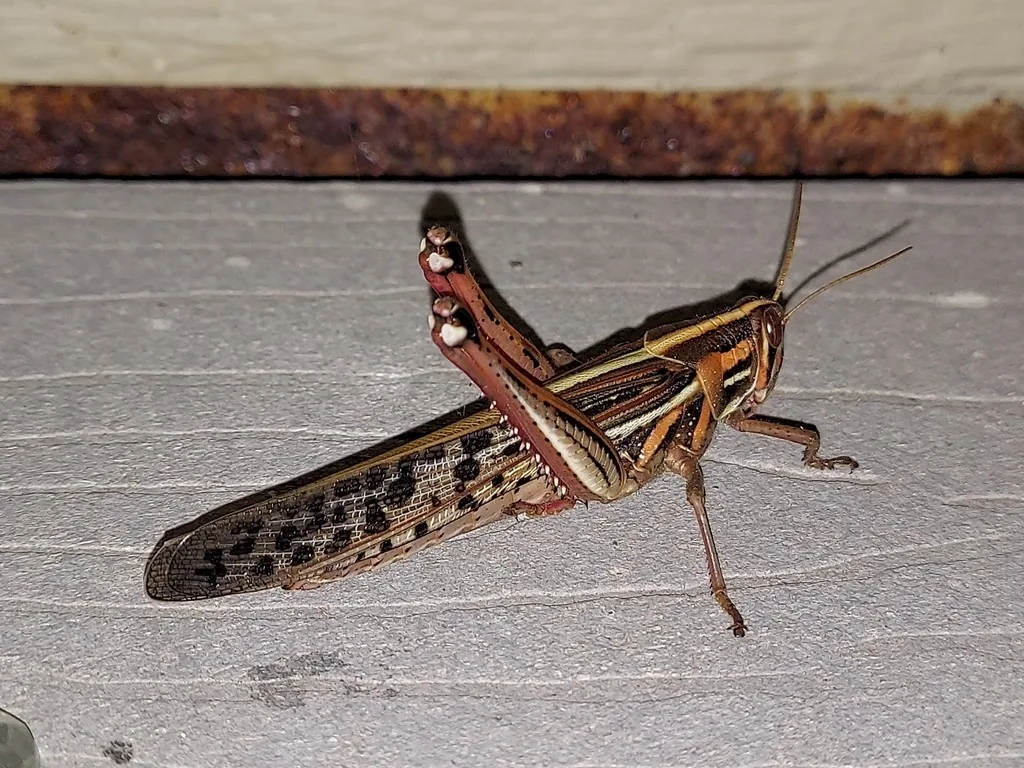
- Adults are tan to light brown, sometimes olive or pinkish, with darker brown spots on the wings, a large creamy stripe down the back from the head to the wings, a dark spot split by a pale stripe on each side of the pronotum, and a white spot on the side of each knee. UF/IFAS says the overall color shifts from pinkish-brown or reddish-brown to yellowish-brown as it matures, and the fully developed wings carry large dark brown spots on a lighter background.[1][4][3]
- Mature females are about 2 inches long and males slightly smaller. Nebraska's guide gives body lengths of 28 to 40 mm (about 1 1/8 to 1 5/8 inches) for males and 36 to 54 mm (about 1 3/8 to 2 1/8 inches) for females. UF/IFAS gives 39 to 45 mm (1 1/2 to 1 3/4 inches) for males and 42 to 55 mm (1 2/3 to 2 1/8 inches) for females.[2][4][3]
- Nymphs pass through five or six stages and are usually green or tan, but their color depends on conditions. In a rearing study, nymphs kept alone were mainly bright green, while crowded ones developed strong black patterns and bright background colors. UF/IFAS says six instars are normal and only five at low densities. First instars are pale green with a black stripe down the back and 6 to 9 mm long; sixth instars reach 32 to 45 mm, and the wing pads are the easiest way to tell the stages apart.[1][5][3]
Look-alikes
| Look-alike | How to tell them apart |
|---|---|
| Admirable grasshopper | Also long-bodied and ornate but not closely related. Check the head: the admirable grasshopper's is quite slanted. The American grasshopper has the creamy back stripe, split dark spot on the pronotum and spotted wings.[1] |
Where it lives
MDC calls it widespread in eastern North America. It does not breed as far north as Nebraska, where it turns up only as a migrant. GBIF's 1990-2026 U.S. records (about 13,800) come mostly from Texas, Florida and North Carolina. UF/IFAS gives its range as east of the Great Plains, throughout the Southeast and north to near Iowa and Pennsylvania, common throughout Florida, and also in Mexico and the Bahamas.[1][4][6][3]
Biology and life cycle
Unlike most grasshoppers, which spend the winter as eggs in the soil, American grasshoppers overwinter as adults; sluggish adults can be seen on warm winter days.[2][1]
It has two generations a year, with broods that can overlap in summer, and it is most abundant in fall.[2][1]
It lives in sunny, open places such as fields, pastures, cropland, gardens and open woodland. When flushed it may fly several hundred feet and land high in a tree.[1][2]
It belongs to the same genus as the desert locust. Under crowding and poor conditions it can become gregarious and disperse, but it never reaches a plague-level migratory phase like the desert locust.[1][2][5]
UF/IFAS says females push egg pods 2 to 3 cm into the soil, preferring some ground cover but not dense sod. A pod generally holds 60 to 80 yellow-orange eggs in a frothy secretion, and a female may lay up to three pods. Nymphs hatch three to four weeks later and at first feed in small groups.[3]
UF/IFAS gives the main hatching periods as February to May and August to September, and says adults are present all year in Florida. Adults may invade fields daily and roost at night in nearby trees and shrubs, while nymphs stay in sunny fields.[3]
Damage and signs
- It feeds on many kinds of plants, including grasses, forbs, shrubs and trees, and can damage crops in the southern United States.[4][1]
- Outbreaks are more common in Florida than in Mississippi. In Mississippi it usually causes damage along with other grasshopper species, on sensitive crops such as vegetables and ornamentals, often concentrated along field edges.[2]
- MDC says it can feed destructively on cultivated plants, especially in Florida, where it is a notable pest in citrus groves.[1]
- UF/IFAS lists citrus, corn, cotton, oats, peanuts, rye, sugarcane, tobacco and vegetables among crops injured, plus grasses such as bahiagrass, bermudagrass and crabgrass, and dogwood, hickory and palms. In Florida it draws attention for defoliating young citrus trees, and young vegetable plants can be eaten to the ground.[3]
- UF/IFAS says the third through fifth instars eat far more than adults. When abundant, grasshoppers climb pool screen enclosures and house walls, and their sharp mandibles can chew holes in fiberglass window and pool screening.[3]
- UF/IFAS says outbreaks usually follow a rise in weedy grasses, from mild winters, more rain, less grazing or untilled fields, while short or sparse vegetation lets birds find and eat grasshoppers.[3]
Health risk
It feeds on plants, and no cited source describes any risk to people or pets.[2][1]
Control
Prevention
Texas A&M's general grasshopper guide advises clearing tall grass and weeds from around plants you want to protect, which makes the area less attractive to grasshoppers and easier for birds to hunt.[7]
UF/IFAS says mowing, disking and plowing cut the weeds that build populations and can destroy eggs and small nymphs, and clean cultivation in citrus groves discourages egg-laying. Timing matters: cultivating too late can drive grasshoppers onto the crop.[3]
Biological control
Natural enemies include a fungus that kills many grasshoppers in warm, humid weather, along with blister beetle larvae, bee flies, robber flies and birds, though birds have little effect on large populations.[7]
UF/IFAS says cattle egrets eat large numbers, and robins, mockingbirds and crows some. The fungus Entomophaga grylli can be effective locally, and UF/IFAS does not recommend Nosema locustae, citing no data for its use against Florida grasshoppers.[3]
Pesticides
Treat early: smaller grasshoppers are more susceptible to insecticides than larger ones. Note that this species overwinters as adults, so the Texas guide's advice on tilling to destroy egg pods (written for species that overwinter as eggs) fits it less well. UF/IFAS says nymphs are easier to kill than adults and refers readers to their local UF/IFAS Extension office for specific insecticide recommendations.[7][2][3]
Also called the American bird locust
Mississippi State notes the 'locust' name reflects its relationship to the desert locust, but American grasshoppers never form the plague swarms that locusts do.[2]
Where the sources disagree
How much of a pest it is: Mississippi State says it is not a major pest in Mississippi and that outbreaks are more common in Florida, and Nebraska's guide gives it no economic importance there but says it damages crops in the southern United States; MDC calls it a notable pest in Florida citrus groves.[2][4][1]
Size: Mississippi State says mature females are about 2 inches long and males only slightly smaller, while Nebraska's guide gives a wider range, 36 to 54 mm (about 1 3/8 to 2 1/8 inches) for females and 28 to 40 mm (about 1 1/8 to 1 5/8 inches) for males. UF/IFAS gives 39 to 45 mm for males and 42 to 55 mm for females.[2][4][3]
Swarming: Mississippi State says it never enters a plague-level migratory phase, but MDC says that at high densities under adverse conditions it may group together and disperse, and in a rearing study crowded nymphs became more active, more attracted to each other and darker patterned, much like locusts.[2][1][5]
Damage threshold: UF/IFAS says damage is possible when late-instar nymphs or adults exceed about 15 per square yard, while Texas A&M rates 8 to 14 adults per square yard in a field as threatening.[3][7]
Common questions
- How many grasshoppers is too many?
- Texas A&M rates field counts of 8 to 14 adults per square yard as threatening and 15 to 28 as severe. If most of the grasshoppers are first to third instars (wingless and generally under 1/2 inch), divide the count by three for the adult equivalent; count fourth instar and older nymphs as adults.[7]
- When should grasshoppers be treated?
- While they're still small nymphs, which are easier to kill than adults.[7]
- Why do I see big grasshoppers in winter?
- American grasshoppers spend the winter as adults, and on warm winter days they can be active in meadows and along wooded edges.[2][1]
- Can grasshoppers damage window and pool screens?
- Yes. UF/IFAS says that when American grasshoppers are abundant they climb screen enclosures and house walls, and their sharp mandibles can chew holes in fiberglass screening.[3]
- Why are dead grasshoppers clinging to the tops of plants?
- That is a sign of the fungus Entomophaga grylli. UF/IFAS says infected grasshoppers climb to a high point, grip the plant tightly and die there head-up, which helps the fungus spread its spores.[3]
Sources
- Missouri Department of Conservation, “American Bird Grasshopper (Field Guide).” mdc.mo.gov/discover-nature/field-guide/american-bird-grasshopper (accessed 2026-11-13)
- Mississippi State University Extension, “American Grasshopper, No. 25.” extension.msstate.edu/newsletters/bugs-eye-view/2015/american-grasshopper-no-25 (accessed 2026-11-14)
- University of Florida IFAS Extension (EDIS), “American Grasshopper, Schistocerca americana (Drury), EENY-004/IN130 (Featured Creatures).” ask.ifas.ufl.edu/publication/IN130 (accessed 2026-11-14)
- University of Nebraska-Lincoln Extension, “The Grasshoppers (Orthoptera: Acrididae and Romaleidae) of Nebraska, EB3 (M. L. Brust, W. W. Hoback and R. J. Wright).” extensionpubs.unl.edu/publication/eb3/2009/pdf/view/eb3-2009.pdf (accessed 2026-11-14)
- Journal of Insect Physiology, via PubMed, “Gotham S, Song H (2013), Non-swarming grasshoppers exhibit density-dependent phenotypic plasticity reminiscent of swarming locusts, Journal of Insect Physiology 59(11):1151-1159.” pubmed.ncbi.nlm.nih.gov/24035748/ (accessed 2026-11-13). Cited from the PubMed abstract.
- Global Biodiversity Information Facility (GBIF), “Schistocerca americana (American grasshopper): occurrence records in the U.S., 1990-2026 (GBIF occurrence search).” api.gbif.org/v1/occurrence/search?taxonKey=1707282&country=US&hasGeospatialIssue=false&occurrenceStatus=PRESENT&year=1990%2C2026&facet=stateProvince&facetLimit=400&limit=0 (accessed 2026-11-13). State counts are records reported (iNaturalist research-grade, museum specimens, surveys), not abundance.
- Texas A&M AgriLife Extension Service, “Grasshoppers and Their Control, E-209 (Patrick and Davis).” agrilifeextension.tamu.edu/wp-content/uploads/2025/06/Grasshoppers-Their-Control.pdf (accessed 2026-11-14)
- Global Biodiversity Information Facility (GBIF), “Schistocerca americana (Drury, 1773) (GBIF Backbone Taxonomy).” api.gbif.org/v1/species/1707282 (accessed 2026-11-13)