On this page
How to identify it
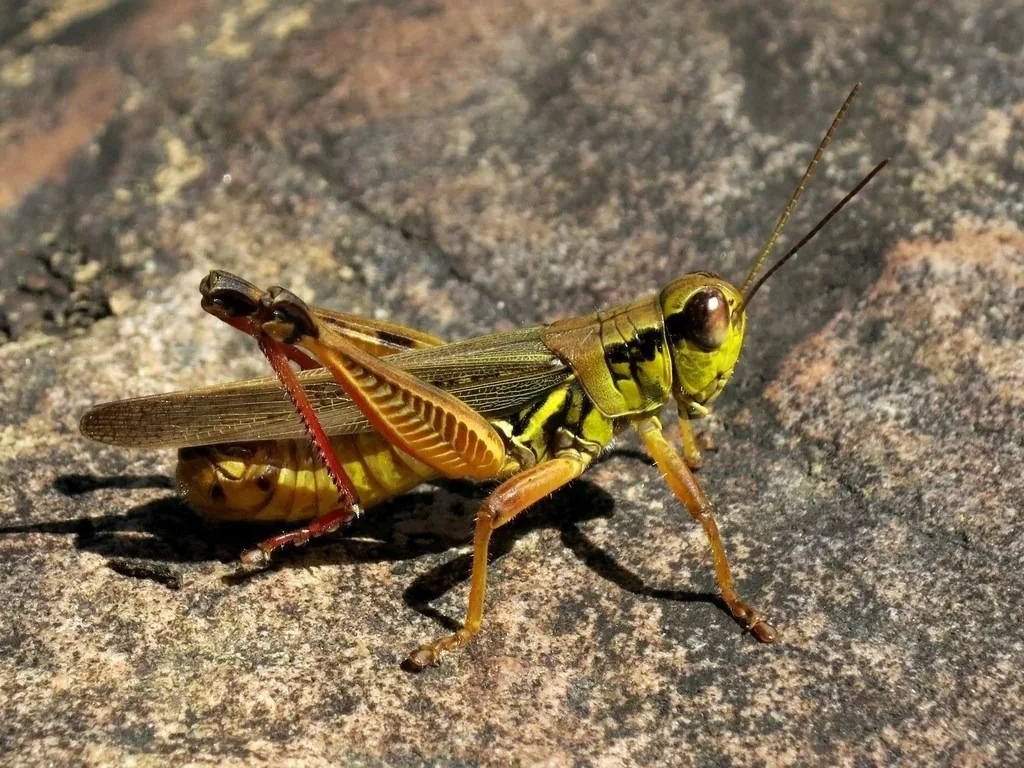
- Adults reach about 1 inch; color varies from red-brown and yellow to dark brown or olive green, with yellow undersides.[1][3]
- The hind legs are bright red or yellowish with a black herringbone pattern.[1][3]
- It has a small spur between the bases of the front legs, like other spur-throated grasshoppers.[3]
- University of Kentucky Entomology describes the upper surface as red-brown to brown with a dull yellow-green underside, colorless wings and red hind legs with black stripes. It is one of the three most common grasshoppers in Kentucky, with the two-striped and differential grasshoppers.[4]
- USDA ARS describes a bright yellow underside and a bright red hind tibia (the long, slender lower section of the hind leg); rarely the tibia is yellowish green or blue. Nymphs are strikingly marked in yellow and black.[9]
Look-alikes
| Look-alike | How to tell them apart |
|---|---|
| Differential grasshopper | Yellowish to olive green with black chevrons on the hind leg rather than red legs.[1] |
| Other Melanoplus grasshoppers | Nearly 250 close relatives look very similar and may need an expert to identify.[3] |
Where it lives
Found throughout most of North America, especially in sunny, moist, low grassy and weedy sites, yards, roadsides and field borders. USDA ARS's species fact sheet says it ranges over most of North America except high mountains and the far north, is the most widely distributed of the major crop grasshoppers, and is the most abundant grasshopper in the eastern United States and Canada.[2][3][9]
Biology and life cycle
Females lay several egg pods in soil, each with up to about 20 eggs; the eggs overwinter and hatch in spring.[2][3]
It is one of the later-hatching grasshoppers, and nymphs reach adult size by August or early September.[2][3]
When food is scarce, as in drought, it develops longer wings and disperses.[3]
A 2007 Miami University (Ohio) field experiment found adults feed mainly on grasses but lay eggs almost only in soil dominated by forbs (broadleaf plants), so they move between the two habitats.[5]
Diet descriptions differ: Missouri Department of Conservation and Colorado State say it prefers legumes and composites, and it has been classed as a forb specialist, but a 2015 University of Guelph DNA study of gut contents found grasses as well as forbs, a broad diet.[3][2][6][9]
It has one generation a year. Its eggs start hatching about three weeks after those of the twostriped grasshopper, and hatching stretches over about 52 days, so young nymphs can be found nearly all summer.[9]
Egg pods are curved and three-quarters to one inch long. Caged females on a good mixed diet laid 336 eggs each.[9]
Strong fliers: flushed adults usually fly 30 to 40 feet, and in drought years they grow longer wings and make long flights, often with migratory grasshoppers. Most individuals still stay close to where they hatched.[9]
Fun fact: in lab tests it ate only 25 percent of the leaf material it cut off six host plants and wasted the other 75 percent.[9]
Damage and signs
- Adults and nymphs eat grasses and many broadleaf plants, preferring legumes and composites, and it feeds on many garden plants.[2][3]
- It is often considered a crop pest.[3]
- University of Kentucky Entomology says that where rainfall is low (under 30 inches a year) it can be a very destructive pest of clover, alfalfa and soybeans, can completely defoliate legumes, and attacks almost any plant when numbers are high. It prefers humid places and is rarely found on dry hillsides.[4]
- In gardens, Colorado State lists lettuce, carrots, beans, sweet corn and onions among the vegetables grasshoppers favor, while squash, peas and tomato leaves tend to be avoided.[2]
- In outbreaks it can severely damage alfalfa, clover, soybeans and small grains, and has caused losses of 20 to 25 percent in individual oat fields. It also attacks corn, tobacco and vegetables, especially beans, beets, cabbage and potatoes.[9]
- In a 2017-2018 survey of eastern South Dakota it made up 47.32 percent of all grasshoppers counted, far more than any other species.[10]
Health risk
Control
Prevention
Step 1, scout: grasshoppers seen in late summer and early fall predict problems the next year. In spring, look for clusters of young nymphs to find egg beds, where eggs were laid in undisturbed soil.[2][7]
Coordinate with neighbors: grasshopper control is often much more successful as an area-wide community effort, because the insects move between properties.[2][7]
Biological control
Weather around egg hatch is the biggest natural control; blister beetles, robber flies, parasitic flies and birds also kill grasshoppers.[2]
Nosema locustae bait infects only young grasshoppers, acts slowly and fits a long-term program.[2]
Nosema locustae baits are sold as NOLO Bait or Semaspore. They affect only grasshoppers, work best placed at breeding sites, and are perishable, so keep them refrigerated and check the expiration date.[2][7]
Pesticides
Sprays or baits work best on young grasshoppers at egg-laying sites; once adults migrate in, treating plants often fails and repeat applications may be needed.[1][2]
Colorado State lists baits made by mixing carbaryl (Sevin) with a carrier, which kill grasshoppers that eat them and limit effects on other insects; baits must be reapplied after rain. Permethrin, sold under many trade names, is labeled for many fruits and vegetables but has fairly short persistence against grasshoppers. NC State adds that grasshoppers are not resistant to insecticides, but repeat sprays two or three days apart may be needed because new ones fly in.[2][1]
Where sources disagree
Where eggs are laid: Colorado State and University of Idaho describe grasshoppers laying eggs in concentrated egg beds, which spring scouting can find and treat. The USDA ARS fact sheet says red-legged females lay eggs scattered throughout the habitat.[2][7][9]
Diet: Missouri Department of Conservation and Colorado State say it prefers legumes and composites; USDA ARS says it can be a forb feeder or a mixed feeder eating plenty of grass, depending on what grows nearby, and that a diet of alfalfa alone killed 70 to 90 percent of nymphs in lab tests.[3][2][9]
Common questions
- Why do grasshoppers keep coming back after I spray?
- Grasshoppers are highly mobile and move in from nearby areas, so repeat treatments may be needed.[1][2]
- When is the best time to control grasshoppers?
- While they are young nymphs near egg-laying sites, before adults migrate.[2]
- Are red-legged grasshoppers harmful?
- Not to people or pets. They are plant feeders that can damage gardens, legumes and small grains when numbers are high.[1][3][4]
- Do Nosema grasshopper baits work?
- They can, on young grasshoppers at breeding sites. Nosema locustae acts slowly, only infects young grasshoppers and fits a long-term program; it does little once adults have migrated in.[2][7]
- How far can red-legged grasshoppers fly?
- Flushed adults usually fly 30 to 40 feet, about 3 or 4 feet above the plants. In drought years they develop longer wings and can make long flights.[9]
Sources
- NC State Extension, “Grasshoppers on Ornamental Plants (PDIC Factsheet).” content.ces.ncsu.edu/grasshoppers-on-ornamental-plants (accessed 2026-11-12)
- Colorado State University Extension, “Grasshopper Control in Gardens and Small Acreages (Fact Sheet 5.536).” extension.colostate.edu/resource/grasshopper-control-in-gardens-and-small-acreages/ (accessed 2026-11-12)
- Missouri Department of Conservation, “Red-Legged Grasshopper (Field Guide).” mdc.mo.gov/discover-nature/field-guide/red-legged-grasshopper (accessed 2026-11-12)
- University of Kentucky Entomology, “Three Common Kentucky Grasshoppers and Their Natural Enemies (ENTFACT-116).” entomology.ca.uky.edu/ef116 (accessed 2026-11-12)
- Oecologia 153, 2007 (Haynes, Diekötter & Crist), via PubMed, “Resource complementation and the response of an insect herbivore to habitat area and fragmentation.” pubmed.ncbi.nlm.nih.gov/17530292/ (accessed 2026-11-12)
- Ecology and Evolution 5, 2015 (McClenaghan et al.), via PubMed, “Discrimination of grasshopper (Orthoptera: Acrididae) diet and niche overlap using next-generation sequencing of gut contents.” pubmed.ncbi.nlm.nih.gov/26356479/ (accessed 2026-11-12)
- University of Idaho Extension, “Grasshoppers (Integrated Pest Management).” www.uidaho.edu/extension/food/ipm/ag-pests/grasshoppers (accessed 2026-11-12)
- iNaturalist, “Melanoplus femurrubrum taxon page (order and family).” www.inaturalist.org/taxa/129094 (accessed 2026-11-12)
- USDA Agricultural Research Service (Pfadt, University of Wyoming), “Redlegged Grasshopper, Melanoplus femurrubrum (Species Fact Sheet, Wyoming Agricultural Experiment Station Bulletin 912).” ars.usda.gov/ARSUserFiles/30320505/grasshopper/Extras/PDFs/Species%20Fact%20Sheets/Redleg.pdf (accessed 2026-11-12)
- South Dakota State University Extension, “Survey of Grasshoppers in South Dakota (P-00340).” extension.sdstate.edu/sites/default/files/2025-06/P-00340.pdf (accessed 2026-11-12)