On this page
How to identify it
- Mississippi State gives adults as about 1 1/2 to 2 inches long; Nebraska measured males at 26 to 33 mm and females at 33 to 44 mm.[1][4]
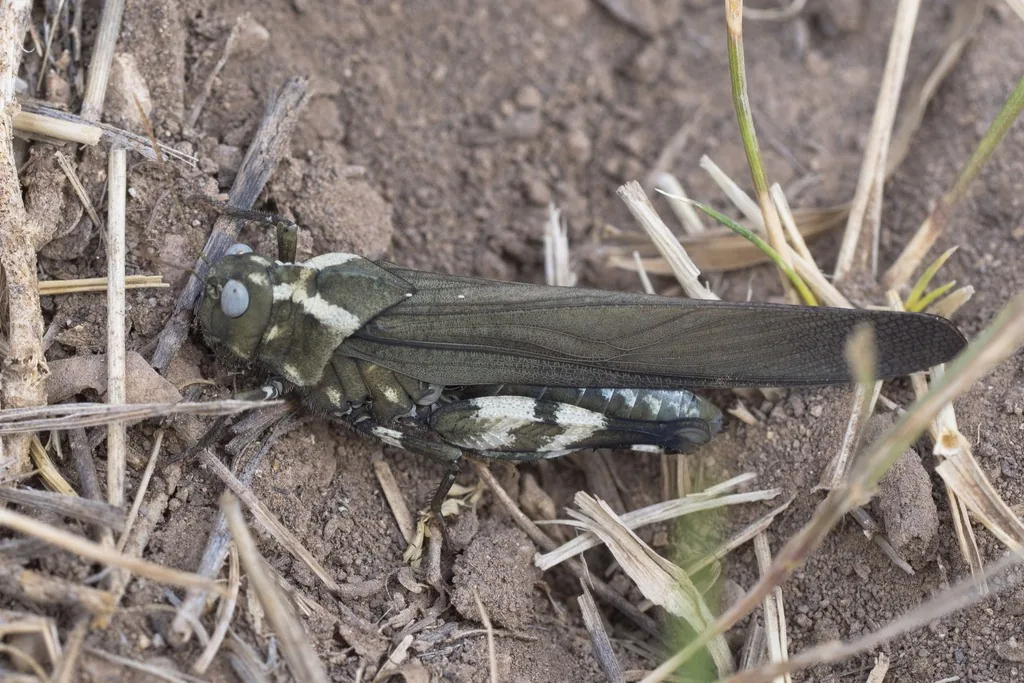
- The body is gray-brown (Mississippi State), light brown, reddish brown or gray brown (Nebraska), or light grayish yellow to reddish brown (Colorado State), and it blends in well with bare soil.[1][4][5]
- The outspread hind wings are black with a pale border. Mississippi State and Missouri describe the border as light or pale yellow, like a mourning cloak butterfly; Nebraska describes it as whitish to greenish, limited to the outer third or quarter of the wing.[1][2][4]
- The shield behind the head is ridged lengthwise like a rooftop, with a strongly triangular rear edge, and there is no spur on the throat.[2]
- Its flight makes a crackling, buzzing, ticking or whirling sound. Flushed grasshoppers usually fly 20 to 40 feet before landing, and males hover 4 to 6 feet up in short, noisy display flights that attract females.[1][2][5]
Look-alikes
| Look-alike | How to tell them apart |
|---|---|
| Mourning cloak butterfly | In flight its black, yellow-bordered hind wings look like a mourning cloak.[2] |
| High Plains grasshopper | A close, similar-looking relative (Dissosteira longipennis) that swarmed during the Dust Bowl but is now an uncommon grasshopper of western Kansas and western Colorado.[6] |
Where it lives
Mississippi State calls it one of North America's most widely distributed insects, found in every state of the continental U.S. and in southern Canada; Nebraska finds it throughout that state. GBIF's public U.S. records since 1990 (about 14,000) come from 47 states on the map, most from Massachusetts, New York and Colorado, with only a few records from Florida. Nebraska notes speculation that it was once far more limited and spread as people altered the land.[1][4][10]
Biology and life cycle
It favors bare, disturbed ground: plowed fields, dirt roads, roadsides, parking lot edges, lawns, gardens and vacant lots. Nebraska calls it generally uncommon in grasslands.[1][4][2]
Nymphs appear in spring, and adults are most common from early or mid-July to September in Nebraska; in Mississippi they are most often flushed in late summer and fall.[4][1]
Females lay eggs about an inch deep in the soil, in pods that hold several dozen eggs each, and the species spends the winter as eggs.[1]
It eats a variety of grasses and forbs (broadleaf plants), including smooth brome, western wheatgrass, kochia and Russian thistle. DNA from the guts of wild Carolina grasshoppers confirmed that it is a broad generalist.[4][7]
Females are the larger sex, and a 2021 study found they have larger eyes with more facets, giving them finer vision than males, likely because females watch for visual signals from males.[8]
Damage and signs
- Mississippi State says it occasionally reaches damaging numbers in other regions but rarely in the Southeast, where high rainfall keeps grasshopper outbreaks uncommon. Colorado State says it rarely becomes abundant enough at a site to cause serious damage.[1][5]
- Nebraska says it seldom damages rangeland because it sticks to disturbed areas, but it can cause minor damage to crops, and disturbed areas seeded with smooth brome can build large numbers. A lab study called it a pest of grasses, including switchgrass.[4][9]
Health risk
It is a plant-feeding grasshopper; none of these sources describes any bite, sting or other risk to people or pets.[1][2][4][5]
Control
Prevention
Control is rarely needed: Mississippi State says damaging numbers rarely occur in the Southeast, and Colorado State says it rarely becomes abundant enough to cause serious damage.[1][5]
Common questions
- What is the grasshopper that looks like a butterfly when it flies?
- Likely a Carolina grasshopper, with black, yellow-edged hind wings.[1][2]
- Why does it make a crackling sound?
- Band-winged grasshoppers like this one crackle or buzz as they fly.[2]
- Is it a crop pest?
- Only occasionally. It can cause minor crop damage and build up in disturbed, brome-seeded areas, but extension sources say serious damage is rare, especially in the Southeast.[4][1][5]
- Where do Carolina grasshoppers lay their eggs?
- In bare soil, about an inch deep, in pods of several dozen eggs that survive the winter.[1]
Sources
- Mississippi State University Extension (Bug's Eye View), “Carolina Grasshopper, Vol. 2, No. 31.” extension.msstate.edu/newsletters/bugs-eye-view/2016/carolina-grasshopper-vol-2-no-31 (accessed 2026-11-11)
- Missouri Department of Conservation, “Carolina Grasshopper (Field Guide).” mdc.mo.gov/discover-nature/field-guide/carolina-grasshopper (accessed 2026-11-11)
- iNaturalist, “Dissosteira carolina taxon page (order and family).” www.inaturalist.org/taxa/126206 (accessed 2026-11-11)
- University of Nebraska-Lincoln Extension, “The Grasshoppers of Nebraska (EB3).” extensionpubs.unl.edu/publication/eb3/2009/pdf/view/eb3-2009.pdf (accessed 2026-11-11)
- Colorado State University Extension, “Grasshopper Control in Gardens and Small Acreages (Fact Sheet 5.536).” extension.colostate.edu/resource/grasshopper-control-in-gardens-and-small-acreages/ (accessed 2026-11-11)
- Missouri Department of Conservation, “Bird Grasshoppers (Field Guide).” mdc.mo.gov/discover-nature/field-guide/bird-grasshoppers (accessed 2026-11-11)
- Ecology and Evolution, via PubMed, “Discrimination of grasshopper diet and niche overlap using next-generation sequencing of gut contents (McClenaghan et al. 2015).” pubmed.ncbi.nlm.nih.gov/26356479/ (accessed 2026-11-11). Cited from the PubMed abstract.
- Integrative Organismal Biology, via PubMed, “A sexual dimorphism in the spatial vision of North American band-winged grasshoppers (Duncan et al. 2021).” pubmed.ncbi.nlm.nih.gov/34396041/ (accessed 2026-11-11). Cited from the PubMed abstract.
- Comparative Biochemistry and Physiology B, via PubMed, “Characterization of cellulolytic activity from digestive fluids of Dissosteira carolina (Willis et al. 2010).” pubmed.ncbi.nlm.nih.gov/20601057/ (accessed 2026-11-11). Cited from the PubMed abstract.
- Global Biodiversity Information Facility (GBIF), “Dissosteira carolina: occurrence records in the U.S., 1990-2026 (GBIF occurrence search).” api.gbif.org/v1/occurrence/search?taxonKey=1712343&country=US&hasGeospatialIssue=false&occurrenceStatus=PRESENT&year=1990%2C2026&facet=stateProvince&facetLimit=400&limit=0 (accessed 2026-11-11). State counts are records reported (iNaturalist research-grade, museum specimens, surveys), not abundance.