On this page
How to identify it
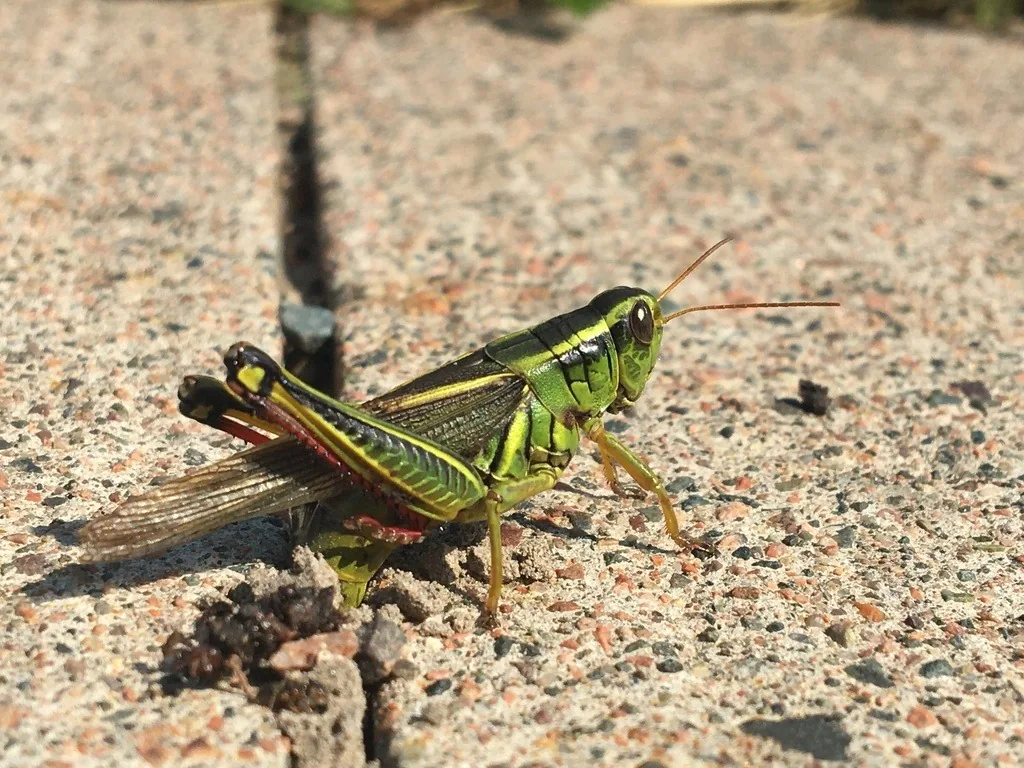
- Adults are large: Nebraska measures males at 24 to 35 mm and females at 32 to 43 mm, making it one of the two largest Melanoplus species there.[4]
- NC State describes it as greenish yellow with black and brown markings; Nebraska as dark green, with lighter greenish to yellow stripes.[1][4]
- Two pale stripes run along the top of the body from the head to the tips of the wings.[1][4]
- The hind wing is clear, and in Nebraska populations the lower hind leg (tibia) is bluish.[4]
- Like other spur-throated grasshoppers, it has a small spine on the underside between the front legs, and the rear edge of the shield behind the head is rounded rather than sharply pointed. Nebraska places it in this group.[5][4]
Look-alikes
| Look-alike | How to tell them apart |
|---|---|
| Red-legged grasshopper | Reddish-brown with yellow undersides and red hind legs instead of two pale stripes.[1] |
| Differential grasshopper | Green, brownish green or olive, up to about 2 inches, with a black herringbone pattern on the hind femur.[1][6] |
Where it lives
Colorado State calls it often the most common grasshopper damaging gardens there, and Nebraska reports it statewide in weedy roadsides, field edges and pastures. GBIF's public U.S. records since 1990 (about 17,100) come from 42 states on the map, most from Colorado, New York and Vermont.[2][4][10]
Biology and life cycle
Eggs are laid in pods in the soil, where they spend the winter, and nymphs appear in spring. Colorado State says it often hatches in late spring, a few weeks later than many grasshoppers.[2][4]
In Nebraska adults are most common from early July to September, and a field study of old-field grasshoppers treated it as a late-season (July to August) grasshopper.[4][8]
It is a generalist. Gut-content DNA confirmed it eats a broad mix of plants, and Nebraska lists legumes, composites, mustards, ragweed and kochia among its preferences.[7][4]
It migrates into gardens from empty lots, roadsides and other undisturbed sites.[2]
Weather drives numbers, and the sources lean different ways. NC State says dry weather tends to let grasshopper populations increase; Colorado State says cold, wet weather at hatch kills young grasshoppers but very dry winters and springs can also hurt survival by leaving no tender plants.[1][2]
Birds, robber flies, blister beetle larvae (which eat the egg pods), parasitic flies and fungal disease all attack grasshoppers. In tallgrass prairie experiments, wolf spiders affected twostriped grasshopper survival only in some conditions.[2][1][9]
Damage and signs
Health risk
Nebraska notes that, unlike many grasshoppers, it is quick to bite if handled. None of the sources describe any other risk to people or pets.[4]
Control
Prevention
Watch weedy lots, roadsides and other undisturbed sites nearby, where grasshoppers develop before moving into gardens. Counting grasshoppers in late summer helps predict problems the next year.[2]
Biological control
Nosema locustae bait infects only young grasshoppers and works slowly, as part of a long-term program.[2]
Pesticides
Sprays or baits work best on young grasshoppers near egg-laying sites, often in May at lower elevations. On migrating adults, treating plants has limited effect, and NC State says several applications two or three days apart may be needed as more move in.[2][1]
Treatments don't need to cover the whole area; bands covering half the area or less have worked on rangeland, and neighbors working together usually do better than one yard alone. Use only products labeled for the plants you are treating.[2]
Common questions
- Where do all these grasshoppers come from?
- Twostriped grasshoppers often move into gardens from nearby empty lots, roadsides and undisturbed areas, where they hatch from eggs laid in the soil.[2][4]
- Why are grasshoppers worse some years?
- Weather at hatching matters most. NC State says dry weather tends to let numbers rise, while Colorado State says cold, wet weather kills young grasshoppers and very dry springs can also reduce survival.[1][2]
- Do twostriped grasshoppers bite?
- They can. Nebraska Extension says this species is quick to bite if handled.[4]
Sources
- NC State Extension, “Grasshoppers on Ornamental Plants (PDIC Factsheet).” content.ces.ncsu.edu/grasshoppers-on-ornamental-plants (accessed 2026-11-11)
- Colorado State University Extension, “Grasshopper Control in Gardens and Small Acreages (Fact Sheet 5.536).” extension.colostate.edu/resource/grasshopper-control-in-gardens-and-small-acreages/ (accessed 2026-11-11)
- iNaturalist, “Melanoplus bivittatus taxon page (order and family).” www.inaturalist.org/taxa/1266323 (accessed 2026-11-11)
- University of Nebraska-Lincoln Extension, “The Grasshoppers (Orthoptera: Acrididae and Romaleidae) of Nebraska, EB3 (M. L. Brust, W. W. Hoback and R. J. Wright).” extensionpubs.unl.edu/publication/eb3/2009/pdf/view/eb3-2009.pdf (accessed 2026-11-11)
- Missouri Department of Conservation, “Short-Horned Grasshoppers (Field Guide).” mdc.mo.gov/discover-nature/field-guide/short-horned-grasshoppers (accessed 2026-11-11)
- Missouri Department of Conservation, “Differential Grasshopper (Field Guide).” mdc.mo.gov/discover-nature/field-guide/differential-grasshopper (accessed 2026-11-11)
- Ecology and Evolution, via PubMed, “Discrimination of grasshopper diet and niche overlap using next-generation sequencing of gut contents (McClenaghan et al. 2015).” pubmed.ncbi.nlm.nih.gov/26356479/ (accessed 2026-11-11). Cited from the PubMed abstract.
- Oecologia, via PubMed, “Interspecific competition among grasshoppers and their effect on plant abundance in experimental field environments (Ritchie and Tilman 1992).” pubmed.ncbi.nlm.nih.gov/28311883/ (accessed 2026-11-11). Cited from the PubMed abstract.
- Environmental Entomology, via PubMed, “Predator-prey interactions are context dependent in a grassland plant-grasshopper-wolf spider food chain (Laws and Joern 2015).” pubmed.ncbi.nlm.nih.gov/26313957/ (accessed 2026-11-11). Cited from the PubMed abstract.
- Global Biodiversity Information Facility (GBIF), “Melanoplus bivittatus: occurrence records in the U.S., 1990-2026 (GBIF occurrence search).” api.gbif.org/v1/occurrence/search?taxonKey=1699027&country=US&hasGeospatialIssue=false&occurrenceStatus=PRESENT&year=1990%2C2026&facet=stateProvince&facetLimit=400&limit=0 (accessed 2026-11-11). State counts are records reported (iNaturalist research-grade, museum specimens, surveys), not abundance.