On this page
How to identify it
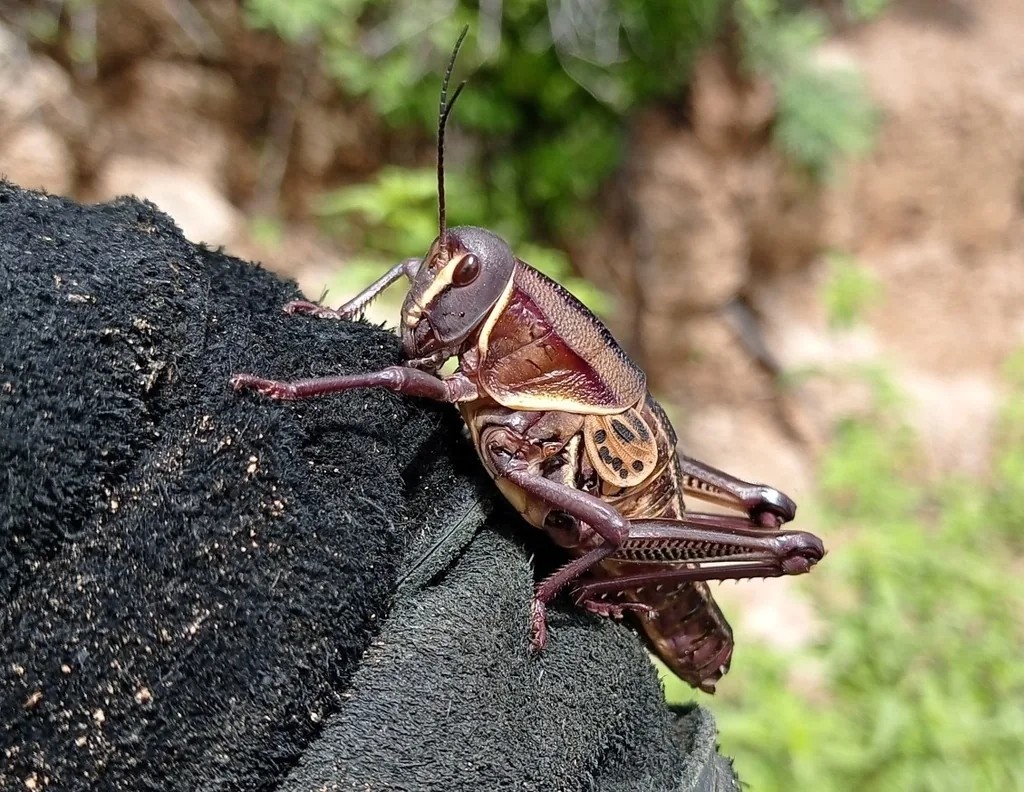
- Adults are robust and flightless, with only short, round wings; Texas A&M gives their length as 1 3/4 to 2 inches.[1][3][2]
- The short forewings are pink with conspicuous black dots, and the body is boldly striped and banded in green, brown and pink.[1][2]
- The pronotum, the shield behind the head, is trapezoid-shaped and covered with many small knobs. The hind legs are large and multicolored, and the male's hind thighs are noticeably larger than the female's.[1]
- It is heavy for a grasshopper: an individual may exceed 3 to 4 grams, and in Bent County, Colorado, fresh adults averaged 3,935 mg for males and 4,287 mg for females.[2][1]
Look-alikes
| Look-alike | How to tell them apart |
|---|---|
| Mormon cricket | Another large insect of western rangeland, but it is a longhorned grasshopper related to katydids, not a true grasshopper.[2] |
Where it lives
It ranges widely on the western plains of the United States and Mexico, in shortgrass, mixedgrass, tallgrass, sand and desert prairies, but its distribution is patchy. Populations live in disturbed sites with forbs, especially common sunflower, which often grows along roadsides and field margins.[1]
Biology and life cycle
It eats many kinds of forbs and some grasses and is drawn to common sunflower. In the gut contents of 68 lubbers from a weedy Nebraska field, common sunflower was the most frequent plant (in 35 percent of them), and 19 percent held insect or other arthropod parts.[1][2]
It also eats animal matter: females studied in Arizona ate disabled insects and even caught smaller grasshoppers, and Texas A&M notes that lubbers sometimes feed on dead insects, even their own kind.[1][3]
The eggs need two years of incubation, with overwintering, before they hatch, and field counts in Montana, Wyoming and Texas run higher in alternate years.[1]
Hatching starts in mid-May in eastern Kansas, the first week of June in northern Colorado and Wyoming, and mid-June in Montana; in southeastern Arizona it waits for the summer monsoon rains. Nymphs pass through five stages in about 45 days.[1]
Adults appear from the last week of June in eastern Kansas to the fourth week of July in Montana. Egg laying begins in August and continues for about 60 days, to the end of September; in milder climates some adults live longer, into early November in northeastern Kansas.[1]
Females appear to choose bare, sandy loam soil for their eggs. The gourd-shaped egg pod is 1 3/4 to 2 inches long and holds 20 to 35 large, dark reddish brown eggs.[1]
It gets around by crawling and hopping and is often seen crossing highways and country roads.[1][2]
Oklahoma State Extension notes that large lubber grasshoppers are found in western Oklahoma.[4]
Fun fact: chemists who tested an extract of this Texas grasshopper found pancratistatin and two related compounds that slow the growth of cancer cells in the lab, compounds previously known only from amaryllis-family plants.[5]
Grasshopper mice hunt it: in lab tests, southern grasshopper mice preferred plains lubbers over Taeniopoda eques, an unpalatable grasshopper that produces a defensive secretion, and rejected plains lubbers that had been coated with that secretion.[6]
Damage and signs
- In its favored sunflower and weed patches it behaves more like a beneficial insect, giving some control of weeds.[1]
- Large populations from roadsides and field margins have invaded gardens in Iowa and cotton fields in western Oklahoma and on the western plains of Texas. It can be extremely damaging to young cotton, eating all the foliage and leaving only stems; outbreak numbers have destroyed whole stands, though damage is more often limited to 40 or 50 rows along the edge.[1]
- About one adult per 3 feet of cotton row, or two per square yard in vegetation bordering the field, can cause economic damage.[1]
- Texas A&M calls it a sixth species that is not as damaging as the state's top five. It prefers weedy areas and is seldom a problem in grasslands, and its limited mobility makes it less damaging, though it can be a problem in crops, especially cotton.[3]
Health risk
It eats plants and sometimes dead insects. The University of Wyoming, Texas A&M and Colorado State sources don't mention any risk to people or pets.[1][3][2]
Control
Prevention
The University of Wyoming fact sheet says that in sunflower and weed patches the plains lubber behaves as a beneficial insect by providing some biological control of weeds, and Texas A&M says its limited mobility makes it less damaging than the state's top five pest grasshoppers.[1][3]
Biological control
Colorado State says baits containing the protozoan Nosema locustae, sold as NOLO Bait or Semaspore, can infect many grasshopper species and affect only grasshoppers, but only young grasshoppers are susceptible, the bait is slow acting and perishable (best kept refrigerated), and it works best in a long-term program with other controls. In EPA's product search today, Semaspore Bait has an active registration and the NOLO Bait registrations are inactive. The University of Wyoming fact sheet says the plains lubber is eaten by predators such as birds, rodents and carnivores.[2][8][9][1]
Pesticides
For grasshoppers in gardens and small acreages, Colorado State says control methods need to be applied to the developing stages and concentrated at sites where egg laying occurs. Once grasshoppers are adults and migrate, insecticides applied directly to plants have limited effectiveness or may be ineffective, and few allow direct application to garden fruit and vegetables. Colorado State names baits containing carbaryl (Sevin) as an alternative but says availability of Sevin baits is frequently limited; EPA's product search lists Sevin bait products with active registrations. Follow the label.[2][7]
Where the sources disagree
Size: Texas A&M gives adults as 1 3/4 to 2 inches long; Colorado State says an individual may exceed 3 to 4 grams; the University of Wyoming fact sheet gives average fresh weights of 3,935 mg for males and 4,287 mg for females in Bent County, Colorado.[3][2][1]
Pest status: the University of Wyoming fact sheet says it can be extremely damaging to young cotton and has invaded gardens in Iowa; Texas A&M says it can be a problem in crops, especially cotton, but is seldom a problem in grasslands; Colorado State lists it among grasshoppers that are not damaging to gardens and croplands.[1][3][2]
Weeds or crops: the University of Wyoming fact sheet calls it a beneficial insect in sunflower and weed patches; Texas A&M says it prefers weedy areas but can be a problem in crops.[1][3]
Common questions
- What is the huge, colorful grasshopper walking across the road?
- On the western plains it is often the plains lubber, one of North America's largest grasshoppers. It can't fly, so it crawls and hops, and it is often seen crossing highways and country roads in summer.[1][2]
- Will plains lubbers eat my garden?
- They can. The University of Wyoming fact sheet says large populations from roadsides and field margins have invaded gardens in Iowa. Colorado State, by contrast, lists it among unusual grasshoppers that are not damaging to gardens and croplands.[1][2]
- Why are there so many some years and so few the next?
- Their eggs take two years to hatch, and populations tend to run higher in alternate years.[1]
- Does the plains lubber bite or sting?
- It eats plants and sometimes dead insects. The University of Wyoming, Texas A&M and Colorado State sources don't mention any risk to people or pets.[1][3][2]
Sources
- University of Wyoming Agricultural Experiment Station (PDF hosted by USDA ARS), “Plains Lubber Grasshopper, Brachystola magna (Girard): Species Fact Sheet, Wyoming Agricultural Experiment Station Bulletin 912 (R. E. Pfadt).” www.ars.usda.gov/ARSUserFiles/30320505/grasshopper/Extras/PDFs/Species%20Fact%20Sheets/PlainsLb.pdf (accessed 2026-11-13)
- Colorado State University Extension, “Grasshopper Control in Gardens and Small Acreages, Fact Sheet 5.536.” extension.colostate.edu/topic-areas/insects/grasshopper-control-in-gardens-small-acreages-5-536/ (accessed 2026-11-13)
- Texas A&M AgriLife Extension Service, “Grasshoppers and Their Control, E-209 (C. D. Patrick and S. G. Davis).” agrilifeextension.tamu.edu/wp-content/uploads/2025/06/Grasshoppers-Their-Control.pdf (accessed 2026-11-13)
- Oklahoma State University Extension, “Grasshoppers of the Cherokee Nation in Northeast Oklahoma (EPP-7342).” pods.okstate.edu/fact-sheets/EPP-7342_POD2022.pdf (accessed 2026-11-13)
- Journal of Natural Products, via PubMed, “Antineoplastic agents. 553. The Texas grasshopper Brachystola magna (Pettit et al. 2005).” pubmed.ncbi.nlm.nih.gov/16124772/ (accessed 2026-11-13). Cited from the PubMed abstract.
- Behavioural Processes, via PubMed, “Olfactorily mediated attack suppression in the southern grasshopper mouse toward an unpalatable prey (Whitman, Blum and Jones 1986).” pubmed.ncbi.nlm.nih.gov/24924865/ (accessed 2026-11-13). Cited from the PubMed abstract.
- U.S. EPA Pesticide Product Label System, “Pesticide Product Label System: product-name search 'Sevin'.” ordspub.epa.gov/ords/pesticides/cswu/ProductSearch/partialprodsearch/v2/riname/Sevin (accessed 2026-11-13). 2697 product-name rows, 45 Active; 121 have BAIT in the name and 7 of those are Active (for example 2935-366 SEVIN 5 BAIT, 2935-556 2% SEVIN BAIT, 829-285 SEVIN 5% BAIT); saved 2026-11-13.
- U.S. EPA Pesticide Product Label System, “Pesticide Product Label System: product-name search 'Semaspore'.” ordspub.epa.gov/ords/pesticides/cswu/ProductSearch/partialprodsearch/v2/riname/Semaspore (accessed 2026-11-13). 4 product-name rows; only SEMASPORE BAIT (95566-1) has product status Active, and SEMASPORE, SEMASPORE C and SEMASPORE HC are Inactive; saved 2026-11-13.
- U.S. EPA Pesticide Product Label System, “Pesticide Product Label System: product-name search 'Nolo'.” ordspub.epa.gov/ords/pesticides/cswu/ProductSearch/partialprodsearch/v2/riname/Nolo (accessed 2026-11-13). 248 product-name rows containing 'nolo' (most are other products); the four NOLO rows under registration 46149 (NOLO BAIT, NOLO BAIT FD 5000, NOLO BAIT FD 10000, NOLO BB CONCENTRATE) all have product status Inactive; saved 2026-11-13.
- Global Biodiversity Information Facility (GBIF), “Brachystola magna (Girard, 1854) (GBIF Backbone Taxonomy).” api.gbif.org/v1/species/1714647 (accessed 2026-11-13)
- iNaturalist, “Brachystola magna taxon page (order and family).” www.inaturalist.org/taxa/122262 (accessed 2026-11-12)