On this page
How to identify it
- Mississippi State calls them the second-largest insects in the state: some females top 3 inches and weigh as much as 12 grams, and only the eastern Hercules beetle weighs more.[1]
- They are boldly marked in black with red, yellow or orange, colors that warn predators. Adults often spread their wings when threatened, flashing bright pink hind wings.[1]
- When disturbed they hiss and push a foul-smelling foam out of their breathing holes. Researchers have found that the defensive secretion, from the rear part of the thorax, normally contains phenolics and quinones the insect makes itself. UF/IFAS adds that alarmed lubbers spread their wings and can spray the chemicals at least 0.6 inches, and that the defense affects many vertebrate predators but not invertebrate ones.[1][3][2]
- Females are larger than males in every body measurement, with relatively wider heads and thoraxes.[4]
- UF/IFAS says adults are often mostly yellow or tawny with black on the antenna tips, pronotum and abdomen; darker forms exist, and a mostly black form sometimes turns up in northern Florida. The forewings reach two-thirds to three-fourths of the way down the abdomen and are pink centrally, and the short hind wings are rose colored.[2]
- UF/IFAS gives adult males at least 1.7 to 2.2 inches and females often 2 to 2.8 inches, sometimes 3.5 inches. They are poor at leaping but good climbers that often feed on new foliage at branch tips.[2]
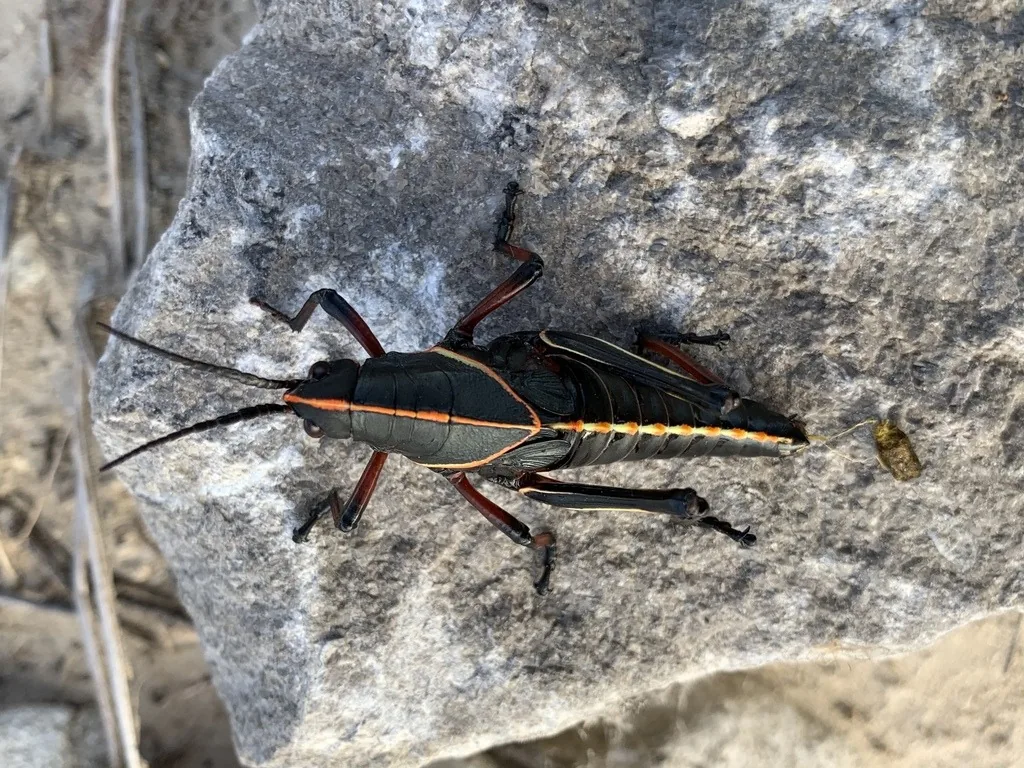
- UF/IFAS says the nymphs look so different that they are often mistaken for another species: almost completely black with a yellow, orange or red stripe down the back, sometimes reddish brown. There are usually five instars, about 0.4, 0.7, 0.9, 1.4 and 1.5 inches long.[2]
Look-alikes
| Look-alike | How to tell them apart |
|---|---|
| Other grasshoppers | Lubbers are heavier than almost any other insect in Mississippi, move slowly and clumsily, and can't fly.[1] |
Where it lives
A grasshopper of the Deep South. Mississippi State says it is most numerous in south Mississippi and grows scarcer to the north, and research populations have come from Florida, Georgia and Louisiana. About three-quarters of GBIF's US records since 1990 come from Florida, followed by Louisiana and Texas. UF/IFAS gives the range as North Carolina south through South Carolina, Georgia and Florida, and west through Alabama, Mississippi and Louisiana to central Texas.[1][5][6][2]
Biology and life cycle
There is one generation a year. Eggs spend the winter in the soil, nymphs hatch in spring, and they reach adulthood by mid to late summer.[1]
In nature the eggs stay underground for eight to nine months. In a lab test, 65% of eastern lubber eggs survived three months underwater, a sign of how well they suit wet ground; at 79°F (26°C) eggs took an average of 176 days from laying to hatch.[7]
Because they can't fly, they spread slowly and patchily: you may have dozens in your yard while a neighbor a mile away has none.[1]
In one field study, females ate mostly smooth cordgrass while males most often ate the narrow-leaved hemp sesbania.[4]
Populations differ from place to place. Lubbers from Georgia, Louisiana and Florida reared on the same diets started reproducing at different ages, earliest in Georgia and latest in Florida.[5]
Moving slowly helps them survive. In lab trials leopard frogs attacked slow-moving lubbers less often, and later, than lubbers made to move quickly.[8]
Eggs are laid in pods of 25 to 50 in rows held together by a secretion, with only 1 to 3 pods per female in the field. UF/IFAS says the female buries each pod 1.2 to 2 inches deep, closing the hole with a frothy plug, and prefers open, sunny spots in drier sites.[2]
UF/IFAS says nymphs or adults are around most of the year in southern Florida, while in northern Florida and along the Gulf Coast they appear from March or April to about October or November. Adults peak in July and August and start producing eggs about a month after they emerge.[2]
Loggerhead shrikes impale lubbers on thorns and barbed wire and eat them after 1 to 2 days, once the toxins break down. UF/IFAS says the tachinid fly Anisia serotina can parasitize 60 to 90 percent of young lubbers, and two flesh flies also attack them.[2]
Damage and signs
- They feed on a wide range of plants, including thick, fleshy-leaved ones such as daffodils and lilies. UF/IFAS says their favored habitat is low, wet ground along ditches and ponds, but nymphs disperse widely into crops and neighborhoods. They eat at least 100 species from 38 plant families, commonly defoliate amaryllis-family plants such as crinum and narcissus, and also feed on oleander, butterfly weed, Mexican petunia, cordyline and lantana.[1][2]
- In bait trials, adults favored lettuce, carrot, yellow squash, cauliflower, collards, green onion, chives, cucumber, cabbage, cantaloupe, endive, society garlic, caladium and amaryllis. Tomato, pepper, eggplant, leek, parsley, fennel, daylily, lily of the Nile and canna were less preferred.[9]
- In groups they can damage vegetables, peanuts, cowpeas, corn, citrus, figs, peaches and ornamentals. Among vegetables, UF/IFAS says they prefer peas, lettuce, kale, beans and cabbage over eggplant, tomato, pepper, celery, okra and sweet corn, and they tend to chew irregular holes and move on.[2]
Health risk
A garden pest rather than a health pest: its defense is a chemical secretion, and researchers describe it as a chemically defended grasshopper. None of the sources here reports people or pets being harmed by eastern lubbers.[3][8][1]
Control
Prevention
UF/IFAS lists shaking plants or spraying water to dislodge them, growing less attractive plants, and mowing border vegetation to expose them to predators. Scout often: young nymphs are the most vulnerable, and most methods work better at low numbers.[2]
Traps and physical control
For low numbers, hand-picking and stomping may be all you need. If you'd rather not squash them, drop them into a container of strong soapy water. UF/IFAS adds that collected lubbers can instead be put in a plastic bag and held in a freezer for a few days.[1][2]
Pesticides
Pyrethroid insecticides such as zeta-cypermethrin, permethrin, bifenthrin, cyfluthrin or cyhalothrin control them, but large nymphs and adults need direct spray coverage. On vegetables, make sure the product is labeled for that crop and observe the pre-harvest interval. UF/IFAS cautions that spraying is generally not necessary and usually ineffective, especially against adults, which can detoxify insecticide on the foliage they eat, and that these products can harm bees and aquatic life.[1][2]
Researchers developed a wheat bran and corn oil bait carrying carbaryl that killed lubbers in field cages; a single treated flake could kill one. The bait was eaten less when favored plants were nearby, so it works best for protecting less preferred plants.[9]
More from Mississippi State Extension
Mississippi State University Extension notes that lubbers can't fly, so they turn up in one yard but not another a mile away; they are most numerous in south Mississippi, have one generation a year, spend the winter as eggs in the soil, and feed on fleshy-leaved plants such as daffodils and lilies.[1]
Names you may hear
Local names include Texas grasshopper, graveyard grasshopper and soldier boy.[1]
Older research often calls the eastern lubber Romalea guttata.[9]
UF/IFAS says 'lubber' comes from an old English word, lobre, meaning lazy or clumsy.[2]
Where sources disagree
How well the chemicals work: Mississippi State says lubbers contain toxins that can sicken or kill birds or mammal predators that eat them. In a lab study, leopard frogs never learned to avoid lubbers raised on lettuce, and the authors concluded that the insect's own chemicals don't matter much in defense against frogs; slow movement helped more. Another study found the secretion repelled ants far better when lubbers fed only on wild onion and stored its sulfur compounds.[1][8][3]
How long eggs stay in the soil: UF/IFAS gives 6 to 8 months, while a lab and field study puts it at eight to nine months in nature.[2][7]
Range: Mississippi State describes a Deep South grasshopper most numerous in south Mississippi, while UF/IFAS gives a range from North Carolina to central Texas.[1][2]
Common questions
- Why do I have lubbers when my neighbor doesn't?
- They can't fly, so they spread slowly and populations are patchy; a yard can be full of them while one a mile away has none.[1]
- Can lubbers fly?
- No. They are too big and heavy to fly, and they don't hop very well either.[1]
- What is the foam they make?
- A defense. When disturbed, lubbers hiss and push foul-smelling foam from their breathing holes; the secretion contains phenolics and quinones.[1][3]
- Why are the young ones black when adults are yellow?
- Eastern lubber nymphs are almost completely black with a yellow, orange or red stripe, and UF/IFAS says they look so different that people often take them for another species.[2]
Sources
- Mississippi State University Extension, “Eastern Lubber Grasshopper, Vol. 7, No. 21.” extension.msstate.edu/newsletters/bugs-eye-view/2021/eastern-lubber-grasshopper-vol-7-no-21 (accessed 2026-11-11)
- University of Florida IFAS Extension (EDIS), “Eastern Lubber Grasshopper, Romalea microptera (Beauvois), EENY-006/IN132 (Featured Creatures; T. Saracino and N. Leppla).” ask.ifas.ufl.edu/publication/IN132 (accessed 2026-11-14)
- Journal of Chemical Ecology, via PubMed, “Reduction in diet breadth results in sequestration of plant chemicals and increases efficacy of chemical defense in a generalist grasshopper (Jones et al. 1989).” pubmed.ncbi.nlm.nih.gov/24272184/ (accessed 2026-11-11)
- Zoology, via PubMed, “Sex-based divergence in head shape and diet in the eastern lubber grasshopper (Vincent 2006).” pubmed.ncbi.nlm.nih.gov/16962299/ (accessed 2026-11-11)
- Oecologia, via PubMed, “Geographic variation of reproductive tactics in lubber grasshoppers (Hatle et al. 2002).” pubmed.ncbi.nlm.nih.gov/28547637/ (accessed 2026-11-11)
- Global Biodiversity Information Facility (GBIF), “Romalea microptera: US occurrence records since 1990 by state (GBIF occurrence search API).” api.gbif.org/v1/occurrence/search?taxonKey=1714599&country=US&hasGeospatialIssue=false&occurrenceStatus=PRESENT&year=1990%2C2026&facet=stateProvince&facetLimit=400&limit=0 (accessed 2026-11-11)
- Environmental Entomology, via PubMed, “Divergent egg physiologies in two closely related grasshopper species: Taeniopoda eques versus Romalea microptera (Stauffer et al. 2011).” pubmed.ncbi.nlm.nih.gov/22182625/ (accessed 2026-11-11)
- Oecologia, via PubMed, “Slow movement increases the survivorship of a chemically defended grasshopper in predatory encounters (Hatle and Faragher 1998).” pubmed.ncbi.nlm.nih.gov/28308461/ (accessed 2026-11-11)
- Journal of Economic Entomology, via PubMed, “Development of a toxic bait for control of eastern lubber grasshopper (Barbara and Capinera 2003).” pubmed.ncbi.nlm.nih.gov/12852592/ (accessed 2026-11-11)
- iNaturalist, “Romalea microptera taxon page (order and family).” www.inaturalist.org/taxa/466003 (accessed 2026-11-11)