The short answer
- Look at the plate on the back (the scutum). An adult female deer tick has a plain black or dark brown plate on an orange-red body. An American dog tick has whitish or silvery markings on a brown plate, and those markings stay visible even after she feeds.[10][7][6][8]
- Look at the size. Stage for stage, the deer tick is smaller. An unfed female deer tick is about 1/10 inch long and the nymph is about the size of a poppy seed; an adult American dog tick is about 3/16 to 1/4 inch.[6][8][2]
- Look at the mouthparts. Deer ticks have long mouthparts that stick out in front; American dog ticks have short ones.[7][6]
- Think about the stage and season. Deer tick nymphs bite people from spring into summer and adults are out in fall, winter and early spring whenever it is above freezing. With American dog ticks it is almost always the adults that bite, mostly in spring and summer.[1][10][11][6][8]
Profiles on this site
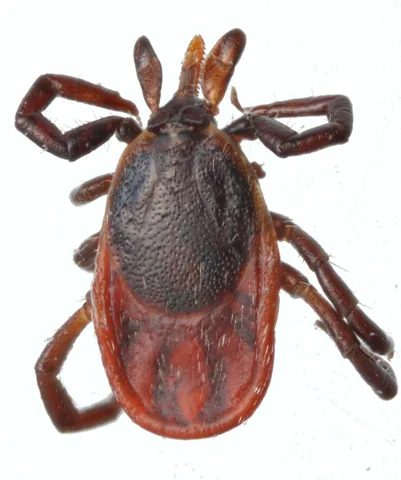 Blacklegged Tick
Ixodes scapularis
The blacklegged tick, often called the deer tick, is widely distributed across the eastern United States and spreads the bacteria that cause Lyme disease along with several other infections.
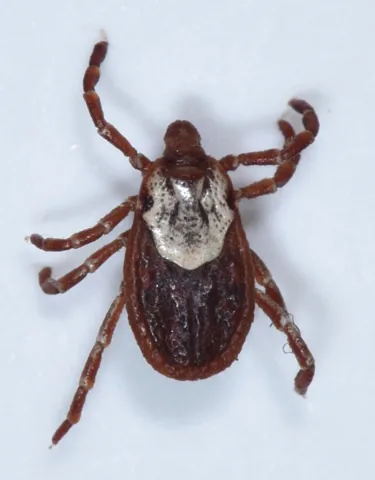 American Dog Tick
Dermacentor variabilis
The American dog tick, also called the wood tick, is widely distributed east of the Rocky Mountains. Adult females are the stage most likely to bite people, especially in spring and summer, and adults commonly climb to the crown of the head.
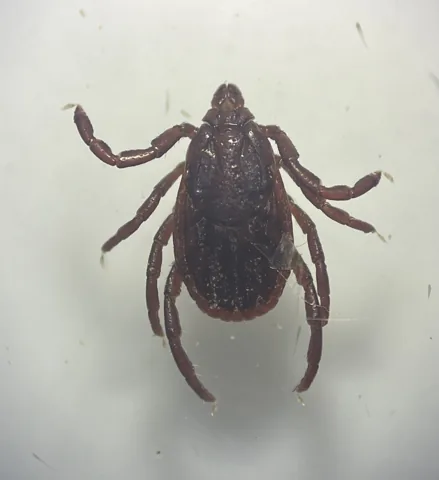 Brown Dog Tick
Rhipicephalus sanguineus
The brown dog tick is unusual: unlike most ticks, it can complete its entire life cycle indoors. It occurs across the United States, is met more often in the southern states, and can build up to high numbers on dogs and in homes and kennels. UF/IFAS Featured Creatures adds that this lets it set up populations even in colder climates.
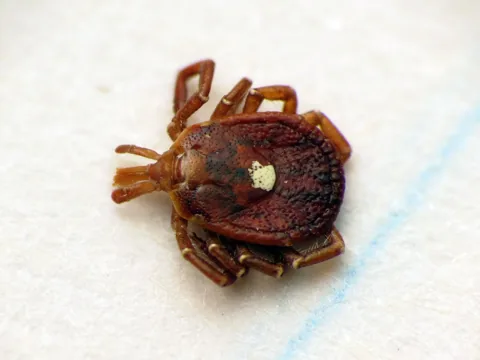 Lone Star Tick
Amblyomma americanum
The lone star tick is a very aggressive tick that readily bites people and pets across the Northeast, South and Midwest; its bite is linked to alpha-gal syndrome, a red meat allergy.
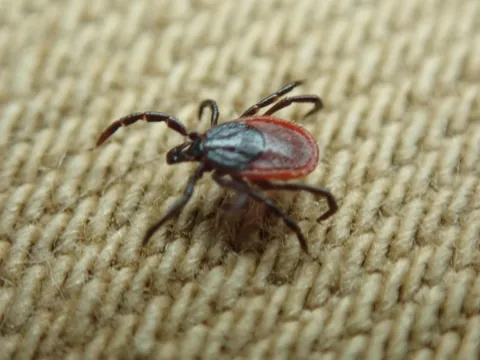 Western Blacklegged Tick
Ixodes pacificus
The western blacklegged tick is the Pacific Coast relative of the eastern deer tick and, in California, the only tick whose nymphs and adult females pass Lyme disease bacteria to people. It attaches to people more often than any other tick species in the state.
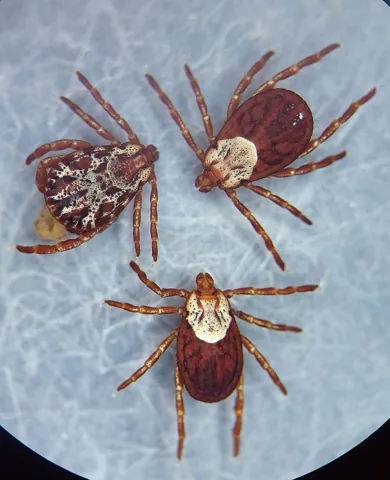 Rocky Mountain Wood Tick
Dermacentor andersoni
The Rocky Mountain wood tick is the tick most often found on people and pets in Colorado and Utah. It is most active in spring, then goes dormant as the weather turns hot and dry, and it is the vector of Colorado tick fever.
Side by side
Names: blacklegged tick (deer tick), Ixodes scapularis, vs American dog tick (also called wood tick), Dermacentor variabilis. The Connecticut Agricultural Experiment Station notes that the right name is either "blacklegged tick" or "deer tick", not both run together.[6][8][9]
Adult female color: deer tick, an orange-red to reddish body around a black or dark brown scutum, with black legs. American dog tick, a reddish brown or brown body with a whitish, silvery or light gray pattern on the scutum.[10][7][9][6][8]
Adult male: the deer tick male is smaller and completely dark brown. On a male American dog tick the ornate pattern spreads over the whole back, because the male's scutum covers almost all of it.[6][8]
Mouthparts: long in the deer tick, short in the American dog tick.[7][6]
Festoons: many hard ticks have small rectangular panels along the rear edge of the body, called festoons. Ixodes ticks such as the deer tick do not. Festoons may not show on a fully engorged female.[6]
Underside: Ixodes ticks have a groove that curves around the front of the anal opening. In other ticks the groove sits behind the opening or is missing.[6]
Adult size: an unfed female deer tick measures about 3 to 3.7 mm (about 1/10 inch) and a male 2 to 2.7 mm. Ohio State puts unfed deer tick females at about 3/32 inch. The American dog tick adult is about 3/16 inch according to Ohio State and almost 6.4 mm (1/4 inch) according to the Connecticut station.[6][8]
Engorged female: a fed female deer tick gets large enough to be mistaken for an engorged American dog tick, and Ohio State notes engorged deer tick females may look gray. A fully fed American dog tick female reaches about 1/2 inch (Connecticut) to about 5/8 inch (Ohio State) and looks like a dark pinto bean. The scutum does not grow, so look for the white markings on the small plate behind the head.[6][8]
Nymphs and larvae: deer tick nymphs are 1.3 to 1.7 mm with a translucent body and black scutum and legs; larvae are only 0.7 to 0.8 mm. American dog tick immatures are brown or tan, very small and rarely seen, because they feed on mice, voles and other rodents.[6][7][8][11]
Where found: the blacklegged tick is widely distributed across the eastern United States; a separate species, the western blacklegged tick, lives along the Pacific coast. The American dog tick is widely distributed east of the Rocky Mountains with limited areas farther west, and CDC notes a newly described relative, Dermacentor similis, west of the Rockies.[1]
Habitat: deer ticks live in deciduous woods and in tall grass and shrubs along forest edges,. American dog ticks favor open, grassy places: forest edges, fields, scrub, roadsides, paths and trails.[10][8][11][6]
Where they attach: in Connecticut's tick submissions, deer ticks were spread over the body, with over a third from the legs and arms. Most American dog ticks were removed from the head and neck, and Ohio State notes they often settle on the scalp and the hairline at the back of the neck.[6][8][11]
Season: CDC puts the greatest risk of deer tick bites in spring, summer and fall, with adults searching for hosts any time winter temperatures are above freezing. For the American dog tick CDC puts the highest risk in spring and summer; Rhode Island gives adult activity as April to early August in most regions.[1][11][8]
Which diseases each one carries
Blacklegged (deer) tick, per CDC: anaplasmosis, babesiosis, Lyme disease, hard tick relapsing fever (Borrelia miyamotoi), ehrlichiosis caused by Ehrlichia muris eauclairensis, and Powassan virus disease.[1]
American dog tick, per CDC: tularemia and Rocky Mountain spotted fever. The Connecticut station, which tests ticks for the state, says this tick does not transmit the Lyme disease bacterium.[1][6]
Lyme disease in the United States is spread by blacklegged ticks, the deer tick in the Northeast, mid-Atlantic and north-central states and the western blacklegged tick on the Pacific coast. CDC says blacklegged ticks in most of the Southeast are almost never infected.[2][1]
Timing matters for Lyme. CDC says a tick generally has to be attached for more than 24 hours before the Lyme bacterium is passed on, so removing a tick within 24 hours greatly lowers the chance of infection.[2]
Rocky Mountain spotted fever can start with fever and headache and progress quickly to a life-threatening illness; a rash usually appears 2 to 4 days after the fever begins. If you get sick after a tick bite or time in brushy areas, see a health care provider.[3]
- Finding the species does not tell you whether that tick was infected. CDC notes that a tick living in an area does not mean it spreads a given disease there.[1]
Two more ticks that get called dog ticks or deer ticks
Brown dog tick (Rhipicephalus sanguineus): reddish brown with no markings and short mouthparts; unfed adults are about 1/8 inch, and a fed female turns bluish gray and grows to about 1/2 inch. It is the tick that can live and breed indoors in homes with dogs and in kennels.[8][7][12]
Brown dog tick and disease, per CDC: Rocky Mountain spotted fever in the southwestern U.S. and along the U.S.-Mexico border. Dogs are its main host at every stage, but it may also bite people.[1]
American dog ticks carried in on a dog or on clothes can survive indoors for many days but do not set up an indoor population. The Connecticut station names the brown dog tick as the species that may cause household infestations.[6][8]
Lone star tick (Amblyomma americanum): the adult female is reddish brown with one white dot at the rear of her scutum; males have smaller white marks around the rear edge. Mouthparts are long, unlike the American dog tick's. Ohio State gives unfed females and males as about 3/16 inch.[1][7][8][13]
- Lone star tick and disease, per CDC: Bourbon virus, ehrlichiosis, Heartland virus and tularemia, plus a circular rash called STARI and growing evidence that its bites may trigger alpha-gal syndrome (red meat allergy). It is a very aggressive biter of people.[1]
How to confirm what you have
Check the scutum for a white pattern, the mouthpart length, the color of the legs, and the rear edge of the body for festoons.[7][6]
Engorged ticks are the hardest to name, because size and color change a lot. Look at the small scutum behind the head: it does not grow, so its markings stay readable.[9][6]
Save the tick after you remove it by sealing it in a container or wrapping it tightly in tape, so it can be identified later. CDC does not recommend commercial tick testing for treatment decisions.[4]
- For a local answer, CDC suggests asking your local health department or Cooperative Extension office about the ticks and tickborne disease risks in your area.[1]
Why the difference matters
The risks differ. A deer tick bite raises the question of Lyme disease, anaplasmosis and babesiosis; an American dog tick bite raises Rocky Mountain spotted fever and tularemia.[1][2][3]
The places to watch differ. Deer ticks live mainly in or near woods and along forest edges, while American dog ticks wait on grass and weeds along paths, roadsides and field edges.[10][8][11]
What to do for each
Removing either tick from a person is the same: grasp it close to the skin with clean, fine-tipped tweezers and pull away with steady, even pressure. Do not twist or jerk it, and do not use petroleum jelly, heat or nail polish. Then clean the bite and your hands.[4][5]
If you develop a rash or fever within several days to weeks after removing a tick, see your doctor.[4][5]
On dogs, Merck Veterinary Manual says to remove ticks as soon as possible with tweezers, grasping close to the skin and pulling gently, and not with bare hands. Watch the bite site and see a veterinarian if it turns red or swells; take a heavily infested dog to the veterinarian.[14]
For pet flea and tick products, FDA says to match the product to the pet's species, life stage and weight, never put a dog product on a cat, and involve your veterinarian, especially for sick, old, pregnant or nursing pets.[15]
- To cut down on ticks of any kind around pets, Merck advises keeping animals out of tick microhabitats such as tall grass and the border between woods and lawn, and removing tall grass and weeds.[14]
Common questions
- Is a deer tick the same as a blacklegged tick?
- Yes. Deer tick is a common name for the blacklegged tick, Ixodes scapularis. Adults feed on large mammals, mostly white-tailed deer, which is where the name comes from.[2][8][10]
- Can a dog tick give you Lyme disease?
- Lyme disease in the U.S. is spread by blacklegged ticks. CDC lists tularemia and Rocky Mountain spotted fever, not Lyme, for the American dog tick, and the Connecticut tick lab says it does not transmit the Lyme bacterium.[2][1][6]
- Which is bigger, a deer tick or a dog tick?
- The American dog tick. Ohio State puts unfed adults at about 3/16 inch against about 3/32 inch for an unfed female deer tick, and says every stage of the deer tick is smaller than the matching stage of the other medically important ticks.[8][6]
- Are deer ticks active in winter?
- Adults can be. CDC says adult blacklegged ticks may look for a host any time winter temperatures are above freezing, and Minnesota Extension says they are active at temperatures as low as the mid-to-upper 30s F.[1][9]
- I found a tick on my dog. Is it a dog tick?
- Not necessarily. Deer ticks, American dog ticks and brown dog ticks all feed on dogs. Use the scutum, mouthparts and size to tell them apart, and remove it promptly with tweezers.[10][11][12][14]
Photo credits
- Blacklegged Tick: (c) Christian Back, some rights reserved (CC BY) — via iNaturalist, CC BY 4.0
- American Dog Tick: (c) Don Loarie, some rights reserved (CC BY) — via iNaturalist, CC BY 4.0
- Brown Dog Tick: (c) NoahM, some rights reserved (CC BY) — via iNaturalist, CC BY 4.0
- Lone Star Tick: (c) Katja Schulz, some rights reserved (CC BY) — via iNaturalist, CC BY 4.0
- Western Blacklegged Tick: Randal, public domain (CC0), via iNaturalist
- Rocky Mountain Wood Tick: (c) Toby, some rights reserved (CC BY) — via iNaturalist, CC BY 4.0
Sources
- Centers for Disease Control and Prevention, “Where Ticks Live.” www.cdc.gov/ticks/about/where-ticks-live.html (accessed 2026-11-14)
- Centers for Disease Control and Prevention, “Causes of Lyme Disease.” www.cdc.gov/lyme/causes/index.html (accessed 2026-11-14)
- Centers for Disease Control and Prevention, “About Rocky Mountain Spotted Fever.” www.cdc.gov/rocky-mountain-spotted-fever/about/index.html (accessed 2026-11-14)
- Centers for Disease Control and Prevention, “Tick Removal (What to Do After a Tick Bite).” www.cdc.gov/ticks/after-a-tick-bite/index.html (accessed 2026-11-14)
- MedlinePlus (U.S. National Library of Medicine), “Tick Bites.” medlineplus.gov/tickbites.html (accessed 2026-11-14)
- Connecticut Agricultural Experiment Station, “Tick Management Handbook (Bulletin No. 1010).” portal.ct.gov/-/media/CAES/DOCUMENTS/Publications/Bulletins/b1010pdf.pdf (accessed 2026-11-14)
- University of Kentucky Entomology, “Ticks (ENTFACT-618).” entomology.mgcafe.uky.edu/ef618 (accessed 2026-11-14)
- Ohio State University Extension (Ohioline), “Ticks and Tick-Borne Diseases in Ohio (HYG-2073).” ohioline.osu.edu/factsheet/hyg-2073 (accessed 2026-11-14)
- University of Minnesota Extension, “Ticks.” extension.umn.edu/garden-and-home/yard-and-garden/yard-and-garden-insects/ticks (accessed 2026-11-14)
- University of Rhode Island TickEncounter Resource Center, “Blacklegged Tick.” web.uri.edu/tickencounter/species/blacklegged-tick/ (accessed 2026-11-14)
- University of Rhode Island TickEncounter Resource Center, “American Dog Tick.” web.uri.edu/tickencounter/species/dog-tick/ (accessed 2026-11-14)
- University of Rhode Island TickEncounter Resource Center, “Brown Dog Tick.” web.uri.edu/tickencounter/species/brown-dog-tick/ (accessed 2026-11-14)
- University of Rhode Island TickEncounter Resource Center, “Lone Star Tick.” web.uri.edu/tickencounter/species/lone-star-tick/ (accessed 2026-11-14)
- Merck Veterinary Manual, “Ticks of Dogs (Dog Owners).” www.merckvetmanual.com/dog-owners/skin-disorders-of-dogs/ticks-of-dogs (accessed 2026-11-14)
- U.S. Food and Drug Administration, “Safe Use of Flea and Tick Products in Pets.” www.fda.gov/consumers/consumer-updates/safe-use-flea-and-tick-products-pets (accessed 2026-11-14)