On this page
How to identify it
- The unfed nymph is about the size of a poppy seed, roughly 1/25 inch long, with eight legs, a dark brownish-black plate on its back and a pale, see-through abdomen.[1]
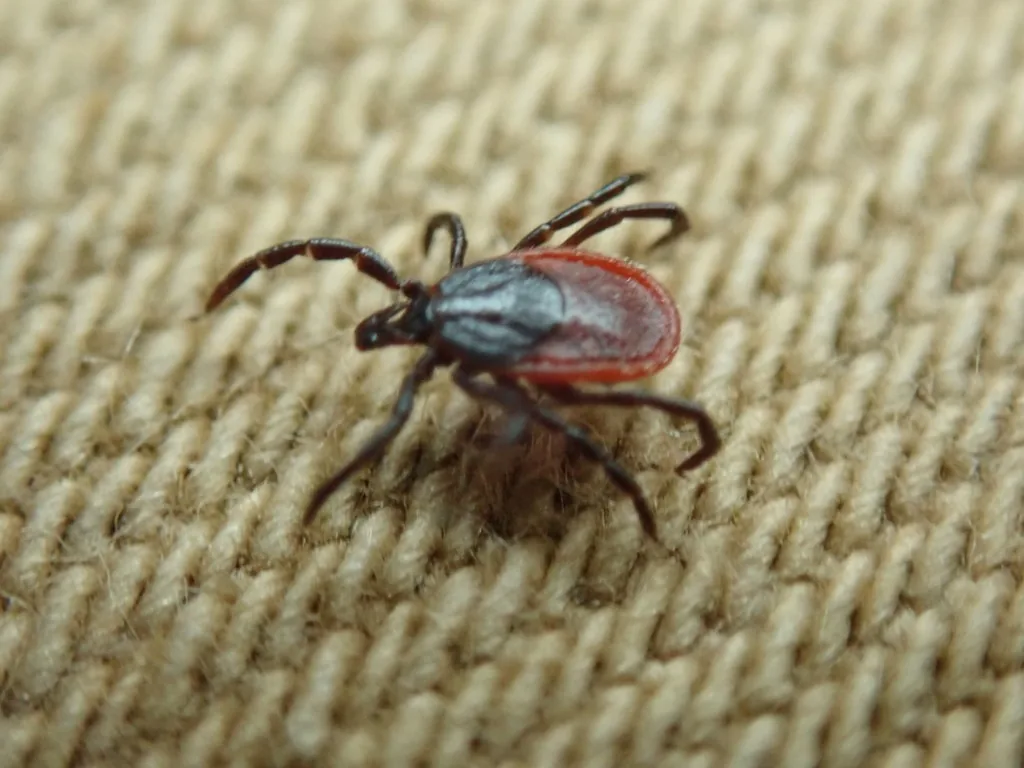
- The unfed adult female is about 1/8 inch long, with long forward-pointing mouthparts, brownish-black legs, a dark plate covering the front half of the back and a reddish-orange abdomen.[1]
- Adult males are smaller, about 1/10 inch, oval and brownish-black all over; they rarely attach to people.[1]
- A feeding female swells to 3/8 inch or longer, while larvae are pinhead-sized, have only six legs and seldom bite people.[1]
Look-alikes
| Look-alike | How to tell them apart |
|---|---|
| Blacklegged (deer) tick | A close relative that carries Lyme disease bacteria in eastern North America; it does not occur in California.[1] |
| Pacific Coast tick | Found along the coast of California, Oregon and Washington; CDC says it spreads Pacific Coast tick fever, which usually starts with a dark scab at the bite, rather than Lyme disease. CDC names the cause Rickettsia rickettsii subsp. californica, while UC IPM's 2016 Pest Note calls it Rickettsia philipii.[12][1] |
| American dog tick | CDC says the American dog tick (Dermacentor variabilis) is widespread east of the Rocky Mountains and transmits tularemia and Rocky Mountain spotted fever; west of the Rockies, the newly described D. similis occurs, and its role in disease is still being studied. Neither is listed as a Lyme disease carrier.[2] |
Where it lives
Lives along the Pacific coast of the U.S., especially northern California, where it has been found in 56 of the state's 58 counties. From 2005 to 2014, Lyme disease incidence was highest in the northwestern counties of Trinity, Humboldt and Mendocino and the northern Sierra Nevada counties of Sierra and Nevada. Washington's health department names it as the Lyme tick of the Pacific Coast, and it has also been collected in Utah, where Utah State University calls the chance of meeting one very low.[2][1][10][4]
Biology and life cycle
Larvae and nymphs feed on lizards, birds and small mammals for several days; adult females feed for about a week on medium and large mammals, then lay 900 to 1,000 eggs in soil or litter.[1]
In northwestern California the full life cycle takes about three years.[1]
Nymphs live in shady woodlands with oak, madrone or Douglas fir, in leaf litter and on logs, rocks and tree trunks up to 3 or 4 feet high.[1]
Adults climb grass and shrub tips, often along trail edges, and wait for deer, coyotes and other passing animals.[1]
People are most likely to be bitten by nymphs in spring and early summer. Adults seek hosts from late fall through spring and are most active in winter on the north coast and in the Sierra Nevada foothills; in central and southern California they quest from late November until late April or early May.[1]
Nymphs strongly prefer lizards: in some woodlands, more than 90% of them attach to lizards rather than birds or mammals.[1]
Damage and signs
- Dogs can get Lyme disease and may show lameness, tiredness, poor appetite or swollen lymph nodes; cats, horses and livestock can be infected but rarely get sick.[1]
Health risk
CDC lists it as a carrier of Lyme disease, anaplasmosis and hard tick relapsing fever (Borrelia miyamotoi); nymphs and adult females are the stages most often found on people. Health agencies give different attachment times for Lyme: CDC says infected ticks generally must be attached more than 24 hours, while Washington's health department says usually at least 36 hours. CDC says Lyme symptoms like fever and rash can be treated with antibiotics, and doxycycline is the drug of choice for anaplasmosis.[2][5][10][6][7]
Control
Prevention
Wear long pants tucked into socks and a long-sleeved shirt; stay in the center of trails and avoid brushing against grass and brush.[1]
Use an EPA-registered repellent; CDC lists DEET, picaridin, IR3535, oil of lemon eucalyptus, para-menthane-diol and 2-undecanone, and UC IPM notes that products with 20 to 30% DEET are effective. Treat clothing and gear, never skin, with 0.5% permethrin, or buy pre-treated clothing.[8][1]
Check your body and your pets during and after time outdoors. CDC advises tumbling outdoor clothes in a dryer on high heat for 10 minutes (longer if damp) and showering soon after coming in; UC IPM and CDC note that showering within two hours has been linked to lower Lyme disease risk.[8][1]
Keep them out
Discourage the deer and rodents that carry ticks: choose plantings that don't attract deer or fence deer out, and practice rodent control around the home.[11]
Sanitation
Clear leaf litter, brush, woodpiles and trash near the house, keep grass mowed and shrubs trimmed, and use gravel, paving or decking to keep the area right around the home open and sunny. UC IPM says about half of California's reported cases are picked up around semirural homes, and that clearing leaf litter or putting woodchip barriers between lawns and woodland may help there.[11][1]
Traps and physical control
Remove an attached tick right away with fine-tipped tweezers, gripping close to the skin and pulling slowly straight out without twisting or crushing it, then wash the bite and your hands.[1][9]
Pesticides
For dogs and cats, ask a veterinarian about registered tick-control products and follow the label; UC IPM notes that Lyme disease vaccines are available for dogs in California.[1][11]
Common questions
- When is Lyme disease risk highest in California?
- UC IPM says people are most likely to be bitten in spring and early summer, when nymphs are active, and that cases from local bites peak from May to July, following the nymphs' peak from April to June.[1]
- Why are nymphs the bigger worry?
- Nymphs are tiny and easy to miss. In northern California areas where Lyme disease occurs, about 1 to 2% of adults and 2 to 15% of nymphs carry the bacteria on average, and UC IPM says most people are probably infected by nymphs rather than adults.[1]
- Should I get the tick that bit me tested?
- Neither UC IPM nor Washington's health department recommends testing a tick to make medical decisions. See a doctor if you get a rash, fever or flu-like illness within several weeks of a tick bite.[1][11]
- What does a Lyme disease rash look like?
- Washington's health department says the erythema migrans rash is often bull's-eye shaped and at least 5 cm across, shows up in 70 to 80 percent of infected people, and usually starts at the bite 3 to 30 days later. A rash that appears within 36 hours of a bite is very unlikely to be Lyme disease and is commonly an allergic reaction.[10]
Sources
- University of California Statewide IPM Program, “Pest Notes: Lyme Disease in California, Publication 7485 (May 2016).” ipm.ucanr.edu/legacy_assets/PDF/PESTNOTES/pnlymedisease.pdf (accessed 2026-11-12)
- Centers for Disease Control and Prevention, “Where Ticks Live.” www.cdc.gov/ticks/about/where-ticks-live.html (accessed 2026-11-12)
- iNaturalist, “Ixodes pacificus taxon page (order and family).” www.inaturalist.org/taxa/60599 (accessed 2026-11-12)
- Utah State University Extension and Utah Plant Pest Diagnostic Laboratory, “Ticks and Tickborne Diseases of Utah (ENT-189-17, December 2017).” epi.utah.gov/wp-content/uploads/Ticks-and-Tickborne-Diseases-of-Utah.pdf (accessed 2026-11-12)
- Centers for Disease Control and Prevention, “How Lyme Disease Spreads.” www.cdc.gov/lyme/causes/index.html (accessed 2026-11-12)
- Centers for Disease Control and Prevention, “About Lyme Disease.” www.cdc.gov/lyme/about/index.html (accessed 2026-11-12)
- Centers for Disease Control and Prevention, “About Anaplasmosis.” www.cdc.gov/anaplasmosis/about/index.html (accessed 2026-11-12)
- Centers for Disease Control and Prevention, “Preventing Tick Bites.” www.cdc.gov/ticks/prevention/index.html (accessed 2026-11-12)
- Centers for Disease Control and Prevention, “What to Do After a Tick Bite.” www.cdc.gov/ticks/after-a-tick-bite/index.html (accessed 2026-11-12)
- Washington State Department of Health, “Lyme Disease.” doh.wa.gov/you-and-your-family/illness-and-disease-z/lyme-disease (accessed 2026-11-12)
- Washington State Department of Health, “Ticks.” doh.wa.gov/community-and-environment/pests/ticks (accessed 2026-11-12)
- Centers for Disease Control and Prevention, “About Other Spotted Fever Rickettsioses.” www.cdc.gov/other-spotted-fever/about/index.html (accessed 2026-11-12)