On this page
How to identify it
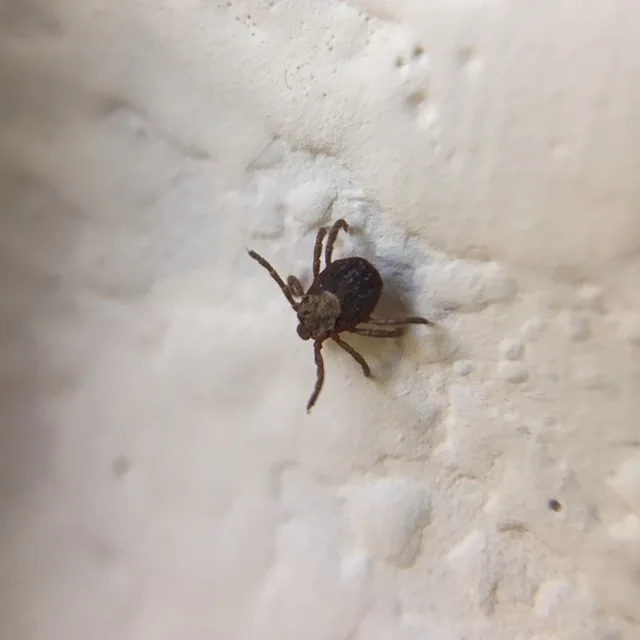
- The body is flat, oval and dark brown with whitish-gray markings; females have a mottled off-white shield behind the head, and males look mottled and spotty all over.[1]
- Larvae have six legs, while nymphs and adults have eight.[1]
- Size runs from about 3 mm to 15 mm, roughly 1/8 to 5/8 inch, depending on how much blood the tick has taken.[1]
Look-alikes
| Look-alike | How to tell them apart |
|---|---|
| American dog tick | Another Dermacentor tick; CDC says D. variabilis is widespread east of the Rockies and the newly described D. similis occurs west of them. CDC lists it as a carrier of tularemia and Rocky Mountain spotted fever, not Pacific Coast tick fever.[7][5] |
| Western blacklegged tick | The female has a plain dark shield and a reddish-orange abdomen, with no whitish mottling. CDC lists it as the Pacific coast carrier of Lyme disease, anaplasmosis and hard tick relapsing fever.[2][7] |
Where it lives
Found across most of California except the driest parts of the Central Valley and the southeastern deserts, especially along the coast and in the foothills. Sources differ on the rest: an Oregon vector control district says the only other places it has been collected are Oregon and Baja California, while CDC and a 2024 CDC-led study also include parts of Washington (south-central Washington in the study, which suggests a fairly recent arrival at the northern edge).[1][5][11]
Biology and life cycle
It is a three-host tick: the larva, nymph and adult each feed, often on a different animal, then drop off before the next stage.[1][3]
Damage and signs
- It can pass spotted fever and tularemia to cats and dogs, spreads bovine anaplasmosis to cattle, and has been implicated in tick paralysis in cattle, deer and ponies.[1]
Health risk
CDC says Pacific Coast tick fever is spread by infected Pacific Coast ticks and is caused by Rickettsia rickettsii subsp. californica, formerly called Rickettsia 364D; earlier sources call it R. philipii. The first sign is usually a dark scab (eschar) at the bite a few days to a week later. It is less severe than Rocky Mountain spotted fever, and CDC recommends doxycycline for all spotted fevers. CDC's RMSF page does not list this tick as an RMSF carrier, while an Oregon vector control district says all its life stages can carry RMSF. A San Mateo County, California study found tularemia bacteria mostly in Pacific Coast tick samples at a site with two human cases.[5][12][6][1][14]
Control
Prevention
Ticks live in wooded and brushy areas with high grass and leaf litter; avoid them where you can and walk in the center of trails.[8]
Use an EPA-registered repellent containing DEET, picaridin, IR3535, oil of lemon eucalyptus, PMD or 2-undecanone, and treat boots, clothing and gear with 0.5% permethrin.[8]
Shower soon after coming indoors, check your body and clothing for ticks, and tumble dry clothes on high heat for 10 minutes to kill ticks on dry clothing.[8]
Traps and physical control
Remove an attached tick as soon as possible with clean fine-tipped tweezers, grasping it close to the skin and pulling away with steady, even pressure; don't twist or jerk it, and don't use petroleum jelly, heat or nail polish.[9]
Common questions
- What is Pacific Coast tick fever?
- A spotted fever caused by Rickettsia rickettsii subsp. californica (formerly Rickettsia 364D) and spread by infected Pacific Coast ticks. CDC says it usually starts with a dark scab at the bite, is less severe than Rocky Mountain spotted fever, and is treated with doxycycline.[5][12]
- Does the Pacific Coast tick spread Lyme disease?
- CDC says Lyme disease bacteria in the U.S. are spread by blacklegged (Ixodes) ticks; on the Pacific coast that is the western blacklegged tick, not the Pacific Coast tick.[10][7]
- How soon should I remove a tick?
- Right away. CDC says not to wait to see a healthcare provider to remove an attached tick, because delaying removal could increase your risk of infection.[9]
Sources
- Columbia Drainage Vector Control District (Oregon), “Pacific Coast Tick (Dermacentor occidentalis).” cdvcd.specialdistrict.org/pacific-coast-tick-dermacentor-occidentalis (accessed 2026-11-12)
- University of California Statewide IPM Program, “Pest Notes: Lyme Disease in California, Publication 7485 (May 2016).” ipm.ucanr.edu/legacy_assets/PDF/PESTNOTES/pnlymedisease.pdf (accessed 2026-11-12)
- Colorado State University Extension, “Colorado Ticks and Tick-Borne Diseases.” extension.colostate.edu/resource/colorado-ticks-and-tick-borne-diseases/ (accessed 2026-11-12)
- iNaturalist, “Dermacentor occidentalis taxon page (order and family).” www.inaturalist.org/taxa/83016 (accessed 2026-11-12)
- Centers for Disease Control and Prevention, “About Other Spotted Fever Rickettsioses.” www.cdc.gov/other-spotted-fever/about/index.html (accessed 2026-11-12)
- Centers for Disease Control and Prevention, “About Rocky Mountain Spotted Fever.” www.cdc.gov/rocky-mountain-spotted-fever/about/index.html (accessed 2026-11-12)
- Centers for Disease Control and Prevention, “Where Ticks Live.” www.cdc.gov/ticks/about/where-ticks-live.html (accessed 2026-11-12)
- Centers for Disease Control and Prevention, “Preventing Tick Bites.” www.cdc.gov/ticks/prevention/index.html (accessed 2026-11-12)
- Centers for Disease Control and Prevention, “What to Do After a Tick Bite.” www.cdc.gov/ticks/after-a-tick-bite/index.html (accessed 2026-11-12)
- Centers for Disease Control and Prevention, “How Lyme Disease Spreads.” www.cdc.gov/lyme/causes/index.html (accessed 2026-11-12)
- Paddock CD et al. (via PubMed), “Rickettsia species identified in adult, host-seeking Dermacentor occidentalis from Baja California, Mexico, and Oregon and Washington, United States (J Med Entomol 61:781-790, 2024) (abstract).” pubmed.ncbi.nlm.nih.gov/38408183/ (accessed 2026-11-12)
- Paddock CD et al. (via PubMed), “Rickettsia rickettsii subsp californica subsp nov, the etiologic agent of Pacific Coast tick fever (J Infect Dis 231:849-858, 2025) (abstract).” pubmed.ncbi.nlm.nih.gov/39432903/ (accessed 2026-11-12)
- Paddock CD et al. (via PubMed), “Rickettsia species isolated from Dermacentor occidentalis from California (J Med Entomol 55:1555-1560, 2018) (abstract).” pubmed.ncbi.nlm.nih.gov/29982649/ (accessed 2026-11-12)
- Roth TM, Crews A, Nakano A (via PubMed), “Five years of surveillance for tularemia serovar B including two human cases at an endemic site in San Mateo County, California (J Med Entomol 59:1787-1792, 2022) (abstract).” pubmed.ncbi.nlm.nih.gov/35912704/ (accessed 2026-11-12)