On this page
How to identify it
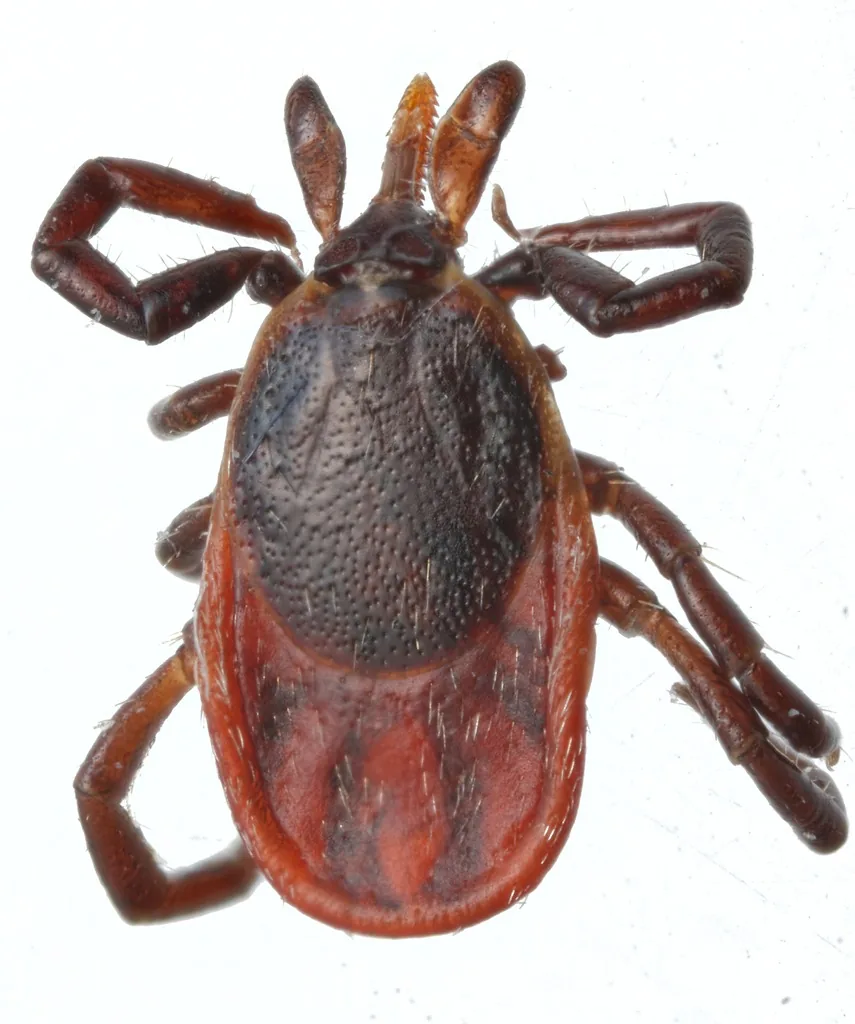
- Adult females have a reddish-orange body with black legs and a black shield (scutum) behind the head; mouthparts are long.[3]
- Nymphs are tiny, about the size of a poppy seed, with a translucent body and dark legs, so attached nymphs are easily overlooked.[2][3][4]
- On adult females the shield covers only the front half of the back; on males it covers the whole back.[3]
Look-alikes
| Look-alike | How to tell them apart |
|---|---|
| American dog tick | Brown with a whitish ornate pattern on the shield and short mouthparts.[3] |
| Lone star tick | Females have a single white spot on the back. CDC lists ehrlichiosis, tularemia and other infections for the lone star tick, but not Lyme disease.[5][1] |
Where it lives
Widely distributed across the eastern United States in wooded areas with dense leaf litter. CDC says Lyme-infected ticks are most common in forests of the northeastern, north-central and mid-Atlantic states; on the Pacific coast the related western blacklegged tick carries Lyme bacteria.[1][2][3]
Biology and life cycle
Life stages are egg, larva, nymph and adult, each tick stage taking a blood meal. The Connecticut Agricultural Experiment Station (CAES) describes a two-year life cycle; CDC gives two to three years.[6][2]
Seasons differ by source: CDC says nymphs quest from April through July and adults are most active in early spring and fall, and that adults may seek hosts any time winter temperatures are above freezing; Kentucky Extension gives adults October to June, nymphs May to August, and says adults stay active above 40°F.[2][1][3]
Nymphs and adult females are the stages most likely to bite people.[1]
In the Northeast, CAES says eggs are laid in May, larvae peak in August, and nymphs peak in May through July; nymphs that feed molt into adults that appear in fall.[6]
CAES calls white-tailed deer the keystone host for adult blacklegged ticks; larvae and nymphs feed on white-footed mice, which rodent-targeted tick products aim at.[6]
Damage and signs
- Ticks are picked up in grassy, brushy and wooded areas, including people's own yards.[7]
Health risk
CDC lists anaplasmosis, babesiosis, Lyme disease, hard tick relapsing fever, ehrlichiosis and Powassan virus disease. In most cases a tick must be attached for more than 24 hours to pass Lyme bacteria, so prompt removal matters. See a doctor if a rash or fever develops in the weeks after removing a tick.[1][2][8]
Control
Prevention
Use an EPA-registered repellent (DEET, picaridin, IR3535, oil of lemon eucalyptus, PMD or 2-undecanone) and treat clothing and gear with 0.5% permethrin; walk in the center of trails.[7]
Make the yard less tick-friendly: remove leaf litter, clear tall grass and brush, mow often, and put a 3-foot strip of wood chips or gravel between lawn and woods.[7]
Sanitation
After being outdoors, tumble dry clothes on high heat for 10 minutes, check gear and pets, shower within two hours, and do a full-body tick check.[7]
Traps and physical control
Remove an attached tick right away with fine-tipped tweezers, grasping close to the skin and pulling straight out with steady pressure; don't use petroleum jelly, heat or nail polish.[8]
Biological control
CAES reports that commercial formulations of the fungi Metarhizium anisopliae and Beauveria bassiana, applied around yard perimeters, controlled blacklegged ticks in small experimental trials.[6]
Pesticides
Yard pesticide applications can reduce ticks, but CDC says not to rely on spraying alone to prevent infection. CAES lists acaricides labeled for residential landscapes, including bifenthrin (Talstar, Ortho products), carbaryl (Sevin), cyfluthrin (Tempo) and deltamethrin (Suspend, DeltaGard), and advises focusing on where lawn meets woods, stone walls and groundcover.[7][6]
Host-targeted products give mixed results. Permethrin-treated cotton tubes (Damminix Tick Tubes) cut tick numbers in Massachusetts studies but showed no reduction in infected nymphs in Connecticut and New York trials; the fipronil Maxforce Tick Management System bait box is no longer made; and '4-Poster' feeding stations let deer treat themselves with acaricide.[6]
Common questions
- How long does a tick need to be attached to spread Lyme disease?
- CDC says that in most cases an infected tick must be attached for more than 24 hours before it can pass Lyme bacteria, so removing ticks within 24 hours greatly cuts the risk.[2]
- What's the best way to remove a tick?
- Grasp it close to the skin with fine-tipped tweezers and pull straight out with steady pressure, then clean the area.[8]
Sources
- Centers for Disease Control and Prevention, “Where Ticks Live.” www.cdc.gov/ticks/about/where-ticks-live.html (accessed 2026-11-12)
- Centers for Disease Control and Prevention, “How Lyme Disease Spreads.” www.cdc.gov/lyme/causes/index.html (accessed 2026-11-12)
- University of Kentucky Entomology, “ENTFACT-618: Ticks and Disease in Kentucky.” entomology.mgcafe.uky.edu/ef618 (accessed 2026-11-12)
- University of California Statewide IPM Program, “Pest Notes: Lyme Disease in California, Publication 7485 (May 2016).” ipm.ucanr.edu/legacy_assets/PDF/PESTNOTES/pnlymedisease.pdf (accessed 2026-11-12)
- University of Kentucky Entomology, “ENTFACT-648: The Lone Star Tick in Kentucky.” entomology.mgcafe.uky.edu/ef648 (accessed 2026-11-12)
- Connecticut Agricultural Experiment Station, “Tick Management Handbook, revised edition (Bulletin No. 1010; K. C. Stafford III).” portal.ct.gov/-/media/CAES/DOCUMENTS/Publications/Bulletins/b1010pdf.pdf (accessed 2026-11-12)
- Centers for Disease Control and Prevention, “Preventing Tick Bites.” www.cdc.gov/ticks/prevention/index.html (accessed 2026-11-12)
- Centers for Disease Control and Prevention, “What to Do After a Tick Bite.” www.cdc.gov/ticks/after-a-tick-bite/index.html (accessed 2026-11-12)
- iNaturalist, “Ixodes scapularis taxon page (order and family).” www.inaturalist.org/taxa/60598 (accessed 2026-11-12)