On this page
How to identify it
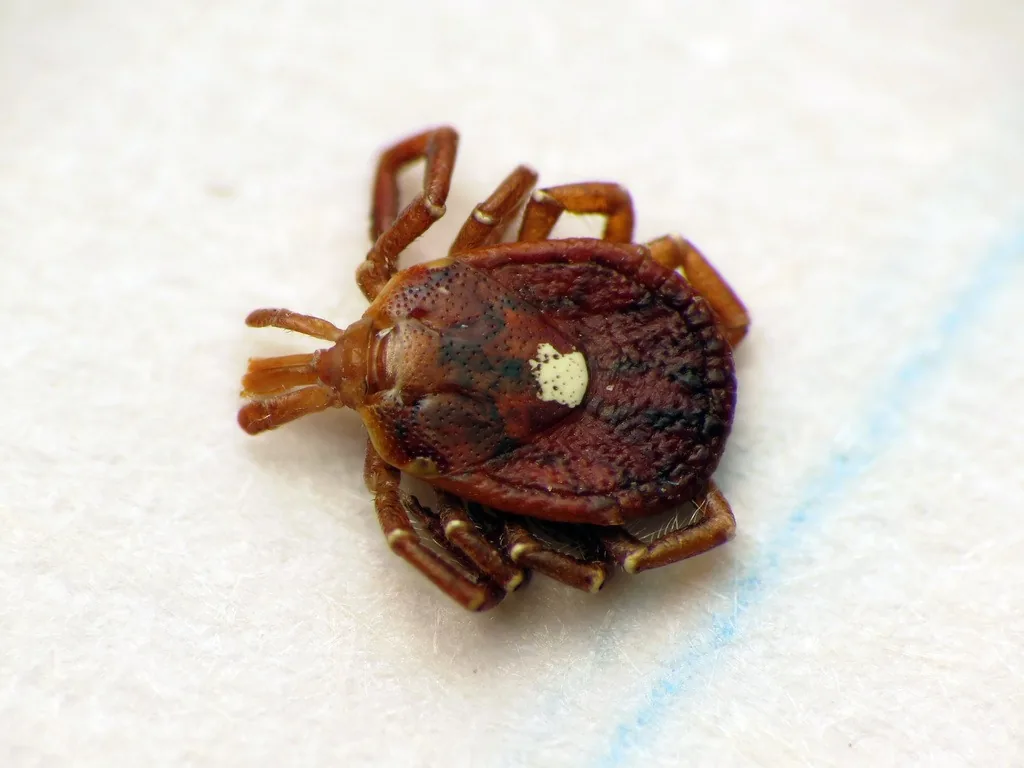
- Adult females are reddish brown with a single white dot, the "lone star," on the back.[1][3]
- Males have small white markings along the rear edge; mouthparts are long.[3]
- Larvae ("seed ticks") can appear in large numbers in late summer.[2]
- Nymphs and larvae are reddish brown with a circular body; larvae have six legs.[3][2]
Look-alikes
| Look-alike | How to tell them apart |
|---|---|
| Blacklegged tick | Adults have a reddish-orange body with black legs and black shield and no white spot.[3] |
Where it lives
Widely distributed in the Northeast, South and Midwest, in woodlands and open areas with dense vegetation.[1][3]
Biology and life cycle
Active from about March through September; nymphs and adults in spring, larvae in late summer and fall.[2][3]
Lone star ticks actively chase their hosts and are often present in large numbers.[3]
Each of its three active stages (larva, nymph and adult) needs a blood meal. Its most common hosts are wild mammals and ground-nesting birds; white-tailed deer, raccoons and striped skunks are important hosts and can carry ticks into yards.[2]
Damage and signs
Health risk
CDC lists the lone star tick as a carrier of the bacteria that cause ehrlichiosis (Ehrlichia chaffeensis and E. ewingii), tularemia, and the Heartland and Bourbon viruses; Heartland and Bourbon cases are rare. A red, expanding rash of unknown cause, called southern tick-associated rash illness (STARI), sometimes follows its bite. CDC says it is the tick most often associated with alpha-gal syndrome, a serious, potentially life-threatening allergy, and it doesn't list Lyme disease among this tick's diseases.[1][8][10][11][9][4]
Control
Prevention
Use an EPA-registered repellent (DEET, picaridin, IR3535, oil of lemon eucalyptus, PMD or 2-undecanone) and treat clothing and gear with 0.5% permethrin; walk in the center of trails.[6]
Make the yard less tick-friendly: remove leaf litter, clear tall grass and brush, mow often, and put a 3-foot strip of wood chips or gravel between lawn and woods.[6]
Sanitation
After being outdoors, tumble dry clothes on high heat for 10 minutes, check gear and pets, shower within two hours, and do a full-body tick check.[6]
Traps and physical control
Remove an attached tick right away with fine-tipped tweezers, grasping close to the skin and pulling straight out with steady pressure; don't use petroleum jelly, heat or nail polish.[5]
Pesticides
Yard pesticide applications can reduce ticks, but you shouldn't rely on spraying alone to prevent infection.[6]
Diseases in more detail
Ehrlichiosis often causes fever, chills, headache and muscle aches starting 1 to 2 weeks after the bite. CDC says doxycycline is the treatment of choice for adults and children of all ages, and there is no vaccine.[8]
The STARI rash usually appears within 7 days of the bite and expands to 3 to 12 inches across, sometimes clearing in the middle like a bull's-eye. CDC notes it is different from the small red spot common at any tick bite, and that studies show STARI is not caused by the Lyme disease bacteria.[9]
CDC counted more than 110,000 suspected alpha-gal syndrome cases from 2010 to 2022 and says as many as 450,000 people may be affected. Most reported cases come from southern, eastern and central states, where most lone star ticks live; a few cases have followed blacklegged and western blacklegged tick bites.[4]
Common questions
- Can a tick bite make me allergic to red meat?
- Yes. Alpha-gal syndrome can develop after tick bites, most often from the lone star tick in the U.S.[4]
- Does the lone star tick carry Lyme disease?
- No. CDC says Lyme disease bacteria in the U.S. are spread by blacklegged (Ixodes) ticks and doesn't list Lyme among lone star tick diseases. The STARI rash that can follow a lone star bite looks like the Lyme rash, but CDC says it is not caused by the Lyme bacteria.[12][1][9]
Sources
- Centers for Disease Control and Prevention, “Where Ticks Live.” www.cdc.gov/ticks/about/where-ticks-live.html (accessed 2026-11-12)
- University of Kentucky Entomology, “ENTFACT-648: The Lone Star Tick in Kentucky.” entomology.mgcafe.uky.edu/ef648 (accessed 2026-11-12)
- University of Kentucky Entomology, “ENTFACT-618: Ticks and Disease in Kentucky.” entomology.mgcafe.uky.edu/ef618 (accessed 2026-11-12)
- Centers for Disease Control and Prevention, “About Alpha-gal Syndrome.” www.cdc.gov/alpha-gal-syndrome/about/index.html (accessed 2026-11-12)
- Centers for Disease Control and Prevention, “What to Do After a Tick Bite.” www.cdc.gov/ticks/after-a-tick-bite/index.html (accessed 2026-11-12)
- Centers for Disease Control and Prevention, “Preventing Tick Bites.” www.cdc.gov/ticks/prevention/index.html (accessed 2026-11-12)
- iNaturalist, “Amblyomma americanum taxon page (order and family).” www.inaturalist.org/taxa/83744 (accessed 2026-11-12)
- Centers for Disease Control and Prevention, “About Ehrlichiosis.” www.cdc.gov/ehrlichiosis/about/index.html (accessed 2026-11-12)
- Centers for Disease Control and Prevention, “About Southern Tick-Associated Rash Illness.” www.cdc.gov/stari/about/index.html (accessed 2026-11-12)
- Centers for Disease Control and Prevention, “About Heartland Virus.” www.cdc.gov/heartland-virus/about/index.html (accessed 2026-11-12)
- Centers for Disease Control and Prevention, “About Bourbon Virus.” www.cdc.gov/bourbon-virus/about/index.html (accessed 2026-11-12)
- Centers for Disease Control and Prevention, “How Lyme Disease Spreads.” www.cdc.gov/lyme/causes/index.html (accessed 2026-11-12)