On this page
How to identify it
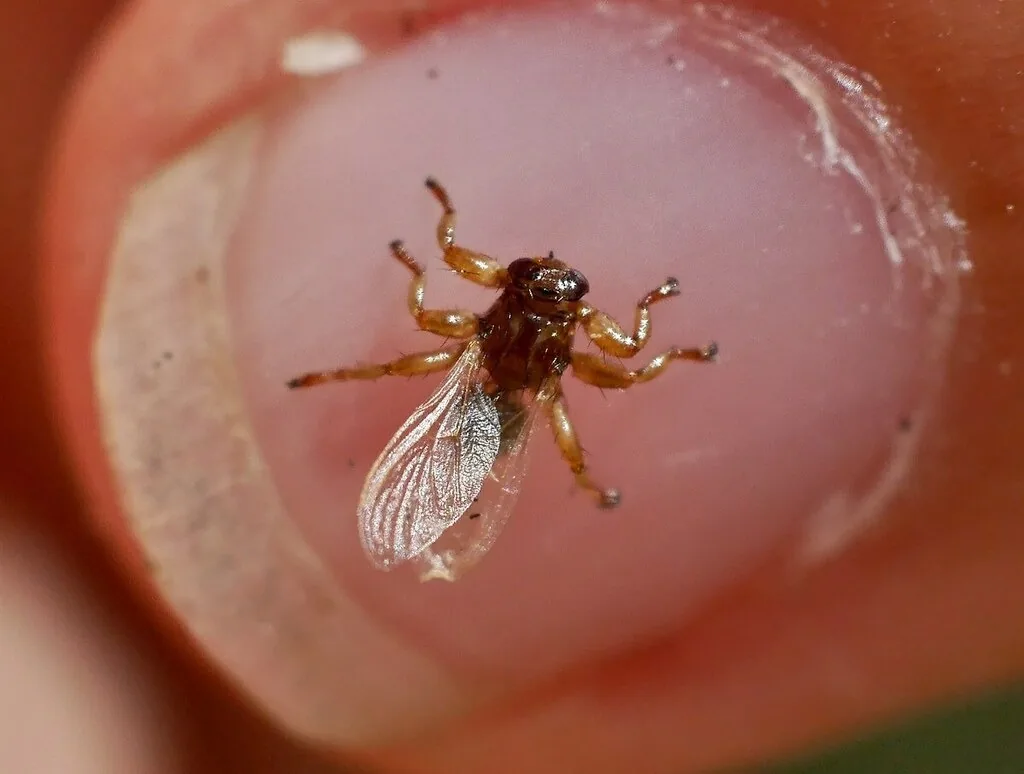
- Deer keds are brown, flattened flies; newly emerged adults have wings and fly to a host, then shed them, leaving small wing stubs on the thorax.[1]
- Wingless keds climb quickly through hair and are often taken for ticks. After a blood meal a ked's abdomen expands, but not nearly as much as an engorged tick's.[1]
- They find hosts by movement rather than by smell or carbon dioxide, so they fly to large moving objects, including people, who often don't feel the first bite.[1][3]
Look-alikes
| Look-alike | How to tell them apart |
|---|---|
| Blacklegged (deer) tick | Keds are flies that scurry quickly through hair and swell only a little after feeding, while ticks swell greatly. The bites differ too: in a Polish clinical comparison, tick bites left a poorly defined red patch around a central bite mark that usually faded within one to several days, while deer ked bites left scattered, irregular red papules that itched and could last up to one year.[1][10] |
Where it lives
Four species occur in North America: the European deer ked in the northeastern United States and adjacent Canada (introduced, first found in New Hampshire and Pennsylvania in 1907 and since spread west into Ohio and south into Virginia), the Neotropical deer ked from the southeastern United States south through Central and South America, and the western and Pacific deer keds in western North America. In Pennsylvania the European deer ked is most abundant in the northern tier counties and nearly absent from the southeast.[1][2][6]
Biology and life cycle
A female produces one offspring at a time: the egg hatches inside her and she feeds the larva a milk-like secretion. When mature, the larva is deposited and pupates at once. Pupae rest in soil and leaf litter for up to 11 months, so they pile up where deer bed down. Based on related species, Penn State estimates a female produces fewer than a dozen offspring.[1][2]
Adult European deer keds emerge on warm fall days, en masse over about four to six weeks in the Northeast, fly to a host and can live for at least a year on it. They stay mostly in wooded areas but may fly up to 50 yards into fields and lawns.[1][3]
The other North American species emerge spread out over the summer rather than in one fall burst.[3]
In Finnish experiments using people as targets, keds landed more on dark and red clothing than on white, attacked mostly the upper body and the back, and preferred the warmest parts of the body.[11]
Damage and signs
- Most deer carry modest numbers without obvious harm; research on Neotropical deer keds in South Carolina found more grooming but no effect on overall deer health.[1]
- In Scandinavia keds can become so numerous on moose that the moose lose hair and die in harsh winters; this has not been seen on North American deer or elk.[1]
Health risk
Keds occasionally bite people and domestic animals. Bites can cause deer ked dermatitis: very itchy papules, mostly on the head and back, that resisted treatment and lasted from 2 weeks to 12 months in a Finnish study of 19 patients. Tick-borne bacteria including Anaplasma phagocytophilum, Borrelia burgdorferi and Bartonella schoenbuchensis have been found in keds, but it is not known whether keds can transmit them. A 2025 review calls keds a highly probable vector of B. schoenbuchensis and says doctors should consider ked bites when diagnosing skin lesions.[2][9][7][8][4][12]
Control
Prevention
Wear permethrin-treated clothing. In a 2024 Penn State study, DEET, IR3535, oil of lemon eucalyptus, picaridin and permethrin repelled keds no better than water, but keds exposed to permethrin died much sooner: median survival 0.58 hours, against 23.12 hours on the water control.[5][1]
Light-colored clothing may help, since European studies found keds land more on dark clothing. Nitrile gloves help when handling deer: in testing, keds could not climb nitrile.[1][11][3]
After time in ked habitat, a 2025 occupational-health review recommends checking the body for keds and bite sites.[12]
Where sources disagree
How fast permethrin kills: Penn State Extension says 100% of keds died within 20 minutes; the lead researcher told Entomology Today they died within 15 minutes, often in 5 to 10; the published study reports a median survival of 0.58 hours on permethrin.[1][3][5]
New records: Penn State News reported ten new state and 122 new county records from the 2019 survey; the paper's abstract gives 7 new state and 91 new county records.[2][4]
Common questions
- What is the flat, tick-like bug that crawled on me after handling a deer?
- Likely a deer ked: a flat, brown, wingless fly that scurries quickly through hair and often crawls from a deer onto whoever handles it.[1]
- Does bug spray keep deer keds away?
- No. In testing, DEET, picaridin, IR3535 and oil of lemon eucalyptus didn't repel keds, but keds exposed to permethrin-treated fabric died much sooner.[5][3]
- How long do deer ked bites itch?
- Ked bites can leave itchy red papules that last from about 2 weeks up to a year.[9][10]
Sources
- Penn State Extension, “Deer Keds.” extension.psu.edu/deer-keds (accessed 2026-11-11)
- Penn State News, “New records show spread of parasitic deer flies across US (May 30, 2019).” news.psu.edu/story/576201/2019/05/30/research/new-records-show-spread-parasitic-deer-flies-across-us (accessed 2026-11-11)
- Entomology Today (Entomological Society of America), “Meet the Deer Ked: The Fly That Makes Life Tough for Hunters and Hikers.” entomologytoday.org/deer/ (accessed 2026-11-11)
- Journal of Medical Entomology, via PubMed, “Deer keds (Diptera: Hippoboscidae: Lipoptena and Neolipoptena) in the United States and Canada: new state and county records, pathogen records, and an illustrated key to species (Skvarla and Machtinger 2019).” pubmed.ncbi.nlm.nih.gov/30668798/ (accessed 2026-11-11)
- Journal of Medical Entomology, via PubMed, “Commercial products are not effective at repelling European deer keds, Lipoptena cervi, but may increase mortality after exposure (Skvarla et al. 2024).” pubmed.ncbi.nlm.nih.gov/39183458/ (accessed 2026-11-11)
- Parasites & Vectors, via PubMed, “Patterns of deer ked and tick infestation on white-tailed deer in the eastern United States (Poh et al. 2022).” pubmed.ncbi.nlm.nih.gov/35057829/ (accessed 2026-11-11)
- Journal of Vector Ecology, via PubMed, “Detection of Lyme disease and anaplasmosis pathogens via PCR in Pennsylvania deer ked (Buss et al. 2016).” pubmed.ncbi.nlm.nih.gov/27860010/ (accessed 2026-11-11)
- Journal of Clinical Microbiology, via PubMed, “Isolation of Bartonella schoenbuchensis from Lipoptena cervi, a blood-sucking arthropod causing deer ked dermatitis (Dehio et al. 2004).” pubmed.ncbi.nlm.nih.gov/15528732/ (accessed 2026-11-11)
- Acta Dermato-Venereologica, via PubMed, “Persistent pruritic papules from deer ked bites (Rantanen et al. 1982).” pubmed.ncbi.nlm.nih.gov/6183862/ (accessed 2026-11-11)
- International Journal of Environmental Research and Public Health, via PubMed, “Comparison of skin lesions caused by Ixodes ricinus ticks and Lipoptena cervi deer keds infesting humans in the natural environment (Buczek et al. 2020).” pubmed.ncbi.nlm.nih.gov/32397578/ (accessed 2026-11-11)
- Bulletin of Entomological Research, via PubMed, “Experiments on the ectoparasitic deer ked that often attacks humans; preferences for body parts, colour and temperature (Kortet et al. 2010).” pubmed.ncbi.nlm.nih.gov/19698197/ (accessed 2026-11-11)
- Journal of Occupational Medicine and Toxicology, via PubMed, “The role of deer keds in occupational and public health (Braun et al. 2025).” pubmed.ncbi.nlm.nih.gov/41310658/ (accessed 2026-11-11)
- iNaturalist, “Lipoptena cervi taxon page (order and family).” www.inaturalist.org/taxa/130393 (accessed 2026-11-11)