On this page
How to identify it
- NC State gives deer flies as 10 to 13 mm long. The Illinois Department of Public Health says about ¼ inch, about the size of a house fly, and Wisconsin calls them slightly larger than house flies.[1][4][2]
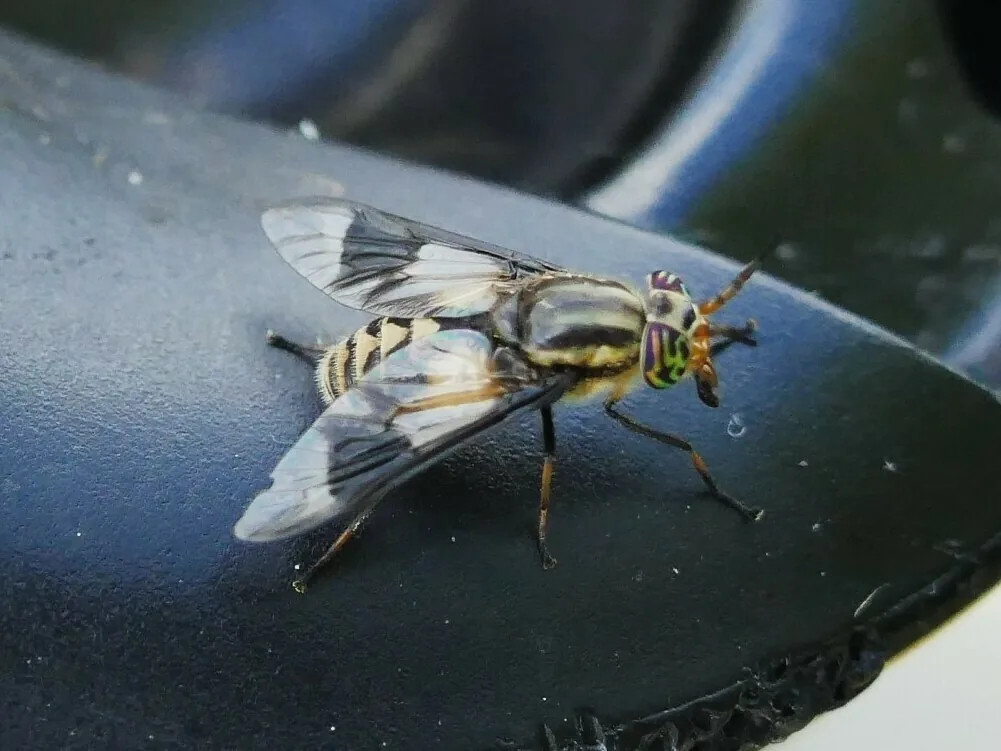
- The wings are tinted smoky gray-brown or carry dark patterns or bands. The body is often yellow and black striped, and NC State describes the thorax as greenish-yellow with dark stripes.[1][2][4]
- Like horse flies they are stout-bodied with large, often brightly colored eyes; in some species the eyes are iridescent green. UF/IFAS says males' eyes touch while females' are widely separated, and describes deer flies as yellow to black with stripes on the abdomen and wings mottled with dark patches.[3][4][5]
- There are many species: Wisconsin has over 30 species of deer flies and horse flies, and more than 40 occur in North Carolina. The photo shows Chrysops callidus, one member of the genus.[2][1][6]
Look-alikes
| Look-alike | How to tell them apart |
|---|---|
| Horse fly | Horse flies are bigger, 14 to 19 mm in NC State's description and up to two inches in some species, with clear wings and a grayish-brown thorax. Horse flies often attack the legs, while deer flies go for the head and neck. UF/IFAS gives horse flies as 10 to 25 mm, black to dark brown with green or black eyes, and notes that deer flies have spurs at the tips of the hind legs' tibiae that horse flies lack.[1][2][5] |
| Stable fly | About ¼ inch long and gray with four dark stripes behind the head, it looks like a house fly with a pointed beak and often bites the ankles.[4] |
| Yellow fly | Diachlorus ferrugatus, known in Florida as a fierce biter, has a deer fly's body shape but is yellowish, with dark purple to black eyes marked by fluorescent green lines.[5] |
Where it lives
Horse flies and deer flies are found worldwide. They are most numerous near their breeding sites, such as swamps, marshes, floodplains and the banks of ponds, lakes and streams, and are often met along trails, narrow lanes and woodland edges. UF/IFAS notes they are unreported in Hawaii, Greenland and Iceland, and that Florida, with 35 economically important species, has large populations because of its mild climate and large, permanently wet, undeveloped areas.[1][2][4][5]
Biology and life cycle
Females lay eggs in masses cemented to plant stems, leaves or other objects near water or on wet soil; NC State gives 200 to 500 eggs per mass. The eggs hatch in about a week and the larvae crawl or drop into the water or wet soil. UF/IFAS says eggs are laid in layers on vertical surfaces directly over water or wet ground, with aquatic plants preferred, and hatch in five to seven days.[1][2][3][5]
The larvae live in mud or wet organic matter and may take a month to a year or more to develop. When mature they move to drier soil near the surface and pupate for 1 to 4 weeks.[1][2][4]
Most species have one generation a year, though some take two or three years. Wisconsin says tabanids can be active from May until September; NC State says most emerge from May through August.[1][2]
Males don't bite; they feed on nectar and plant sugars. Females feed on blood and also take nectar.[1][2]
Deer fly larvae live where the water content is high and feed on organic matter in the soil. They pass through six to nine stages over a few months to a year, then move into the top 1 to 2 inches of soil, where it is drier, to pupate for two to three weeks.[5]
Most species spend the winter as larvae and have a one-year life cycle, and adults live 30 to 60 days. Mating starts in the air and is completed on the ground, UF/IFAS says.[5]
Native wasps parasitize the eggs, and other wasps and flies parasitize larvae and pupae; nest-building wasps stock their nests with adult flies, and cattle egrets and killdeer eat them. UF/IFAS says there are no effective biological control programs.[5]
Damage and signs
- Deer flies hunt by sight and are drawn to dark, moving objects and to carbon dioxide. They wait on leaves or tall grass, then circle a person's head persistently until they get a chance to bite, usually around the head and neck. UF/IFAS says sight is the main way they find hosts, with carbon dioxide and odor also playing a role.[2][3][1][4][5]
- Their blade-like mouthparts cut the skin and the fly laps up the blood that pools. Saliva with an anticoagulant keeps it flowing, so the bites are painful and bleed.[2][4][3]
- In livestock, horse and deer flies can carry equine infectious anemia virus from horse to horse on their mouthparts.[3][1]
- Attacks peak for about three hours from sunrise and again from two hours before sunset, and are few on overcast days and at temperatures below 71.6°F (22°C) or above 89.6°F (32°C), UF/IFAS says.[5]
- On livestock they bite the belly, legs and neck, and repeated attacks lower weight gains and milk production.[5]
Health risk
CDC says deer flies have been shown to transmit tularemia in the western United States, and the Illinois Department of Public Health names Chrysops discalis. In a 2007 outbreak at Utah Lake, visitors who reported deer fly bites were 7.2 times more likely to become ill. Allergy to deer fly and horse fly bites is reported, although the medical literature is limited to case reports and small case series.[7][4][8][9]
Control
Prevention
Cover up with long sleeves, long pants and a hat. Repellents give only partial, temporary relief; Wisconsin says products with high levels of DEET give some protection. UF/IFAS advises applying repellent to exposed skin and clothing before going out and notes that most repellents work less well against biting flies than against mosquitoes, so they need reapplying more often.[2][1][5][10]
Don't swat or run when the flies are swarming; Wisconsin says that only attracts more of them.[2]
Give pets and livestock a shaded shelter such as a barn, shed or doghouse; these flies are active in the sun and avoid shade.[2][3]
Biting flies are most active in still air, so increasing air movement on porches, patios and picnic areas helps, though it may not give complete protection; pruning shrubs and mowing weedy areas where they rest can also cut numbers.[10]
Traps and physical control
Sticky patches or tape on the back of a cap catch the flies that circle your head, and NC State reports some success with blue cups or buckets coated in glue.[2][1]
Traps built around a hanging dark ball or a dark box mimic a host animal. NC State says box traps help in small areas such as home yards and campgrounds, and Penn State says placement in a sunny spot visible from the woods matters most.[1][3][2]
UF/IFAS says traps are sometimes effective in small areas such as yards, campsites and swimming pools. Blue cylinders such as inverted cups, coated with sticky material and worn on a cap or mounted on something moving slower than 7 miles per hour, like a riding mower, reduce the flies nearby.[5]
Pesticides
No satisfactory chemical control exists. Adults rest only briefly, so residual sprays don't work, fogging kills only the flies present at the time, and treating wetland breeding sites is impractical. UF/IFAS also calls spraying for adults ineffective and says breeding in water and mucky areas makes source reduction difficult; your local mosquito control district can tell you about area programs.[2][1][5][10]
If you are bitten
Wash the bite with soap and water, then apply ice wrapped in a washcloth, 10 minutes on and 10 minutes off. An antihistamine or an anti-itch cream can help.[11]
Over the next several days watch for signs of infection, such as increasing redness, swelling or pain.[11]
Call 911 for trouble breathing, swelling of the face or mouth, or throat tightness. The Illinois Department of Public Health notes that in sensitive people biting fly saliva can trigger life-threatening allergic reactions, and an allergy review advises an action plan and, where appropriate, self-injectable adrenaline.[11][4][9]
Deer flies and tularemia
Tularemia from a tick or deer fly bite usually takes the ulceroglandular or glandular form, and most people with tularemia get a fever, which can be as high as 104 °F.[7]
The 2007 Utah Lake outbreak had 14 reported cases and was Utah's second documented deer-fly-associated outbreak, and a 2023 case report described ulceroglandular tularemia after a deer fly bite in Utah.[8][12]
Where sources disagree
Size: NC State gives deer flies as 10 to 13 mm long, UF/IFAS 7 to 10 mm, and the Illinois Department of Public Health about ¼ inch.[1][5][4]
Season: Wisconsin says deer flies are most active in June and July, while the Illinois Department of Public Health calls them most prevalent in spring. UF/IFAS says adult tabanids are seen in Florida from May to September, while its biting-fly guide calls deer flies most prevalent there in early to late spring.[2][4][5][10]
Egg masses: NC State gives 200 to 500 eggs per mass, while UF/IFAS gives masses of 100 to 1,000 eggs.[1][5]
Shade: UF/IFAS says tabanids lie in wait in shady areas under bushes and trees for a host to pass, while Wisconsin and Penn State say these flies are active in the sun and avoid shade, which is why shaded shelters help pets and livestock.[5][2][3]
Common questions
- Why do deer flies circle my head?
- They hunt mainly by sight and are drawn to dark, moving objects and to carbon dioxide, so they circle your head until they can bite. A sticky patch on the back of a cap catches many of them.[2][3]
- Do male deer flies bite?
- No. Only females bite; males feed on nectar and plant sugars.[1][2]
- Can deer flies spread disease?
- Yes, occasionally. CDC says deer flies have been shown to transmit tularemia in the western United States.[7][4]
- When do deer flies bite most?
- UF/IFAS says attacks peak for about three hours after sunrise and again from two hours before sunset, and drop on overcast days and in cool or very hot weather.[5]
Sources
- NC State Extension, “Horse Flies and Deer Flies (Biting and Stinging Pests).” content.ces.ncsu.edu/horse-flies-and-deer-flies (accessed 2026-11-11)
- University of Wisconsin Extension, “Deer Flies and Horse Flies (Garden Facts XHT1049, P. Pellitteri).” hort.extension.wisc.edu/files/2014/11/Deer_Flies_and_Horse_Flies.pdf (accessed 2026-11-11)
- Penn State Extension, “Protecting Horses From Horse and Deer Fly Bites (2022).” extension.psu.edu/protecting-horses-from-horse-and-deer-fly-bites (accessed 2026-11-11)
- Illinois Department of Public Health, “Biting Flies.” idph.illinois.gov/envhealth/pcbitingflies.htm (accessed 2026-11-11)
- University of Florida IFAS Extension (EDIS), “Deer Flies, Yellow Flies and Horse Flies, Chrysops, Diachlorus, and Tabanus spp., EENY-028/IN155 (J. M. Squitier; Featured Creatures).” ask.ifas.ufl.edu/publication/IN155 (accessed 2026-11-14)
- iNaturalist, “Chrysops callidus taxon page (order and family).” www.inaturalist.org/taxa/216856 (accessed 2026-10-06)
- U.S. Centers for Disease Control and Prevention, “How Tularemia Spreads (reviewed May 15, 2024).” www.cdc.gov/tularemia/causes/index.html (accessed 2026-11-11)
- Public Health Reports, via PubMed, “Calanan and others (2010), Tularemia outbreak associated with outdoor exposure along the western side of Utah Lake, Utah, 2007.” pubmed.ncbi.nlm.nih.gov/21121232/ (accessed 2026-11-11)
- Clinical and Experimental Allergy, via PubMed, “Whyte, Popescu and Carlson (2020), Tabanidae insect (horsefly and deerfly) allergy in humans: a review of the literature.” pubmed.ncbi.nlm.nih.gov/32512632/ (accessed 2026-11-11)
- University of Florida IFAS Extension (EDIS), “Biting Flies, ENY-220/IG081 (J. B. Pitzer, P. G. Koehler and J. W. Diclaro II).” ask.ifas.ufl.edu/publication/IG081 (accessed 2026-11-14)
- MedlinePlus, U.S. National Library of Medicine, “Insect bites and stings (Medical Encyclopedia).” medlineplus.gov/ency/article/000033.htm (accessed 2026-11-11)
- American Journal of Medicine, via PubMed, “Wormser and Wormser (2023), Ulceroglandular tularemia from the bite of a deerfly in Utah.” pubmed.ncbi.nlm.nih.gov/37028693/ (accessed 2026-11-11)