On this page
How to identify it
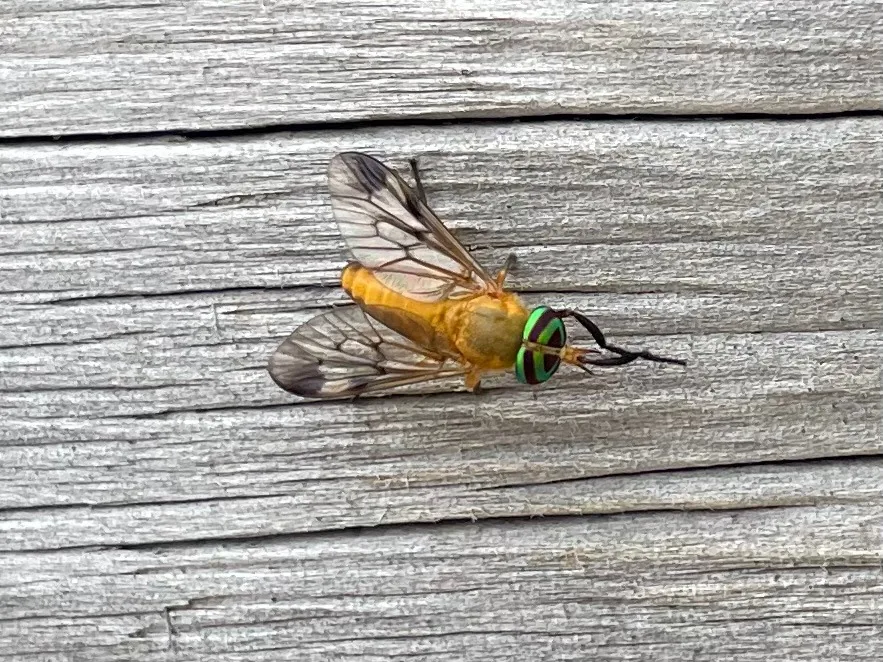
- Adults are mostly yellow and about 1 cm (roughly 3/8 inch) long, with dark front legs and yellow middle and hind legs.[1]
- The wings have dark veins with clear spaces between them and a brown patch at the tip. UF/IFAS adds a black stigma (the dark spot on the front edge of the wing) and a yellow costal cell.[1][2][3]
- The eyes are striking: the University of Georgia describes them as vibrant green with two dark bands, while a 2025 dermatology report describes dark purple to black eyes crossed by two fluorescent green lines. UF/IFAS describes live flies' eyes as brilliant blue-green with two purple bands.[2][1][3]
- The abdomen is yellow with black hairs along the sides and a broad yellow stripe down the middle.[1]
- In Florida, UF/IFAS says 'yellow fly' is used loosely for about a dozen yellow-bodied biting flies in the family Tabanidae, but tabanid experts recognize only Diachlorus ferrugatus as the true yellow fly. In Belize it is called the doctor fly.[3]
- Females have a very narrow frons, the space between the eyes on the face, which UF/IFAS uses to separate them from deer flies.[3]
- Eggs are tiny, about 1/16 inch, creamy white when laid and dark within hours, so egg masses can look like tar specks. Larvae are slender whitish grubs nearly covered in fine yellowish hairs.[3]
Look-alikes
| Look-alike | How to tell them apart |
|---|---|
| Deer flies | Deer flies are about the same shape but have stripes on the abdomen and thorax and mottled wings with dark patches; the yellow fly has clear wings with one brown patch at the tip. UF/IFAS puts it simply: the yellow fly's brown wing patch sits at the tip of the wing, not across the middle as in deer flies.[1][2][4][3] |
| Horse flies | Horse flies are darker and larger, 10 to 25 mm, black to dark brown, with green or black eyes.[1][2][4] |
Where it lives
Common in the southeastern United States; the 2025 Cutis report says its range spans several states including New Jersey, Florida and Texas, and the University of Georgia says Georgia produces large populations of yellow flies, deer flies and horse flies. UF/IFAS gives a range from New Jersey to Texas plus the Bahamas and from Mexico to Costa Rica. Of the 23 species in its genus, all neotropical, it is the only one to have reached the United States, probably by way of Mexico.[1][2][3]
Biology and life cycle
Like other tabanids, yellow flies develop in aquatic and semi-aquatic habitats, and the life cycle (egg, larva, pupa, adult) usually takes about a year. Adults live 30 to 60 days. UF/IFAS says mature larvae have been found only in deeply shaded root mats of cypress, shingle oak and other woody plants, always under water. Females lay egg masses on plants, rocks or sticks, usually over water; eggs hatch in five to 12 days, and larvae feed on decaying organic matter, may molt more than 10 times, spend the winter as larvae and grow to about 1/2 inch before moving to drier soil to pupate.[2][1][3]
They mate soon after emerging from the pupa in the soil. Females then need blood to develop eggs and are drawn to large, dark, moving objects; males feed on pollen and nectar.[1][4]
In Florida activity peaks from April through June, and it is highest around sunrise and sunset. UF/IFAS gives a Florida flight season of March to November, peaking April through June, and says the flies bite throughout the day but are most active in late afternoon and on cloudy days.[1][3]
Tabanids stay near shaded woodlands prone to flooding and turn up in forests, parks and gardens with lakes or streams. Tabanids are strong fliers and can travel miles from where they developed, so the flies biting you may not be breeding on your property. UF/IFAS says the yellow fly is especially common near large bodies of water but stays in or near forests, and that adults may travel considerable distances for a blood meal.[1][2][3]
Damage and signs
- A tabanid slashes the skin and laps up the blood, and the bite may keep bleeding briefly after the fly leaves; a small spot of blood at the bite suggests a fly rather than a sting.[2][1]
- Bites also bother livestock, contributing to lower weight gain and milk production.[1][2]
- It is one of the few tabanids that bite indoors. Its flight is quiet, so people often don't notice it until they feel the bite, and it will go for any exposed skin. Dogs and other domestic animals are bitten readily, but its liking for shade makes it less of a pest to cattle and horses in open pastures.[3]
Health risk
Most tabanid bites cause a short-lived red, itchy welt, but some people develop large, fast-spreading swelling, and severe allergic reactions are rare. Cutis reported a ranch worker in Florida whose hand and forearm swelled within 30 minutes of a bite; he had noticed worse reactions over the years. For ordinary bites MedlinePlus advises washing with soap and water, wrapped ice 10 minutes on and 10 off, and an antihistamine or anti-itch cream if needed, then watching for infection over the next several days. Call 911 for trouble breathing, wheezing, swelling of the face or mouth, throat tightness or feeling weak; people with a history of anaphylaxis may be advised to carry an epinephrine autoinjector. Yellow flies do not appear to play a considerable role in spreading disease, though a Florida study found Bartonella DNA in yellow flies collected at one residence.[1][5][6]
Control
Prevention
Cover up with long sleeves and long pants when you are near shaded, wet woods in season. UF/IFAS says gloves and head nets are the only sure protection.[1][3]
Repellents help only so much: the 2025 dermatology report lists products with DEET, citronella or geraniol, while NC State says repellents give temporary relief but are not extremely effective against tabanids. UF/IFAS rates DEET the most effective repellent and says mosquito repellents work moderately well except when the flies are very abundant or very hungry.[1][4][3]
Horses and show animals can be stabled during the day and turned out at night, since tabanids are not active at night.[2]
Traps and physical control
Traps cannot fully protect people or animals but can reduce local numbers, especially placed between the animals and the wet areas the flies come from. Sticky strips worn on a hat are reported to catch some deer flies. UF/IFAS says traps are sometimes effective in small areas such as yards, campsites and swimming pools.[2][4][3]
Pesticides
Spraying or treating breeding sites is rarely practical: the larvae live across large wet areas, and flies spend so little time on a host that on-animal insecticides control them poorly. UF/IFAS says no effective method of larval control is known.[2][4][3]
Where sources disagree
Eye color: Georgia describes vibrant green eyes with two dark bands; the 2025 Cutis report describes dark purple to black eyes with two fluorescent green lines. UF/IFAS describes them as brilliant blue-green with two purple bands.[2][1][3]
Repellents: the Cutis report recommends DEET, citronella or geraniol repellents; NC State calls repellents only temporarily helpful against horse and deer flies. UF/IFAS calls DEET the most effective repellent and mosquito repellents moderately effective.[1][4][3]
Larval development: Cutis says the life cycle typically spans a year; NC State says tabanid larvae may need a month to a year or more.[1][4]
Time of day: the 2025 Cutis report says activity is highest around sunrise and sunset, while UF/IFAS says yellow flies are most active in late afternoon and on cloudy days.[1][3]
Common questions
- What is the yellow fly that bites so hard in Florida?
- Often the yellow fly, Diachlorus ferrugatus, a bright yellow deer fly relative with a brown patch at each wing tip that is common across the Southeast.[1][2]
- Does repellent work on yellow flies?
- Only partly. Long sleeves and pants help most; repellents with DEET may help, but NC State says repellents give tabanids only temporary relief.[1][4]
- When should I see a doctor for a yellow fly bite?
- Call 911 for trouble breathing, face or mouth swelling or throat tightness, and watch the bite for signs of infection such as increasing redness, swelling or pain. In the 2025 Cutis case, fast-spreading swelling was treated by a doctor with oral prednisone.[5][1]
- Can yellow flies bite indoors?
- Yes. UF/IFAS says the yellow fly is one of the few tabanids that attack indoors, and its quiet flight means you often don't notice it until it bites.[3]
Sources
- Cutis (peer-reviewed dermatology journal), “Managing Cutaneous Reactions to Yellow Fly (Diachlorus ferrugatus) Bites (Sequeira et al. 2025), Cutis 115(4):121-124.” cdn.mdedge.com/files/s3fs-public/issues/articles/CT115004121_0.pdf (accessed 2026-11-11)
- University of Georgia Integrated Pest Management, “Yellow flies (also known as deer flies, horse flies).” ipm.uga.edu/?p=3123 (accessed 2026-11-11)
- University of Florida IFAS Extension (EDIS), “Yellow Fly, Diachlorus ferrugatus (Fabricius), EENY320/IN595 (G. B. Fairchild, H. V. Weems Jr. and T. R. Fasulo; Featured Creatures).” ask.ifas.ufl.edu/publication/IN595 (accessed 2026-11-14)
- NC State Extension, “Horse Flies and Deer Flies.” content.ces.ncsu.edu/horse-flies-and-deer-flies (accessed 2026-11-11)
- MedlinePlus, U.S. National Library of Medicine, “Insect bites and stings (Medical Encyclopedia).” medlineplus.gov/ency/article/000033.htm (accessed 2026-11-11)
- Vector-Borne and Zoonotic Diseases, via PubMed, “Detection of Bartonella DNA in yellow flies, lone star ticks, and a human patient in northeast Florida (Clark and Villegas Nunez 2023).” pubmed.ncbi.nlm.nih.gov/37428518/ (accessed 2026-11-11)
- iNaturalist, “Diachlorus ferrugatus taxon page (order and family).” www.inaturalist.org/taxa/258381 (accessed 2026-11-11)