On this page
How to identify it
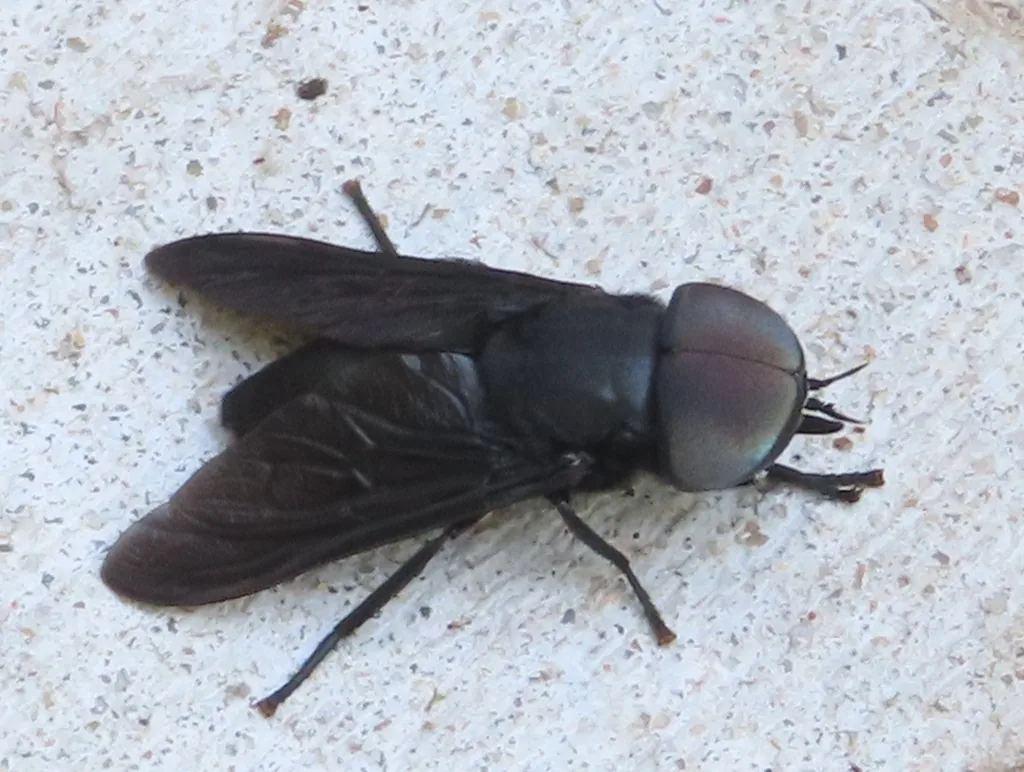
- Stout flies with very large eyes. Sources give different sizes because species vary: NC State says 14 to 19 mm, Kentucky 3/4 to 1-1/4 inches, Missouri's field guide notes horse flies can top 1 inch, and Wisconsin says some, like the black horse fly, reach two inches.[2][3][7][4]
- Most are drab brown, gray or black. The eyes are often bright or iridescent, frequently green, and on horse flies usually solid-colored or striped rather than spotted.[7][6][4]
- Wings are usually clear or solidly colored, without the dark bands or spots of deer flies.[3][2][7]
- Seen from above, a female's eyes have a space between them, while a male's eyes nearly touch.[7]
- There are many horse fly species; the photo shows the black horse fly, Tabanus atratus, one member of the genus.[1]
- UF/IFAS gives horse flies a length of 10 to 25 mm (up to about 1 inch), describes them as black to dark brown with green or black eyes, and notes that their hind legs lack the small tip spurs deer flies have.[14]
Look-alikes
| Look-alike | How to tell them apart |
|---|---|
| Deer fly | Usually smaller, from under 1/4 to about 3/4 inch, with dark bands or spots on the wings and often spotted eyes. Deer flies tend to circle and bite around the head. UF/IFAS gives deer flies 7 to 10 mm, yellow to black with a striped abdomen, mottled wings and spurs at the tips of the hind legs.[7][6][3][2][14] |
| Stable fly | Looks like a house fly, with a stiff piercing mouthpart sticking out from the front of the head, and both males and females bite. UF/IFAS adds that it is about the size and color of a house fly and is also called the dog fly.[12][15] |
| Yellow fly | A smaller southeastern relative, about 1 cm long and mostly yellow, with dark front legs and dark eyes crossed by two fluorescent green lines. UF/IFAS calls it a fierce biter in Florida.[11][14] |
Where it lives
Horse and deer flies occur nearly worldwide. Missouri's field guide counts more than 200 horse fly species in North America north of Mexico; NC State reports more than 40 tabanid species in North Carolina and Wisconsin Extension over 30 in Wisconsin. They are thickest near swamps, marshes, streams, ponds and wooded edges. UF/IFAS says tabanids are unreported only in Hawaii, Greenland and Iceland, counts 35 economically important species in Florida, and ties Florida's large populations to big, permanently wet, undeveloped areas.[7][2][4][14]
Biology and life cycle
Females lay eggs in clusters on plants or other objects over water or wet ground. Counts differ by source: NC State gives 200 to 500 eggs per mass, Kentucky 25 to 1,000.[2][3][7]
Eggs hatch in about a week, and the larvae drop into water or wet soil.[2][3]
Horse fly larvae are mostly predators of insects and other small animals in mud and water; NC State says they also eat organic matter.[7][2][6]
Larvae molt 4 to 9 times and need from a month to a year or more; Kentucky gives one to three years for the larval stage. Mature larvae move to drier soil and pupate for 1 to 4 weeks.[2][3]
Most species have one generation a year, but larger ones can take two or three years.[2][4]
Males feed on nectar and pollen and never bite. Females also feed on nectar but need blood to make eggs.[7][2]
UF/IFAS says eggs are laid in layers on vertical surfaces directly over water or wet ground, preferably on aquatic plants, start creamy white and darken to gray and black, and hatch in five to seven days.[14]
Horse fly larvae prefer drier mud than deer fly larvae and eat insect larvae, crustaceans and earthworms. UF/IFAS notes they are cannibalistic, yet up to 120 larvae per square yard have been found; its biting-fly guide adds that larvae of many species take snails and even tadpoles and minnows.[14][15]
Ready to pupate, larvae move into the top 1 to 2 inches of soil, and the pupal stage lasts two to three weeks. Most species spend the winter as larvae; adults live 30 to 60 days, and the whole life cycle takes 70 days to two years depending on species.[14][15]
Damage and signs
- Females find hosts mainly by sight. They are drawn to large, dark, moving objects and carbon dioxide, and Kentucky adds shiny surfaces and warmth, which is why they swarm around cars, swimmers and pools.[7][4][3][5]
- They are day biters that stay in the sun and avoid shade and barns. Wisconsin gives the season as May into September.[5][3][4]
- On livestock, an old USDA estimate cited by Kentucky puts one horse fly meal at about 1 cc of blood: 20 to 30 flies feeding for 6 hours would take 20 teaspoons. Bites also cut grazing and milk production as animals bunch together or run.[3]
- Because feeding is often interrupted, they can carry disease agents mechanically between animals; NC State names equine infectious anemia and anaplasmosis among the livestock diseases they are suspected of spreading.[2][10][5]
- UF/IFAS says horse flies wait in shade under bushes and trees for a host. Attacks peak for about three hours from sunrise and again from about two hours before sunset, and drop off on overcast days and below 71.6°F (22°C) or above 89.6°F (32°C). In Florida, adults are around from May to September.[14]
- On livestock they bite the abdomen, legs and neck. UF/IFAS says as many as 100 flies may feed on one animal at a time, and twenty to thirty flies feeding for six hours can take 3.4 fluid ounces of blood, lowering weight gain and milk production.[14]
Health risk
The bite is painful because the female cuts the skin with blade-like mouthparts, and her saliva keeps the blood flowing. The Illinois Department of Public Health notes horse fly bites can cause severe allergic reactions; one case report describes a large red swelling on the thigh that was a local inflammatory reaction, and another a man already allergic to bee and wasp venom who went into anaphylaxis after a horse fly bite. For an ordinary bite, MedlinePlus advises washing with soap and water, cold packs 10 minutes on and 10 off, an antihistamine or anti-itch cream if needed, and watching for infection. Call 911 for trouble breathing, face or mouth swelling, or fainting.[7][6][8][9][13]
Control
Prevention
Cover up with long sleeves, long pants and a hat. Kentucky says light-colored clothing and mesh outdoor wear may help a little.[4][3]
Repellents help only partly. Kentucky says DEET can give several hours of protection and permethrin products are for clothing only; Wisconsin calls standard repellents only marginally effective, with high-DEET products giving some protection. Flies may keep circling even after you apply them.[3][4]
For horses and livestock, give access to a barn, run-in shed or deep shade, or turn horses out at night when the flies are inactive. Fly sheets, masks and boots add protection.[3][5][4]
Removing unnecessary woody plants from residential areas or draining wet areas has been suggested to cut breeding habitat, but because horse flies breed in water and mucky areas near ponds and swamps, UF/IFAS says source reduction is difficult. Ask your local mosquito control district about area biting-fly programs.[14][15]
Traps and physical control
Traps that use a dark hanging ball or dark panel lure horse flies and work best in sunny spots visible from woods or marsh. Penn State estimates one well-placed trap covers about 2 acres, and NC State says box traps help in small areas like home yards; Kentucky, though, knows of no effective fix for flies around swimming pools. UF/IFAS says traps are sometimes effective in small areas such as yards, campsites and swimming pools. Shiny black balls moved by the wind attract the flies, and blue cylinders such as inverted cups coated with sticky material, carried on a slow-moving (under 7 mph) truck or riding mower or on top of a cap, reduce their numbers.[5][2][4][3][14]
Biological control
There is no effective biological control program. Native wasps parasitize the eggs, other wasps and flies parasitize larvae and pupae, nest-building wasps stock their nests with adult flies, and cattle egrets and killdeer eat them.[14]
Pesticides
Spraying for adults does little. They rest only briefly, so residual sprays don't work, fogging kills only flies present at that moment, and treating wetland breeding sites is impractical and harmful to other wildlife.[4][2][3]
Sources disagree on animal sprays. Penn State says full-body pyrethroid repellents seem effective if reapplied at least daily, and Kentucky says permethrin drives flies off almost at once without always killing them; Wisconsin calls insecticide sprays on animals ineffective because the flies land so briefly. UF/IFAS calls pyrethroid pour-ons only limited repellents, says self-application methods don't work for horse flies, and reports some success with insecticide-impregnated ear tags and head collars.[5][3][4][14]
Horse fly or deer fly?
Size and wings are the quickest check. Horse flies are the bigger ones, with clear or evenly colored wings and solid or striped eyes, and they often bite the legs. Deer flies are smaller, with dark-banded or spotted wings, and go for the head and neck.[7][2][3]
Illinois notes the iridescent green eyes of some species earn them the name greenheads.[6][7]
Where the sources disagree
Egg masses: NC State gives 200 to 500 eggs per mass, Kentucky 25 to 1,000 and UF/IFAS 100 to 1,000.[2][3][14]
Traps near pools: UF/IFAS says traps are sometimes effective in small areas including swimming pools, while Kentucky knows of no effective fix for horse flies around pools.[14][3]
Repellents: UF/IFAS calls long sleeves and pants combined with a repellent containing DEET, citronella or geraniol effective, while Wisconsin Extension calls standard repellents only marginally effective.[14][4]
Common questions
- Do horse flies bite at night?
- No. They are daytime biters that stay in sunny areas, which is why turning horses out at night or keeping them in shade cuts bites.[5][3]
- Why does a horse fly bite hurt so much?
- Instead of piercing with a fine needle, the female slices the skin with scalpel-like mouthparts and laps up the blood that pools.[7][3][6]
- Do male horse flies bite?
- No. Males feed on nectar and pollen; only females take blood.[7][2]
- When is a horse fly bite an emergency?
- Most bites are painful and itchy but heal on their own. Call 911 for signs of a severe allergic reaction such as trouble breathing, face or mouth swelling, chest pain or fainting.[13][9]
- What time of day are horse flies worst?
- UF/IFAS says attacks peak for about three hours after sunrise and again from about two hours before sunset, and are light on overcast days.[14]
Sources
- iNaturalist, “Tabanus atratus taxon page (order and family).” www.inaturalist.org/taxa/116680 (accessed 2026-11-11)
- NC State Extension, “Horse Flies and Deer Flies.” content.ces.ncsu.edu/horse-flies-and-deer-flies (accessed 2026-11-11)
- University of Kentucky Entomology, “Horse Flies and Deer Flies (Entfact 511).” entomology.ca.uky.edu/ef511 (accessed 2026-11-11)
- University of Wisconsin-Madison Extension, Wisconsin Horticulture, “Deer Flies and Horse Flies.” hort.extension.wisc.edu/articles/deer-flies-and-horse-flies/ (accessed 2026-11-11)
- Penn State Extension, “Protecting Horses From Horse and Deer Fly Bites (2022).” extension.psu.edu/protecting-horses-from-horse-and-deer-fly-bites (accessed 2026-11-11)
- Illinois Department of Public Health, “Biting Flies.” idph.illinois.gov/envhealth/pcbitingflies.htm (accessed 2026-11-11)
- Missouri Department of Conservation, “Horse and Deer Flies (Tabanids) (Field Guide).” mdc.mo.gov/node/219250 (accessed 2026-11-11)
- BMJ Case Reports, abstract via PubMed (PMID 36750307), “Kelly and Grose 2023, Horsefly (genus Tabanus) bite: allergy or infection?.” pubmed.ncbi.nlm.nih.gov/36750307/ (accessed 2026-11-11)
- European Annals of Allergy and Clinical Immunology, via PubMed, “Quercia O, Emiliani F, Foschi FG, Stefanini GF (2009), A case of anaphylaxis: horse-fly or hymenoptera sting?, European Annals of Allergy and Clinical Immunology 41(5):152-154.” pubmed.ncbi.nlm.nih.gov/20101929/ (accessed 2026-11-11). Cited from the PubMed abstract.
- Journal of Medical Entomology, via PubMed, “Krinsky WL (1976), Animal disease agents transmitted by horse flies and deer flies (Diptera: Tabanidae), Journal of Medical Entomology.” pubmed.ncbi.nlm.nih.gov/137982/ (accessed 2026-11-11). Cited by title only; PubMed has no abstract.
- Cutis (peer-reviewed dermatology journal), “Managing Cutaneous Reactions to Yellow Fly (Diachlorus ferrugatus) Bites (Sequeira et al. 2025), Cutis 115(4):121-124.” cdn.mdedge.com/files/s3fs-public/issues/articles/CT115004121_0.pdf (accessed 2026-11-11)
- University of Kentucky Entomology, “Fly Control Around Horse Barns and Stables (Entfact 514).” entomology.ca.uky.edu/ef514 (accessed 2026-11-11)
- MedlinePlus, U.S. National Library of Medicine, “Insect bites and stings (Medical Encyclopedia).” medlineplus.gov/ency/article/000033.htm (accessed 2026-11-11)
- University of Florida IFAS Extension, EDIS (Featured Creatures), “Deer Flies, Yellow Flies and Horse Flies, Chrysops, Diachlorus, and Tabanus spp., EENY-028/IN155 (Featured Creatures).” ask.ifas.ufl.edu/publication/IN155 (accessed 2026-11-14)
- University of Florida IFAS Extension, EDIS, “Biting Flies, ENY-220/IG081.” ask.ifas.ufl.edu/publication/IG081 (accessed 2026-11-14)